
Adobe Gallery
221 Canyon Road
Santa Fe, New Mexico 87501
Phone (505) 955-0550
Fax (866) 919-9506
www.adobegallery.com
info@adobegallery.com


Advanced Search

Keyword Search

Item ID Search

Advanced Criterion Search

Please select any combination of fields and information to narrow your search.

Close Window

Membership has benefits! Join My Adobe Gallery now for FREE!Already a Member?
LOGIN NOW

Join Now!

Hopi Katsina Doll by Wilson Tawaquaptewa

25502-katsina.jpg + Add to my watchlist
Wilson Tawaquaptewa 1871-1960
  • Category: Traditional
  • Origin: Hopi Pueblo
  • Medium: cottonwood root, feathers
  • Size: 13-1/2” tall
  • Item # 25502
  • Price: $8,500.00

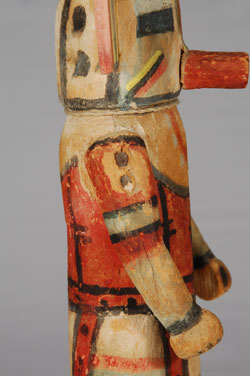
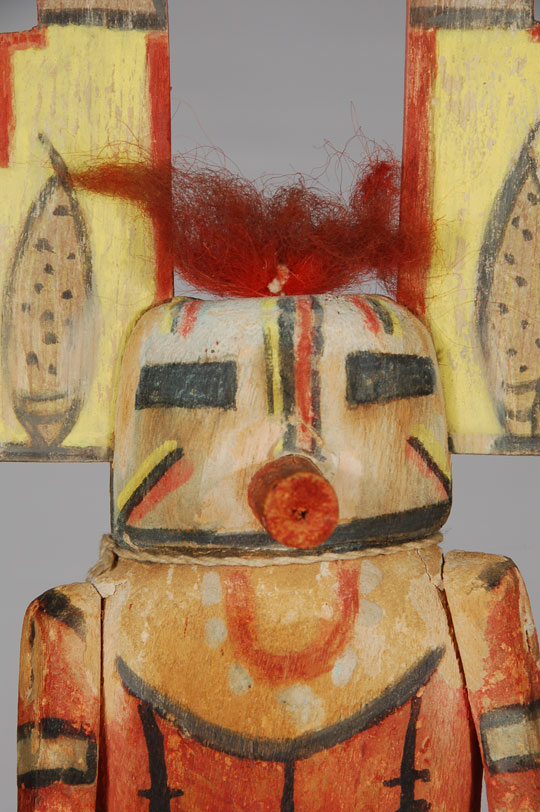
Wilson Tawaquaptewa was Kikmongwi (Chief) of Oraibi Village at the time of the famous rift that occurred on September 8, 1906, which divided the village into progressives and traditionalists. The progressives were in favor of cooperating with the U.S. Government’s policy that Hopi children must go to school. The traditionalists wanted nothing to do with the government’s policies.  Tawaquaptewa is the earliest carver that we know by name and he created figures that were given to the children as well as pieces that he sold. His carving career spanned at least four decades.  Tawaquaptewa would unhesitatingly alter the iconography of a Katsina doll in subtle ways. All his pieces were beautifully made and his style is quite identifiable although it is sometimes difficult to determine which katsina he had in mind while carving. This was not by accident. As a religious leader at Hopi, he was not comfortable with selling authentic katsina dolls to tourists, so he made slight changes to the carvings. This satisfied his conflict with religion and sales, and appeased the tourist who was unaware anyway. The full body of this carving is from a single piece of cottonwood.  The arms have been attached and the snout has been added as a separate piece.  The tableta-type ears were missing from this doll and have been replaced with the traditional type the carver was known to make.  The feathers from the back of the mask have been removed most likely because they were in violation of federal policy against the use of migratory bird feathers. Condition: Overall, the doll is in excellent condition for its age.  One foot has been glued back on at the toes and, as mentioned above, the tableta ears have been replaced. Recommended Reading:  Kikmongwi as Artist: The Katsina Dolls of Wilson Tawaquaptewa by Barry Walsh. American Indian Art Magazine, Vol. 24, No. 1, Winter 1998. Provenance: a Santa Fe gentleman
 

Wilson Tawaquaptewa was Kikmongwi (Chief) of Oraibi Village at the time of the famous rift that occurred on September 8, 1906, which divided the village into progressives and traditionalists. The progressives were in favor of cooperating with the U.S. Government's policy that Hopi children must go to school. The traditionalists wanted nothing to do with the government's policies.

Tawaquaptewa is the earliest carver that we know by name and he created figures that were given to the children as well as pieces that he sold. His carving career spanned at least four decades.

Tawaquaptewa would unhesitatingly alter the iconography of a Katsina doll in subtle ways. All his pieces were beautifully made and his style is quite identifiable although it is sometimes difficult to determine which katsina he had in mind while carving. This was not by accident. As a religious leader at Hopi, he was not comfortable with selling authentic katsina dolls to tourists, so he made slight changes to the carvings. This satisfied his conflict with religion and sales, and appeased the tourist who was unaware anyway.

The full body of this carving is from a single piece of cottonwood.  The arms have been attached and the snout has been added as a separate piece.  The tableta-type ears were missing from this doll and have been replaced with the traditional type the carver was known to make.  The feathers from the back of the mask have been removed most likely because they were in violation of federal policy against the use of migratory bird feathers.

Condition: Overall, the doll is in excellent condition for its age.  One foot has been glued back on at the toes and, as mentioned above, the tableta ears have been replaced.

Recommended Reading:  Kikmongwi as Artist: The Katsina Dolls of Wilson Tawaquaptewa by Barry Walsh. American Indian Art Magazine, Vol. 24, No. 1, Winter 1998.

Provenance: a Santa Fe gentleman

Wilson Tawaquaptewa was Kikmongwi (Chief) of Oraibi Village at the time of the famous rift that occurred on September 8, 1906, which divided the village into progressives and traditionalists. The progressives were in favor of cooperating with the U.S. Government’s policy that Hopi children must go to school. The traditionalists wanted nothing to do with the government’s policies.  Tawaquaptewa is the earliest carver that we know by name and he created figures that were given to the children as well as pieces that he sold. His carving career spanned at least four decades.  Tawaquaptewa would unhesitatingly alter the iconography of a Katsina doll in subtle ways. All his pieces were beautifully made and his style is quite identifiable although it is sometimes difficult to determine which katsina he had in mind while carving. This was not by accident. As a religious leader at Hopi, he was not comfortable with selling authentic katsina dolls to tourists, so he made slight changes to the carvings. This satisfied his conflict with religion and sales, and appeased the tourist who was unaware anyway. The full body of this carving is from a single piece of cottonwood.  The arms have been attached and the snout has been added as a separate piece.  The tableta-type ears were missing from this doll and have been replaced with the traditional type the carver was known to make.  The feathers from the back of the mask have been removed most likely because they were in violation of federal policy against the use of migratory bird feathers. Condition: Overall, the doll is in excellent condition for its age.  One foot has been glued back on at the toes and, as mentioned above, the tableta ears have been replaced. Recommended Reading:  Kikmongwi as Artist: The Katsina Dolls of Wilson Tawaquaptewa by Barry Walsh. American Indian Art Magazine, Vol. 24, No. 1, Winter 1998. Provenance: a Santa Fe gentleman

Wilson Tawaquaptewa 1871-1960
  • Category: Traditional
  • Origin: Hopi Pueblo
  • Medium: cottonwood root, feathers
  • Size: 13-1/2” tall
  • Item # 25502
  • Price: $8,500.00

25502-katsina.jpg25502-large.jpg Click on image to view larger.