




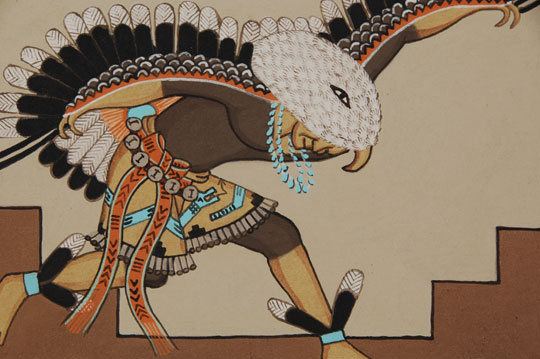
Special Value Offer: Mineral Earth Painting of Pueblo Eagle Dancer [SOLD]
+ Add to my watchlist Forward to Friend
- Category: Paintings
- Origin: Santa Clara Pueblo, Kha'p'oo Owinge
- Medium: earth mineral
- Size: 9-1/2” x 11-1/2” image; 20-3/4” x 22-3/4” framed
- Item # C3199A SOLD
Special Value Offer: The consignor has requested that we reduce the price of this painting by 20% from the original price of $3500 to a new price of $2800.
Pueblo dances are a lure for visitors to the Southwest. One must remember that these are not performed to entertain the visitors but are performed because they are a part of a religious ceremony. The Pueblo Indian feels he is an important part of nature and the universe and that he must be in balance with nature and the universe. Ceremonial dances are part of achieving that balance. Such dances always have a purpose, a function, whether it be for rain, snow, game animals, crops or other good things in life.
These dances often follow many days of ritual and fasting in the kiva, a part of the ceremony not seen by spectators. These pueblo dances may be enjoyed aesthetically without understanding the meanings behind them. Any observant spectator is not unaware that there is meaning to the costume or the movements of the dance or of the drummers and their chanting.
The Eagle Dance is performed in early spring and repeated from time to time during the summer. The eagle is believed to have direct intercourse with sky powers and is much venerated by the Pueblo Indians. The Pueblo Eagle Dance is a dramatization of the relationship between the eagle and man and supernatural powers. Generally, two young men, costumed as eagles, imitate, during the dance, almost every movement possible of the eagles. They replicate eagles soaring over the fields, perching on high places, and resting on the ground.
Pablita Velarde was well familiar with dance costume details and she was careful to portray dancers with accurate clothing. Her paintings are ethnographically important as well as artistically important. She has provided us with a detailed representation of pueblo dancers of her time. This presentation of a very active Eagle Dancer is no exception. His costume is accurate and the presentation of the dance is as one would see at the pueblo.
Condition: The painting is in original excellent condition and is in the original frame of the period. Velarde had her paintings framed in the style of Helen Hardin starting in the mid-1970s and she started dating the images in 1978, so this painting must have been executed between the mid-70s and before 1978.
Provenance: an Albuquerque gentleman
Reference: Handbook of Indian Dances, I, New Mexico Pueblos by Dorothy N. Stewart, 1952.
Recommended Reading: American Indian Paintings of the Southwest and Plains Areas by Dorothy Dunn
- Category: Paintings
- Origin: Santa Clara Pueblo, Kha'p'oo Owinge
- Medium: earth mineral
- Size: 9-1/2” x 11-1/2” image; 20-3/4” x 22-3/4” framed
- Item # C3199A SOLD

 Click on image to view larger.
