




Rare Historic Tesuque Pueblo Nineteenth Century Black-on-red Pottery Jar with Lid
+ Add to my watchlist Forward to Friend
- Category: Historic
- Origin: Tesuque Pueblo, Tet'sugeh Owingeh
- Medium: clay and pigments
- Size: 11" tall x 10-1/2" diameter
- Item # 22965
- Price: $18500
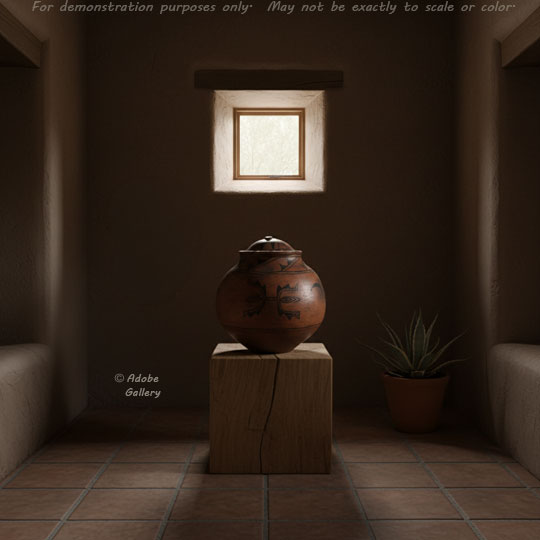
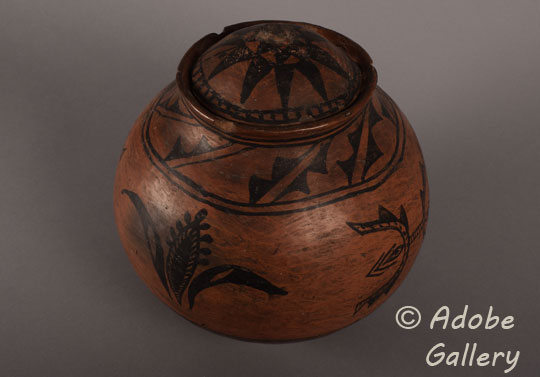
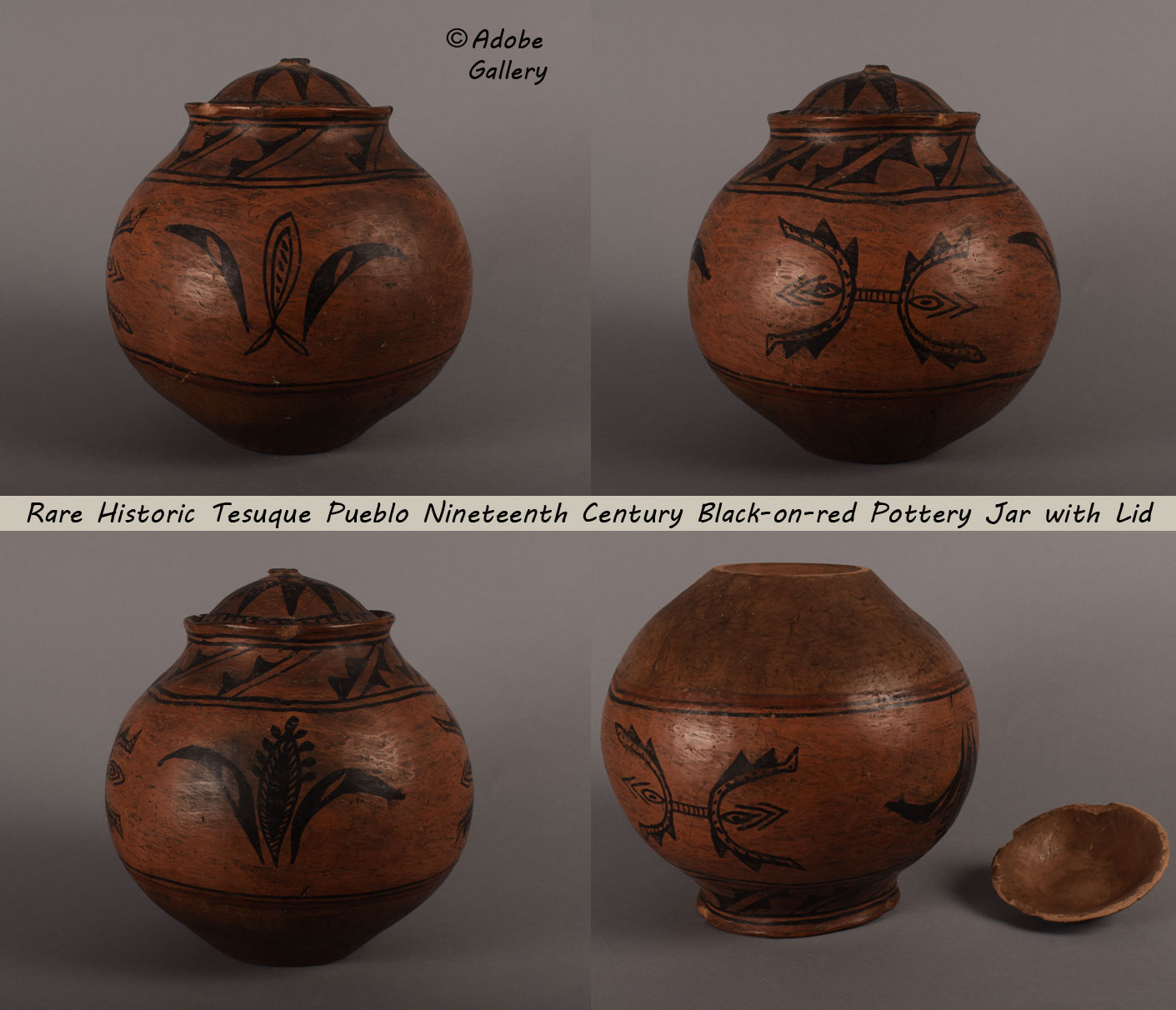
This rare and historic Tesuque Pueblo Black-on-red pottery jar is an exceptional find, not only for its age but because it retains its original lid. While Tesuque potters frequently made lidded jars, most lids have been lost or broken over time. Fortunately, the lid for this vessel remains, missing only its small knob.
Design and Dating
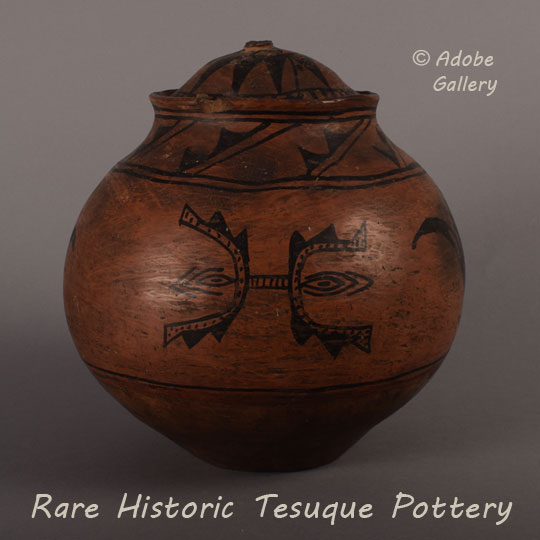
The vessel's form and sparse design point to an origin date of circa 1880. It features the rounded body typical of Tewa vessels and a concave underside. The Black-on-red style is achieved by wiping a red slip onto the vessel instead of the cream slip used for Polychrome wares, while the clay, temper, paste, and construction methods remain the same.
The design is cleverly contained within the main body area, which is isolated by double framing lines at the shoulder and just below the rim. The pattern is composed of mirrored, C-like elements, chevron lines, and eye-like shapes. Within this design, the potter has skillfully concealed two Avanyu (Water Serpents), with their heads pointing up and down in an adjoining pattern.
A key marker of its origin is visible at the lower third of the vessel: the light tan paste exhibits the characteristic bumpiness that is a trademark of historic Tesuque pottery. A red band divides this bumpy underbody from the main design field.
Distinguishing Tesuque from San Ildefonso
Historically, it can be challenging to distinguish between Tesuque and San Ildefonso pottery due to similarities in shape and design. However, there are a couple of useful — and often subtle — differences:
Floating Designs: Tesuque potters often favored designs on the main body that are composed of individual items that float on the surface, unattached to one another. The design on this jar is a perfect example, featuring the two Avanyu and additional floral elements floating independently. In contrast, San Ildefonso designs tend to be more anchored.
Underbody Texture: Another telltale sign can be felt on the un-slipped, polished lower portion of the jar. When you rub your hand over the polished underbody of a historic San Ildefonso jar, the feeling is typically smooth. At Tesuque, however, the texture is often distinctly bumpy.
This beautiful jar, with its surviving lid and unique Avanyu motif, is a powerful example of Tesuque's late 19th-century artistry.
What are Avanyu? a deity of the Tewa Pueblos—San Ildefonso, Tesuque, Ohkay Owingeh, Santa Clara, Nambe, and Pojoaque—and is the guardian of water. He is represented as a horned or plumed serpent with curves suggestive of flowing water or the zigzag of lightning. He appears on the walls of caves located high above canyon rivers in New Mexico and Arizona and may be related to the feathered serpent of Mesoamerica—Quetzalcoatl and related deities.

Condition: this Rare Historic Tesuque Pueblo Nineteenth Century Black-on-red Pottery Jar with Lid is in very good condition with knob of lid missing
Provenance: from the collection of a resident of Santa Fe
Recommended Reading: Pottery of the Pueblos of New Mexico 1700-1940 by Jonathan Batkin
TAGS: Southwest Indian Pottery, Historic Pottery, Tesuque Pueblo

- Category: Historic
- Origin: Tesuque Pueblo, Tet'sugeh Owingeh
- Medium: clay and pigments
- Size: 11" tall x 10-1/2" diameter
- Item # 22965
- Price: $18500
 Click on image to view larger.
Adobe Gallery Recommended Reading

Adobe Gallery Recommended Items
If you are interested in this item, we would also like to recommend these other related items: