




Hopi Kohoninmana — Supai or Konin — Katsina Doll
+ Add to my watchlist Forward to Friend
- Category: Traditional
- Origin: Hopi Pueblo Nation, Hopituh Shi-Nu-Mu
- Medium: wood, pigments, felt, feathers
- Size: 14” height x 7” width
- Item # C4887ZE
- Price: $1750
There is often confusion surrounding the dual names of this figure — Konin Katsina and Supai Katsina. The explanation lies in Hopi vocabulary and geography: The Hopi created this katsina to honor their neighbors, the Havasupai (or "Supai") people, who live at the bottom of the Grand Canyon. The Hopi word for the Havasupai is Kohonin. Because this doll represents the female version of the katsina, her correct title is Kohoninmana (mana meaning "girl" or "woman").
Over time, "Konin" emerged in collector circles as a simplified misspelling of the original Hopi name, Kohonin.
Physical Description & Presence
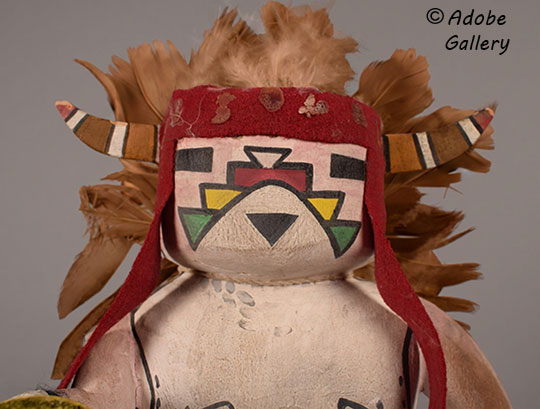
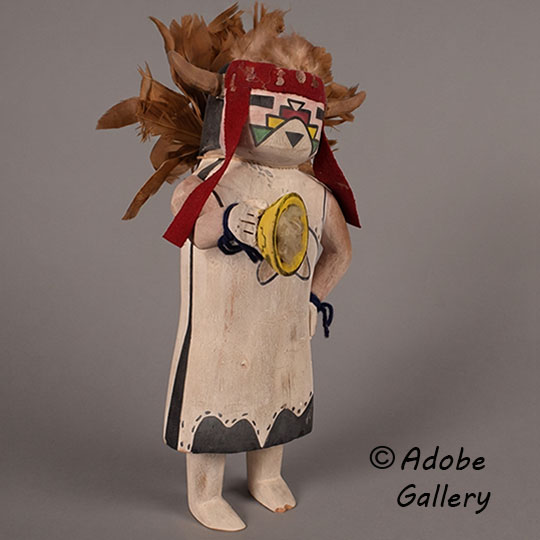
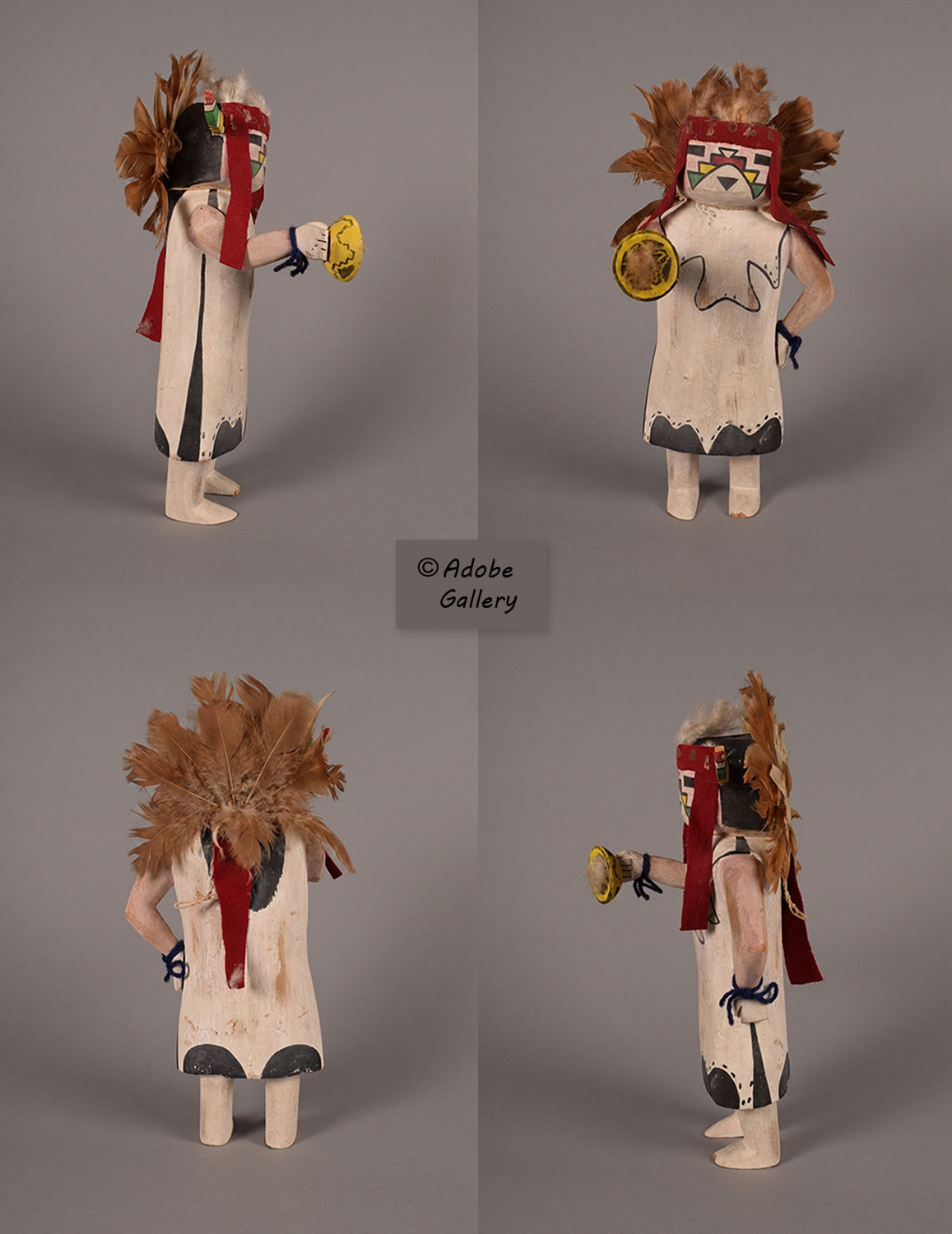
Dating to the 1940s, this Hopi Kohoninmana - Supai or Konin - Katsina Doll possesses a commanding physical presence. Standing an impressive 14 inches tall, she is significantly larger than most carvings from this era. Every detail of her posture and attire conveys significance. She stands with her left hand resting confidently on her hip — a traditional symbol of authority — while her right hand cradles a classic Havasupai basket.
Her dress is finely painted to represent the traditional animal skin worn by the Katsinamana. Her striking features include bold, black rectangular eyes and a triangular mouth, topped by a colorful arch of green, yellow, red, and white geometric patterns. These same vibrant colors are repeated on the horns extending from the sides of her mask. Strips of red felt wrap around her forehead, drape down the sides of her face, and cascade down her back, complemented by a magnificent array of feathers decorating the top and back of her head.
Ethnographic Context
To understand the significance of this figure, historic Hopi expert Barton Wright explains the cultural practice of depicting neighboring tribes:
"The Hopi have converted many of their neighbors into kachinas. These kachinas are not borrowed from these groups but are instead figures who represent that tribe of Indians. The Kachina is believed to be the essence of the people and in no way a true representation of their [actual] appearance.
Ethnologists speculate that this may have begun as an effort to capitalize on the luck or 'power' that other tribes apparently possessed. Each of these Indian groups has an aspect that has been captured by the Hopi and incorporated into their kachina forms to produce a type... These kachinas have roles in many ceremonies or dances without any consideration of their ethnic overtones." — Barton Wright, Hopi Kachinas (1977:66)
This carving is an exceptional, highly preserved representation of the Kohoninmana, making it a premier acquisition for any collector of mid-century Hopi art.
Condition: very good condition
Provenance: this Hopi Kohoninmana - Supai or Konin - Katsina Doll is from the collection of a client from California
Reference: Wright, Barton. Hopi Kachinas: The Complete Guide to Collecting Kachina Dolls
TAGS: Kachina – Katsina Doll, Hopi Pueblo
- Category: Traditional
- Origin: Hopi Pueblo Nation, Hopituh Shi-Nu-Mu
- Medium: wood, pigments, felt, feathers
- Size: 14” height x 7” width
- Item # C4887ZE
- Price: $1750
 Click on image to view larger.
Adobe Gallery Recommended Reading

Adobe Gallery Recommended Items
If you are interested in this item, we would also like to recommend these other related items: