




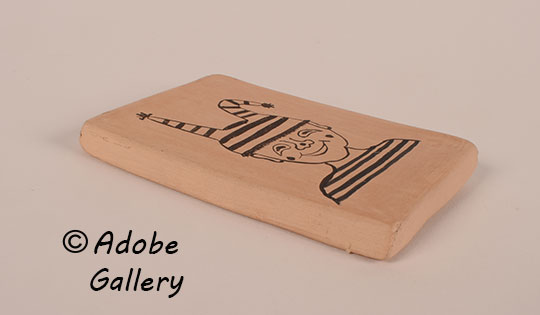
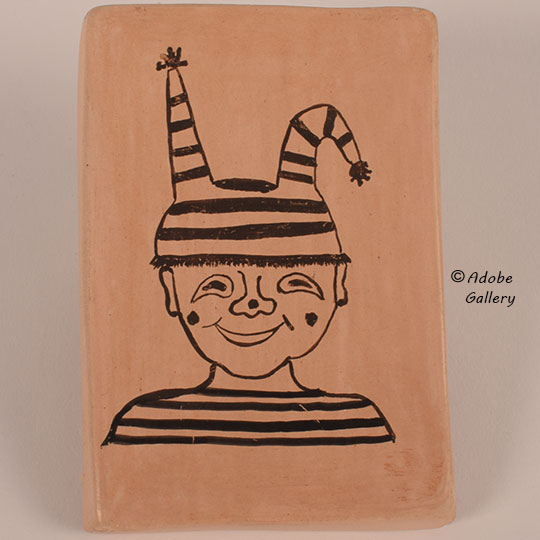
Hopi-Tewa Pottery Tile with Koshare Clown Image
+ Add to my watchlist Forward to Friend
- Category: Modern
- Origin: Hopi Pueblo Nation, Hopituh Shi-Nu-Mu
- Medium: clay, pigment
- Size: 4” x 2-¾”
- Item # C2425U
- Price: $250
The Smiling Clown: A 21st-Century Hopi-Tewa Pottery Tile
This traditional pottery tile, crafted around 2010, captures one of the most vibrant figures in Pueblo culture: the Koshare (clown). Rendered in the classic black-and-white horizontal stripes, this particular piece tells a story of youth, tradition, and the blending of two distinct cultures.
The Subject: A Rare Glimpse of Joy
While Koshare figures are often depicted as mischievous or stoic, this tile features a young boy in the role. You can tell he is a child by his wide, earnest smile. In traditional plaza ceremonies, an adult Koshare usually performs with a focused, silent intensity, often using pantomime to convey a message. In contrast, the portrayal of a child captures the early, joyful stage of participating in these sacred communal duties.
The History: From New Mexico to First Mesa
The Koshare is a ubiquitous figure across all Hopi villages today, but his presence is actually the result of a fascinating cultural journey: The Koshare originated with the Tewa Pueblos of New Mexico (where they are known as the Koosa).
Following the Pueblo Revolt of 1680, Tewa immigrants settled in Hano Village atop Hopi's First Mesa. Over centuries, the people of Hano adopted Hopi culture while fiercely maintaining their Tewa language. Through them, the Koshare was introduced to the Hopi, eventually becoming an essential thread in the fabric of Hopi ceremonial life.
The "Sting" of Truth: Why We Need Clowns
Koshare is beloved because his humor serves a higher purpose. These clowns are the "mirrors of the community," balancing entertainment with education. During ceremonies, they perform pantomimes that mimic behaviors considered "non-Hopi," such as greed, vanity, or gluttony. When the audience laughs at the clown's ridiculous behavior, they are being gently reminded to remain humble and maintain communal balance. It is humor with a moral backbone.
Condition: very good condition
Provenance: this Hopi-Tewa Pottery Tile with Koshare Clown Image is from the collection of Alexander E. Anthony, Jr.
Recommended Reading: Clowns of the Hopi: Tradition Keepers and Delight Makers by Barton Wright
TAGS: Southwest Indian Pottery, Hopi Pueblo, Hopituh Shi-nu-mu
- Category: Modern
- Origin: Hopi Pueblo Nation, Hopituh Shi-Nu-Mu
- Medium: clay, pigment
- Size: 4” x 2-¾”
- Item # C2425U
- Price: $250
 Click on image to view larger.
Adobe Gallery Recommended Reading

Adobe Gallery Recommended Items
If you are interested in this item, we would also like to recommend these other related items: