




Milland Lomakema Hopi Painting “The Old One - The Village Chief” [SOLD]
+ Add to my watchlist Forward to Friend
- Category: Paintings
- Origin: Hopi Pueblo, Hopituh Shi-nu-mu
- Medium: casein
- Size:
30” x 18-½” image;
37” x 25” frame - Item # C4964G SOLD
This striking piece is a significant example of early modernist Hopi art. Painted in 1967, it captures the transition of Hopi painting from traditional "studio style" into the more experimental, symbolic movement that was developed by The Artist Hopid.
The title, "The Old One - The Village Chief," provides the essential context for the central figure. In Hopi culture, the Village Chief (Kikmongwi) is a spiritual father to the people, responsible for maintaining the "Hopi Way" through prayer and ritual.
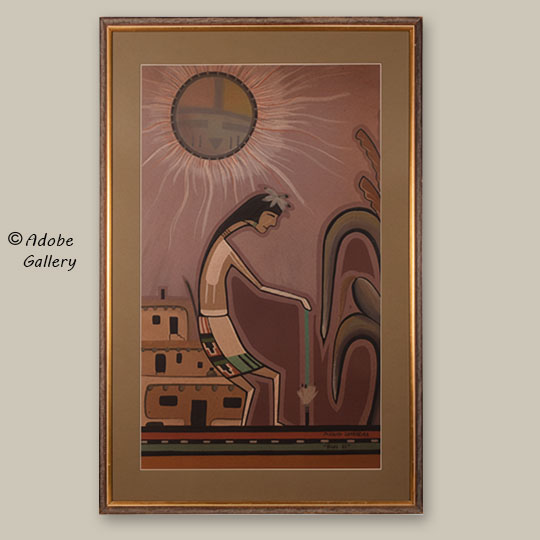
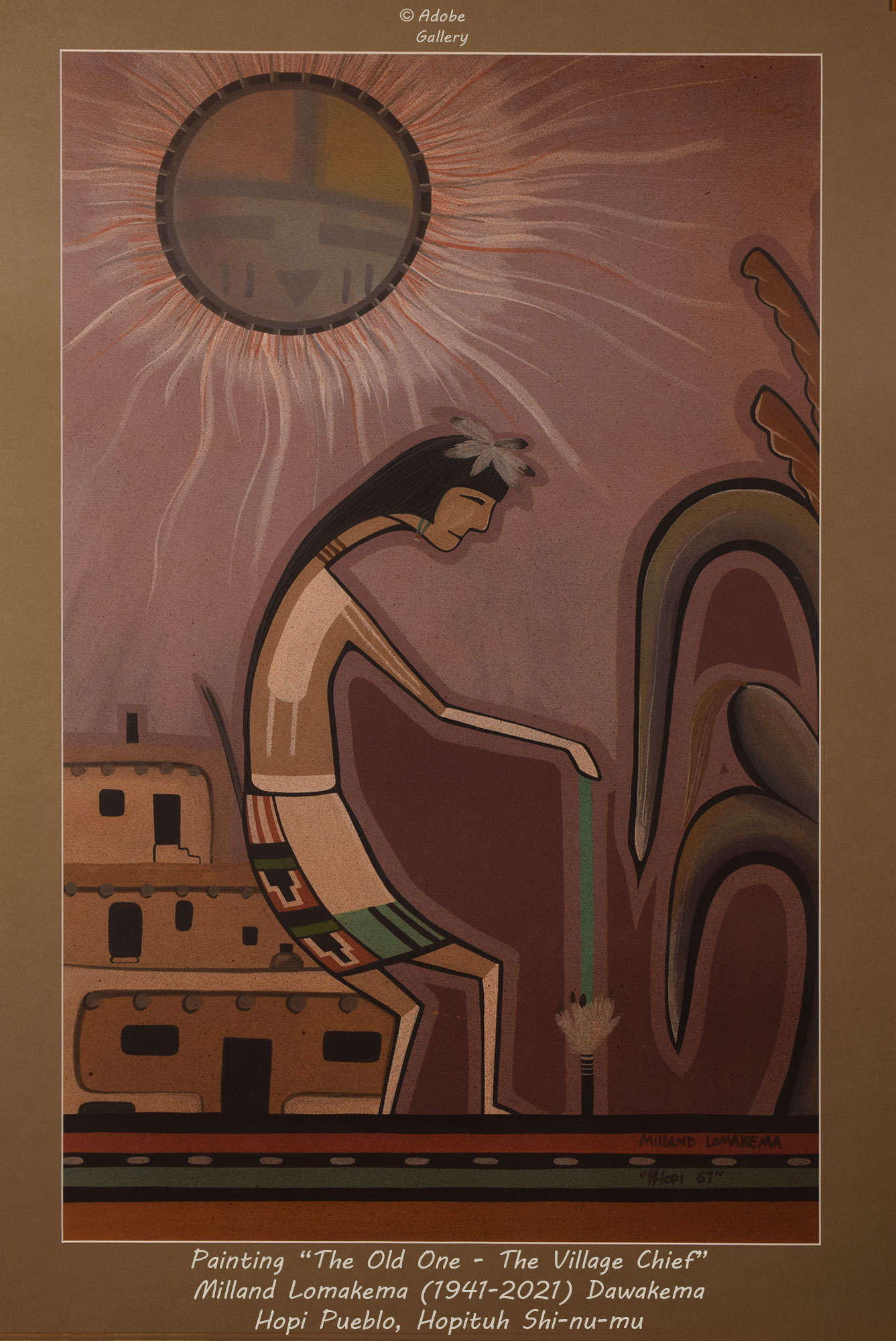
 The Kikmongwi (Village Chief) is depicted in a stylized, elongated form typical of Lomakema's early work. He is shown in a ritual posture, likely performing a prayer for the community's well-being. The large, radiant sun at the top is a vital deity in Hopi cosmology. It represents the source of all life and energy. Lomakema often used these circular motifs to anchor his compositions.
The multi-leveled structure in the background represents the ancient stone dwellings of the Hopi mesas. Its presence emphasizes the continuity of life and the Chief's responsibility to his village. To the right, the large, curving forms represent corn or squash plants — the physical lifeblood of the Hopi. The "Chief" is often depicted "planting" prayers to ensure the success of these crops. The use of muted earth tones (ochre, terracotta, and deep purples) reflects the natural landscape of the Arizona mesas while adding a sense of spiritual mystery.
This 1967 painting is particularly interesting because it was created just before he won first place at the Heard Museum's National Indian Art Show in 1968, the moment that launched his professional career.
Why This Piece Matters. This painting is published in Broder, page 67. In 1967, most Native American art sold to tourists was quite literal. Lomakema was part of a generation that pushed back, using abstraction and cubist influences to represent the essence of a ceremony rather than just a photographic likeness. By 1967, Lomakema was still working as a detective and later a police officer, painting primarily in his spare time. This piece represents the "spiritual breakout" that would eventually lead him to become one of the most celebrated Hopi painters of the 20th century. Lomakema was a self-taught artist and a member of the Corn-Water Clan from the village of Shungopovi. He is best known as a key member of the Artist Hopid, a radical group formed in 1973 that sought to redefine Hopi art by combining traditional heritage with modern techniques.
Condition: Very good condition
Provenance: this Milland Lomakema Hopi Painting "The Old One - The Village Chief" is from a client of Adobe Gallery. Displayed in Special Exhibit: Ancestral Symbols, Modern Masterpieces: Documenting the Sacred Narratives and History of the Hopi People at Adobe Gallery for its 50th Anniversary Celebration Santa Fe, NM, May 2026.
Reference: Broder, Patricia Janis. Hopi Painting: The World of the Hopis, Brandywine Press, New York. 1978
TAGS: Hopi Pueblo, Michael Kabotie, Terrance Talaswaima, Neil David, Sr., Native American Painting, Milland Lomakema

- Category: Paintings
- Origin: Hopi Pueblo, Hopituh Shi-nu-mu
- Medium: casein
- Size:
30” x 18-½” image;
37” x 25” frame - Item # C4964G SOLD
 Click on image to view larger.
