




Milland Lomakema Hopi Painting Untitled Three Katsinas [SOLD]
+ Add to my watchlist Forward to Friend
- Category: Paintings
- Origin: Hopi Pueblo, Hopituh Shi-nu-mu
- Medium: acrylic
- Size:
14-1/2” x 11” image
19” x 16” framed - Item # C4964o SOLD
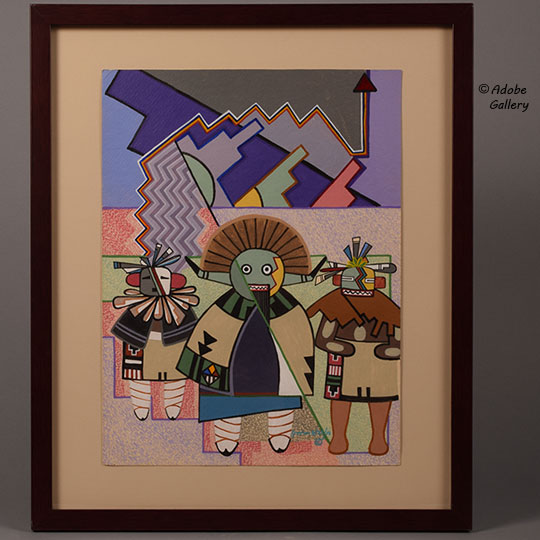
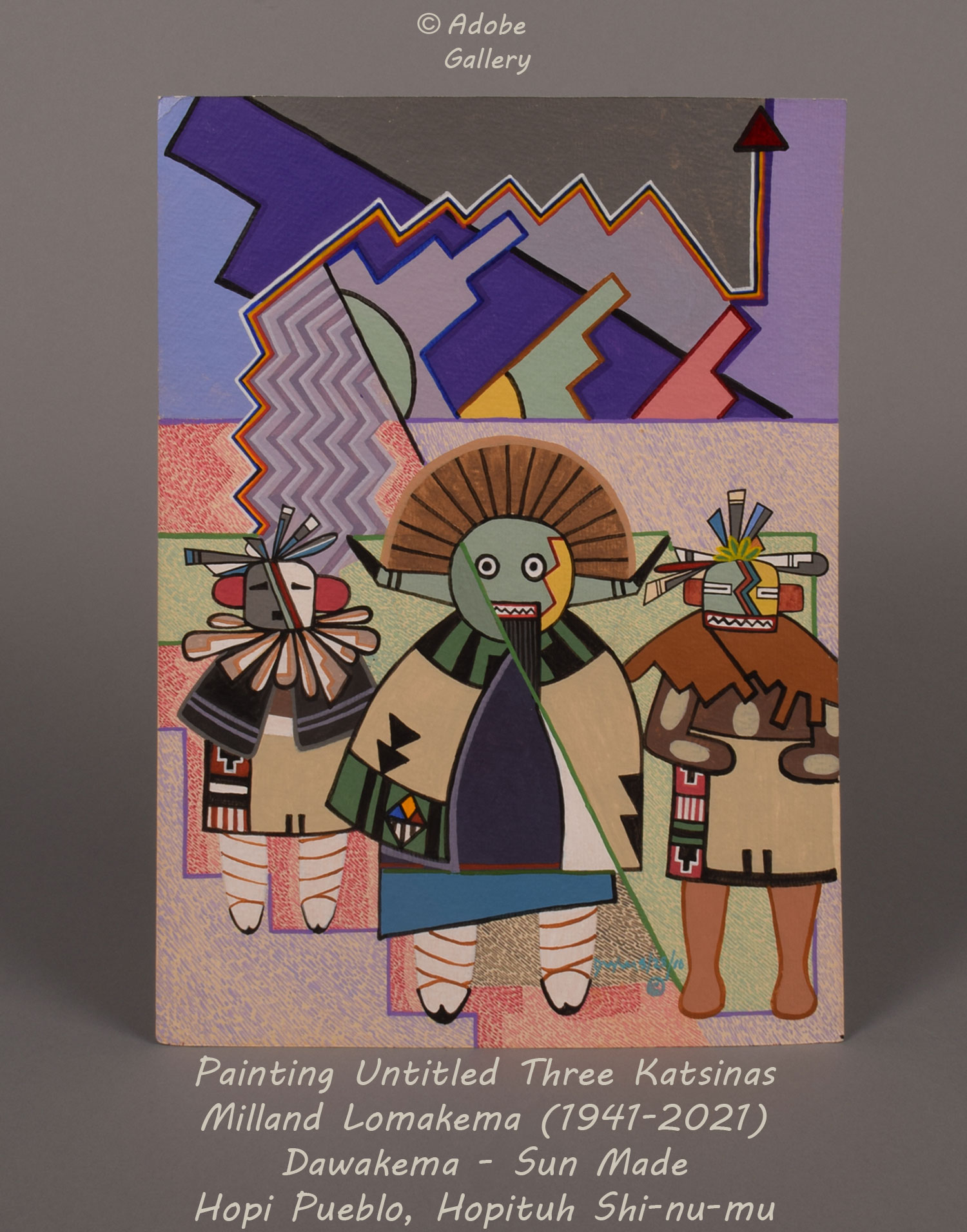
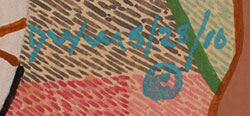 This vibrant acrylic painting is a late-career work by Milland Lomakema (1941-2021), a highly influential Hopi artist who painted under the name Dawakema. Created in 2016, this piece demonstrates the signature "Artist Hopid" style that Lomakema helped pioneer — a fusion of traditional Hopi symbolism with bold, modern geometric abstraction.
The Three Katsinam
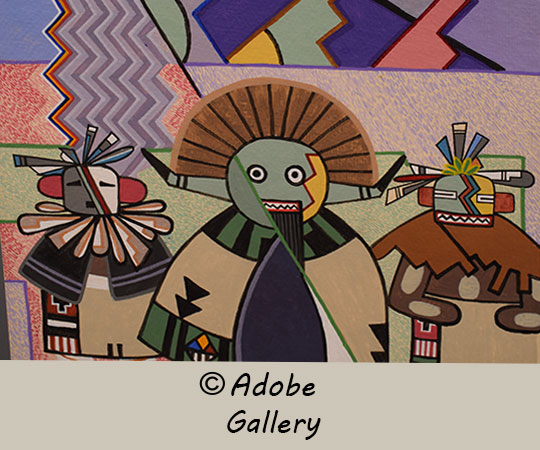
The painting features three Katsinam (spirit beings) who play vital roles in Hopi ceremonial life. While their forms are stylized, they can be identified by their traditional masks and attire. The center one and the one on the left are wearing white leg-wrapped moccasins, an identifying mark of a female or katsinmana. The one on the right is a male.
This center figure wears a Sun Tablet (headdress), likely representing the Tawa (Sun) Katsina. The green face and distinctive "Sunburst" headdress symbolize the warmth and life-giving energy of the sun.
The left figure, based on the large red ears and the striped, stepped headdress, represents a Katsina Maiden (Mana). These figures often participate in dances to pray for fertility and successful harvests.
The right figure is characterized by a "stepped" tablet and evergreen collar, typical of many Katsinam who bring rain or participate in the Niman (Home Dance) ceremony.
Lomakema's later work is famous for its intricate, layered symbolism:
The cloud pattern at the top defined by the jagged, geometric "staircase" patterns in the background are stylized rain clouds. The sharp angles represent lightning, which is viewed as a messenger or a precursor to life-sustaining rain.
The stepped structures on the right represent the Pueblo dwellings of the Hopi mesas. Lomakema often integrated the village landscape into his spiritual scenes to show the connection between the spirits and the community.
The diagonal green line slashing across the center is a common Lomakema motif representing lightning or spiritual energy descending into the earthly realm.
Cultural Significance
As a late work (2016), this painting reflects Lomakema's lifelong commitment to preserving Hopi culture. By placing these ancient spirits against a modern, almost "Pop Art" backdrop, he emphasizes that Hopi traditions are not relics of the past but are living, vibrant, and evolving.
Milland Lomakema (Dawakema)
Lomakema was a self-taught artist from the village of Shungopavi on Second Mesa. In1973, he co-founded the Artist Hopid collective with four other prominent artists, Delbridge Honanie (Coochsiwukioma), Michael Kabotie (Lomawywesa), Neil David, Sr., Terrance Talaswaima (Honvantewa) andTyler Polelonema (Duvehyestewa). Their goal was to use modern art to document Hopi history and educate the world about their cultural values.
Before dedicating himself fully to art, Lomakema worked as a detective in Phoenix and served on the Hopi police force. His work is included in major collections, such as the Heard Museum and the National Museum of the American Indian.
Condition: original condition
Provenance: this Milland Lomakema Hopi Painting Untitled Three Katsinas is from a client of Adobe Gallery. Displayed in Special Exhibit: Ancestral Symbols, Modern Masterpieces: Documenting the Sacred Narratives and History of the Hopi People at Adobe Gallery for its 50th Anniversary Celebration Santa Fe, NM, May 2026.
Reference: Broder, Patricia Janis. Hopi Painting: The World of the Hopis, Brandywine Press, New York. 1978
TAGS: Hopi Pueblo, Michael Kabotie, Terrance Talaswaima, Neil David, Sr., Native American Painting, Milland Lomakema
- Category: Paintings
- Origin: Hopi Pueblo, Hopituh Shi-nu-mu
- Medium: acrylic
- Size:
14-1/2” x 11” image
19” x 16” framed - Item # C4964o SOLD
 Click on image to view larger.
