




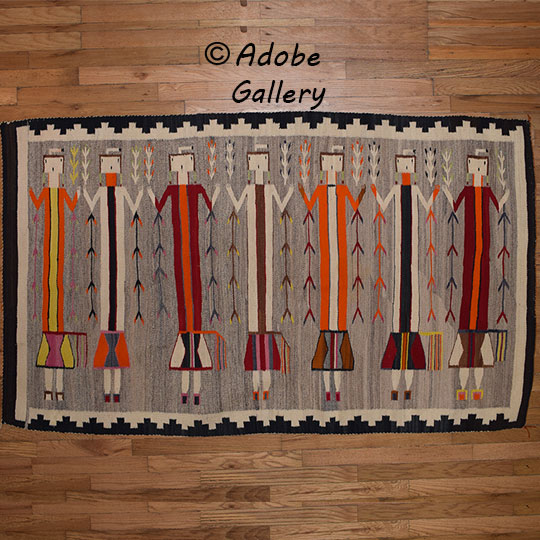
Seven Figure Navajo Ye’ii Textile [SOLD]
+ Add to my watchlist Forward to Friend
- Category: Navajo Textiles
- Origin: Diné of the Navajo Nation, Naabeehó Bináhásdzo
- Medium: Native wool, aniline dyes
- Size: 5’ 10” x 3’ 4”
- Item # C4887Y SOLD
Navajo Ye'ii Textile: Craftsmanship, Taboo, and the "Weaver's Pathway"
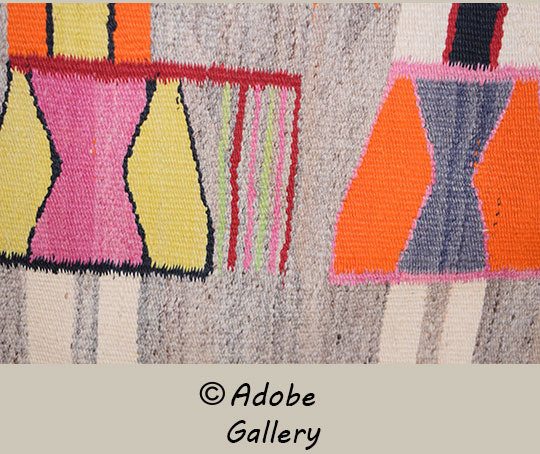
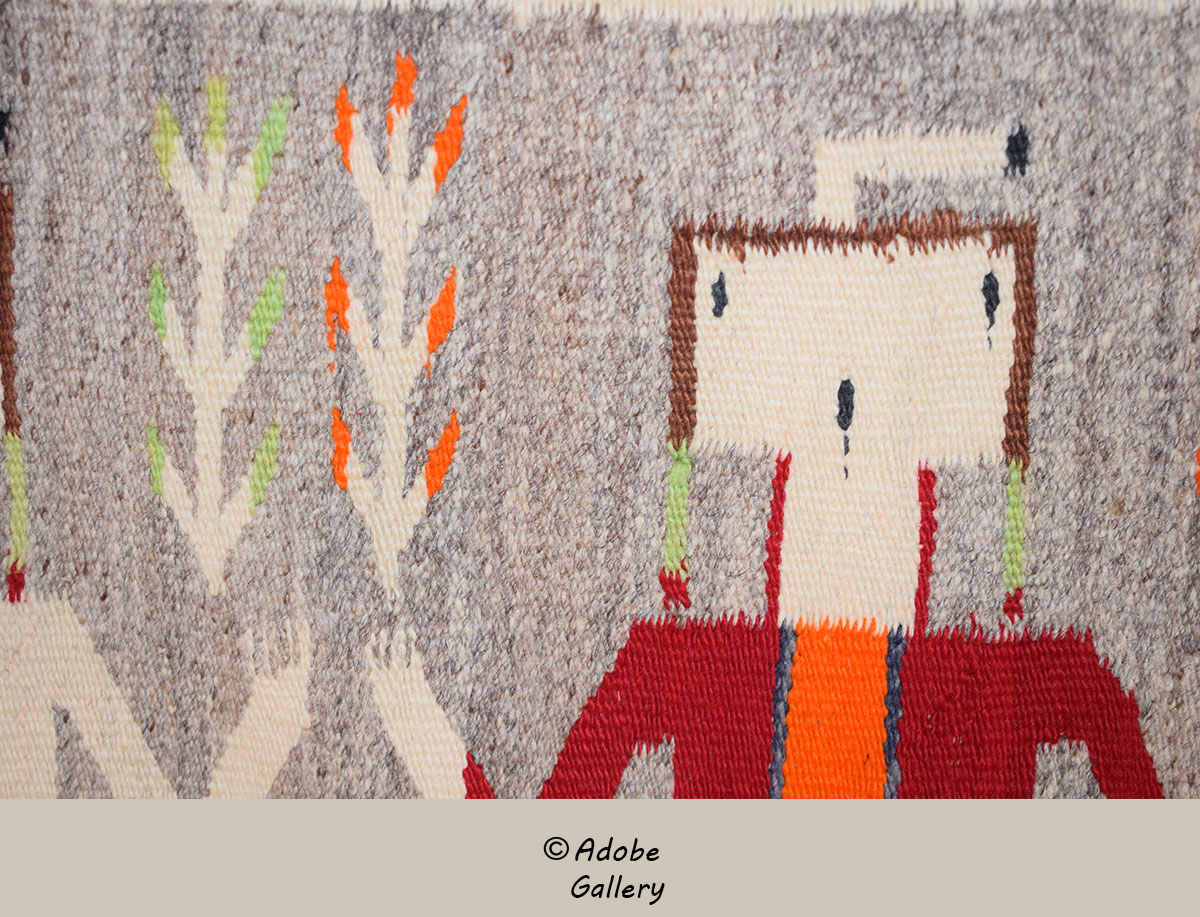
We are proud to present an extraordinary turn-of-the-century Diné (Navajo) textile that masterfully bridges sacred tradition, historic market shifts, and meticulous hand-craftsmanship. This textile was woven entirely from native, handspun wool, displaying a beautiful mix of natural and early synthetic colors. The rich gray background is a custom blend of natural white and black wool, carded together by the artist and likely sourced from her own flock. Throughout the piece, natural white and black wool are also used in their pure, unblended states to create striking contrast. The vibrant orange, red, and green hues were achieved using early aniline dyes, which became highly prized by weavers during this era for their bold expressive qualities.
The Evolution of the Yei Weaving
Beginning in the late 19th century, Diné weavers began incorporating ceremonial figures into their textiles. Unlike traditional blankets, these were created specifically as fine art for sale to Anglo buyers and traders.
In Navajo cosmology, the Ye'ii are the Holy People. In art, their gender is signified by the shape of their masks: female Ye'iis are depicted with square heads, while male Ye'iis feature rounded ones. Because these sacred figures belong to the deeply religious realm of traditional sandpaintings, the transition into commercial weaving was met with intense local resistance.
When the earliest Ye'ii tapestries appeared in the late 1890s, many within the community believed the weavers would invite spiritual disaster. However, as more weavers embraced the practice without consequence, the taboo gradually softened, and by 1900-1920, Ye'ii textiles were being woven in greater numbers.
The Legend of Yanabah Simpson
The high-stakes tension of this artistic transition is famously documented by author George Wharton James. In 1920, he recounted the fury of local Diné community members when a trader first hung a Ye'ii rug in his trading post, predicting the weaver would go blind for creating such a sacrilegious piece.
That pioneering weaver was Yanabah Simpson, wife of Dick Simpson, an English-born trader who owned the post near Farmington, New Mexico. Despite the controversy, the rug sold for several hundred dollars — an astonishing fortune at the time. Yet, the prophecy lingered: Simpson's daughter later revealed that Yanabah did eventually lose her sight and passed away in 1912, having woven only four of these rare textiles. Today, one of those four historic masterworks resides in the permanent collection of the Maxwell Museum of Anthropology at the University of New Mexico. (Rodee 1995:102)
The Border Taboo & The Weaver's Pathway
As Anglo traders pushed weavers to add solid borders to their textiles — mimicking the look of imported Persian rugs — they inadvertently challenged another deeply held Diné tradition. Historically, Navajo blankets were borderless, and traditional Navajo baskets always featured an open design.
Many weavers feared that enclosing a pattern entirely within a border would entrap the artist's creative spirit, preventing them from ever weaving again. To honor this cultural boundary while satisfying the market demand for bordered rugs, clever weavers created a deliberate intentional break: the Weaver's Pathway. By running a single or multiple rows of yarn from the inner pattern directly through the solid borders, the spirit of the textile was allowed to escape.
A Key Feature of This Textile: Look closely at the borders of this spectacular piece. In the upper-left corner, a thin gray "weaver's pathway" line penetrates the two solid borders. This symbolic line is intentionally repeated in the lower-left corner with a wider, prominent strip — a fascinating testament to the artist preserving her spiritual freedom.
Condition: very good condition
Provenance: this Seven Figure Navajo Ye'ii Textile is from the collection of a client of Adobe Gallery
Reference and Recommended Reading: One Hundred Years of Navajo Rugs by Marian E. Rodee, University of New Mexico Press, Albuquerque. 1995
TAGS: Textiles, Navajo Nation
- Category: Navajo Textiles
- Origin: Diné of the Navajo Nation, Naabeehó Bináhásdzo
- Medium: Native wool, aniline dyes
- Size: 5’ 10” x 3’ 4”
- Item # C4887Y SOLD
 Click on image to view larger.
Adobe Gallery Recommended Items
If you are interested in this item, we would also like to recommend these other related items: