



Tyler Polelonema, Hopi Pueblo Artist
+ Add Artist to My Preferences
Tyler Polelonema (b. 1940) Duyauestewa: A Legacy of Shungopavi
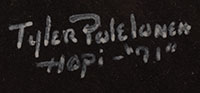 Tyler Polelonema, known by his Hopi name Duyauestewa (meaning "Bluebird"), is a vital link in the chain of 20th-century Hopi painting. Born in 1940 at the village of Shungopavi (Second Mesa), he was raised in the heart of Hopi ceremonial life, a background that serves as the primary wellspring for his artistic expression.
An Illustrious Lineage
Tyler is the son of the legendary Otis Polelonema, one of the "First Generation" Hopi painters who studied at the Santa Fe Indian School under Dorothy Dunn. Growing up in the shadow of such a monumental figure, Tyler did not merely copy his father; he inherited a deep responsibility to document the Hopi way of life with accuracy and reverence.
Artistic Style: The "Traditional" Eye
While many of his contemporaries (like the Artist Hopid group) moved toward abstract modernism, Tyler remained a master of the Traditional Hopi Style. His work is characterized by:
-
Narrative Precision: He specializes in depicting social dances and katsina ceremonies with ethnographic detail, ensuring that every feather, kilt, and mask is rendered correctly according to Hopi law.
-
Movement and Form: Unlike the strictly flat "Bambi Style" of earlier decades, Tyler's figures often possess a subtle sense of weight and motion, capturing the rhythmic step of a dancer in the plaza.
-
Medium: He is a master of watercolor and gouache, often utilizing a soft, earthen palette that mirrors the natural pigments of the Southwest.
Subject Matter: The Sacred and the Social
Tyler's paintings are often windows into the private and public ceremonies of the Second Mesa villages. His favorite subjects include:
-
The Buffalo Dance: Capturing the power and endurance of the dancers.
-
Katsina Spirits: Depicting the intermediaries between the human and spiritual worlds.
-
Hopi Daily Life: Weaving, corn grinding, and the quiet dignity of life on the mesas.
Collections and Recognition
Tyler Polelonema's work is highly sought after by collectors who value the "Old School" Santa Fe Indian School influence combined with authentic Hopi perspective. His paintings are represented in prestigious institutions, including the Museum of Northern Arizona and the Heard Museum.
TAGS: Hopi Pueblo, Native American Painting