



Adobe Gallery Blog
How Modern Pueblo Pottery Forms Reflect Industrialization and Colonial Expansion in Turn-of-the-Century United States
The late nineteenth and early twentieth centuries marked a period of profound transition across the American Southwest, as rapid industrialization, the expansion of the transcontinental railroad, and encroaching colonial infrastructure dramatically altered the landscape. In New Mexico—home to 19 vibrant Native Nations whose ancestors engineered specialized ceramic vessels for thousands of years—the influx of manufactured goods and tourist economies fundamentally disrupted traditional patterns of material culture. As cheap, mass-produced metal and glass containers flooded local markets, the ancestral necessity for large, heavy utility jars diminished. Yet, rather than eroding the practice, Pueblo potters dynamically adapted their craft to survive within the newly imposed market economy, transforming pottery from an instrument of domestic utility into a canvas of economic resistance and artistic identity.
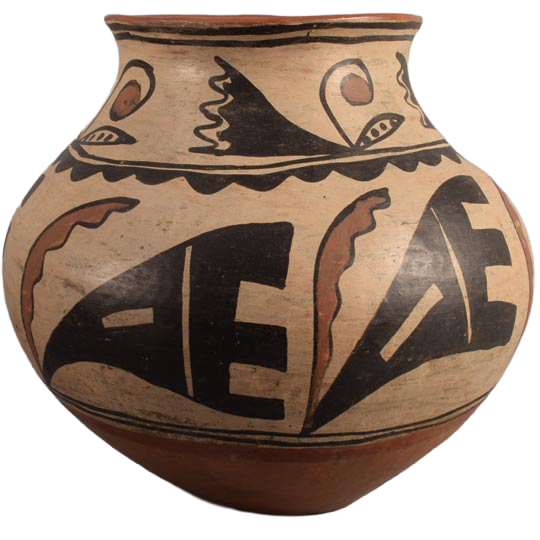
Here in the Southwest, pottery has served as utility to help aid the everyday lives of Native Americans for thousands of years. Form is functionality, and beautiful designs on smooth, polished slip indicate the communities from which they originate. After the arrival of the AT&SF Railroad in the late 1880s, many of the traditional pottery forms, symbols and motifs from the native nations in the Southwest either transformed, continued, or faded away.
San Ildefonso Pueblo (Po-Woh-Geh-Owingeh) pottery is known historically for their polychrome and black-on-red symbols/motifs, during the large tourism boom around the turn-of-the-century they transitioned to black-on-black wares in unique forms.
This artistic evolution established pottery-making as a viable foundation for economic independence and cultural preservation. The blackware aesthetic was expanded upon by later generations of the Martinez family. Julian Martinez reintroduced traditional and sacred motifs onto these modern matte-on-gloss surfaces.
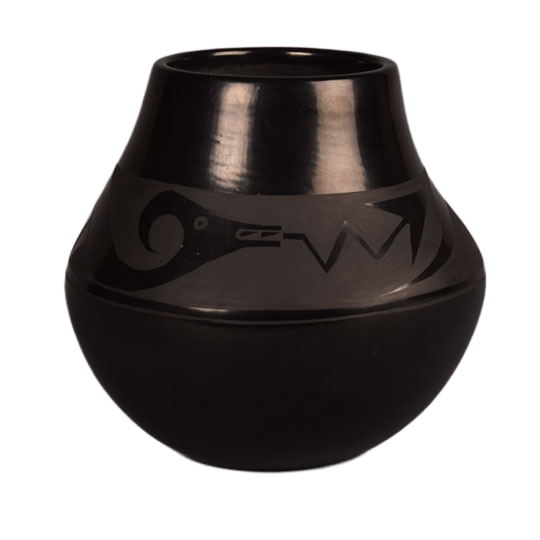
Santa Clara Pueblo (Kha’p’oo Owingeh) pottery experienced significant stylistic changes as tour-bus and train travel expanded in the Southwest during the early to mid-twentieth century. The shift toward smaller, carved blackware and red-slip vessels made the pieces easier for tourists to transport and purchase as souvenirs.
Prior to the expansion of regional tourism and rail lines, Pueblo vessels were primarily large, heavy, and engineered for storage, cooking, or hauling water. The introduction of manufactured enamelware and glass replaced the functional necessity of clay pots, prompting artists to reimagine pottery as an artistic medium and source of economic independence. Beyond sgraffito, Santa Clara Pueblo (Kha’p’oo Owingeh) potters adapted by introducing deeply carved melon jars, double-spouted wedding vases, and bear-paw motifs, expanding their artistic signatures to meet collector demand
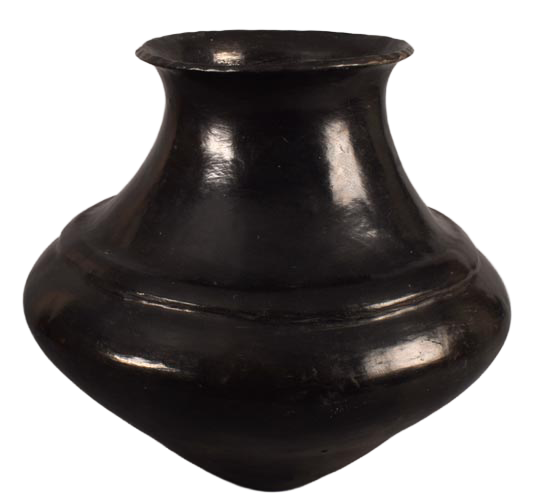
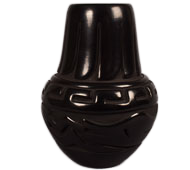

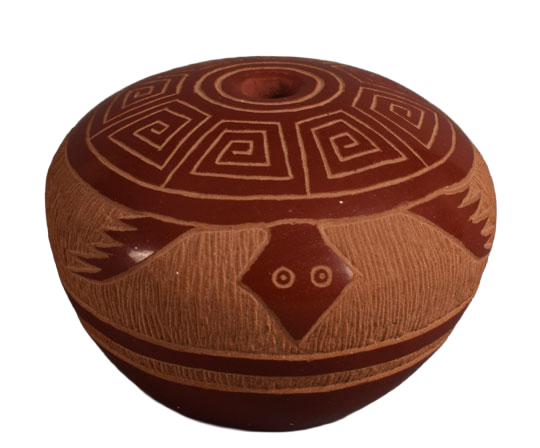
The transition from historic to modern Pueblo pottery unfolded alongside a period of intense colonial expansion and unethical archaeological extraction. Throughout the late nineteenth and early twentieth centuries, anthropological expeditions systematically removed vast collections of ancestral items from Southwestern Native Nations under the guise of scientific preservation. Many Native Americans shifted focus onto tourism to help support their communities. Concurrently, the disruption of traditional inter-tribal trade avenues compelled many Pueblo communities to pivot toward the emerging tourist economy for financial survival. Pottery, traditionally engineered for daily utilitarian function, were adapted into commodities for non-Native consumers. Although rooted in systemic displacement and the commercialization of Indigenous culture, the evolution of commercial Pueblo pottery underscores the profound adaptability, economic sovereignty, and artistic innovation of Southwestern Native artists.
Cited Sources:
Frank, Larry and Harlow, Francis. Historic Pottery of the Pueblo Indians, 1600–1880 West Chester: Schiffer Publishing, 1990, p. 45–48.
Pueblo Pottery Collective. Pueblo Pottery Stories in Clay: Historical Context, Vilcek Foundation. 01 August 2023.