




Delbridge Honanie “Petroglyphs Designs” 1979
+ Add to my watchlist Forward to Friend
- Category: Paintings
- Origin: Hopi Pueblo, Hopituh Shi-nu-mu
- Medium: Acrylic on Board
- Size:
13-½” x 17-½” image;
18-½” x 22-½” frame - Item # C4977.03
- Price: $1750
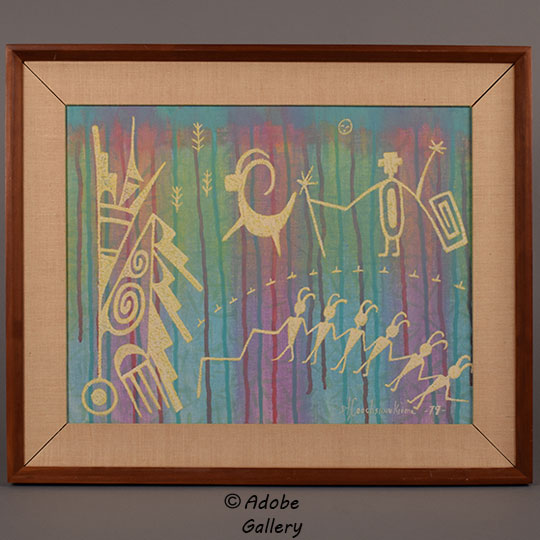
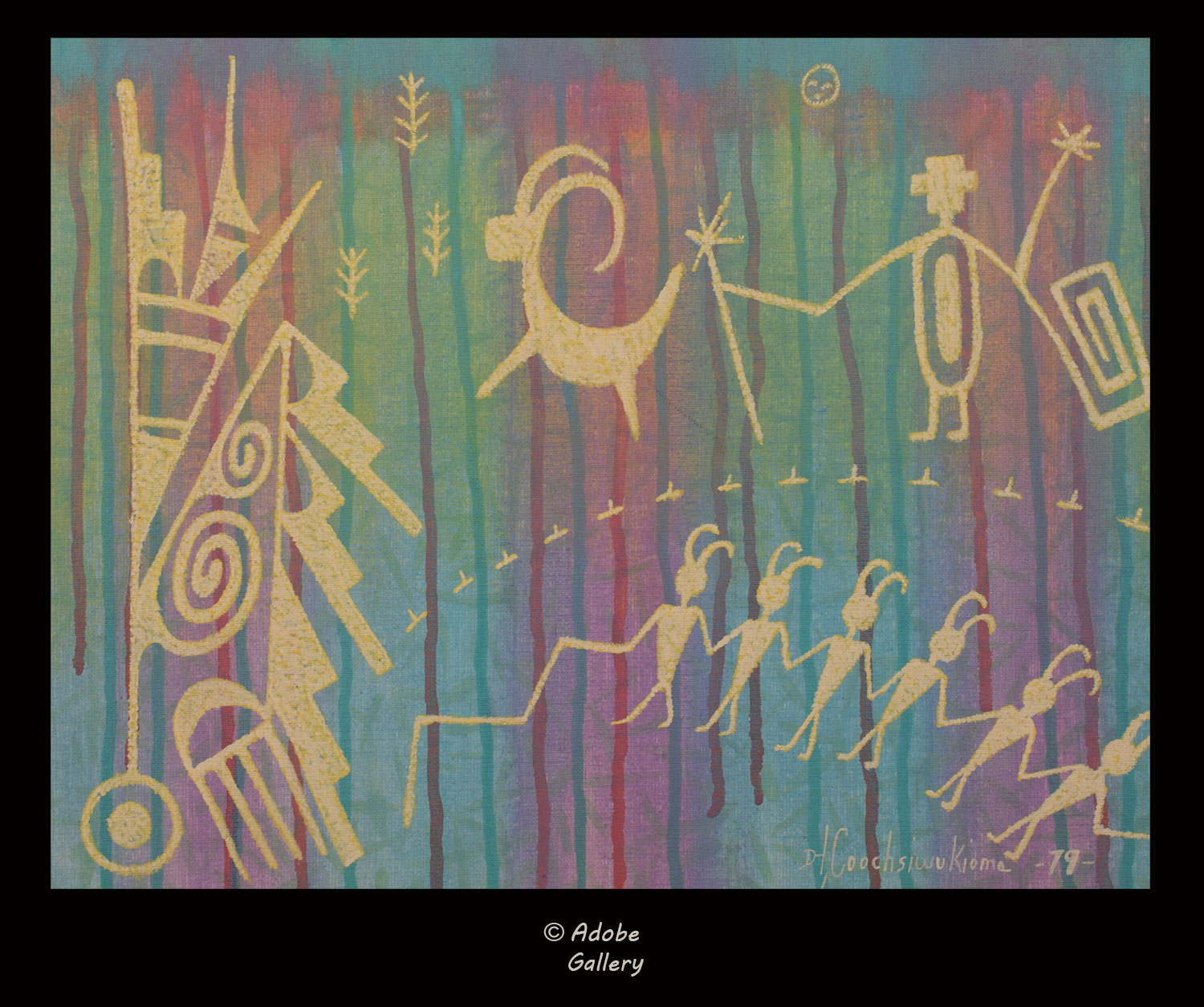
 This painting is a striking 1979 acrylic-on-board piece by the esteemed Hopi Pueblo artist Delbridge Honanie (1946-2017), who painted under his initiated Hopi name, Coochsiwukioma ("Falling White Snow").
Executed in a style deeply rooted in ancestral Hopi pottery designs, petroglyphs, and kiva murals, this artwork is a quintessential example of the revolutionary Artist Hopid movement. Honanie's work utilizes a rich lexicon of symbols to tell a story of emergence, survival, and sacred relationship with the natural and spiritual worlds:
The Rain Backdrop: The vertical, multicolored stripes of blue, green, purple, and red in the background are a signature motif of the Artist Hopid collective. These lines signify life-giving moisture and rain descending to the earth — the ultimate prayer in Hopi agricultural life.
The Migration Line: Along the bottom right, a line of antennaed, insect-like figures holds hands, marching in a diagonal line. In Hopi cosmology, this closely recalls the Ant People (who sheltered humanity in the underworlds) or represents the sacred, ongoing migrations of the clans through different worlds.
The Sacred Bighorn: Centered at the top is a stylized mountain sheep (bighorn). In Southwestern rock art and Pueblo culture, the bighorn sheep is traditionally associated with abundance, rain, and the mountain spirits that watch over animal life.
The Warrior and Sun/Moon: To the right of the bighorn stands a classic petroglyph-style figure holding a staff and a ceremonial shield. Just above is a small, circular celestial face — likely representing the Sun or Moon watching over the procession.
Kiva Mural Elements: The dominant vertical element on the left features stylized kiva mural iconography: stepped "cloud terraces," lightning bolts, and a spiral. The spiral is a universal symbol for migration, wind, and the path of life, while the surrounding geometric elements refer to corn and vegetation.
Signature
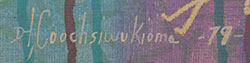
The piece is signed in the lower right corner: DH/Coochsiwukioma -79-, marking it as an authentic work from his highly active, mid-career period in the late 1970s.
The Artist and Movement
Born in Winslow, Arizona, and raised in the Second Mesa village of Shungopavi, Honanie studied at the Institute of American Indian Arts (IAIA) in Santa Fe under Otellie Loloma. In 1973, he co-founded Artist Hopid — a collective of five Hopi artists (including Michael Kabotie, Neil David Sr., Terrance Talaswaima, and Milland Lomakema) who sought to redefine contemporary Native American painting.
By stepping away from the flat, decorative "Bambi Style" favored by the mid-century commercial market, Honanie and his peers combined modern abstraction with ancestral symbols to assert Hopi cultural sovereignty and document their sacred histories. He was named an Arizona Indian Living Treasure in 2006.
Condition: good condition
Provenance: from the collection of a client of Adobe Gallery who purchased in 2013
Recommended Reading: Hopi Painting: the World of the Hopis by Patricia Janis Broder.
TAGS: Hopi Pueblo, Santa Fe, Otellie Loloma, Terrance Talaswaima, Michael Kabotie, Neil David, Sr., Native American Paintings, Katsina Dolls, Delbridge Honanie
- Category: Paintings
- Origin: Hopi Pueblo, Hopituh Shi-nu-mu
- Medium: Acrylic on Board
- Size:
13-½” x 17-½” image;
18-½” x 22-½” frame - Item # C4977.03
- Price: $1750
 Click on image to view larger.
Adobe Gallery Recommended Reading

Adobe Gallery Recommended Items
If you are interested in this item, we would also like to recommend these other related items: