




The Hopi One Horned God Carving Known as Kwanitaqa [SOLD]
+ Add to my watchlist Forward to Friend
- Category: Traditional
- Origin: Hopi Pueblo, Hopituh Shi-nu-mu
- Medium: wood, paint, rope
- Size: 12” height
- Item # C4887Q SOLD
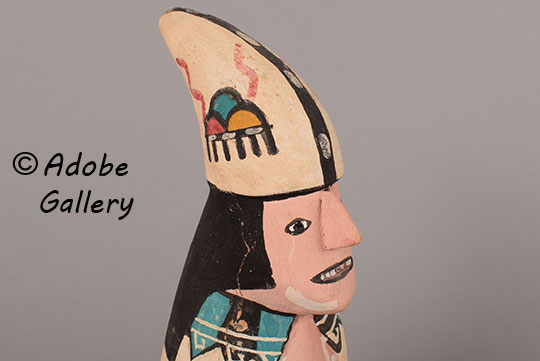
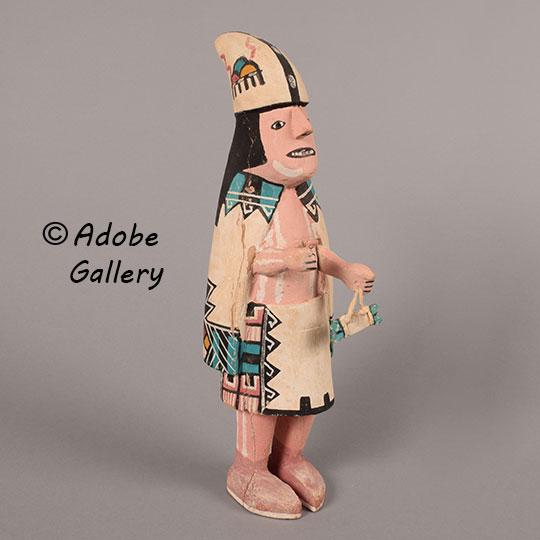
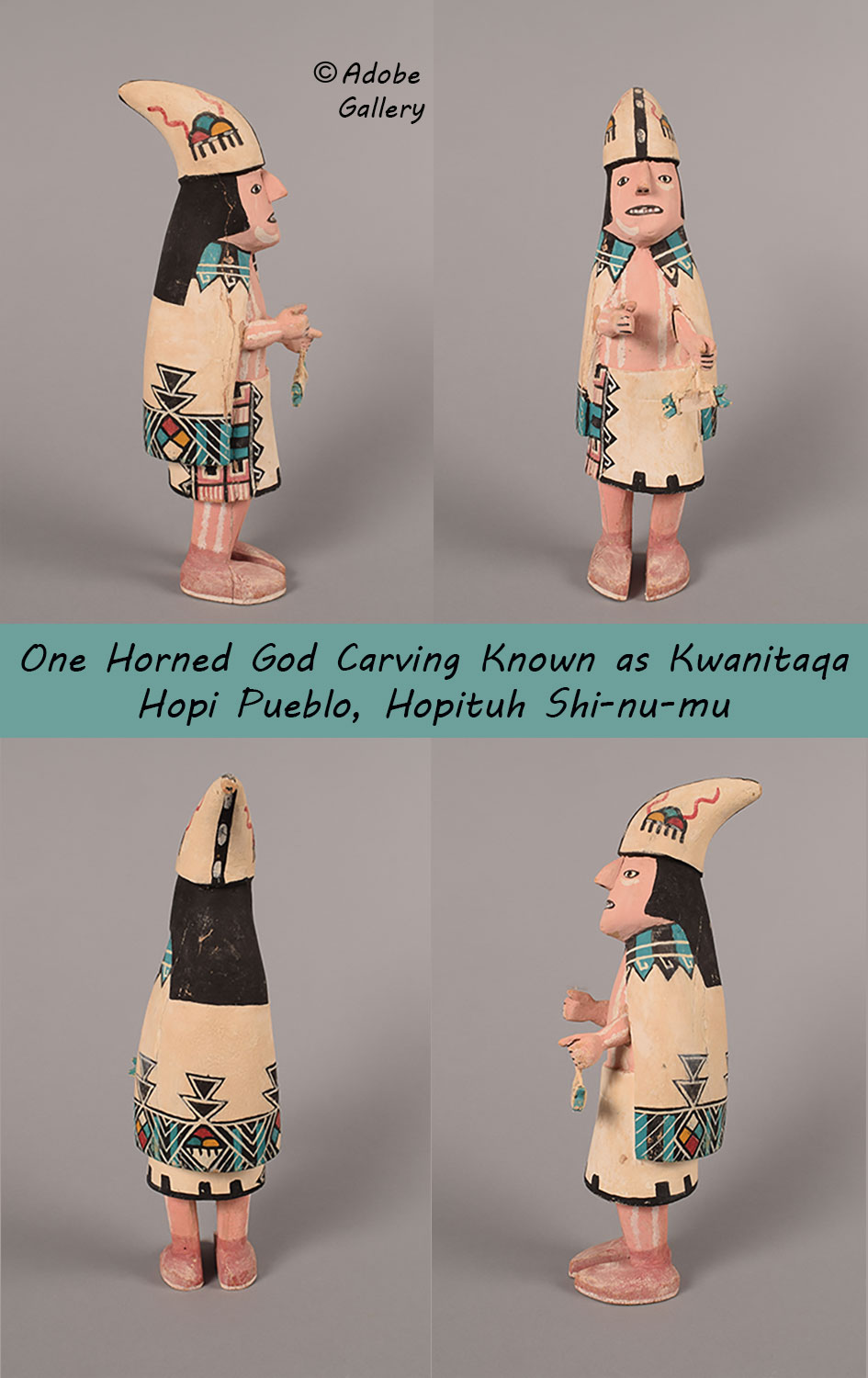
This carving of Kwanitaqa is very close to the traditional representation stated by a description by Harold S. Colton in "Hopi Kachina Dolls" so I will repeat his description and then point out changes in this doll.
"The impersonator wears a headdress with a single horn turned back. There is a white line under his right eye and another white line around the edge of his chin. His only body paint is a white line on the front of his arms and legs. He wears a wildcat skin or a white wedding robe. He is barefooted and carries a bell and wand." (Colton, 1949:79)
In this carving, the white line is under the left eye and not the right one. This carving has white lines on the chest which are not mentioned by Colton. He is wearing a traditional white wedding robe but this one has embroidery and I believe a true wedding robe does not. He is not barefooted as described above but is wearing moccasins. He is not carrying a bell or wand, but is carrying a prayer bundle.
For clarification, it must be pointed out that it is not unusual for a carver to make changes on carvings that are to be sold, reserving strict adherence to tradition on ones reserved for Hopi use.
We will refrain from referring to this carving as a katsina doll as it represents a Hopi One Horned God, who is not a katsina but is one of the Hopi Deities. I think the explanation provided by Harold S. Colton in "Hopi Kachina Dolls" is quite explanatory, so I will quote from him:
"THE RELIGION of the Hopi Indians in certain ways resembles that of the ancient Greeks. It is polytheistic, because there are many gods, and animistic because of the belief that all animate objects, plant and animal as well as some inanimate things, have spirits that the Hopi visualize in human form. When a Hopi goes out to gather yucca roots to use as a shampoo, the first plant that he finds, he prays to and passes by, gathering the second one. When he goes hunting he prays to the spirit of the game and apologizes for having to take their lives.
"In the mind of the Hopi there is a distinction not very sharp between the deities and the spirits of objects. The spirits of men, animals, and plants are the kachinas which are often impersonated. The spirits of some of the deities appear as kachinas and are impersonated, but most of the deities are never impersonated or even represented by images. The Hopi recognize about thirty-six deities. These grade from four major gods through minor gods to folk heroes. It is hard to find a clear separation." (Colton, 1949, 77-78)
This is an extraordinary and rare opportunity to see one of the Hopi Deities in carved doll form. Such carvings of the Hopi Deities are rarely done because of their importance and significance. It is not that the Hopi forbid such gods to be carved, it is only that most carvers will not carve them.
Condition: very good condition, with a break in the right foot that has been professionally glued in place.
Provenance: this The Hopi One Horned God Carving Known as Kwanitaqa is from the collection of a client from California
Reference: Colton, Harold S. "Hopi Kachina Dolls with a Key to their Identification". University of New Mexico Press, Albuquerque. 1949.
TAGS: Kachina – Katsina Doll, Hopi Pueblo
- Category: Traditional
- Origin: Hopi Pueblo, Hopituh Shi-nu-mu
- Medium: wood, paint, rope
- Size: 12” height
- Item # C4887Q SOLD
 Click on image to view larger.
Adobe Gallery Recommended Reading

Adobe Gallery Recommended Items
If you are interested in this item, we would also like to recommend these other related items: