




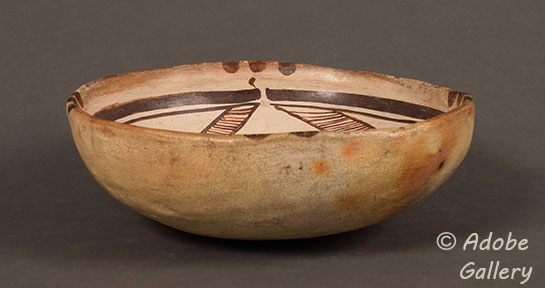
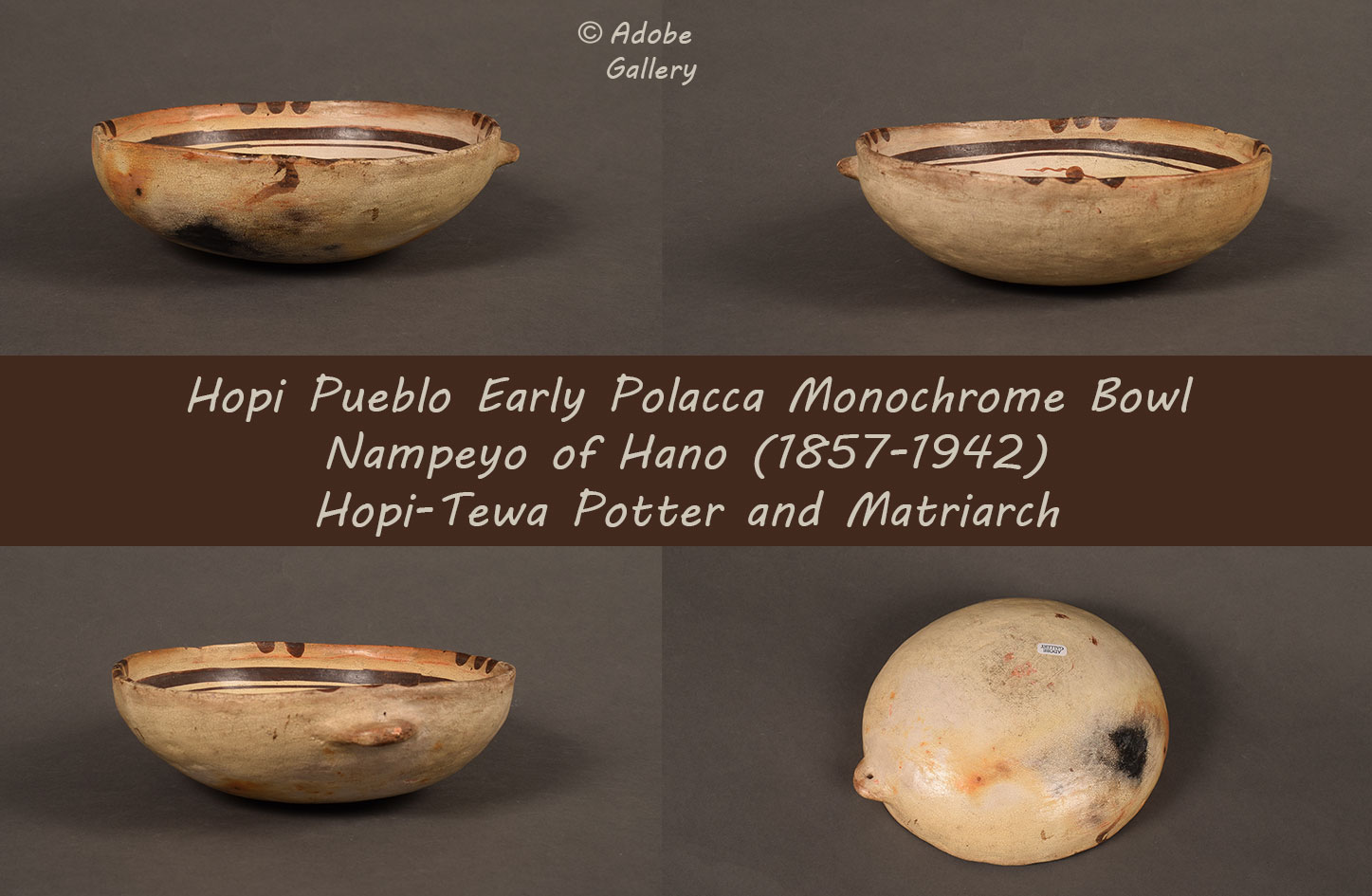
Hopi Early Polacca Monochrome Bowl by Nampeyo of Hano [SOLD]
+ Add to my watchlist Forward to Friend
- Category: Historic
- Origin: Hopi Nation, Hopituh Shi-Nu-Mu
- Medium: clay, pigment
- Size: 2-¾” deep x 8-⅛” diameter
- Item # C4960B
- Price: $3000
A Masterwork Pictorial Bowl by Nampeyo of Hano (c. 1895)
This extraordinary Polacca Polychrome pictorial bowl is a definitive example of the genius of Nampeyo of Hano (1857-1942). Created circa 1895, it dates to the pivotal period when Nampeyo began her revolutionary revival of ancestral Sikyatki designs, forever altering the course of Hopi ceramics.
Attributing unsigned 19th-century pottery to Nampeyo requires a keen eye for both sculptural form and a specific design repertory. This bowl provides a "textbook" example of her early work through two primary characteristics: One of Nampeyo's most distinct physical traits is the added coil of clay on the interior of the rim, used to provide a specific weight and architectural profile to the bowl. She was the first to systematically incorporate motifs from the prehistoric Sikyatki period (A.D. 1375-1625). This bowl bridges the gap between the older Polacca tradition and the burgeoning Sikyatki Revival style.
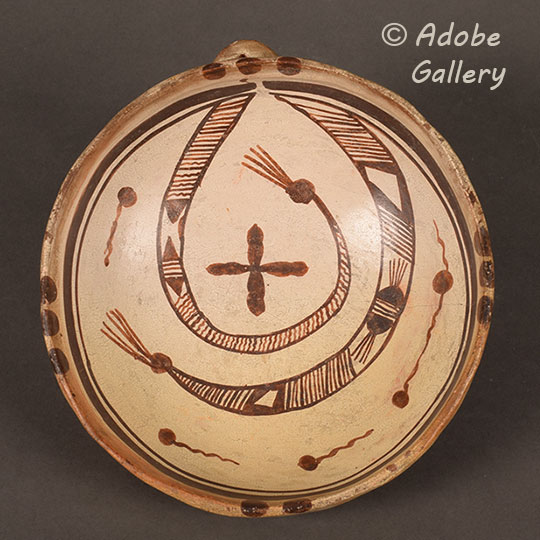
The centerpiece of this bowl is a sophisticated Sikyatki spiral swirl. Nampeyo was clearly fascinated by this specific layout, utilizing it on several of her most famous large jars — superlative examples of which are currently held in the Gilcrease Museum in Tulsa, Oklahoma. In 1898, the famed archaeologist Jesse Walter Fewkes identified this specific spiral motif as representing a reptile. However, many of his contemporaries argued it was a depiction of the Feathered Serpent, a powerful deity associated with water and fertility.
While the layout appears simple, Nampeyo infused the design with a remarkable kinetic energy. The "sperm-like" or germinating elements swirling around the center add a sense of organic motion and visual tension, making the clay feel alive. She added a hanging lug so the bowl could be displayed on a wall.
Several specific motifs in this bowl serve as a "signature" of Nampeyo's work during this era: A particularly distinct motif is the black ball with projecting spikes. Nampeyo frequently used these to terminate a composition. Within the spirals, one finds two black-tipped triangles placed tip-to-tip. In the corresponding spiral, she cleverly substitutes these with a black ball "bisected" and placed back-to-back, separated by parallel lines — a sophisticated play on symmetry. Further confirmation is found at the rim, where groups of black dots fold down from the edge into the interior of the bowl, a frequent finishing touch in her early polychrome works.
Every element of this vessel — from the unique rim construction to the masterful tension of the painted design — unequivocally identifies it as the work of Nampeyo. As a pictorial work from the mid-1890s, it represents the exact moment Nampeyo was rediscovering the aesthetic power of her ancestors, making it a cornerstone piece for any serious collection of Pueblo pottery.
I give credit to Dr. Ed Wade for details of Nampeyo's work as discussed above. He is a knowledgeable expert on her work and he is generous in sharing what he knows.
Condition: a very thin crack from the rim into the bowl about an inch. The bowl is still very stable.
Provenance: this Hopi Early Polacca Monochrome Bowl by Nampeyo of Hano is from the collection of a resident of New Mexico
Recommended Reading: Canvas of Clay: Seven Centuries of Hopi Ceramic Art by Edwin L. Wade and Allan Cooke
TAGS: Hopi Pueblo, Fannie Polacca Nampeyo, Nellie Nampeyo Douma, Annie Healing Nampeyo, Nampeyo of Hano, Hopi-Tewa Potter and Matriarch
- Category: Historic
- Origin: Hopi Nation, Hopituh Shi-Nu-Mu
- Medium: clay, pigment
- Size: 2-¾” deep x 8-⅛” diameter
- Item # C4960B
- Price: $3000
 Click on image to view larger.
Adobe Gallery Recommended Reading

Adobe Gallery Recommended Items
If you are interested in this item, we would also like to recommend these other related items: