




Hopi Pueblo Second Mesa Heheya Amutaka Katsina Doll [SOLD]
+ Add to my watchlist Forward to Friend
- Category: Traditional
- Origin: Hopi Pueblo, Hopituh Shi-nu-mu
- Medium: wood, paint, yarn, mineral, leather
- Size: 10” height
- Item # C4887P SOLD
6Understanding the Heheya Aumutaka:
The "Opposite-Speaking" Katsina
This carving represents the Heheya Aumutaka, a fascinating and complex figure specific to the Second Mesa villages of the Hopi. While versions of the Heheya appear across all three Mesas, the Aumutaka variation possesses unique traits that distinguish it within the Hopi ceremonial cycle.
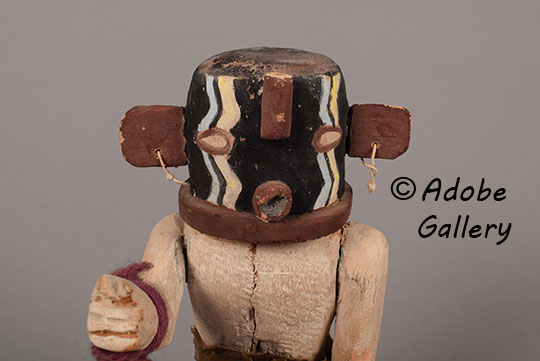
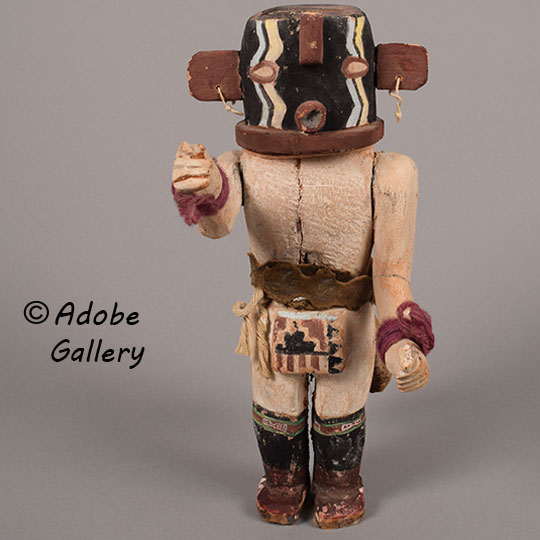
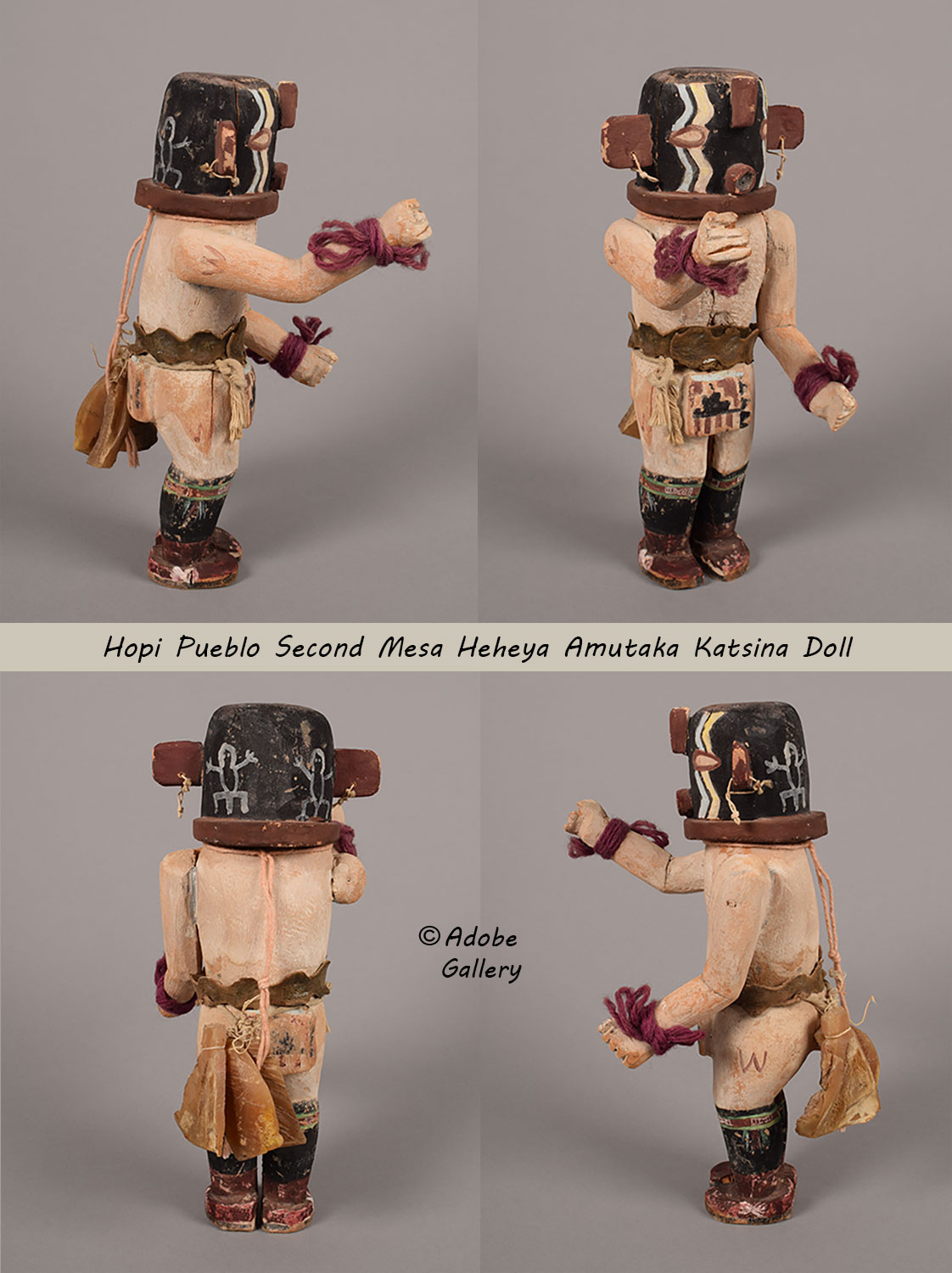
This particular doll is an excellent example of traditional carving, likely sculpted from a single piece of wood (with the exception of the arms and ears). His face is painted with yellow and blue lightning lines, symbolizing the power of the storm. Intriguingly, the back of his mask features painted frogs, which are potent symbols of water, fertility, and the arrival of rain.
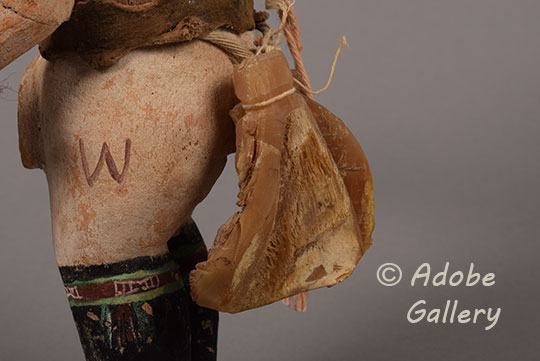
On the outside of each thigh is a mark. Traditionally, these marks are recognized as symbols of female genitalia (sometimes found on the arms as well), highlighting the Katsina's role in the more primal or "lecherous" aspects of certain dances. He wears only a simple loincloth, with colorful yarn wrapped at his wrists and a leather belt around his waist.
One of the most unusual features of this carving is the inclusion of three raw mineral specimens (likely petrified wood or agate) hanging from his backside. These stones are unpolished and translucent, ranging from amber to brown with visible crystalline banding. The use of raw earth elements reinforces the Katsina's connection to the prehistoric landscape and the raw power of nature.
The most defining characteristic of the Heheya Aumutaka is his reverse speech. If he tells a villager that the weather is "good," he means it is "bad." If he describes a person as "beautiful," he implies the opposite. This linguistic inversion serves as a form of sacred clowning, forcing onlookers to think critically and see the world from a different perspective.
The Heheya Aumutaka primarily appears during the Powamu Ceremony (the Bean Dance) in February. The Powamu is one of the most vital Hopi ceremonies, involving a cluster of events focused on the "melting of the snow" and the internal purification of the village. Every few years, when young men undergo tribal initiation, the ceremony expands into its full, unabridged "Pachavu" form.
This katsina is considered one of the sons of the Ogres. In this capacity, he serves as a runner, slave, or servant for the more intimidating Ogre Katsinas. He often carries a rope to "lasso" unwary onlookers or threaten children into behaving. During Night Dances, his behavior can become lewd or rowdy — a performance of "wild" energy that is eventually brought to order by the Ogre Manas (female figures).
Condition: overall good condition with a natural crack in the wood on his chest
Provenance: this Hopi Pueblo Second Mesa Heheya Amutaka Katsina Doll is from the collection of a client from Californai
Reference: Kachinas - Spirit Beings of the Hopi by Ricks and Anthony. Avanyu Publishing, Albuquerque. 1993
TAGS: Hopi Pueblo, Katsina Dolls
- Category: Traditional
- Origin: Hopi Pueblo, Hopituh Shi-nu-mu
- Medium: wood, paint, yarn, mineral, leather
- Size: 10” height
- Item # C4887P SOLD
 Click on image to view larger.
Adobe Gallery Recommended Reading

Adobe Gallery Recommended Items
If you are interested in this item, we would also like to recommend these other related items: