




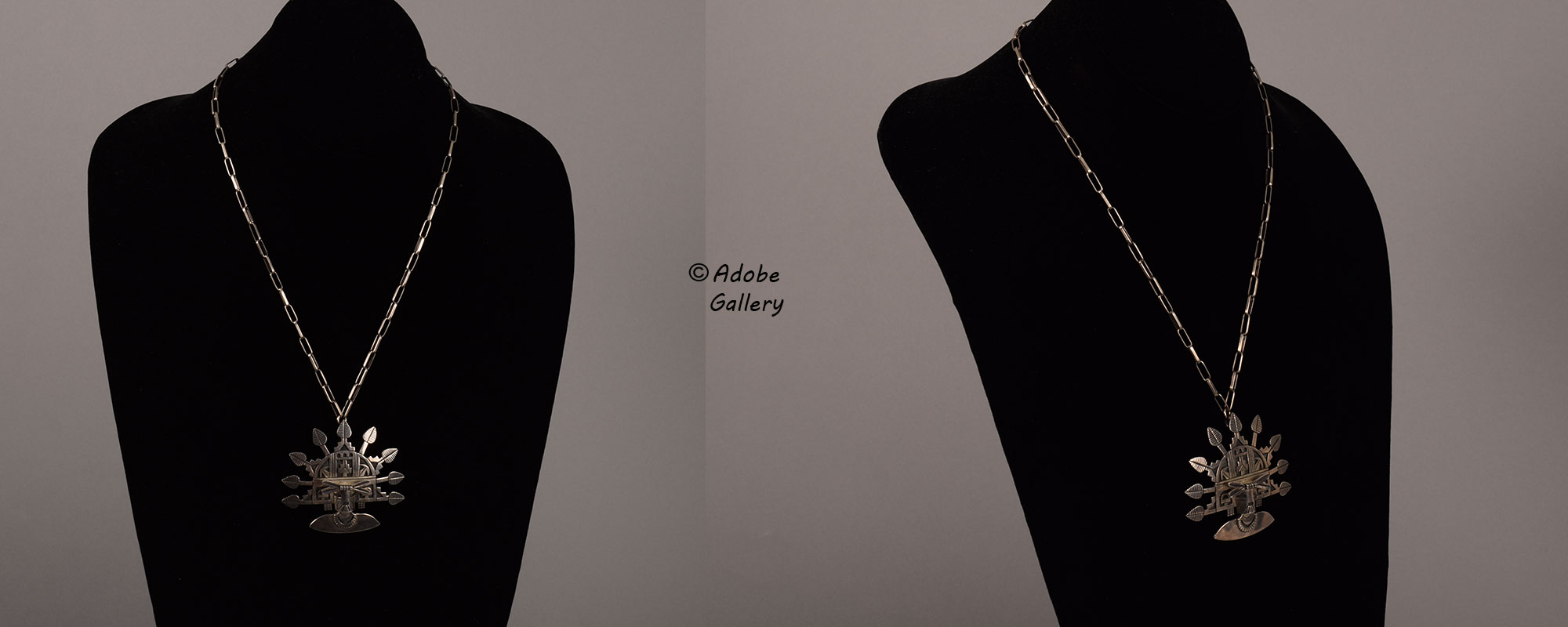
Hopi Sterling Silver Palikmana Pin-Pendant by Lawrence Saufkie
+ Add to my watchlist Forward to Friend
- Category: Pendants
- Origin: Hopi Pueblo, Hopituh Shi-nu-mu
- Medium: sterling silver
- Size:
2-¾” x 3” pendant; 24” chain - Item # C4718C
- Price: $1750
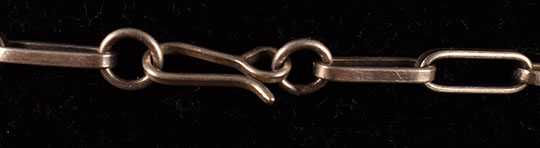
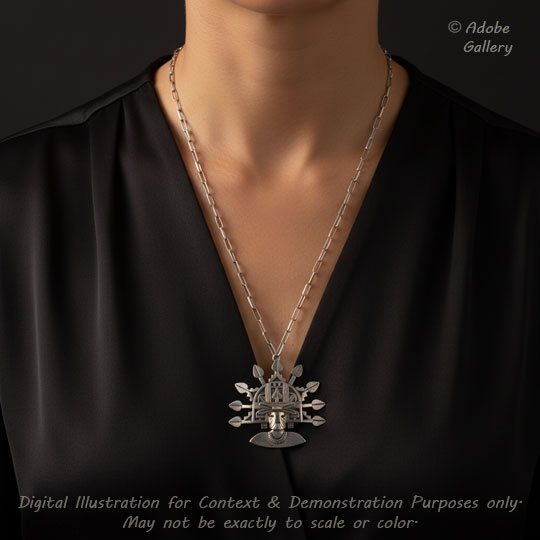
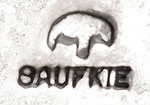 This is a sterling silver pin/pendant suspended on a handmade silver chain. It is removable from the chain when desired to be worn as a pin. It is a striking example of the high-grade silver overlay work for which Lawrence Saufkie (1934-2011) was renowned. As a Master Artist and the son of Paul Saufkie (who, along with Fred Kabotie, pioneered the Hopi overlay technique), Lawrence's work is highly collectible and technically precise.
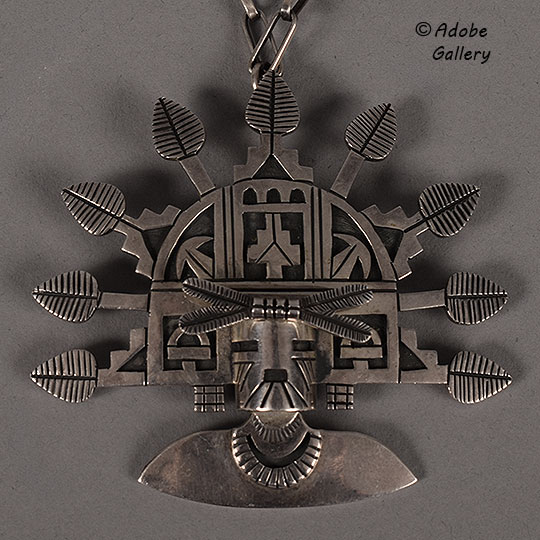
The pin/pendant depicts a bust presentation of the Palhikmana Katsina specifically rendered in the intricate "overlay" method. This involves two layers of sterling silver: the top layer has the design meticulously hand-cut with a jeweler's saw, and it is then soldered to a solid bottom plate. The face and feathers render the unit to a three-dimensional form.
The radiating "feathers" of the tablita surrounding the head are a hallmark of Saufkie's more elaborate pieces. These often represent prayer feathers symbolizing the connection to the spiritual realm. Above the face, the stepped patterns (often called "clouds") and the forehead crossed feathers are common Hopi motifs related to the power of the eagle and the sustenance of the pueblo. The blackened recessed areas are achieved through oxidation and then textured with fine "chisel" marks. This high-contrast look is the signature of quality Hopi jewelry. His ability to maintain perfect symmetry in such a complex, multi-point design is what set him apart from his contemporaries.The artist's name and mark are stamped on the back.
About Lawrence Saufkie
"Lawrence Saufkie (1935-2011), Hopi Pueblo, Bear Clan, active around 1974-2011 was born at the Grand Canyon while his father, Paul Saufkie, worked there for the Fred Harvey Company. By the time Lawrence was thirteen, his father started teaching him the basics of silversmithing. Stamped copper buttons were some of his first products. Within the next year or two, Saufkie was selling jewelry of his own creation at Gallup Inter-Tribal Ceremonial and, by age twenty, he would have his own booth. Once married in 1953, Saufkie turned to silverwork as a full-time occupation. He then joined the Hopi Silvercraft Cooperative Guild and started using his trademark of a bear shortly thereafter. He left the guild a few years later, stating, in 1975, that he preferred to work for himself with the ability to sell his jewelry where he chose.
"Saufkie started winning awards as early as 1958. He exhibited at his first Indian Market in 1962, and his reputation grew as he began winning top honors at southwest shows in the late 1960s and early 1970s. By 1975 he was having difficulty keeping up with the demand for his work." [Messier, 2014:126]
Lawrence Saufkie was designated an "Arizona Living Treasure" in 2002 by the state of Arizona and won numerous awards at the Santa Fe Indian Market and the Heard Museum.
Condition: very good condition
Provenance: this Hopi Sterling Silver Palikmana Pin-Pendant by Lawrence Saufkie is from the collection of a client of Adobe Gallery
References:
- Messier, Pat & Kim Messier, Reassessing Hallmarks of Native Southwest Jewelry, 2014
- Schaaf, Gregory. American Indian Jewelry I, 1,200 Artist Biographies. 2003
TAGS: Hopi Pueblo, Ruby Saufkie, Southwest Indian Jewelry, Lawrence Saufkie
- Category: Pendants
- Origin: Hopi Pueblo, Hopituh Shi-nu-mu
- Medium: sterling silver
- Size:
2-¾” x 3” pendant; 24” chain - Item # C4718C
- Price: $1750
 Click on image to view larger.
Adobe Gallery Recommended Reading

Adobe Gallery Recommended Items
If you are interested in this item, we would also like to recommend these other related items: