




J. B. Moore Crystal Trading Post Navajo Rug, Plate XXIV [SOLD]
+ Add to my watchlist Forward to Friend
- Category: Navajo Textiles
- Origin: Diné of the Navajo Nation
- Medium: wool
- Size: 6’8” x 3’6”
- Item # C3452P SOLD
In the final two decades of the 19th century, most Navajo weavers strongly resisted the local traders’ attempts to induce them to turn out what an Eastern or Midwestern Anglo lady could recognize as a proper rug—a bordered, rectangular, wool textile, its inner space plentifully filled with elaborate motifs suggestive of those found in carpets from the Orient, Persia, Turkey and the Caucasus.
Two of the earliest traders to the Navajo were the most influential in ushering in the Rug Era—Don Lorenzo Hubbell, at Ganado, and J. B. Moore, at Crystal Springs. Design elements from both these gentlemen were similar. Hubbell preferred lots of red; Moore preferred more natural tones.
Very little is known of John B. Moore as an individual other than that he was a native of Sheridan, Wyoming, bought an interest in the post at Washington Pass, N.M. (also known as Cottonwood Pass) in 1896 and abruptly left the Navajo Reservation in the autumn of 1911 as the result of a scandal (for which he was not to blame).
The remoteness of the Crystal area and the fact that winter business was fairly limited led Moore to issue a mail order catalog, a newly developed American merchandizing technique popularized by Sears, Roebuck and Montgomery Ward. His first catalog was issued in 1903 and his second one in 1911, shortly after he departed the Reservation.
Moore’s 1903 catalog featured rugs more akin to the borderless Navajo blankets traditionally being woven by the women. His 1911 catalog introduced Persian-style textiles with borders. It is this 1911 catalog for which his fame grew.
Black (actually the natural dark brown of some sheep), white, gray, and some red were preferred by Moore. He liked “hooks” and he supplied weavers around his post with examples of Turkish and other carpets popular then in Anglo households. He insisted on borders on the rugs as that would make them look more like rugs in his opinion. The Navajo were not used to providing borders on rugs or their baskets, always leaving an outlet or break in what might be a border. Many of the earlier Moore rugs have a ceremonial line break through the border, a way for the Navajo women to feel secure with these foreign concepts of closing a circle or square.
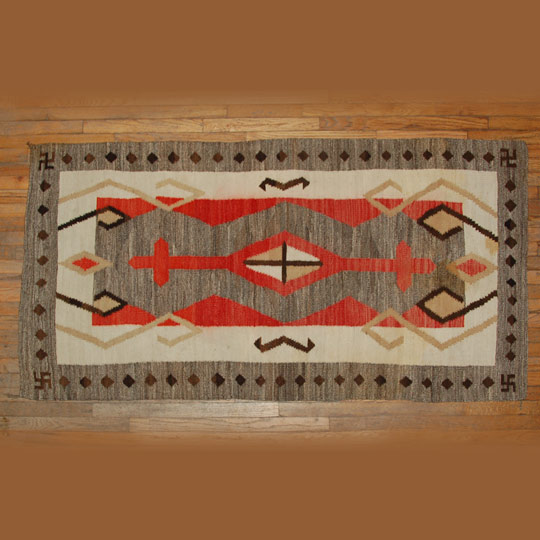
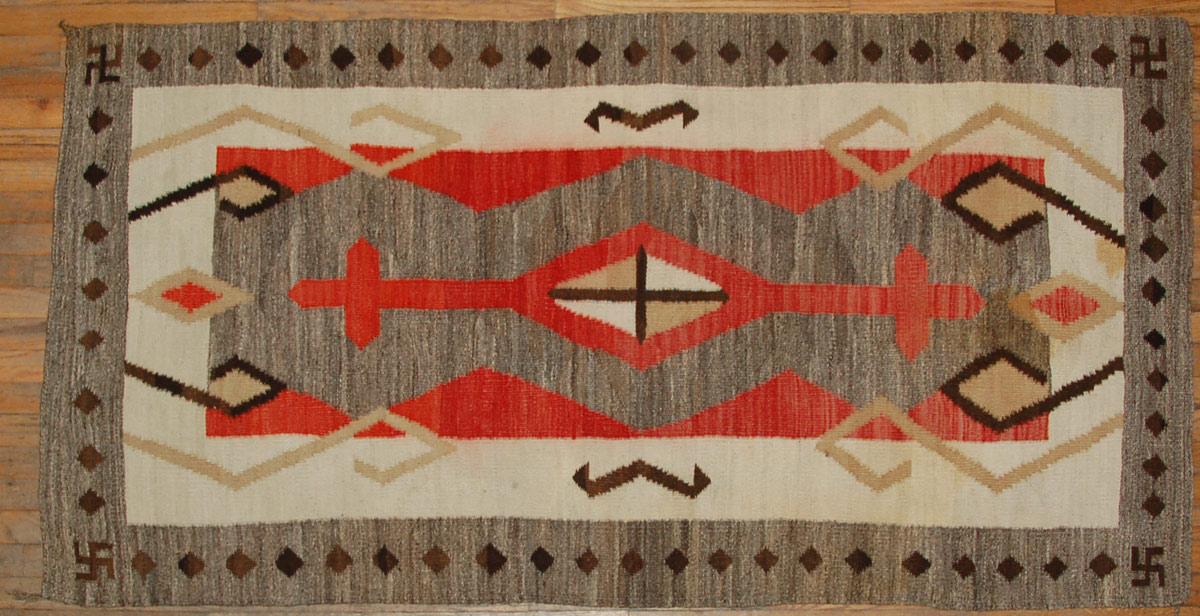
This 1910s rug is very typical of rugs from Crystal Trading Post at that time. Although J. B. Moore had departed the post by 1911, his patterns lingered on for another 20 to 30 years.
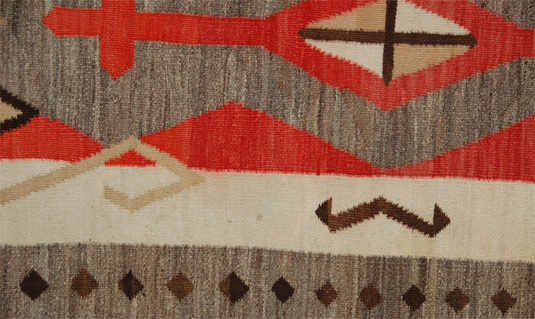
We see in this textile, hooks on the edges of the main pattern of the rug, a sure sign to the weaver that it would be a good seller. The central rectangular pattern features a double cruciform element connected by a diamond. The border is comprised of black diamonds on all four sides and a whirling log design in each corner. This design, combined with the natural colors, was highly prized by Eastern buyers.
In the 1911 catalog, Moore described this textile as follows: "Very handsome in colors as shown and seldom varied much, though we have a few done in red, white, and black which are very pretty. Price 90c to $1.00 per sq. ft., or $21.00 to $23.50 for smaller ones, and up or down according to sizes. Made in any size and colors wished for proportionate price. Sometimes done in ‘T-XX’ class (loose weave pound rug) and we have a few such on hand new. $1.00 to $2.00 per lb., according to quality.”
Moore also stated that this pattern was woven and designed by “Bi-leen Alpi Bi-zha-ahd” so apparently she was the only weaver he used to make this pattern.
Condition: The textile has just been professionally washed and is in very good condition with the exception of some minor bleeding of the red dye into the white yarn.
Provenance: from the Chuck and Jan Rosenak collection, authors and collectors of Navajo folk art.
Recommended Reading: J. B. Moore, United States Licensed Indian Trader, Avanyu Publishing
- Category: Navajo Textiles
- Origin: Diné of the Navajo Nation
- Medium: wool
- Size: 6’8” x 3’6”
- Item # C3452P SOLD
 Click on image to view larger.
