




McCarty’s 4-color Polychrome Jar with Birds [SOLD]
+ Add to my watchlist Forward to Friend
- Category: Historic
- Origin: Acoma Pueblo, Haak’u
- Medium: Native materials
- Size: 11" height x 13" diameter
- Item # C3330 SOLD
 McCarty's Polychrome designation for Acoma Pueblo pottery defines those vessels made after about 1850 and before 1900. Before then, a designation of Ako Polychrome describes the matte paint pottery produced at Acoma and Laguna Pueblos during the early eighteenth century. Before 1700, Acoma was known for its magnificent glazed ware. After 1900, the designation Acoma Polychrome is used.
McCarty's Polychrome designation was named for McCarty, an Acoma farming village below the Acoma Mesa. According to Harlow and Frank (1974), "McCarty's Polychrome vessels have several distinguishing features:
1. The jars are no longer sculptured into a lower and an upper body. The surface of one part simply curves smoothly to that of the other. The neck is no longer abruptly differentiated.
2. Once again the walls of the vessels are usually relatively thin, light and strong.
3. The paste is almost always a clear white color. The slip, too, is whiter than previously.
4. The decoration begins to incorporate birds and floral motifs. They are relatively free and informal and more careful in execution."
According to Dillingham (1992), pueblo pottery had not shown any strong design influence from non-indigenous sources until around 1850, at which time realistic birds, floral designs, and the rainbow band appeared which were most likely derived from external sources. Bird designs—mostly stylized—had been used since prehistoric times, but the advent of more realistic renditions seems to have occurred around 1850.
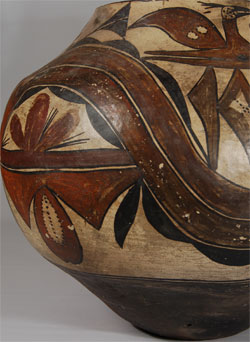
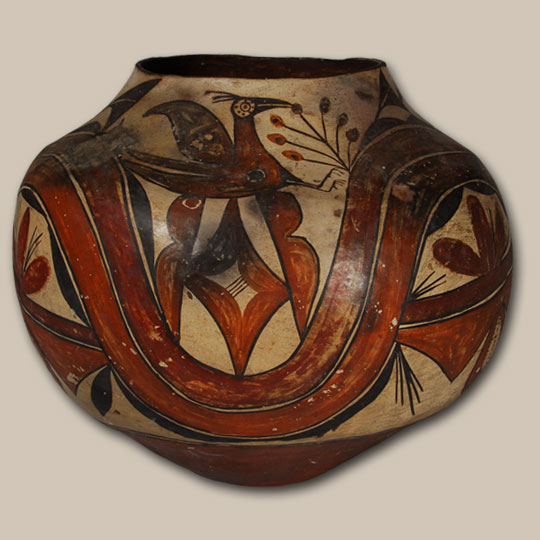
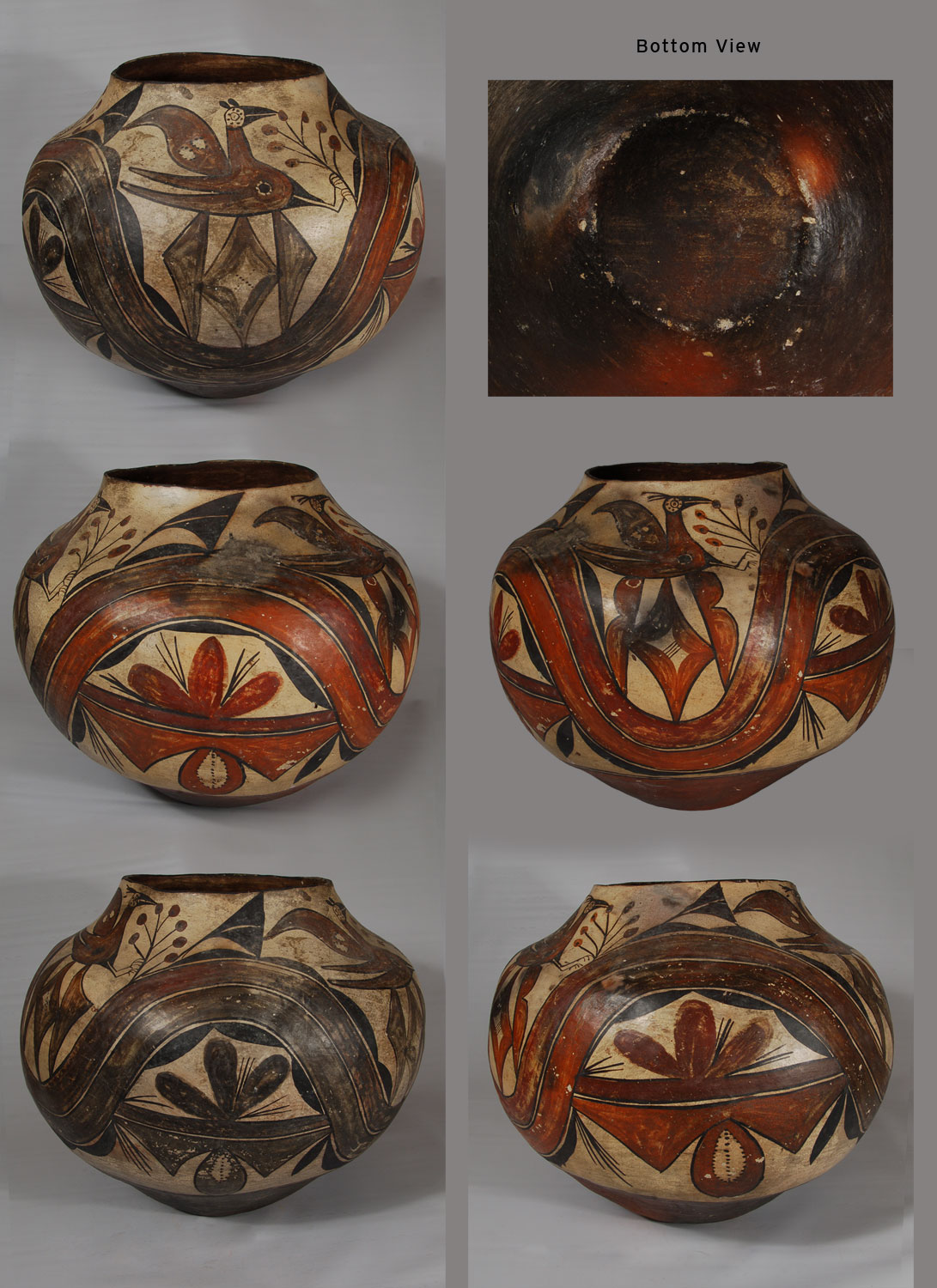
This McCarty's Polychrome jar is truly magnificent. It features a double undulating rainbow—one in deep red, the other in deep orange. Above the rainbow are three startled-looking birds eagerly eating berries from a plant that they are clutching with their claws.
Below the rainbow, three panels of design, each resembling a combination of a floral element—perhaps a yucca—above what may be rain clouds and a cactus leaf, float as if in space.
Condition: This jar is in very good condition with no repairs or restoration. There is a significant amount of fire clouds that attest to a natural outdoor firing.
Provenance: ex. Edwin L. Wade Collection; ex. Elaine Horwich Collection
References:
1. Historic Pottery of the Pueblo Indians 1600-1880 by Larry Frank and Francis H. Harlow. 1974
2. Acoma & Laguna Pottery by Rick Dillingham. 1992.
- Category: Historic
- Origin: Acoma Pueblo, Haak’u
- Medium: Native materials
- Size: 11" height x 13" diameter
- Item # C3330 SOLD
 Click on image to view larger.
