




Diné Folk Art Wood Carving by Charlie Willeto [SOLD]
+ Add to my watchlist Forward to Friend
- Category: Other Items
- Origin: Diné of the Navajo Nation
- Medium: wood, paint, nails
- Size: 17-½” height including stand;
6-¾” width; 1-½” depth - Item # C4468B SOLD
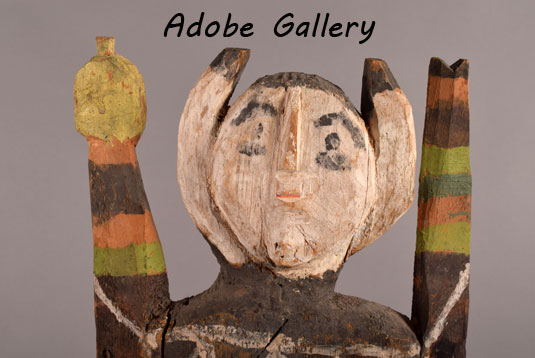
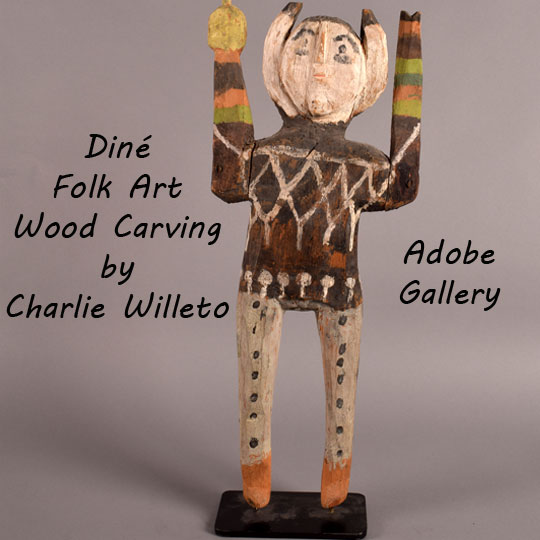
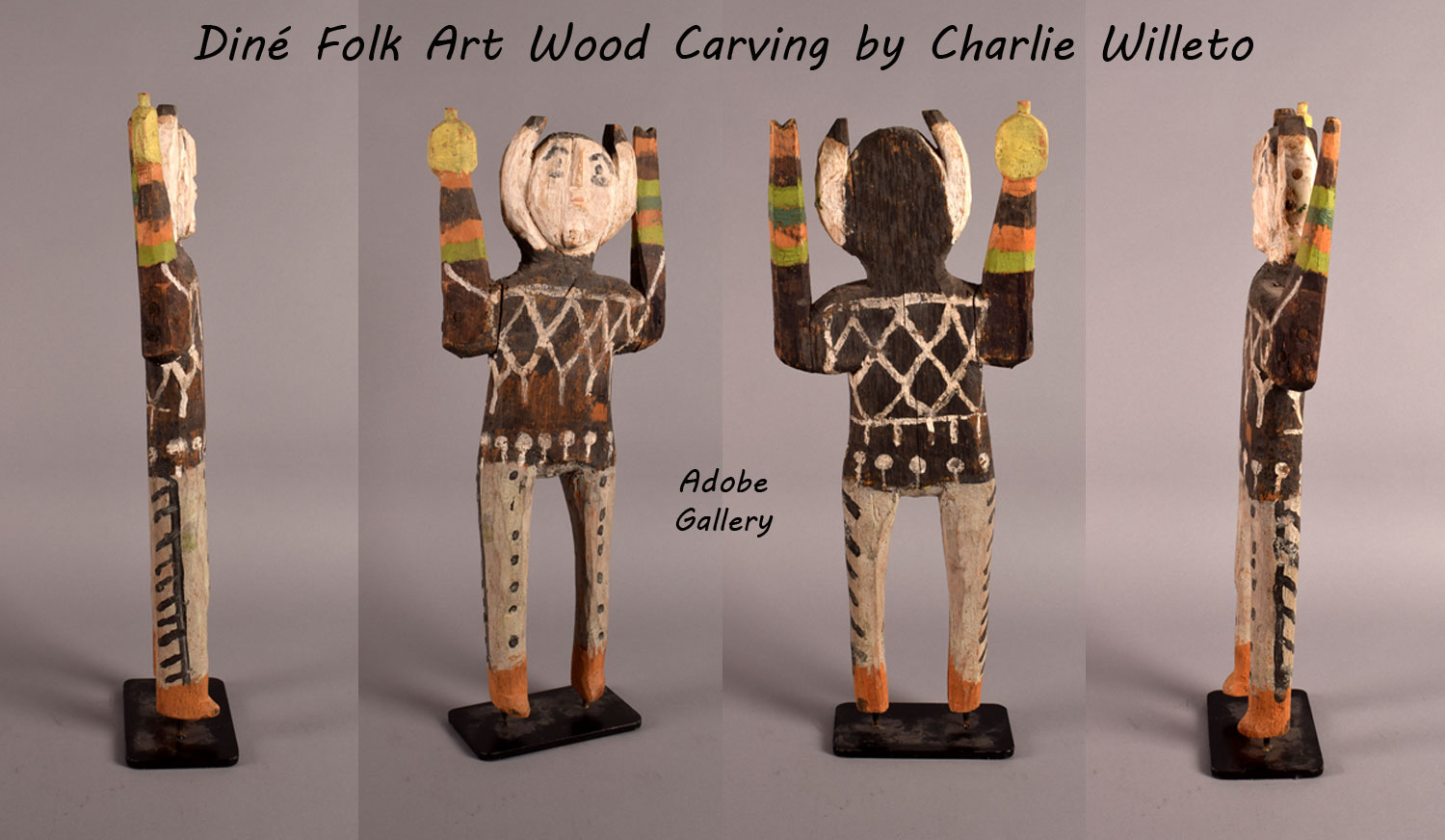
This colorful carving was created by Diné folk artist Charlie Willeto. It is a human figure with raised arms and a particularly lively set of adornments. He wears a black shirt, with a pattern of white diamonds crossing his chest and stripes of blue and green circling his arms. White spots circle his waist, and lines of black dots travel down his white trousers. His face is primitive but extraordinarily expressive, which is typical of Willeto’s works. His eyes—a curved eyebrow, a black dot, and a horizontal line form each one—seem to gaze just past the viewer, inviting interaction in a mysterious way. Because of its rich, alluring character and iconic style, this is an exemplary Willeto carving.
This carving is pictured in Greg LaChapelle’s Navajo Folk Sculpture: Alfred Walleto, a publication made to accompany an early Wheelwright Museum exhibition of Willeto’s work. The carving appears in a stark black and white photograph, casting a large shadow on a white background. A copy of this publication is included with the carving.
The carving is mounted securely on a black stand.
Charlie Willeto (1897-1964) was a Diné artist who was unrecognized during his lifetime but has, in recent years, received a great deal of acclaim for his folk-art carvings. Willeto’s father, Pablo Walito, was a Diné medicine man; his mother Adzaan Tsosie “Slender Woman” was a medicine woman. Willeto himself followed into his parents’ profession, and also married a woman who was born into the traditional Diné healing arts. At the time of Charlie and Elizabeth’s arranged marriage, he was almost fifty and she was 18. They would go on to have six children together, many of whom would become artists themselves. Willeto was a Yei-bi-chei dancer, and his earliest known carvings were what he referred to as “replicas” of the Yei-bi-cheis. His elders discouraged him from continuing to make his “replicas'', and he moved in a different but similarly controversial direction.
In 1961, Willeto began creating the carvings for which he is celebrated today. These works—his early pieces, in particular—bore a resemblance to the “illness” or “healing” dolls made for use in Diné ceremonial functions. They always featured some sort of deliberate aberration, though, as the recreation of these dolls was frowned upon by the Diné. Humans, anthropomorphic figures, and all manner of animals were Willeto’s preferred subjects. He painted his carvings with house paint, chalk, crayons, and his wife’s weaving dyes. The carvings ranged in size from a few inches tall to nearly life-size, with the majority standing between one and three feet. Willeto bartered his carvings for provisions, with trader Jim Mauzy. Mauzy then sold and traded Willeto’s carvings to other dealers and collectors. Willeto is believed to have completed about 400 carvings in total. Today, his works are included in many prominent public and private collections, including the Smithsonian and the Museum of International Folk Art.
Condition: excellent condition
Provenance: this Diné Folk Art Wood Carving by Charlie Willeto is from a private collection, originally acquired from art dealer John C. Hill
Reference: Greg LaChapelle. Navajo Folk Sculpture: Alfred Walleto
Relative Links: Navajo Nation - Diné , Charlie Willeto, Dine Artist
- Category: Other Items
- Origin: Diné of the Navajo Nation
- Medium: wood, paint, nails
- Size: 17-½” height including stand;
6-¾” width; 1-½” depth - Item # C4468B SOLD
 Click on image to view larger.
