




San Ildefonso Pueblo Polychrome Historic Pottery Water Jar
+ Add to my watchlist Forward to Friend
- Category: Historic
- Origin: San Ildefonso Pueblo, Po-Woh-Geh-Owingeh
- Medium: clay, pigment
- Size:
9-½” height x 10” diameter - Item # C4980A
- Price: $5500
Based on the visual characteristics of this beautiful polychrome jar, there is a very interesting stylistic story here. The jar heavily incorporates elements closely associated with San Ildefonso Pueblo very early 20th century (circa 1880-1910). Later in this analysis, we offer a compelling attribution regarding the identity of the potter.
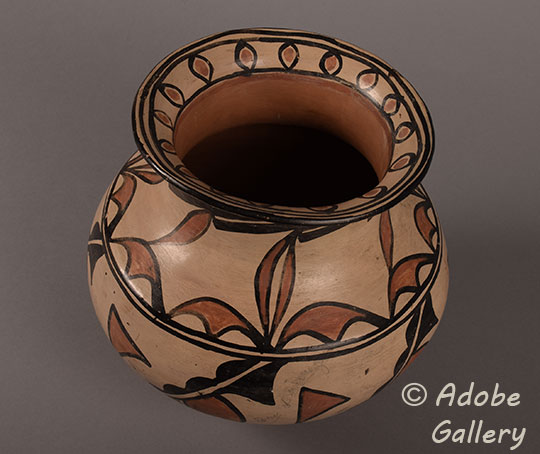
Classic Historic Profile: The vessel features the traditional historic olla shape: a low, rounded underbody that tapers dramatically to a high shoulder, moving into a short, elegant neck with a flared rim. The undercoat is the traditional stone polished cream-to-white slip characteristic of the historic Tewa pottery tradition. It was after 1905 that potters from San Ildefonso began using the cream slip from Cochiti Pueblo that only required rag polishing.
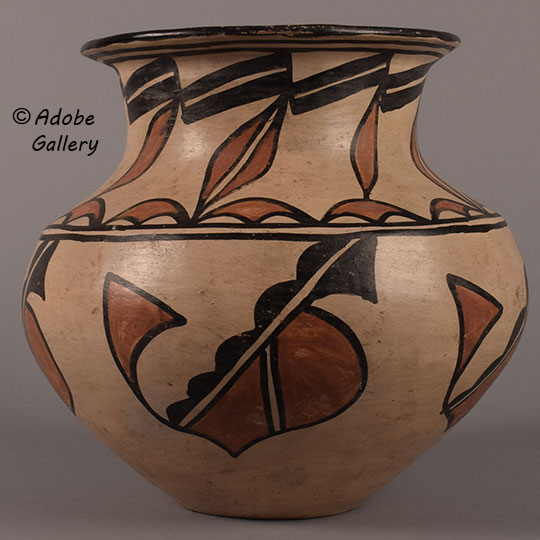
The design relies on the classic historic triad: a native mineral black manganese pigment for the linework, balanced by a rich, warm iron-bearing red slip used as a filler, both applied over the cream slip background. The jar is divided into distinct, masterfully painted design bands that offer the best clues to its historic context:
The inner rim is decorated with a continuous band of small, repeating scalloped circles with red-dotted centers. This is an incredibly common motif found on historic San Ildefonso and Tesuque jars. The neck features an alternating, fluid floral/leaf pattern with black stems and red leaf interiors. The sweeping, diagonal black structural lines framing these leaves create a wonderful sense of movement around the collar.
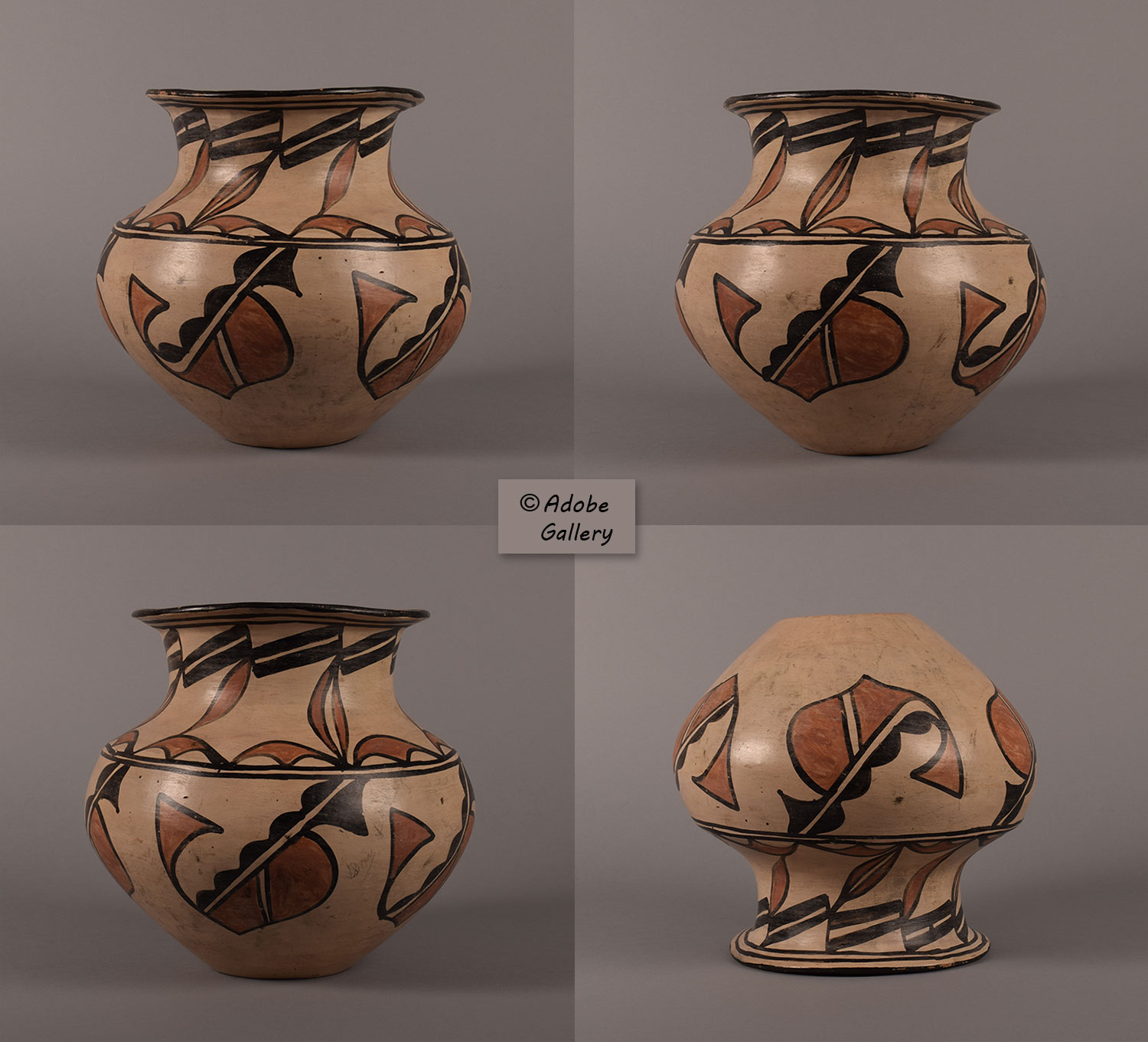
The main body features large, stylized floating designs that may be analyzed in several options. These look like they could be stylized, split feather motifs or abstracted plant elements, bounded by sharp black triangles filled with red slip. The use of negative white space within the black frames is executed with incredible precision. Another, more intriguing analysis of the floating elements is that they represent birds — the red triangle outlined in black is the tail, the black triangle is the face and beak, and the body is a bulbous red outlined in black. The series of black semicircles could be feathers on the bird's back.
Attribution of Potential Potters of this Jar
The jar does not have an expected beige polished lower section as seen most often on jars, but is fully covered with cream slip from rim to base. It has been noted that this trait leads one to two potters of the time period who are known for this technique. Dolorita Vigil (1883-1918) and Martina Vigil (1856-1916) with her husband, Florentino Montoya (1858-1918). Interestingly, the two women were related.
Even though Dolorita Vigil died during the influenza epidemic of 1918, long before pueblo pottery was in the mainstream as a collectible, she is still recognized as one of the finest potters of the early 20th century from San Ildefonso Pueblo. She was a daughter of Alfonso Vigil (1856 -) and Cipriana Martinez Vigil (c.1860 -) and a sister of famous painter Romando Vigil (1902-1978). Other losses of the time were Martina Vigil in 1916, and Florentino Montoya in 1918. Martina was an aunt of Dolorita and was the one who taught Dolorita the techniques of pottery production. It is not surprising then that both artists would apply slip in the same manner.
We are not specifying whether Dolorita Vigil or Martina Vigil was the potter but it seems likely that one of them made this amazing jar.
Condition: very good condition
Provenance: this San Ildefonso Pueblo Polychrome Historic Pottery Water Jar is from the collection of a client from Santa Fe
Recommended Reading: "Martina Vigil and Florentino Montoya - Master Potters of San Ildefonso and Cochiti Pueblos" by Jonathan Batkin. American Indian Art Magazine, Autumn 1987. On page 33, there is a family tree of Matrtina and Dolorita families, including a photograph of Dolorita.
- Category: Historic
- Origin: San Ildefonso Pueblo, Po-Woh-Geh-Owingeh
- Medium: clay, pigment
- Size:
9-½” height x 10” diameter - Item # C4980A
- Price: $5500
 Click on image to view larger.
Adobe Gallery Recommended Reading

Adobe Gallery Recommended Items
If you are interested in this item, we would also like to recommend these other related items: