




Terrance Talaswaima Painting “Hopi Shalako and Rain Spirits”[SOLD]
+ Add to my watchlist Forward to Friend
- Category: Paintings
- Origin: Hopi Pueblo, Hopituh Shi-nu-mu
- Medium: watercolor, ink
- Size:
15-½” x 5-1/2” image
19-3/8" x 9-3/8" - Item # C4964N SOLD
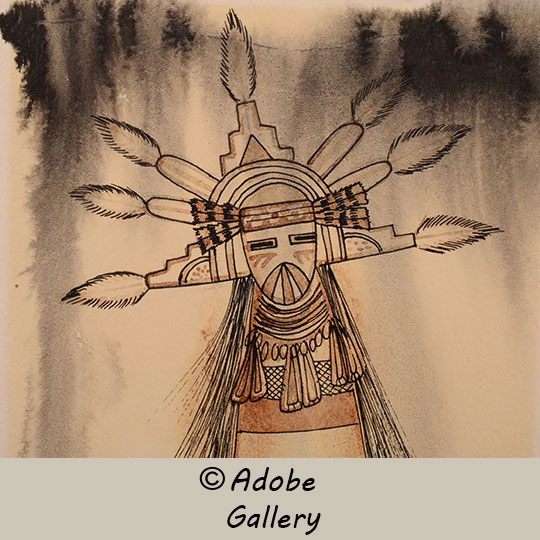
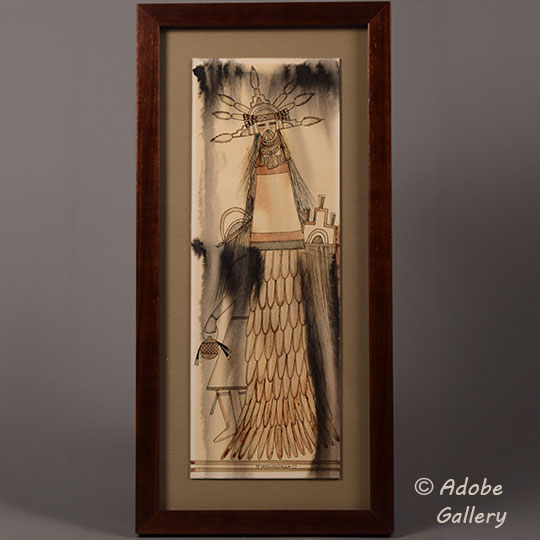
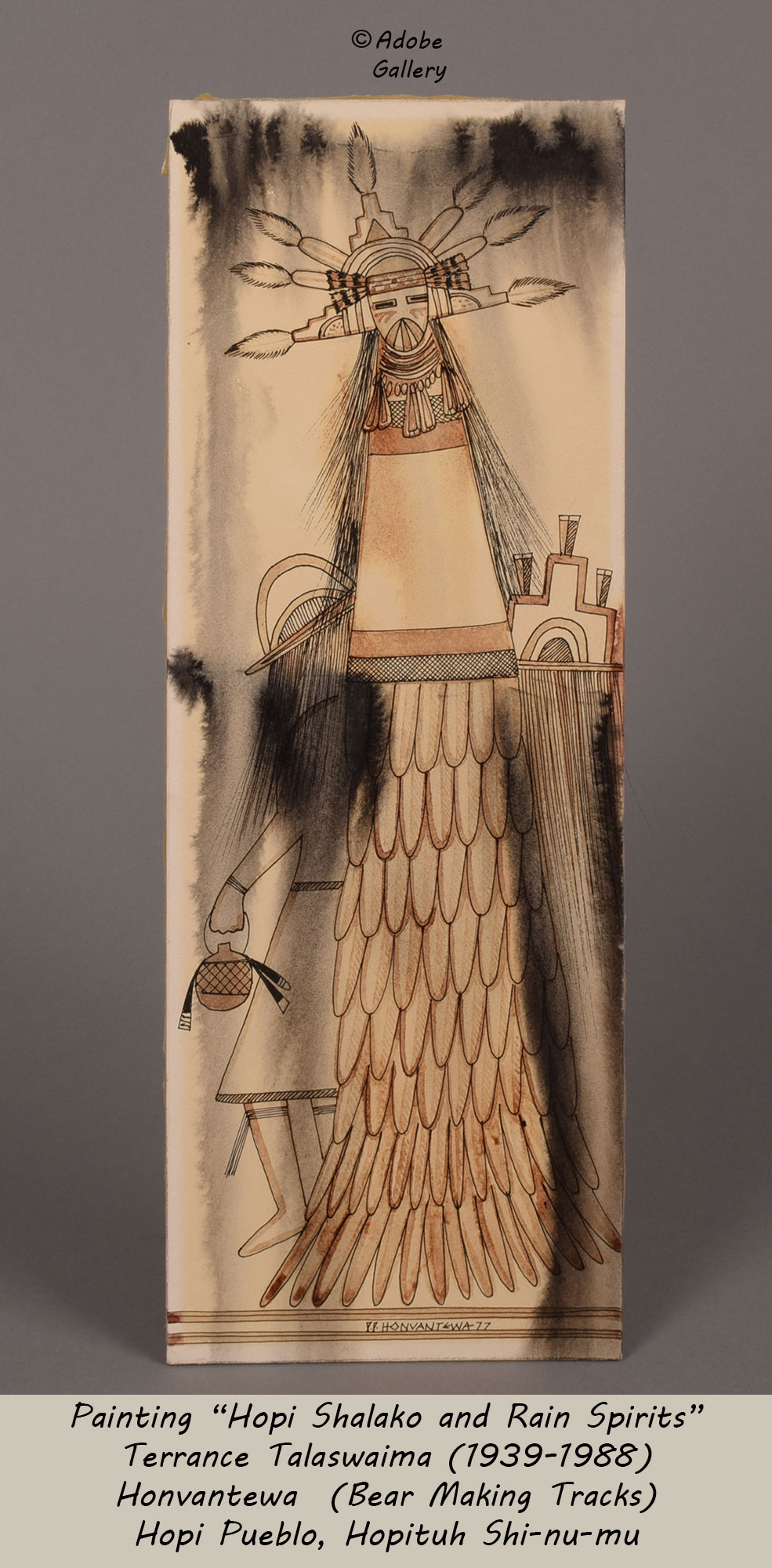
 This striking original painting, titled "Hopi Shalako and Rain Spirits," is a significant work by the renowned Hopi artist Terrance Talaswaima (1939-1988), who painted under his Hopi name, Honvantewa (meaning "Bear Making Tracks"). Dated 1977, this piece was created during a pivotal era for Hopi contemporary art. Here is a breakdown of the artist, the symbolism, and the cultural context of the painting.
Terrance Talaswaima (Honvantewa)
Talaswaima was a cornerstone of the modern Native American art movement. He was a founding member of Artist Hopid (formed in 1973), a group of five Hopi artists who revolutionized their traditional art by blending ancient symbolic imagery with contemporary techniques.
His mission was to "document every aspect of Hopi life" and use art as a tool to teach traditional values.
Hailing from the village of Shungopavi on Second Mesa, he was not just a painter but also a museum director, storyteller, and Katsina carver. His work is highly collectible and held in major institutions like the Heard Museum and the Museum of Northern Arizona.
The painting depicts a Hopi Shalako, one of the most magnificent and spiritually significant Katsinam (spirit beings).
The central figure is a Shalako, recognizable by its towering, elongated form. In Hopi tradition, the Shalako are "Cloud People" or "Rain Makers" who arrive to bring moisture to the arid desert. He used a vertical format to emphasize the height of the Shalako, a being that traditionally stands over seven feet tall in ceremonies.
The elaborate crown features feathers and geometric stepped patterns representing clouds and mesas. The long, vertical "cape" of the figure is composed of stylized feathers, which act as a visual prayer for rain and a connection to the sky.
The watercolor "wash" and dark, bleeding ink at the top of the painting represent the Rain Clouds (omau) themselves. In Hopi art, the movement of paint often mimics the natural movement of weather.
To the left, a smaller figure is seen holding a water gourd — a sacred vessel used in ceremonies to sprinkle water, symbolizing the blessing of rain.
The year 1977 was a prolific time for Talaswaima. This specific piece showcases the "Artist Hopid" style: Likely ink and watercolor (or thin acrylic wash) on board.
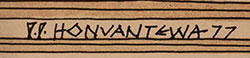
Signed "T.T. HONVANTEWA 77" at the bottom. The "T.T." stands for his English name, Terrance Talaswaima.
This isn't just a decorative image; it is a documented prayer. For the Hopi, who are "dry farmers," rain is the ultimate blessing. By painting these spirits, Talaswaima was participating in a continuous cycle of faith and cultural preservation.
Condition: original condition
Provenance: this Terrance Talaswaima Painting "Hopi Shalako and Rain Spirits" is from a client of Adobe Gallery. Displayed in Special Exhibit: Ancestral Symbols, Modern Masterpieces: Documenting the Sacred Narratives and History of the Hopi People at Adobe Gallery for its 50th Anniversary Celebration Santa Fe, NM, May 2026.
Reference: Broder, Patricia Janis. Hopi Painting: The World of the Hopis, Brandywine Press, New York. 1978
TAGS: Hopi Reservation, Delbridge Honanie, Michael Kabotie, Neil David, Native American Painting, Delbridge Honanie, Milland Lomakema, Michael Kabotie, Neil David Sr., Terrance Talaswaima
- Category: Paintings
- Origin: Hopi Pueblo, Hopituh Shi-nu-mu
- Medium: watercolor, ink
- Size:
15-½” x 5-1/2” image
19-3/8" x 9-3/8" - Item # C4964N SOLD
 Click on image to view larger.
