




Tyler Polelonema Watercolor “Ritual Smoking”
+ Add to my watchlist Forward to Friend
- Category: Paintings
- Origin: Hopi Pueblo, Hopituh Shi-nu-mu
- Medium: casein
- Size:
22” x 16-¾” image;
29” x 23” framed - Item # C4964E
- Price: $3700
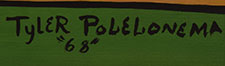 This painting is a striking example of Hopi ceremonial art by Tyler Polelonema (1940-1991), a member of the prominent Polelonema family of artists from Second Mesa, Arizona.
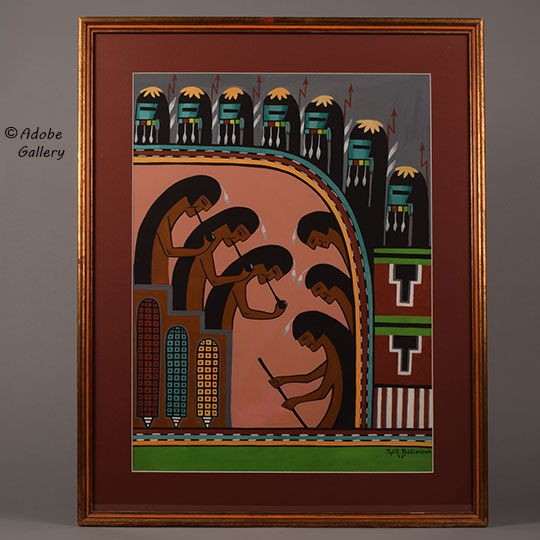
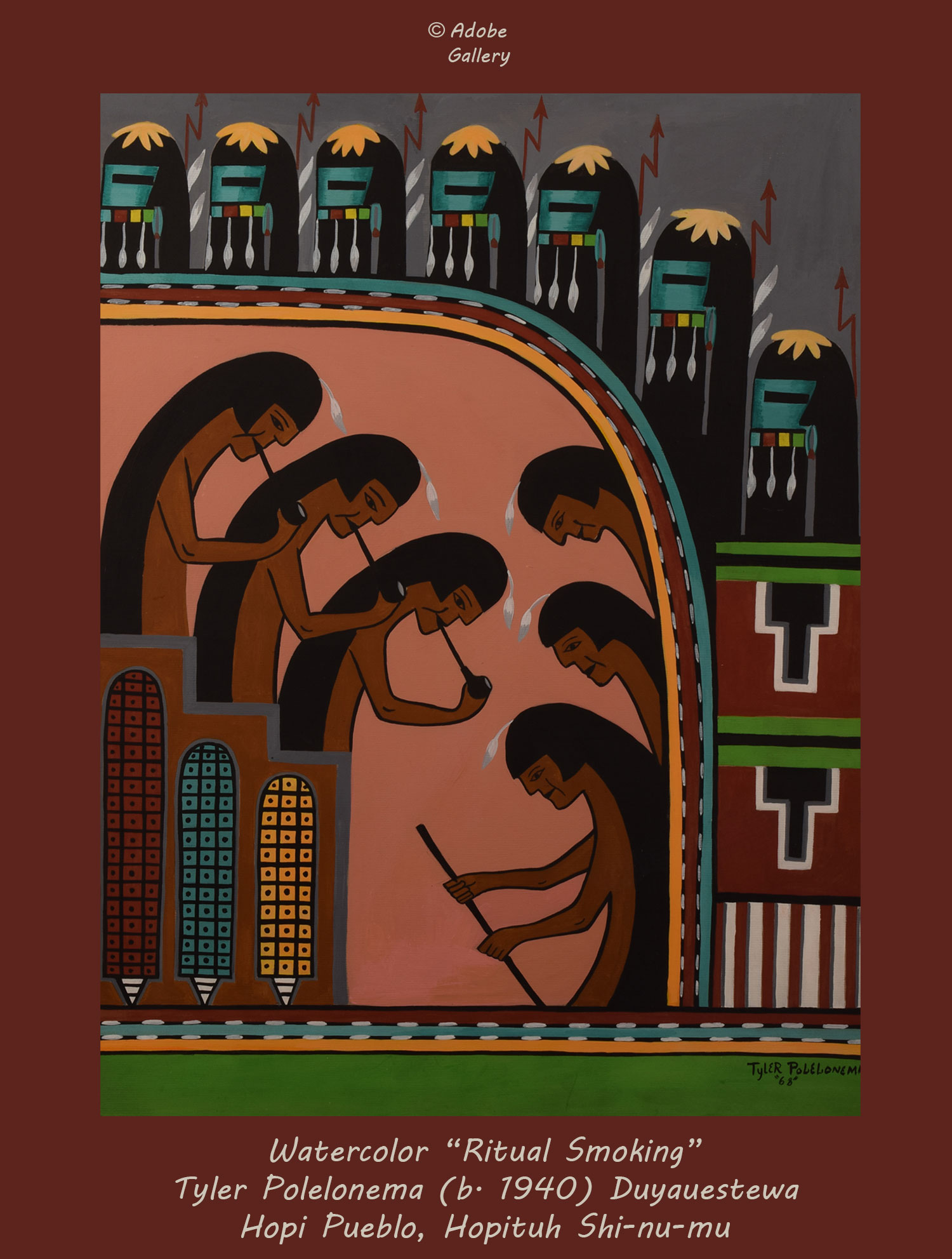
In Hopi culture, smoking is far more than a social habit; it is a sacred act of communication with the spiritual world. Here is a breakdown of the symbolism and context within this 1972 piece:
The Sacred Act of Smoking
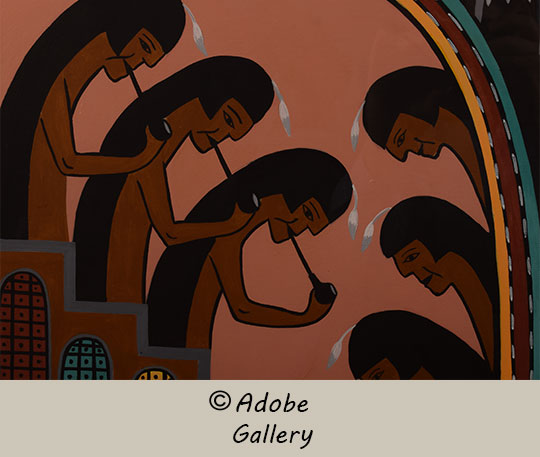
The figures in the center are shown using traditional long-stemmed pipes. In Hopi ritual, tobacco smoke is viewed as equivalent to clouds. By exhaling smoke, the practitioners are symbolically "seeding" the sky, creating a visual prayer for rain to nourish their crops. The ritual of smoking is one of the most important forms of Hopi prayer. The Hopi believe that their prayers are carried to the heavens by the rising smoke.
The Presence of the Katsinam
Along the top and right borders, you see a row of stylized figures. These represent Katsinam (Kachinas), specifically Long Hair Katsinas, the benevolent spirit messengers who live in the San Francisco Peaks and visit the Hopi villages for half the year to bring rain and ensure a good harvest.
Note the teal, yellow, and red on their masks — these often correspond to the cardinal directions and different types of corn. The red zigzag arrows rising from their heads represent lightning, further reinforcing the theme of an impending storm. The way the Katsinam frame the human figures suggests they are observing and legitimizing the ritual.
In the bottom left, the artist includes stylized ears of corn (red, blue/green, and yellow). Corn is the "mother" of Hopi life. The placement of the corn directly below the smoking ritual illustrates the direct relationship between the prayer (the smoke) and the desired outcome (a bountiful harvest).The three men on the left are smoking and the three on the right are planting corn. The rainbow-like border separating the humans from the spirits represents the boundary between the physical and spiritual realms.
Tyler Polelonema's work is characterized by its flat, graphic quality and bold use of color, which was typical of the "Studio Style" that emerged from the Santa Fe Indian School, but updated with a more modern, mid-century precision. The date 1972 falls right in the prime of Polelonema's career when he was refining this specific "nested" composition style.
Tyler Polelonema is the son of Otis Polelonema. He was born in 1940 at the Shungoopavi Village of Second Mesa, Arizona. He is known for Ethno-cubist figure-imagery. He graduated from Oraibi High School and was a long time employee of the Fred Harvey Company. He is married to Jessie Salaftoche and they have one child and continue to live at Second Mesa. By the early 1970s, he was painting in abstract or semi-abstract style in which he used Hopi motifs in a pleasing fashion.
Condition: very good condition
Provenance: this Tyler Polelonema Watercolor "Ritual Smoking" is from a client of Adobe Gallery. Displayed in Special Exhibit: Ancestral Symbols, Modern Masterpieces: Documenting the Sacred Narratives and History of the Hopi People at Adobe Gallery for its 50th Anniversary Celebration Santa Fe, NM, May 2026.
Reference: Broder, Patricia Janis. Hopi Painting: The World of the Hopis, Brandywine Press, New York. 1978
TAGS: Hopi Pueblo, Native American Painting, Tyler Polelonema
- Category: Paintings
- Origin: Hopi Pueblo, Hopituh Shi-nu-mu
- Medium: casein
- Size:
22” x 16-¾” image;
29” x 23” framed - Item # C4964E
- Price: $3700
 Click on image to view larger.
