




Waldo Mootzka Original Watercolor Painting of Sipikne Katsina [SOLD]
+ Add to my watchlist Forward to Friend
- Category: Paintings
- Origin: Hopi Pueblo, Hopituh Shi-nu-mu
- Medium: watercolor
- Size:
7-¼” x 5-⅛” image;
15” x 12-⅜” framed - Item # C4702B SOLD
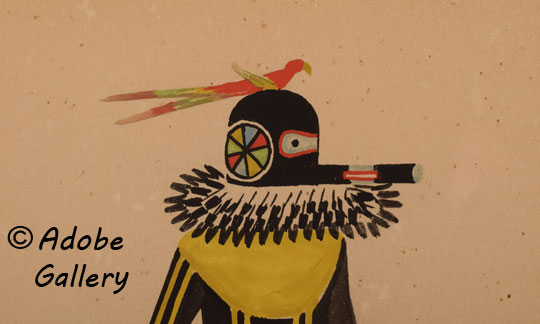
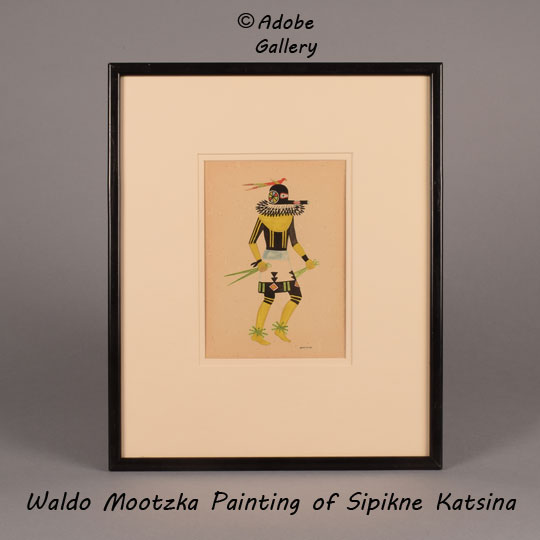
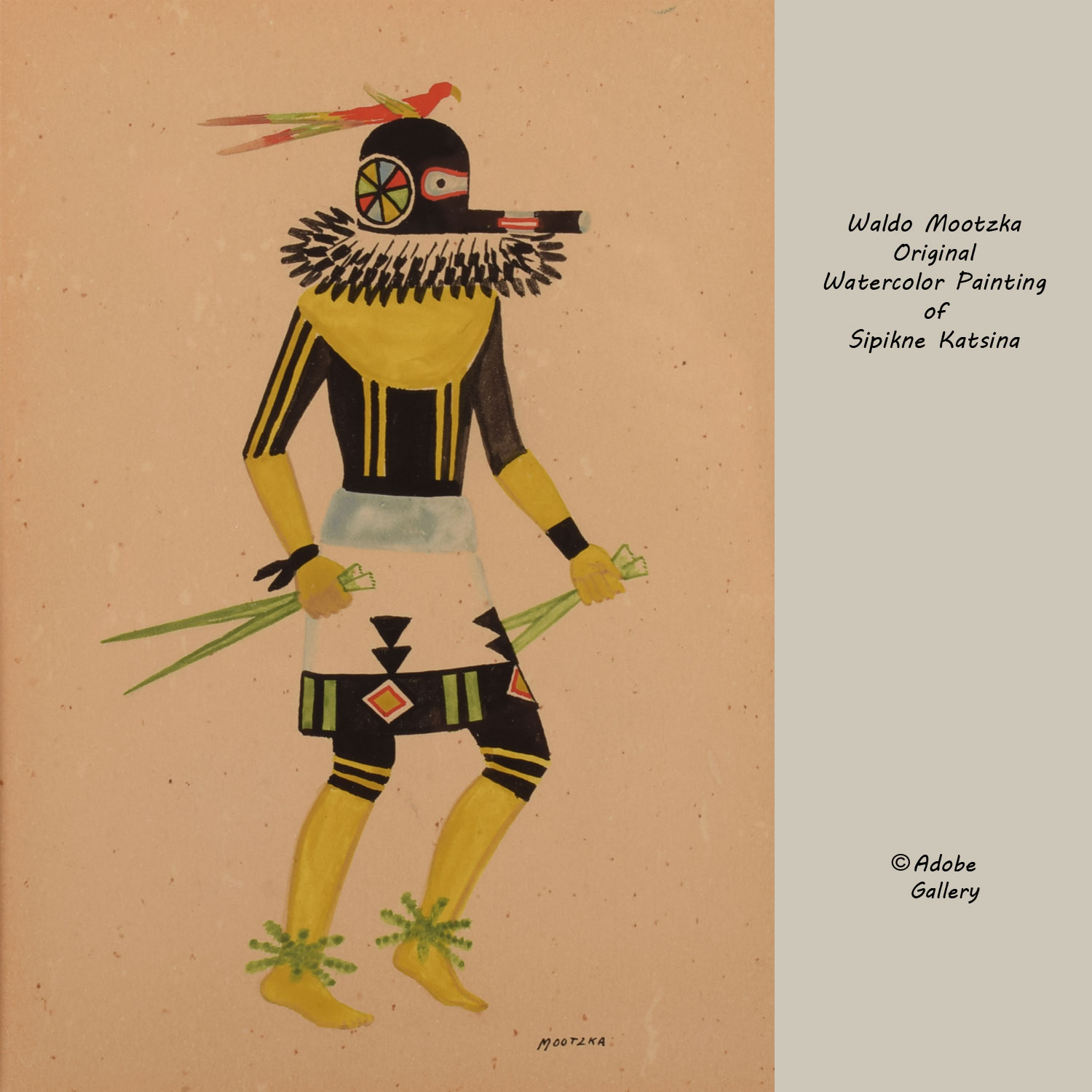
This original watercolor painting of a Sipikne Katsina was created in the 1930s by Hopi Pueblo artist Waldo Mootzka. Those who are familiar with early Hopi painters know that Mootzka was a standout talent. Unfortunately, he lived a short life, so his paintings are not often available on the market today. With this piece, he offered an excellent depiction of a Sipikne katsina, completed in watercolor. The composition is strong, and the colors are both appealing and accurate. The age of the piece is apparent in the paper's tone, but fortunately, there is no damage, and the paints remain strong and bright.
"This particular Zuni Kachina is often danced by the Hopis. His Zuni name is Salimopaiyakya but among the Hopis he may be called Sipikne or Talaimochovi. He dances in a very active manner, bounding about and raising his knees much higher than the usual kachina. The dance is so demanding that only young men usually take this personation. He may appear in the Night Dances, the Bean Dance, a Mixed Dance, or in any other dance where it is felt that he would be appropriate. Sipikne may appear in several different colors but black or yellow seems to be the most favorite. He very often functions as a guard to keep people back from certain other kachinas." (Wright, 1973)
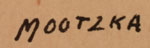 The painting is signed Mootzka in lower right. It is framed using archival materials within a thin black frame.
Waldo Mootzka (1910-1940) was a painter and silversmith from Hopi Pueblo in Arizona. Mootzka received no formal art training and so was self-taught. He often observed Fred Kabotie painting at Oraibi Day School, and it may have been there that he learned or became interested in watercolor painting. So, it's not surprising that Mootzka's work displays Kabotie's influence. In the 1930s, John Louw Nelson employed Mootzka, among others, to create paintings for sale that portrayed Native Americans in their everyday life. Later, in Santa Fe, he was sponsored by Frank Patania, who taught him the art of silversmithing. In 1940, Mootzka was in an automobile accident that exacerbated his tuberculosis, and he died later that year. At the time of his death, Mootzka was devoting almost all his artistic talents to silverwork. Because of his early death at the age of only 30 years and his success as a jeweler, very few paintings by Mootzka are available for collectors to own.
Clara Lee Tanner commented on Mootzka's art in Southwest Indian Painting: A Changing Art, saying, "The paintings of Mootzka combine artistic quality with true recordings of Indian life. Figures are well drawn, displaying a neat and even fragile quality in outlines. Composition of dance groups is fair. A neat separateness of line-work may be said to characterize Mootzka's painting . . . Subject matter treated by Mootzka is quite varied, despite his ever-Hopi emphasis on kachinas, which he presents singly or in groups . . . What he lacked in matters pertaining to background and perspective, Mootzka compensated for in color and splendid detail. Not only did he employ numerous colored papers for the sake of variety, but also he used a full palette. Although pink seems to have been a featured color, it was well handled . . . Mootzka seems to have been more experimental, particularly with color. There is a great range in his pictures, in color and tone."
Condition: excellent condition
Provenance: this Waldo Mootzka Original Watercolor Painting of Sipikne Katsina is from a private Santa Fe collection
References:
- Wright, Barton. KACHINAS A Hopi Artist's Documentary
- Tanner, Clara Lee. Southwest Indian Painting: A Changing Art
TAGS: Hopi Pueblo, painting, Fred Kabotie, Frank Patania, silverwork, Katsina Dolls
- Category: Paintings
- Origin: Hopi Pueblo, Hopituh Shi-nu-mu
- Medium: watercolor
- Size:
7-¼” x 5-⅛” image;
15” x 12-⅜” framed - Item # C4702B SOLD
 Click on image to view larger.
