



Homer S. Cooyama, Hopi Pueblo Artist
+ Add Artist to My Preferences
Homer S. Cooyama (1897-1982)
Pioneering Hopi Modernist & Cultural Preservationist
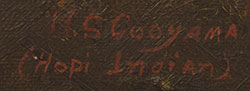 Homer S. Cooyama was a groundbreaking Hopi artist, carver, and community leader whose work bridged the gap between traditional Pueblo representation and Western academic impressionism. Emerging from the Hopi mesas of Arizona, Cooyama carved a distinct niche in Native American art history by defying the rigid stylistic expectations of his era.
Artistic Style and Innovation
While many of his contemporaries adhered closely to the flat, two-dimensional "Studio style" characterized by unshaded gouache or watercolor on blank backgrounds, Cooyama boldly explored a different path:
-
Medium and Texture: He was one of the earliest Hopi artists to master heavy oil paints, frequently employing a thick, dimensional impasto brushwork that gave his canvases tangible texture and life.
-
Atmospheric Realism: Rather than floating figures in negative space, Cooyama painted rich, atmospheric backgrounds. He captured the shifting, luminous light of the Southwest, grounding his subjects in realistic landscapes.
-
Subject Matter: His portfolio seamlessly blended sacred Hopi ceremonial life-such as deeply respectful depictions of Katsinam (Kachinas)-with striking everyday portraits of Pueblo people and expansive landscapes.
Early Life and Academic Training
Born in 1897 in the village of Mishongnovi on Second Mesa, Cooyama's formal artistic journey began far from home:
-
The Sherman Institute: He attended the Sherman Institute in Riverside, California, where he received rigorous training in Western academic art techniques, including oil painting, perspective, and color theory.
-
Fred Harvey Company: In his youth, Cooyama was commissioned by the famous Fred Harvey Company to paint murals, solidifying his reputation as a commercial force capable of working on a grand scale.
Legacy and Community Impact
Cooyama's impact extended well beyond the canvas. He was a deeply respected leader within the Hopi community, balancing his career as a modern artist with his duties as a traditional caretaker of his culture.
By refusing to be confined by the popular "Traditional" Indian art market trends of the mid-20th century, Cooyama paved the way for future generations of Native American modernists. Today, his work is highly sought after by collectors and preserved in major institutions, celebrated for its rare combination of technical mastery, rich texture, and profound cultural authenticity.
TAGS: Hopi Pueblo, Native American Paintings