




Homer S. Cooyama Painting of Hopi Objects [SOLD]
+ Add to my watchlist Forward to Friend
- Category: Paintings
- Origin: Hopi Pueblo, Hopituh Shi-nu-mu
- Medium: oil on canvas
- Size: 13-½” x 15-½” image
- Item # C4977.30 SOLD
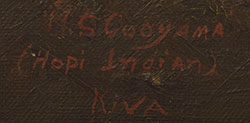
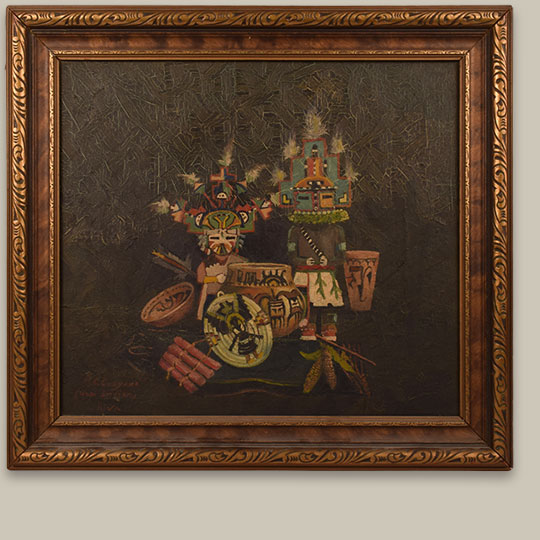
Oil painting titled Kiva by the historic Hopi artist Homer S. Cooyama (1897-1982).
Unlike many of his contemporaries who focused exclusively on flat gouache or watercolor "Studio style" paintings, Homer S. Cooyama (1897-1982) frequently utilized heavy oil paint, dimensional impasto brushwork, and atmospheric backgrounds. The title Kiva places the scene inside a sacred, subterranean Pueblo ceremonial room, providing context for the gathering of spiritual and traditional items depicted.
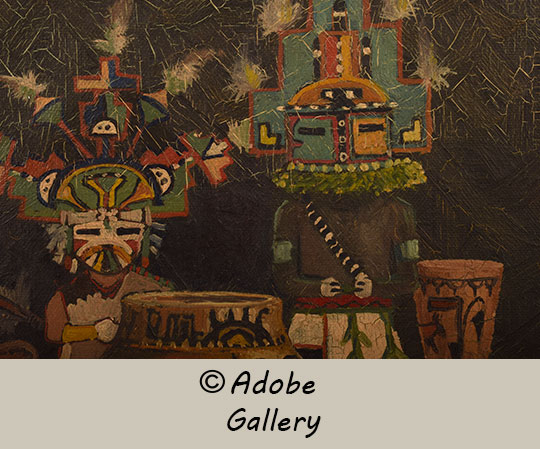
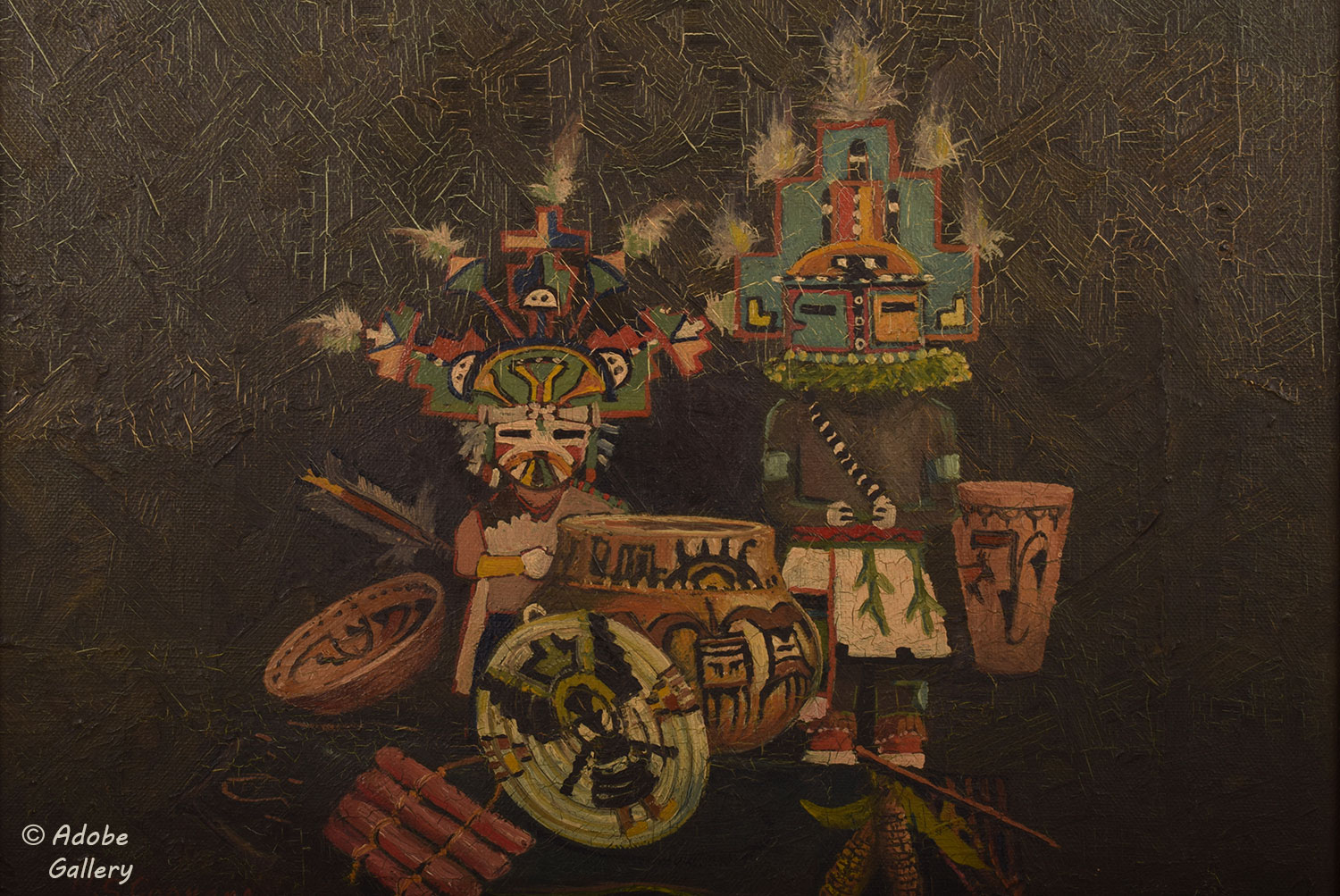
The painting functions as a ceremonial still life combined with figurative representations, showcasing fundamental elements of Hopi spiritual life, agriculture, and material culture. In the background, two katsina dolls, adorned in full ceremonial regalia, occupy the prime space. The figure on the right, the Hemis Katsina, features a prominent, multi-tiered stepped tableta (headdress) decorated with geometric clouds, feathers, and traditional face-mask iconography. The figure on the left, Palhikmana Katsina, wears a radiating, fan-shaped headdress accented with down feathers.
In the center sits a large, beautifully detailed pottery olla displaying classic migration waves and geometric patterns. To its right is a tall cylindrical vessel, and to its left rests a smaller patterned bowl. Leaning against the central jar is a traditional woven Second Mesa coiled plaque, intricately detailed with an image of Crow Mother katsina.
 In the bottom right foreground, multiple ears of multicolored corn (maize) are displayed, a deeply sacred symbol of life and survival in Hopi culture. Beside the corn are bundles of painted ceremonial sticks (likely associated with rattles, dance regalia, or prayer sticks). On the lower left is a bundle of rolled and tied piki bread. A single arrow pierces the image.
Cooyama applied his oil paint with rhythmic, cross-hatched, and heavy impasto brushstrokes. This technique gives the dark background a dramatic, chiseled texture that makes the central figures and vibrant ceremonial objects "pop" out of the darkness.
Condition: very good condition for its age
Provenance: from the collection of a client of Adobe Gallery who purchased it directly from a resident on the Hopi Reservation. She was told that Cooyama was an uncle of Oswald "White Bear" Fredericks (1905-1996). He might have been a clan uncle, not a birth uncle. Fredericks was the Hopi who gathered oral histories of the Hopi and relayed them to Frank Waters who used the information in the "The Book of the Hopi."
Recommended Reading: Hopi Material Culture: Artifacts Gathered by H. R. Voth in the Fred Harvey Collection by Barton Wright
TAGS: Hopi Pueblo, Native American Paintings, Homer S. Cooyama, Oswald "White Bear" Fredericks
- Category: Paintings
- Origin: Hopi Pueblo, Hopituh Shi-nu-mu
- Medium: oil on canvas
- Size: 13-½” x 15-½” image
- Item # C4977.30 SOLD
 Click on image to view larger.
Adobe Gallery Recommended Items
If you are interested in this item, we would also like to recommend these other related items: