




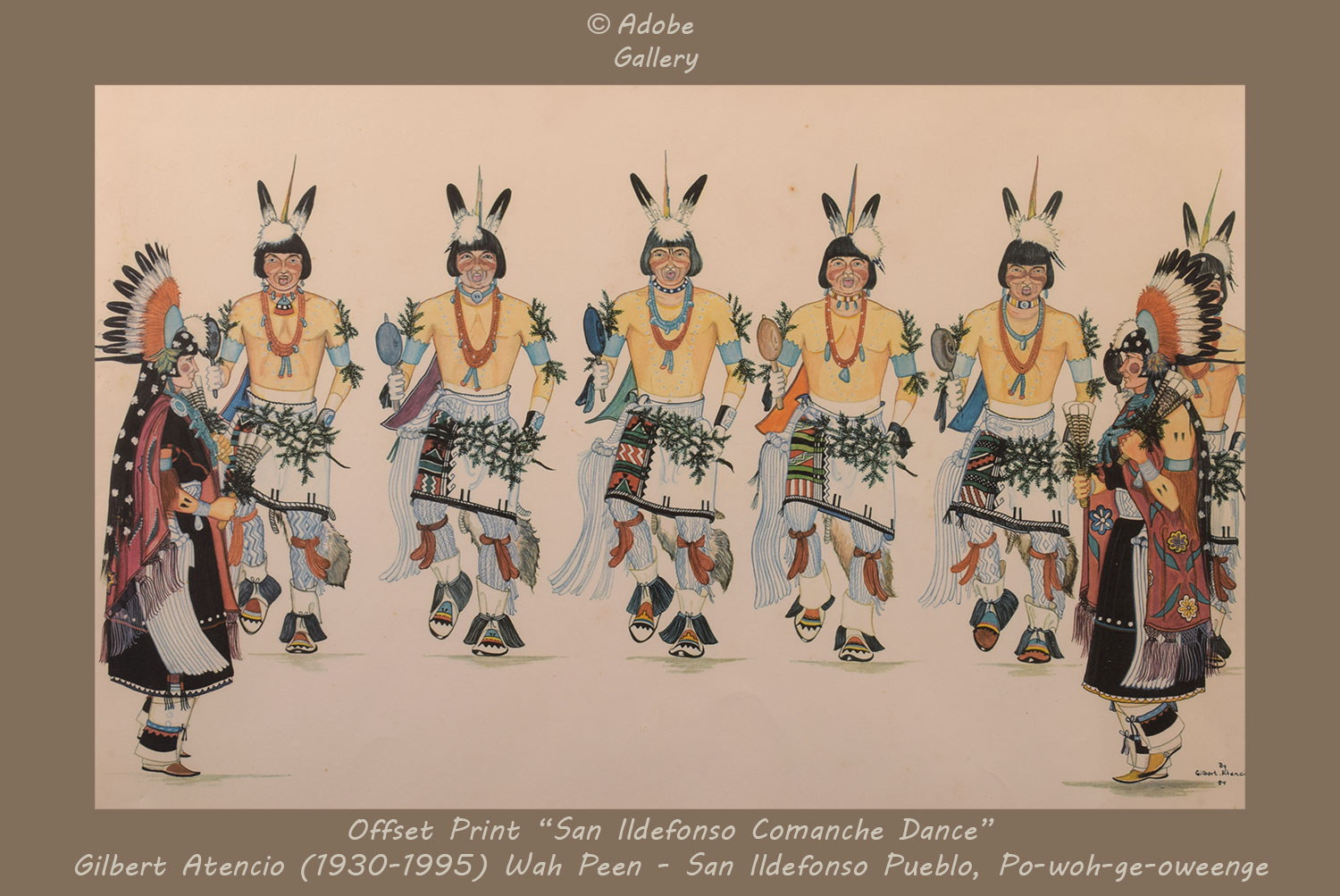
Gilbert Atencio Offset Print “San Ildefonso Comanche Dance”
+ Add to my watchlist Forward to Friend
- Category: Original Prints
- Origin: San Ildefonso Pueblo, Po-Woh-Geh-Owingeh
- Medium: offset print
- Size:
11-¼” x 17-½ image;
20” x 23-½” framed - Item # C4930o
- Price: $750
Precision and Pageantry: Gilbert Atencio's Comanche Dance
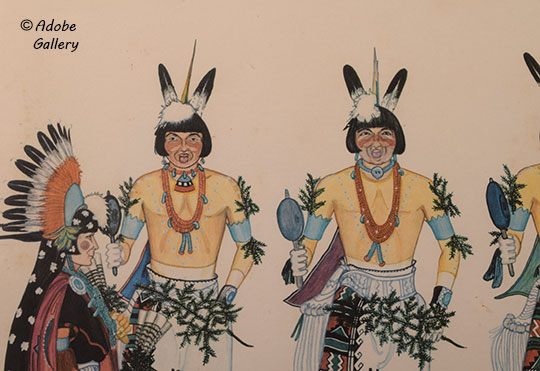
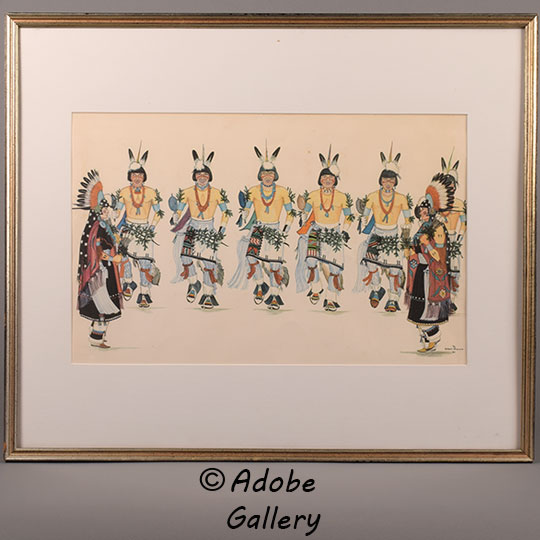
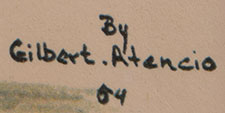 This exceptional offset print is a faithful reproduction of a 1954 original painting by the legendary San Ildefonso artist Gilbert Atencio (1930-1995) Wah Peen. It captures a moment of vibrant movement and historical significance: the Comanche Dance.
Gilbert Atencio was renowned for his "infinite detail," a skill sharpened during his professional career as a medical illustrator at Los Alamos National Labs. Atencio applied the same anatomical precision required for medical charts to his depictions of Pueblo dancers. Every stitch of embroidery, every feather, and every rhythmic posture is rendered with a level of realism that sets his work apart in the world of Pueblo painting.
The Dance: A Celebration of Peace
While the feathered headdresses seen in this image are often associated with the Great Plains, their presence in this San Ildefonso dance carries a specific meaning. Historically, the "peaceful" Pueblo tribes of New Mexico did not wear war bonnets. These were the hallmarks of the nomadic tribes — the Navajo, Apache, Ute, and Comanche — who frequently raided the Pueblos.
The Comanche Dance is performed to honor the end of hostilities between these tribes. It is a celebration of peace and a respectful borrowing of the "enemy's" regalia to commemorate a new era of harmony.
January 23rd: Feast Day at San Ildefonso
This dance is a cornerstone of the San Ildefonso Feast Day ceremonies held every January 23rd. The day begins at dawn with the Deer and Comanche dances. The festivities blend ancient Tewa practices with Catholic traditions, including Mass and Vespers, honoring the pueblo's patron saint, Ildefonso.
A 10,000-Year Legacy
The history of San Ildefonso (Po-Woh-Geh-Owingeh) is an epic of migration and endurance. The people originally migrated from Mesa Verde in Colorado to Bandelier, eventually settling at the current location along the Rio Grande — the Tewa name translates to "Where the water cuts through."
Today, the Pueblo remains a vibrant cultural center with an enrollment of approximately 750 members, continuing traditions that have spanned millennia.
Condition: appears to be in original condition
Provenance: from the estate of the client to whom we sold this in 1990.
Recommended Reading: Handbook of Indian Dances: New Mexico Pueblos by Dorothy Stewart
TAGS: Native American Paintings, San Ildefonso Pueblo, Isabel M. Montoya, Maria Martinez, Gilbert Atencio (1930-1995) Wah Peen
- Category: Original Prints
- Origin: San Ildefonso Pueblo, Po-Woh-Geh-Owingeh
- Medium: offset print
- Size:
11-¼” x 17-½ image;
20” x 23-½” framed - Item # C4930o
- Price: $750
 Click on image to view larger.
Adobe Gallery Recommended Reading

Adobe Gallery Recommended Items
If you are interested in this item, we would also like to recommend these other related items: