




J. D. Roybal Painting of a Pueblo Pottery Firing Stages
+ Add to my watchlist Forward to Friend
- Category: Paintings
- Origin: San Ildefonso Pueblo, Po-Woh-Geh-Owingeh
- Medium: casein
- Size:
4” x 18” image” 11” x 25” framed - Item # C4739o
- Price: $2500
The Alchemy of Clay: J.D. Roybal's Visual Guide to Black Pottery
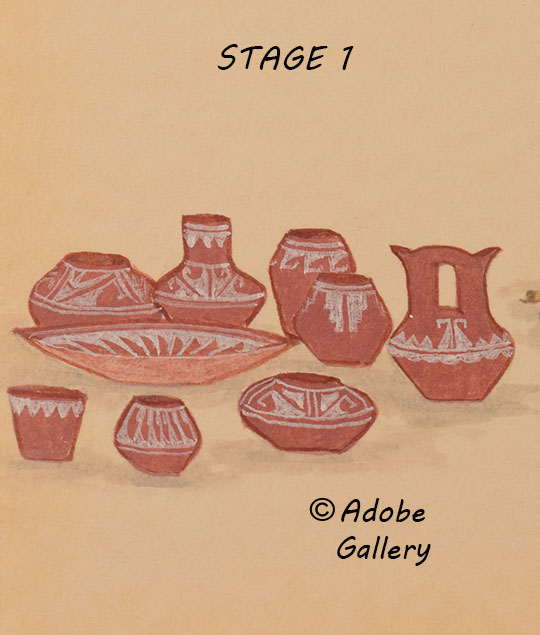
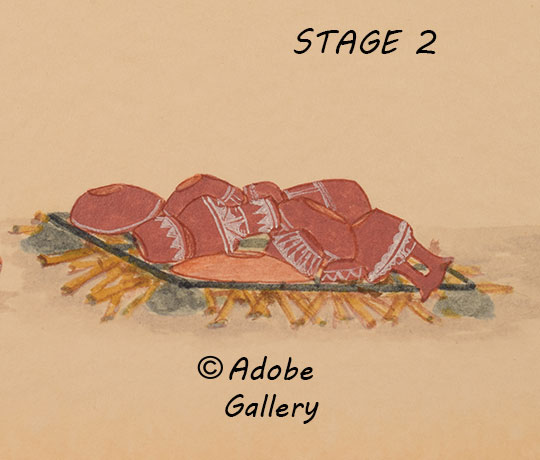
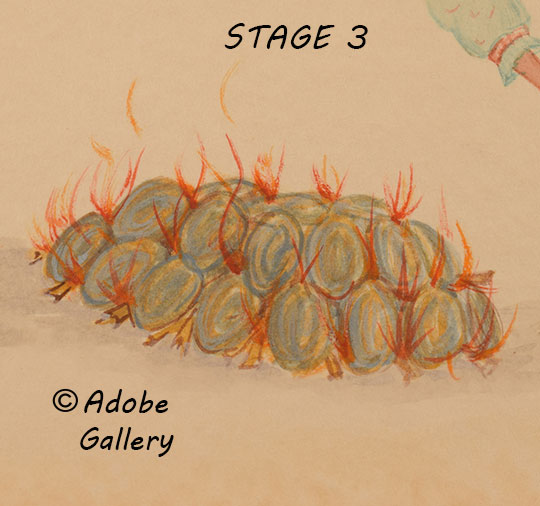
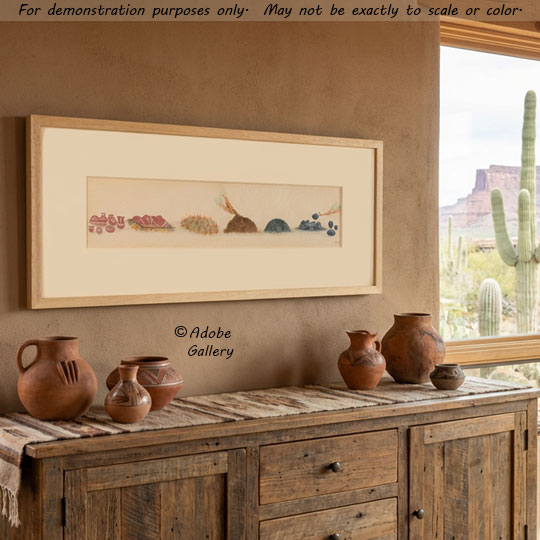
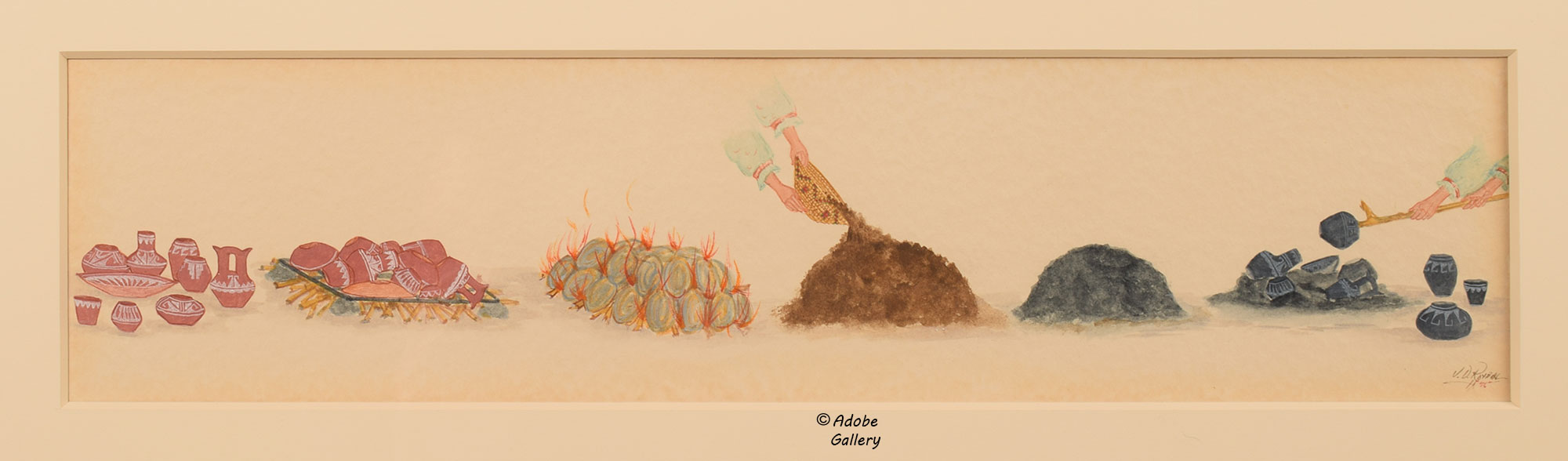
While most Pueblo paintings focus on the beauty of the finished object or the grace of a dance, this 1976 work by J.D. Roybal (Oquwa) is a rare "behind-the-scenes" narrative. Through a series of six clever vignettes, Roybal demystifies the ancient and complex firing process that transforms vibrant red clay into the iconic San Ildefonso polished blackware.
The Six Stages of Transformation
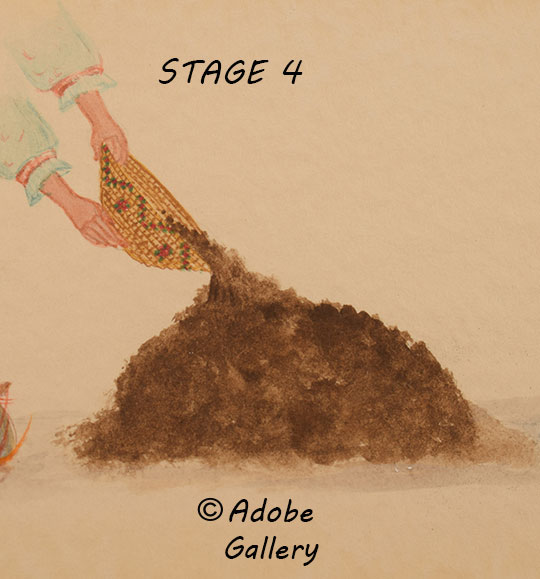
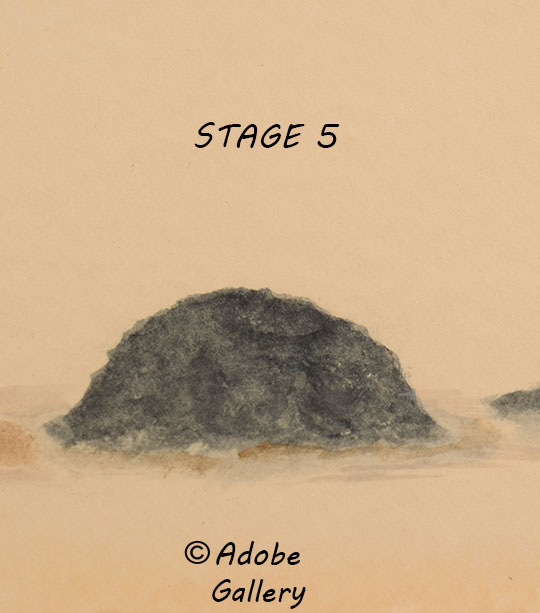
Roybal guides the viewer through the firing sequence with the precision of a master storyteller: On the far left, a group of polished red vessels sits ready. At this stage, the pottery has been stone-polished to a high sheen but has not yet met the flame. The pots are carefully arranged on a metal grill or "kiln" grate. While the arrangement may look casual, it is a calculated layout designed to ensure heat circulates evenly without touching the fuel directly. The potter covers the mound with dried cow chips, which serve as the primary fuel. The fire is ignited, beginning the "oxidation" phase where the pottery remains red.
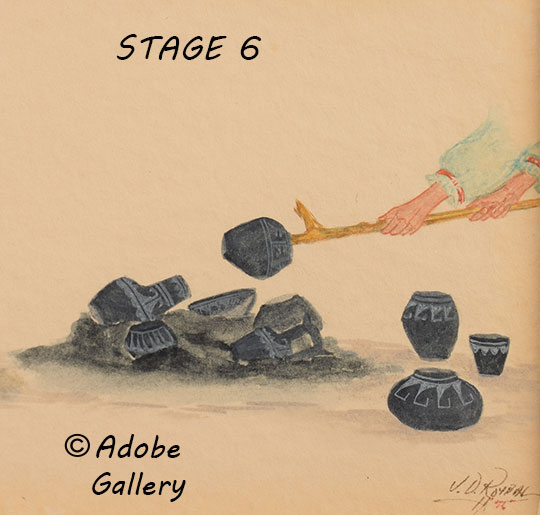
Now for the "magic" moment. The potter pours pulverized manure over the roaring fire. This intentionally smothers the flames, cutting off the supply of oxygen. In this oxygen-starved environment (known scientifically as a reduction firing), the carbon and smoke are "pushed" into the porous clay. This chemical reaction is what permanently turns the red slip into a deep, lustrous black. Finally, the potter uses a long stick to delicately remove the glowing vessels from the smoldering ash, placing them on the ground to cool slowly in the open air.
About the Artist: J.D. Roybal (1922-1978)
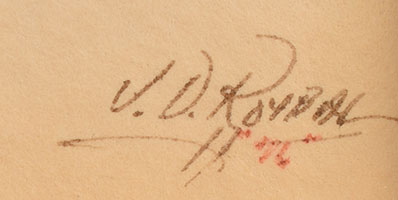 José Desiderio (J.D.) Roybal, also known by his Tewa name Oquwa (Rain God), was a pillar of the San Ildefonso artistic community. He was the son of Tonita and Juan Cruz Roybal and the nephew of the legendary Awa Tsireh (Alfonso Roybal). While he carried the influence of his famous uncle, J.D. developed a distinct, fine-lined style characterized by humor and meticulous detail.
Unlike many contemporaries who studied at the Santa Fe Indian School, Roybal was educated at St. Catherine's in Santa Fe. His artistic journey was sparked early on in 1930 by his teacher, Helen Culley.
This painting is dated 1976, placing it among the very last works created before his passing in 1978. It represents a master artist reflecting on the foundational traditions of his Pueblo.
Collector's Note
It is exceptionally rare to find a painting that serves as a technical "map" of the pottery process. This piece is not just art; it is an educational document that preserves the scientific and spiritual labor behind every San Ildefonso jar.
Condition: very good condition
Provenance: this J. D. Roybal Painting of a Pueblo Pottery Firing Stages is from the collection of a client of Adobe Gallery
Recommended Reading: Indian Painters and White Patrons by J. J. Brody, University of New Mexico Press, Albuquerque, 1971.
TAGS: San Ildefonso Pueblo, Tonita and Juan Cruz Roybal, Alfonso Roybal - Awa Tsireh, Native American Painting, J.D. Roybal, Katsina Dolls
- Category: Paintings
- Origin: San Ildefonso Pueblo, Po-Woh-Geh-Owingeh
- Medium: casein
- Size:
4” x 18” image” 11” x 25” framed - Item # C4739o
- Price: $2500
 Click on image to view larger.
Adobe Gallery Recommended Reading

Adobe Gallery Recommended Items
If you are interested in this item, we would also like to recommend these other related items: