




Navajo Nation Third Phase Chief Blanket Pattern Rug
+ Add to my watchlist Forward to Friend
- Category: Navajo Textiles
- Origin: Diné of the Navajo Nation, Naabeehó Bináhásdzo
- Medium: wool
- Size: 5’9” x 4’11”
- Item # C4979A
- Price: $6500
The Evolution of the Navajo Chief Blanket
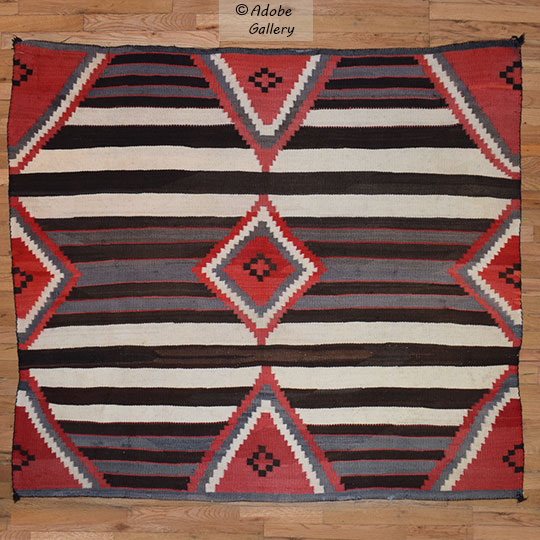
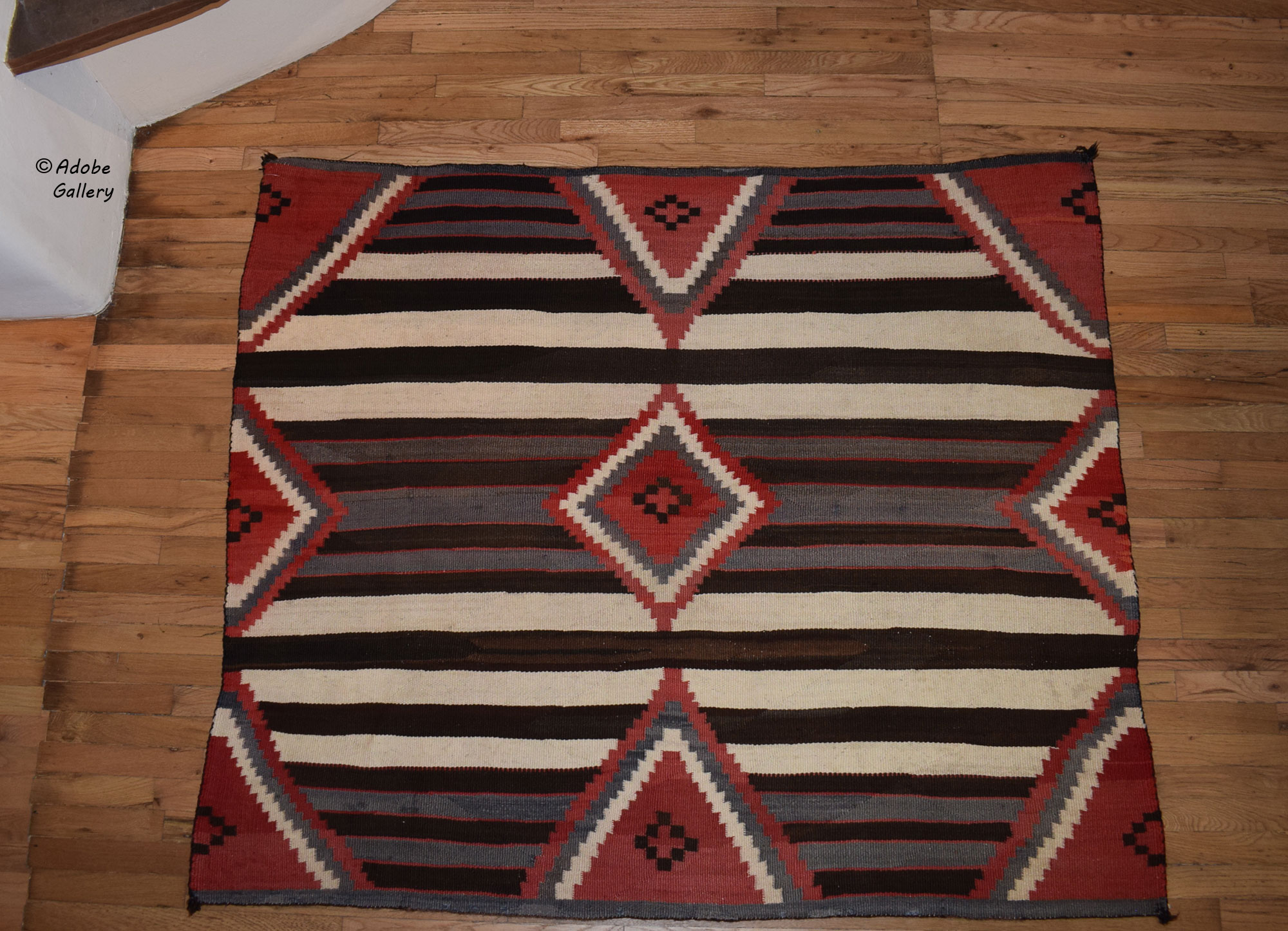
This circa 1930s Navajo textile showcases the "Third Phase" Chief Blanket pattern — a design lineage spanning over two centuries. While traditional Chief Blankets were woven as wearable garments, this specific piece was adapted as a 5 x 6 foot floor rug or wall hanging. It beautifully encapsulates the entire history of the style in its design elements:
-
Brown & White Bands: Retained from the earliest First Phase blankets.
-
Narrow Red & Blue/Gray Bands: Nods to the Second Phase and historic indigo dyes.
-
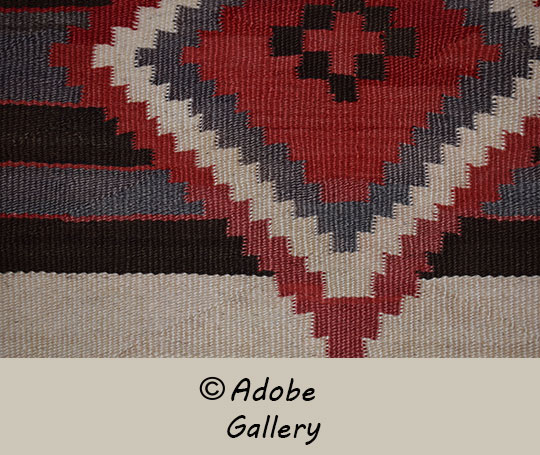
Nine Red Stepped Diamonds: The defining characteristic of the Third Phase style.
The Three Phases of Design
Unlike most Navajo textiles, Chief Blankets were uniquely woven wider than they were long, a format adapted from the traditional manta (shoulder blanket).
-
First Phase (c. 1800-1850): The earliest style featured simple brown, white, and indigo bands. Highly prized by Plains Indian chiefs for their quality, these tight weaves commanded exceptional trade value.
-
Second Phase (c. 1850-1865): Weavers introduced blocks of red yarn, painstakingly unraveled from imported commercial cloth. To match this tight, commercial spin, weavers spun their native wool finer, resulting in an incredibly superior textile.
-
Third Phase (c. 1865-Present): Red transitioned from an accent to a dominant feature. Large geometric shapes — like triangles and stepped diamonds — were woven as if superimposed over the classic First Phase bands.
History & The Transition to Rugs
The shift from wearable blankets to floor rugs was born out of survival and forced adaptation.
In the mid-1860s, the U.S. military, led by Kit Carson, forcibly relocated the Diné (Navajo) to an internment camp at Bosque Redondo. Following four years of incarceration, the Diné returned to their homeland, which had been designated as a government reservation.
Living on the reservation, the Navajo began trading with newly established local post traders. Recognizing a changing market, these sympathetic traders encouraged Navajo women to convert their weaving skills from wearable blankets to floor rugs for non-Indian homes. Weavers built larger looms to accommodate this new demand, ensuring that historic patterns — like the Third Phase Chief design — survived into the 20th century and beyond.
Condition: Good condition after being professionally washed. There is slight fading on one side of the rug from having been hung on a wall without reversing sides. There are some prior repairs.
Provenance: this Navajo Nation Third Phase Blanket Pattern Rug is from the estate of a former resident of Taos, New Mexico
Reference: The Navajo Weaving Tradition 1650 to the Present by Alice Kaufman and Christopher Selser, E. P. Dutton, Inc. New York, 1985.
TAGS: Textiles, Navajo Nation
- Category: Navajo Textiles
- Origin: Diné of the Navajo Nation, Naabeehó Bináhásdzo
- Medium: wool
- Size: 5’9” x 4’11”
- Item # C4979A
- Price: $6500
 Click on image to view larger.
Adobe Gallery Recommended Reading

Adobe Gallery Recommended Items
If you are interested in this item, we would also like to recommend these other related items: