




Annie Healing Nampeyo Black-on-red Jar with White Accents [SOLD]
+ Add to my watchlist Forward to Friend
- Category: Modern
- Origin: Hopi Pueblo Nation, Hopituh Shi-Nu-Mu
- Medium: clay, pigment
- Size: 4-½” height x 8-¾” diameter
- Item # C5006A SOLD
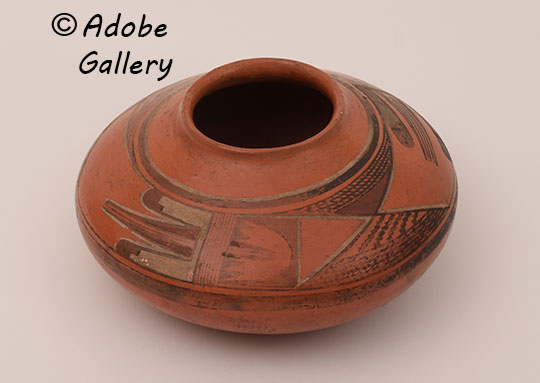
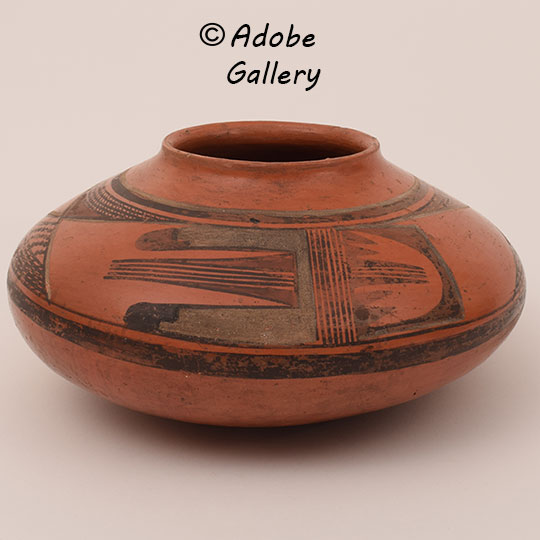
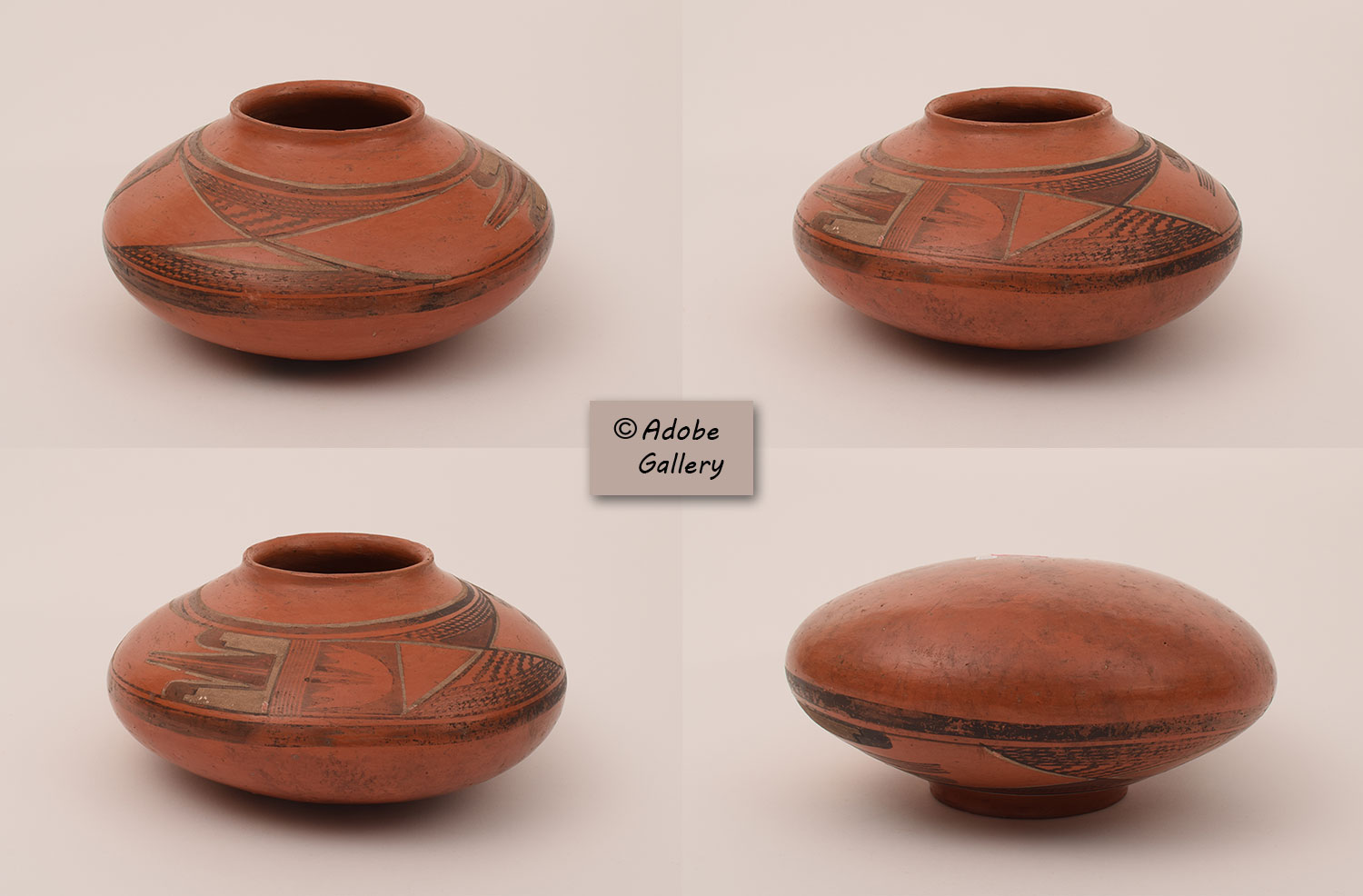
This pottery jar is easily attributable to Hopi-Tewa potter Annie Healing Nampeyo. The age of the piece, the redware style, and the quality and character of the design are the attributes that suggest Annie's hand. It is unsigned, but that is typical of her earlier works. Later pieces would be signed "Annie." This piece is especially distinctive and strongly attributable to Annie due to the use of white pigment in the painted decoration. This uncommon feature, combined with the refined execution of designs originally developed by her mother, reflects Annie's known preference for black and white on red and her characteristically more delicate touch.
The design is a subtle application of two birds, typical of prehistoric Sikyatki pottery-designs reintroduced by Nampeyo. Separating the birds on the vessel wall are triangles stacked point-to-point. All of the black lines are outlined with white pigment, a trait seen on many of Annie's pottery.
Most of the late 19th and early 20th century pieces are not identified with a particular potter. There is an exception in the case of two Hopi potters of note — Nampeyo of Hano and her eldest daughter Annie Healing Nampeyo. Nampeyo became famous, not only because she was an outstanding artisan, but because the Fred Harvey Company housed her and her family in the Hopi House at the Grand Canyon in the summers of the early 1900s, where she demonstrated pottery making and sold her wares. It is well known that Healing collaborated with her mom in the early part of the century. She also made pottery herself, although precious little recognition was given to her in those early days.
Fortunately, collectors for some of the major museums did document collections by artist name at the time. Collections of the Peabody Museum at Harvard, the University of Oslo, the Brooklyn Museum, and the Smithsonian do contain documented vessels by Healing. It is from these documented pieces that we are able to make comparisons today and attribute pieces to the hands of Healing.
It is well documented that she created highly polished red wares with black and white painting. Her preference for designs was large bold elements that stand singly on the surface of the pot, such as these two magnificent birds executed in black and highlighted with white.
From the relatively small but informative museum collections referenced above, some generalizations as to Healing's vessel shapes and design preferences can be drawn, and a close study of these confirms that this jar falls firmly within her style. The vessel shape is very much that of Nampeyo and Annie, as is the use of a pair of birds without competing designs.
Condition: this Annie Healing Nampeyo Black-on-red Jar with White Accents is in very good condition
Provenance: from a client of Adobe Gallery who purchased it from Medicine Man Gallery, Tucson, Arizona, with attribution to Annie Healing Nampeyo. When shown to Priscilla Nampeyo in March 2004, she stated it was by her grandmother, Annie Healing.
Recommended Reading: The Legacy of a Master Potter: Nampeyo and her Descendants by Mary Ellen and Laurence Blair
TAGS: Nampeyo of Hano, Hopi Pueblo, pottery making, Rachel, Daisy, Barbara Kramer, Thomas Keam, Annie Healing Nampeyo - Quinchawa, Hopi-Tewa Potter
- Category: Modern
- Origin: Hopi Pueblo Nation, Hopituh Shi-Nu-Mu
- Medium: clay, pigment
- Size: 4-½” height x 8-¾” diameter
- Item # C5006A SOLD
 Click on image to view larger.
Adobe Gallery Recommended Reading

Adobe Gallery Recommended Items
If you are interested in this item, we would also like to recommend these other related items: