




Polychrome Jar with Flared Rim by Dextra Nampeyo
+ Add to my watchlist Forward to Friend
- Category: Modern
- Origin: Hopi Pueblo, Hopituh Shi-nu-mu
- Medium: clay, pigment
- Size: 4-¾” x 4-¼”
- Item # C4973A
- Price: $3500
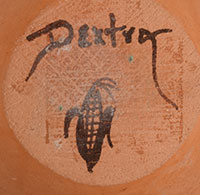 This is a beautiful example of the work of Dextra Quotskuyva Nampeyo (1928-2019), who is widely considered one of the most influential Hopi-Tewa potters of the 20th century. This vessel perfectly illustrates why she was a transitional figure, bridging the strict Sikyatki-revival style of her great-grandmother, Nampeyo of Hano, with a more modern, experimental aesthetic.
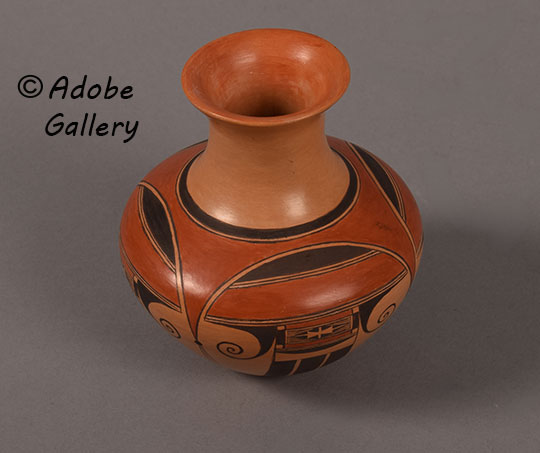
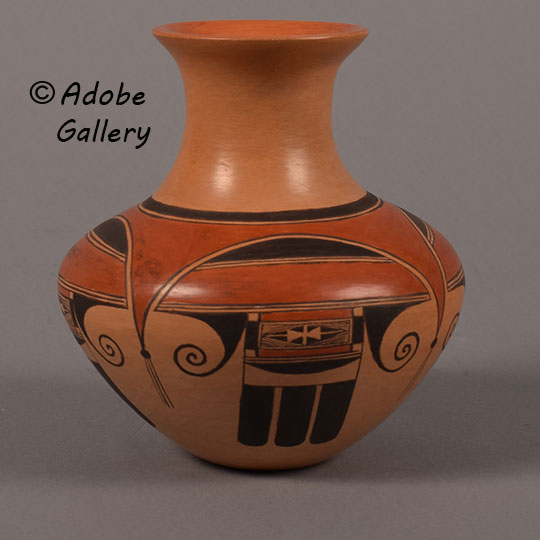
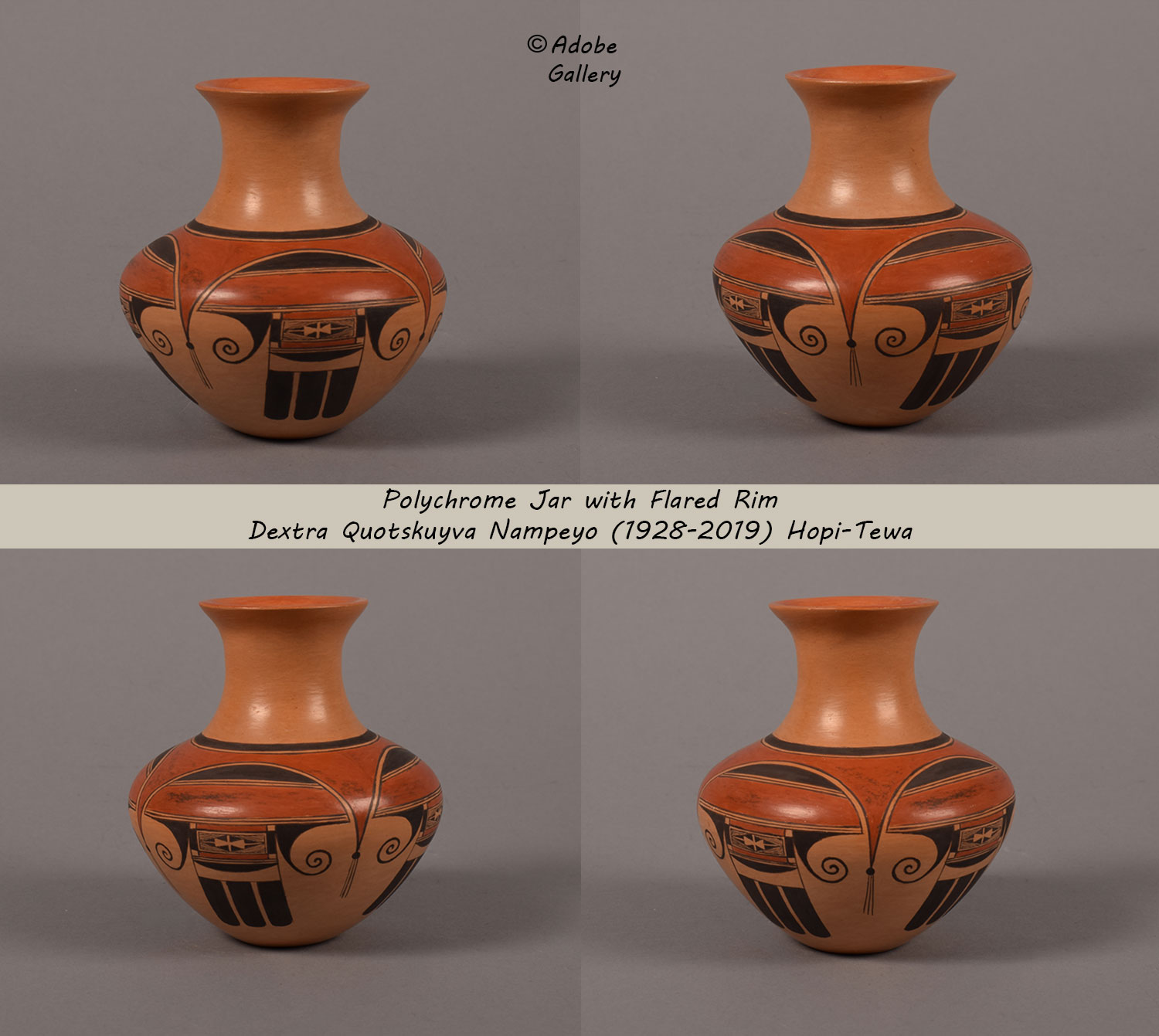
The vessel features a classic Hopi Polychrome palette (black and red on a honey-colored slip), but the application is uniquely Dextra. The stylized bird wings and "eagle tail" motifs are rooted in the ancient designs rediscovered by Nampeyo.
This jar has a strong, high shoulder, which leads to a sharply curved neck and a dramatically flared rim. Skill and precision are apparent in the vessel's perfect form, and the designs are similarly infused with technical mastery.
At the base of the neck, the Sikyatki design traditionally included a square box element of an inch-wide orange pigment. In this jar, Dextra softened the square into an arched design that dips into the tan slip of the body design. Additionally, it drapes over the wide orange band that encircles the mid-body, below which is a traditional Eagle Tail design, repeated four times around the body.
The slip takes on an appealing tan tone. Interestingly, the coloration shifts a bit at the rim and even more in the interior, arriving at an orange color that nearly matches that which is used within exterior designs. When looking back through previously listed works by the artist, we see dozens of examples, and each is unique in some way. Many, including this example, are small in size but powerful in presence.
Hopi-Tewa artist Dextra Quotskuyva Nampeyo (1928- 2019) grew up in a household of artists who worked every day, making pottery to sell to tourists, dealers and museums. Her mother was Rachel Namingha and her grandmother was Annie Healing, oldest daughter of Nampeyo of Hano. Nampeyo was still alive when Dextra was born, and Dextra got to know her great grandmother for a dozen years before she passed away. As a young child, Dextra did what all young girls did — she helped gather and process clay. She later was allowed to fill in designs that were drawn on pottery. This was the learning process for young girls who would become the future generation of potters.
Dextra was known for her exceptionally fine linework and her willingness to leave more "negative space" than her predecessors. The way she organized the designs creates a sense of movement, a hallmark of her "modernist" approach to traditional forms.
This "seed jar" or small water jar shape is exceptionally balanced. The blush — the varying orange and buff tones on the surface — is a result of traditional outdoor firing with sheep dung, a difficult process that Dextra mastered to achieve these warm, organic gradients.
Condition: excellent condition
Provenance: this Polychrome Jar with Flared Rim by Dextra is from a private collection
Recommended Reading: Painted Perfection: The Pottery of Dextra Quotskuyva by Martha Struever
TAGS: Nampeyo of Hano, Annie Healing Nampeyo, Rachel Namingha, Hopi Pueblo, Contemporary Pottery
- Category: Modern
- Origin: Hopi Pueblo, Hopituh Shi-nu-mu
- Medium: clay, pigment
- Size: 4-¾” x 4-¼”
- Item # C4973A
- Price: $3500
 Click on image to view larger.
Adobe Gallery Recommended Reading

Adobe Gallery Recommended Items
If you are interested in this item, we would also like to recommend these other related items: