




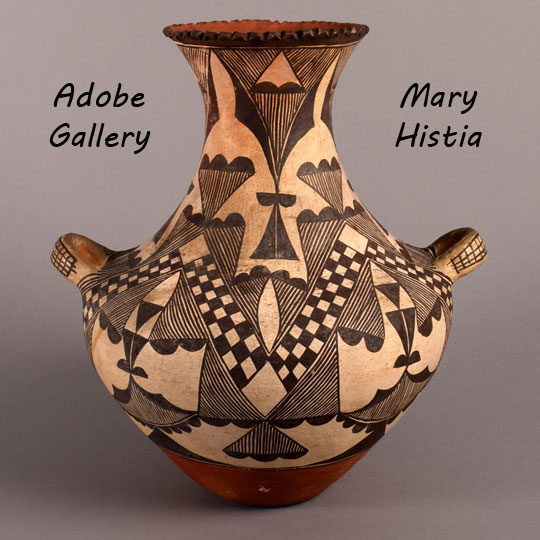
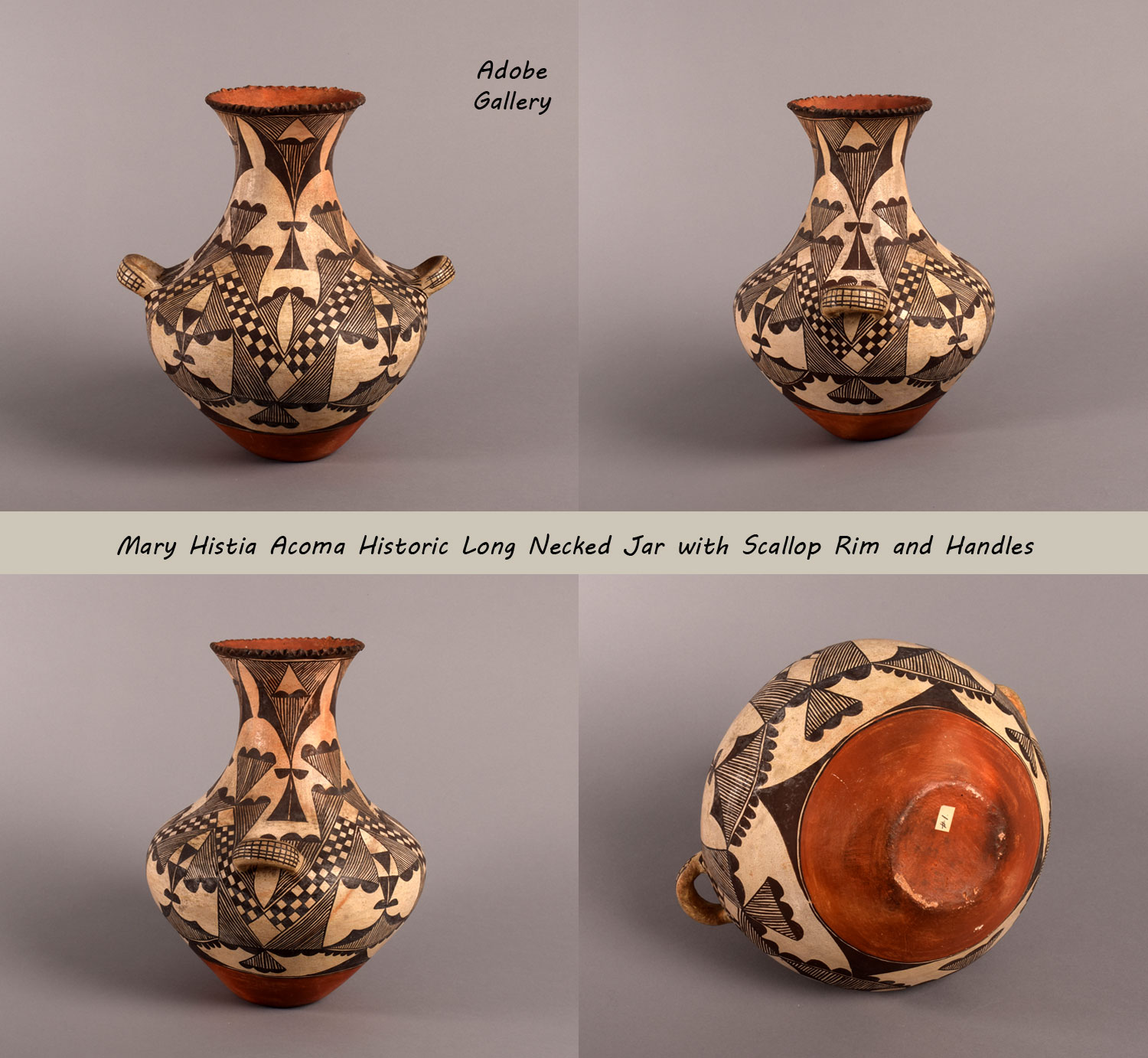
Mary Histia Acoma Historic Long Necked Jar with Scallop Rim and Handles [SOLD]
+ Add to my watchlist Forward to Friend
- Category: Historic
- Origin: Acoma Pueblo, Haak’u
- Medium: clay, pigment
- Size:
11-½” tall x 9-¼” diameter - Item # 26274 SOLD
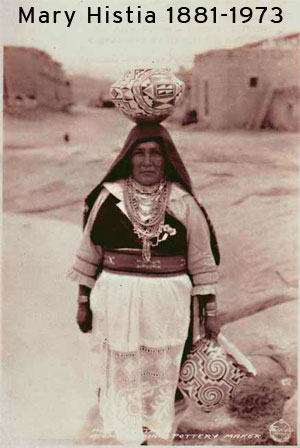
Mary Histia of Acoma Pueblo may have been known as the finest potter of her era, but this jar stands out from even her large and well-known body of work. Although unsigned, the design makes it almost certainly Histia’s. [Harlow & Lanmon, 2013:443-444] This feature most likely dates the jar to her early career, as she did eventually sign her pottery.
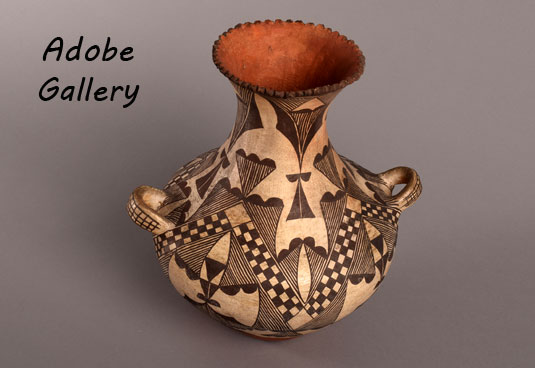
The base structure of this jar is that of a traditional olla, but that is where the similarities end. Handles, and a long neck, topped with a scalloped rim, shape this jar to be of its own category, caliber, and class. The jar tilts slightly to one side but is not distracting because the design is overwhelming and demands one’s attention.
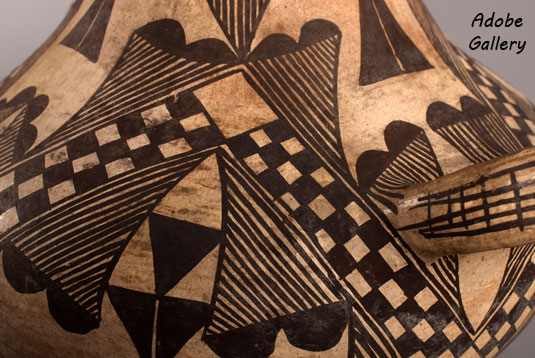
Deep reddish brown bands the base, grounding the piece, and ties in with the interior of the jar. A cream white slip was applied to the remaining exterior and dark brown pictorials were then added. Geometric shapes evoke rain clouds, checkerboards, mountains, textiles, and landscapes, and are capped with a similarly dark brown rim color along a hand-tooled scalloped lip. With talent, imagination, and one-of-a-kind skill, the artist created a piece that provides us with an incredible peek across time into that of not only Pueblo life, but life itself.
Artist Mary Histia (c.1893/1895-1973), is recognized as certainly one of the finest Acoma Pueblo potters of the early twentieth century. Histia traveled to Washington, DC, and became popular as an unofficial potter to President Franklin D. Roosevelt. Her pottery soon decorated many government offices.
Mary Histia deserves to be classed as a Modernist. Her art is old, yet alive and dynamic—an expression of a continuing vigor. She did not confine her art to a mere repetition of her previous work, nor did she resort to meaningless geometric designs, but she continually experimented and added to her repertoire. Her designs are at once classic and modern.
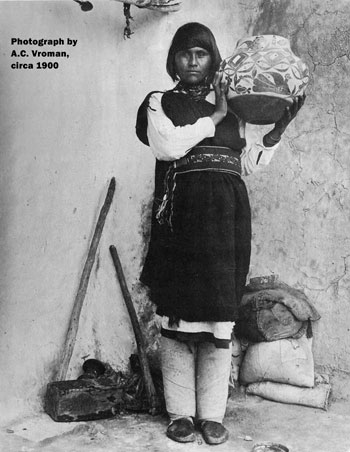 There has been some confusion regarding Mary Histia, particularly since there is evidence there were two women with that name. Harlow and Lanmon successfully explained who they were. [ibid.p.440] One Mary Histia is the one discussed in this write up. The other one was born in 1933 and was the daughter of Lucy Lewis, the famous twentieth century potter. This second Mary married David Histia, Sr., her first husband, thereby becoming Mary Histia. A second marriage removed her from the Histia name. One problem solved.
Another confusing issue regarding Mary Histia is a published photograph by Adam Clark Vroman in 1900, titled Acoma, Mary holding olla, 1900, which has been identified as Mary Histia. Harlow and Lanmon have disputed that it is a photograph of Mary Histia, but is a photograph of Mary Brown. [Ibid. p441]. There are other Vroman photographs that are of Mary Histia. Only this one photograph has been disputed.
This jar is extraordinary, not only in the magnificent designs but also in the vessel shape with a long and graceful neck and a pair of handles. The white slip of the body has been mellowed over decades to a softer hue which, to some, may appear to be dirty, but that is not the case.
Condition: some natural abrasion to the slip has occurred. Overall this jar is in good condition.
Provenance: this Mary Histia Acoma Historic Long Necked Jar with Scallop Rim and Handles is from a private collection
Resource: The Pottery of Acoma Pueblo, by Dwight P. Lanmon and Francis H. Harlow.
Realtive Links: Acoma Pueblo, Southwest Indian Pottery, Mary Histia, Acoma Pueblo Potter
- Category: Historic
- Origin: Acoma Pueblo, Haak’u
- Medium: clay, pigment
- Size:
11-½” tall x 9-¼” diameter - Item # 26274 SOLD
 Click on image to view larger.
