




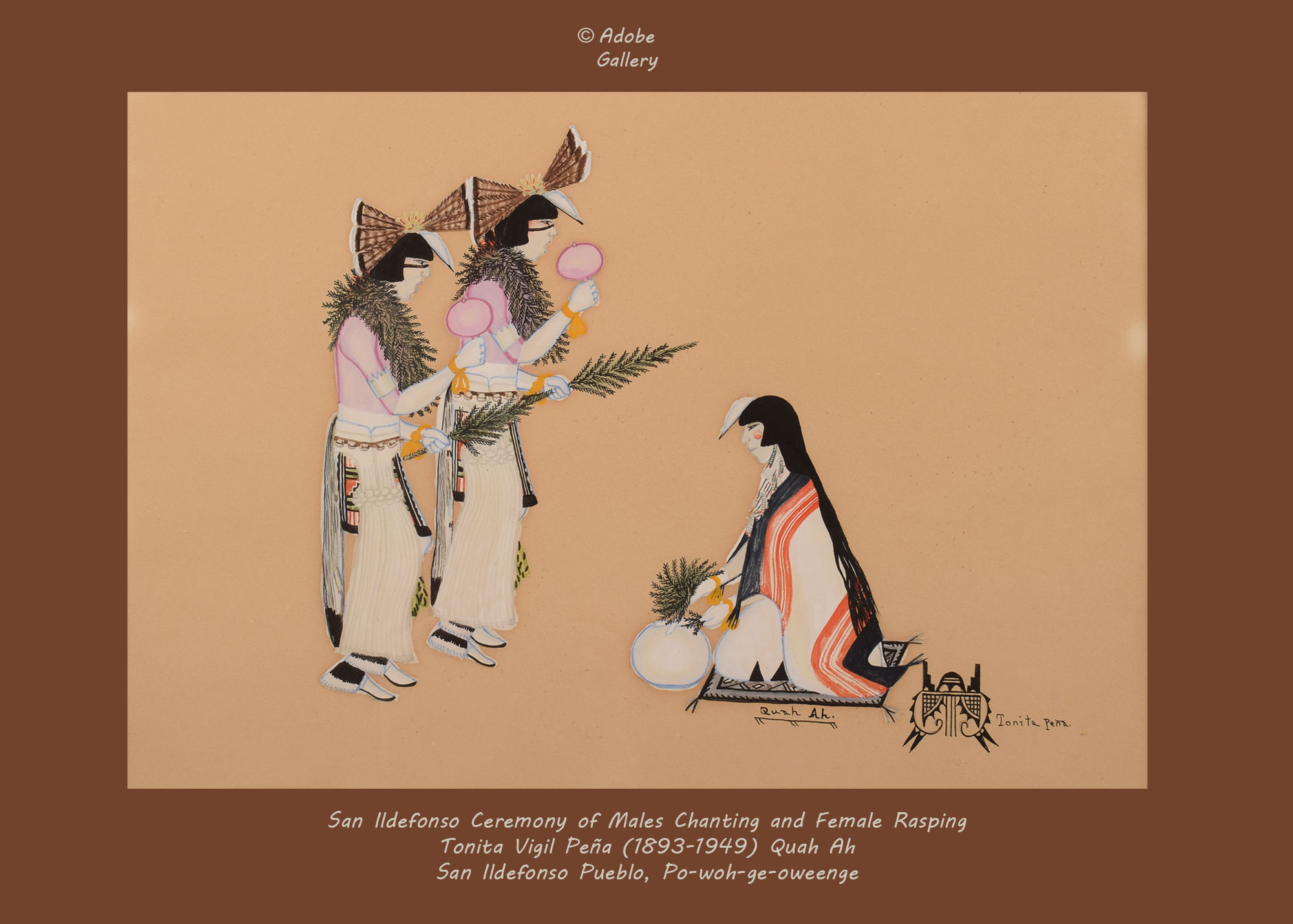
San Ildefonso Ceremony of Males Chanting and Female Rasping
+ Add to my watchlist Forward to Friend
- Category: Paintings
- Origin: San Ildefonso Pueblo, Po-woh-ge-oweenge
- Medium: watercolor
- Size:
11-¼” x 14-¾” image;
11-¾” x 16-½” framed - Item # C4962
- Price: $2500
The Rhythm of Tradition: An Early Work by Tonita Peña
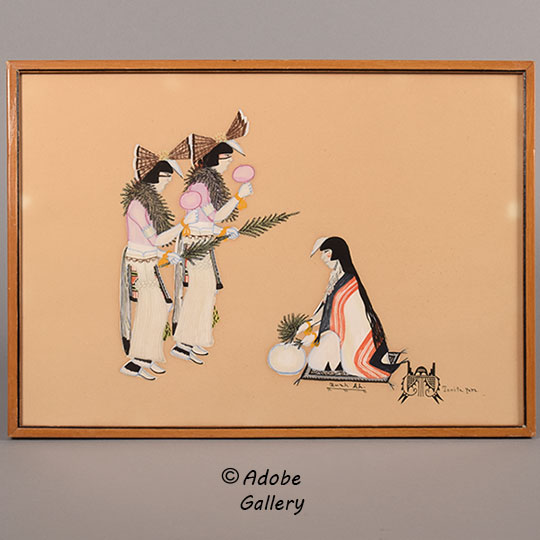
This exceptional painting by Tonita Vigil Peña (1893-1949) Quah Ah captures the sensory heart of a Pueblo ceremony. Rather than focusing solely on the dancers, Peña highlights the acoustic foundation of the event: the rasping.
The painting depicts male dancers moving in perfect synchronization to a unique percussive rhythm. This sound is created by scraping a notched stick across a dried gourd — a traditional technique that produces a resonant, grounding pulse.
By omitting background elements or a sky, Peña focuses our entire attention on the three participants. This "flat style" allows the viewer to appreciate the weight of the dancers' movements and the concentration of the musician.
Widely celebrated as one of the most influential Pueblo artists of the 20th century, Peña's skill is on full display here: The palette of vibrant colors pop against a warm, cream-toned paper. Strategic use of deep blacks and crisp whites anchors the composition, giving the figures a three-dimensional presence despite the lack of a background. The "sharp linework" and meticulous shading on the ceremonial clothing and paraphernalia reveal Peña's keen observational eye. Unlike more rigid depictions of the era, each figure is imbued with a sense of individual humanity and character.
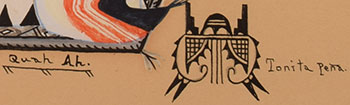 This piece is a fascinating record of the artist's personal and professional journey The painting is signed both "Tonita Peña" and her Tewa name, "Quah Ah." This specific combination is a hallmark of her work until 1915, marking this as an early and highly desirable period piece.
Although born at San Ildefonso, the painting includes a traditional design element typical of Cochiti pottery, reflecting the two worlds she inhabited. The work remains in its original wood frame without matting, allowing the full sheet of paper and its historic character to be seen.
Tonita Peña signed her paintings with varying signatures during her long career. It appears that her earlier paintings were signed with her baptismal or Christian name, Tonita Peña. She then chose to use her Tewa name, Quah Ah, which lasted until around 1915. In 1908, Tonita had married Juan Rosario Chavez, when she was 15 and he was 20 years old. Juan passed away three years later. Tonita then married Felipe Herrera in 1913 and, shortly afterwards, modified her signature to Quah AH, capitalizing the H in honor of Felipe. This signature lasted until Felipe passed away in 1920. After Tonita married her third husband, Epitacio Arquero, in 1921, she then changed her signature to Quah Ah or QuaH AH over Tonita P. Arquero, a signature that lasted until 1923.
Tonita Peña was the only woman in the group of talented early pueblo artists referred to as The San Ildefonso Self-Taught Group, which included such noted artists as Julian Martinez, Alfonso Roybal, Abel Sanchez, Crecencio Martinez, and Encarnación Peña.
By the time she was 25 years old, she was a successful easel artist, and her work was being shown in museum exhibitions and in commercial art galleries in Santa Fe and Albuquerque. She painted what she knew best — scenes of life at the pueblo — mostly ceremonial dances and everyday events. She is still considered one of the best female Indian artists of all time. Her attention to accuracy of presentation of ceremonies and costuming in her subjects is one of her contributions to ethnologists who rely on her details for study.
Dorothy Dunn stated "Quah Ah's art is an art of radiance and tranquility. It is possessed of delicacy and grace, and much music. It is unequalled at conveying the dignity, the serenity, the great earnestness and wholehearted sincerity of the Pueblo ceremonial and the Pueblo people. Quah Ah's work is not ever spectacular or striking, but it is completely unpretentious and authentic. She might be called a conservative painter for she has set her own standards in keeping with tradition and has adhered to them through the years so consistently that, even beyond her death, she has never been superseded as the dean of Indian women painters."
Condition: original condition in original frame
Provenance: this San Ildefonso Ceremony of Males Chanting and Female Rasping is from the collection of a client of Adobe Gallery from Wisconsin
Recommended Reading: Tonita Peña by Samuel L Gray, Avanyu Publishing
TAGS: San Ildefonso, Santa Fe, Cochiti Pueblo, Julian Martinez, Alfonso Roybal, Abel Sanchez, Crecencio Martinez, Encarnación Peña, Albuquerque, paintings, Joe Herrera, Tonita Peña
- Category: Paintings
- Origin: San Ildefonso Pueblo, Po-woh-ge-oweenge
- Medium: watercolor
- Size:
11-¼” x 14-¾” image;
11-¾” x 16-½” framed - Item # C4962
- Price: $2500

 Click on image to view larger.
Adobe Gallery Recommended Reading

Adobe Gallery Recommended Items
If you are interested in this item, we would also like to recommend these other related items: