




Hopi Hemis Contemporary Katsina Doll with Natural Pigments by Raynard Lalo [SOLD]
+ Add to my watchlist Forward to Friend
- Category: Traditional
- Origin: Hopi Pueblo, Hopituh Shi-nu-mu
- Medium: wood, paint, feathers, grass
- Size:
12” to top of head;
19-½” to top of tablita - Item # C4490A SOLD
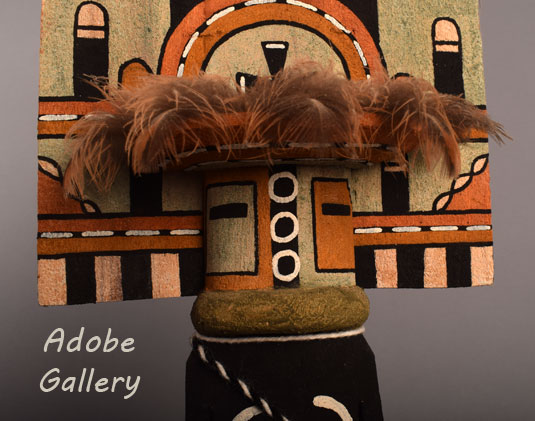
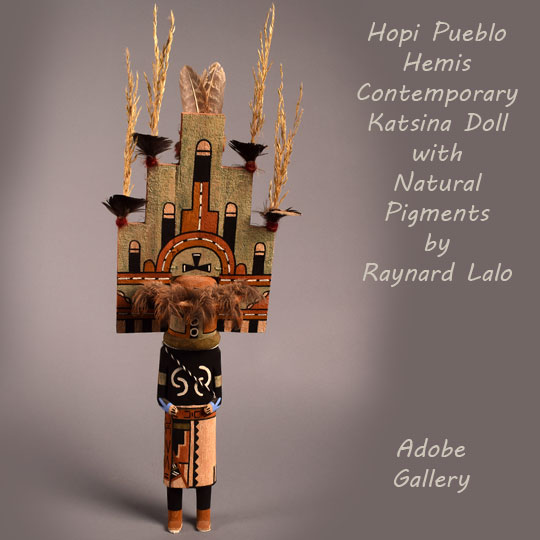
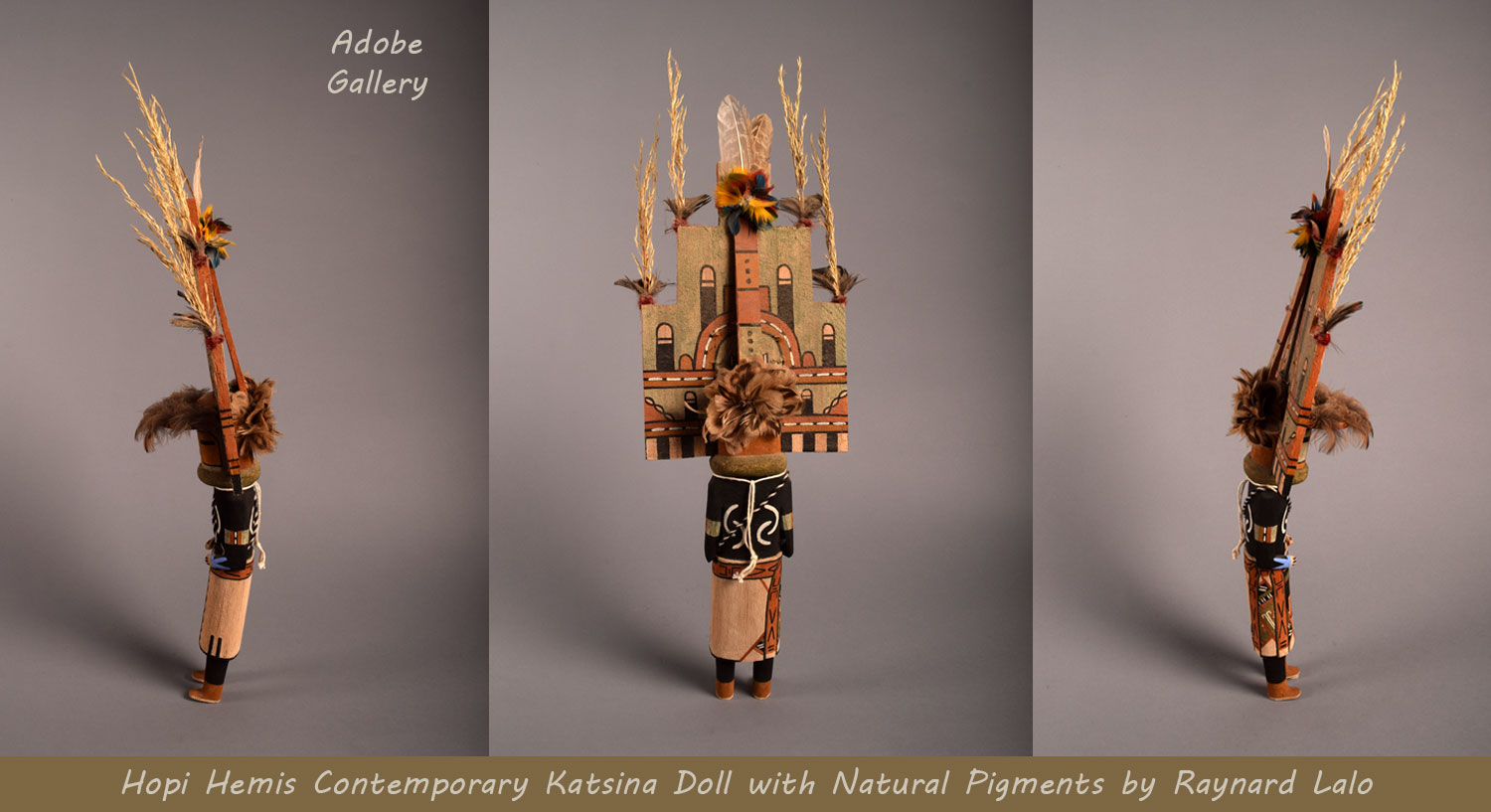
This is a contemporary Hopi Pueblo katsina doll carving in the style of older ones by Raynard Lalo. This version of the Hemis Katsina is large, measuring over 24-½” inches to the tip of the longest grass stalk. It is dressed in traditional Hemis attire. Each step of the tableta has feathers tied to the tips and securing the grass stalks. The tableta is adorned with phallic symbols to indicate its fertility significance—fertility for crops, for animals and for humans. An arched rainbow is painted on the tablita over the top of the head of the katsina. Except for the grass, feathers, and red yarn, the doll is wood. The pigments used in this and in all this carver’s dolls are natural earth pigments crushed to a fine powder.
The body of the katsina is painted with black corn smut with light colored half-moons on the chest and back. He wears an embroidered kilt over which is wrapped a hand-woven sash that hangs down the right side. A Douglas fir ruff wraps around his neck. The doll was carved such that he leans forward at the waist as if ready to take a step forward. The doll will not stand unaided. It was meant to be hung in the traditional Hopi fashion.
The carving is signed with a half spider web underneath the kilt. That is the hallmark of Hopi carver Raynard Lalo (b.1984), who is a traditional Hopi kachina carver from the Third Mesa village of Hotevilla in Arizona. His spider web hallmark is symbolic of the maternal clan to which he belongs: the Spider Clan. Raynard (whose Hopi name is Tawma, meaning “singer”) has been creating traditional katsina carvings since the age of 15.
The Hopi live in a desert and rely solely on rain for their crops and animals. It is to the katsinas that the Hopi plead for rain. In exchange for rain from the katsinas, the Hopi present them with pahos (prayer feathers). They do not ask for anything from the katsinas without giving something in return.
Although the Hemis Katsina may appear in any katsina dance, they are best known for their participation in the Niman Ceremony, a ceremony where many Hemis and Hemismana are the only katsinas represented. The Hemis Katsina is most frequently selected for the Niman because he is a beautiful impersonator, and his songs are popular with the Hopi.
The Niman or Home Ceremony performance, given shortly after the summer solstice, is the ceremony that closes the katsina season. The date of the Niman ceremony is set when the sun reaches its northernmost point.
Condition: new condition
Provenance: this Hopi Hemis Contemporary Katsina Doll with Natural Pigments by Raynard Lalo is from the estate of a Santa Fe resident
Reference: Hopi Katsina 1,600 Artist Biographies by Gregory Schaaf
Relative Links: Hopi Pueblo, Katsina-Kachina Dolls
- Category: Traditional
- Origin: Hopi Pueblo, Hopituh Shi-nu-mu
- Medium: wood, paint, feathers, grass
- Size:
12” to top of head;
19-½” to top of tablita - Item # C4490A SOLD
 Click on image to view larger.
