



Adobe Gallery Blog
How Historic Pueblo Pottery Forms Reflect Industrialization and Colonial Expansion in Turn-of-the-Century United States
19 September 2026
Here in the Land of Enchantment, cultural history and the natural environment interweave in ways distinct to the Southwest. Alongside the other Four Corners states, New Mexico shares a heritage rooted in rich traditions and profound resilience - a legacy that continues to inspire communities today. Though colonial expansion, the influx of tourist economies, and invasive archeological practices have forever altered the trajectory of these communities, New Mexico remains home to 19 Native Nations that have continuously inhabited these ancestral lands for centuries.
It is important to understand that pottery has been utilized for practical needs by agrarian societies such as Southwest Native Americans for thousands of years. While more nomadic societies such as Plains Native Americans relied on materials suited for migratory patterns. “Settled agricultural communities required durable containers for everyday survival, leading Southwest potters to engineer specialized vessels for gathering, preparing, and storing essential resources.” (Frank & Harlow)
Here in the Southwest, pottery has served as utility to help aid the everyday lives of Native Americans for thousands of years. Form is functionality, and beautiful designs on smooth, polished slip indicate the communities from which they originate. Or the influence of neighboring communities which they associate and exchange ideas with.
Small vessels such as water jars feature thin, hand-built walls designed for hauling large volumes of water throughout the day. Every aspect of the form serves its purpose: a narrowed rim and neck prevent spillage during transport, a full belly maximizes water capacity, and a concave foot rests securely on the curve of the bearer's head.
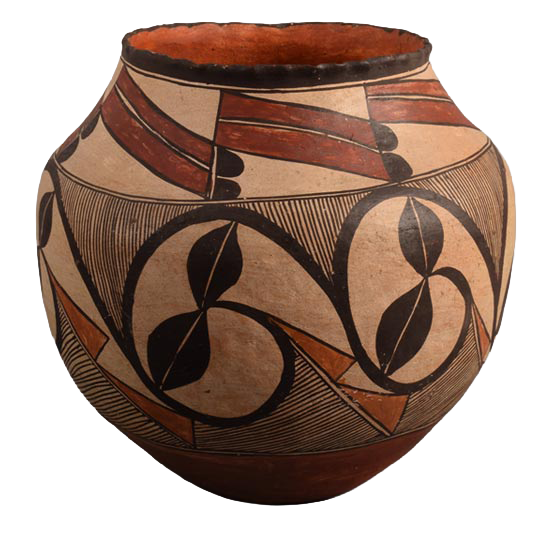
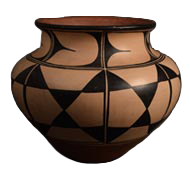
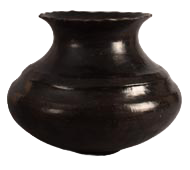
Large vessels for preparation and storage have convex bottoms to easily nestle into the soft earth floors of adobe homes. Rims are much narrower, and bellies hand built as large as the firing process can withstand. Walls are built thick, increasing the weight, which is possible for societies that can settle for long periods of time. These forms would have been very heavy, and engineered to keep out rodents.
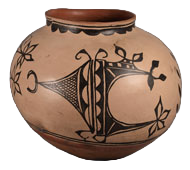
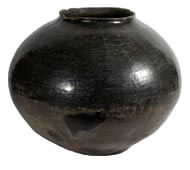
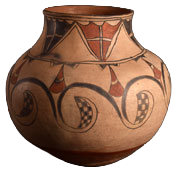
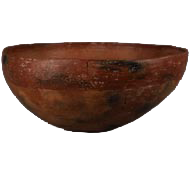
Dough bowls represent another critical utilitarian form, specifically engineered for kneading and rising bread. However, Indigenous communities did not immediately adopt Spanish baking traditions; it took over a century after contact for communities to integrate wheat flour and yeast-risen bread into their diets. Prior to wheat's introduction in the late sixteenth century, Southwestern communities had no need for these broad, low-walled vessels. Instead of above-ground dome ovens, they used pit ovens or baked corn flatbreads—like piki bread and tortillas—indoors on flat, hot stones. Following Spanish colonialism, these forms emerged to accommodate flour-based breadmaking, and Spanish-style hornos (outdoor ovens) served as a clear testament to how Native ceramic practices evolved alongside changing foodways. (Frank and Harlow, p. 45-48).
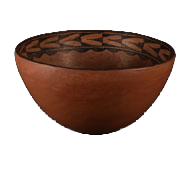
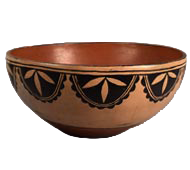
Pueblo Pottery forms experienced a transition period in the late 1800s; pottery forms shifted in size and shape to accommodate tourists arriving on the AT&SF Railroad (completed in 1881). This period saw a decline in utilitarian pottery, replaced both by tourist-driven wares and new metal alternatives. “During the late 1800s, some Pueblo potters began creating decorative pieces of pottery inspired by images of glass and dinnerware seen in magazines and newspaper advertising. In addition to traditional pottery forms, vases, pitchers and other pots with fanciful handles, ash trays, and animal figurines were made” (Pueblo Pottery Collective). It was never present in indigenous ideologies that one must sign their name to pottery - this is how art historians and Native American communities distinguish between historic and modern pottery in this region.
Even the United States in general saw this transition in everyday life. According to Freddie Wilkinson at National Geographic, “the most harmful effects of the Industrial Revolution might have been changes that families had to make. Before the revolution, most people worked with their families on farms or in shops.” So, we can imagine then how this affected Native Americans whose culture relied, and still relies, on the interconnectedness of kinship, community and reciprocity over a market economy.
Around the turn of the century, these vessels shifted from the spirit and femininity inherent in their original designs as their functional necessity faded. Women were at the center of the craft and usage thereof. When we create materials out of necessity over centuries, it is understandable that these objects naturally start to incorporate soulful and personal elements. If not all along. And as economies transition, usually by force, from gift giving to market based, we lose the fact that "gifts from the earth or from each other establish a particular relationship, an obligation of sorts to give, to receive, and to reciprocate" (Kimmerer, p. 25). Thriving communities inspire creativity.
This leaves me to ponder: had major institutions - such as the Smithsonian, the American Museum of Natural History, Harvard’s Peabody Museum, and the Penn Museum - not removed so many sacred artifacts from Native Nations, and had Indigenous communities not been forced into a market economy, would these pottery traditions have ever waned? While we may never have definitive answers, contemporary Native American artists continuously blend the traditional pottery forms of their ancestors with new perspectives that reflect today's world. Championing their living culture through art.
Cited Sources:
Division of Rare and Manuscript Collections, Cornell University Library. Guide to the Hemenway Southwestern Archaeological Expedition Papers, 1886-1896.
Frank, Larry and Harlow, Francis. Historic Pottery of the Pueblo Indians, 1600–1880 West Chester: Schiffer Publishing, 1990, p. 45–48.
Jaffe, Logan, et al. “America’s Biggest Museums Fail to Return Native American Human Remains.” ProPublica, 11 August 2026.
Kimmerer, Robin Wall. Braiding Sweetgrass: Indigenous Wisdom, Scientific Knowledge and the Teachings of Plants. Milkweed Editions, 2013, p. 25.
Wilkinson, Freddie. “Industrialization, Labor and Life.” National Geographic, 30 May 2025.
Pueblo Pottery Collective. Pueblo Pottery Stories in Clay: Historical Context, Vilcek Foundation. 01 August 2023.