




Original Painting Titled “Clowns of the Fire Dance” [SOLD]
+ Add to my watchlist Forward to Friend
- Category: Paintings
- Origin: Diné of the Navajo Nation
- Medium: watercolor
- Size:
9-½” x 9-½” image;
15-⅜” x 15-⅜” framed - Item # C4140D SOLD
Beatien Yazz “Little No Shirt” (or Jimmy Toddy) was an influential Diné painter. Born in 1928 on the Navajo Reservation, Yazz showed promise as an artist very early. At an early age, Yazz met the Lippencotts, traders at the Wide Ruins Trading Post. They made available to him scraps of paper and other equipment so that he might practice in color. He served in the U.S. Marines in World War II and was a member of the famed Navajo Code Talkers. Following the war, he returned to the reservation and began to paint in earnest. He specialized in subjects familiar to him in his daily life on the reservation. He has been eminently popular with collectors since the 1950s.
Yazz is only one of his names. There is his Navajo name, which is unknown. He has signed his paintings with many variations: Beatien Yazz, Beatian Yazz, Beatian Yazzia, Beatin Yazz, and B. Yazz. Finally, there is the name that most people use, Jimmy Toddy. Yazz was the subject of Alberta Hannum's books Spin a Silver Dollar and Paint the Wind, both of which prominently featured his artwork. During the last 20 years of his life, he suffered from severe eye problems, which medical doctors were unable to cure. A Navajo Medicine Man said that his problems were the result of having painted the Navajo sacred Yeibichai and that to be cured, Yazz would need to undergo a purifying ceremony. He was unable to afford the expensive ceremony. Yazz passed away in 2012, leaving behind a significant body of work.
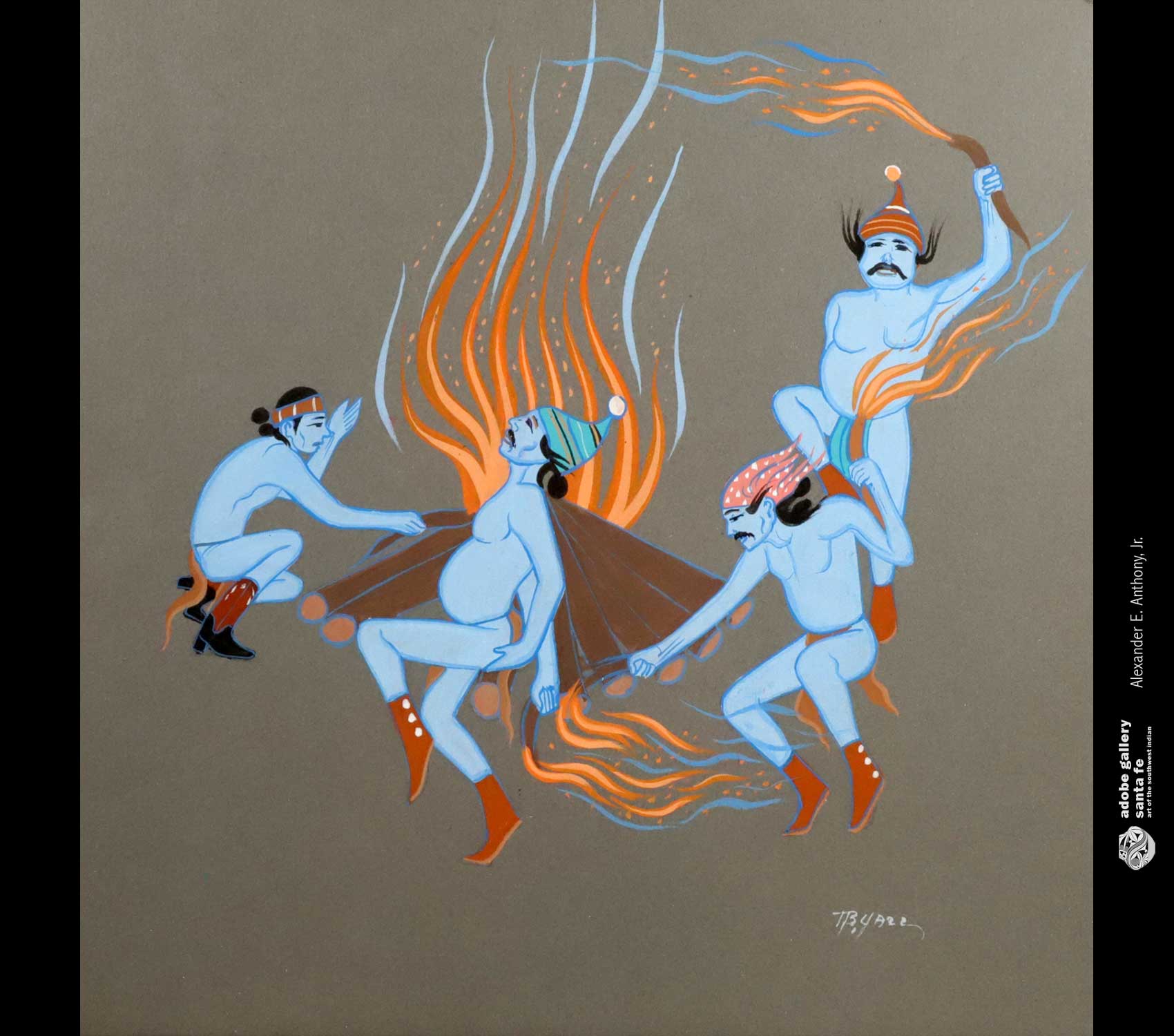
Yazz’s subject here is the Navajo Fire Dance, a sacred ceremony that occurs during the ninth and final night of the Mountain Chant. It’s a grueling ritual, usually performed by young men who are able to handle physically taxing activity. Washington Matthews, surgeon and ethnographer who studied the Navajo people, provided an excellent description of the ceremony: "The men, racing in a circle round the fire, close to the unbearable heat, whooped like demons and beat their own bodies and each other's with the flaming brands. One man beat the bare back in front of him until it slipped away. Then he flared his brand over his own back, showering sparks, he straddled it as he ran, he turned and threw its flames over the man who followed him. They washed each other's backs with flame. They leaped so close to the fire that their bare feet seemed to be treading on live coals. The figures, following each his own devices, together made a painting such as Doré might have done for Dante's Inferno: pale inhuman figures, capering in the firelight, bathed in the red glow and the showers of orange sparks, always calling that queer suggestion of flickering flame. It seemed to last a long time; actually, until the cedar brands were well burned out. Then each man dropped his smoldering bark and, still trilling loudly, ran out of the corral. Intense, brilliant, savage.”
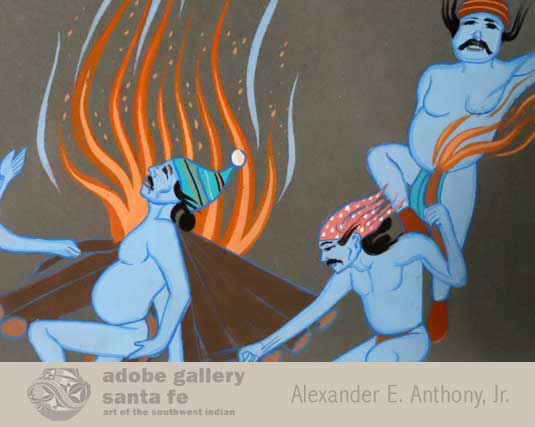
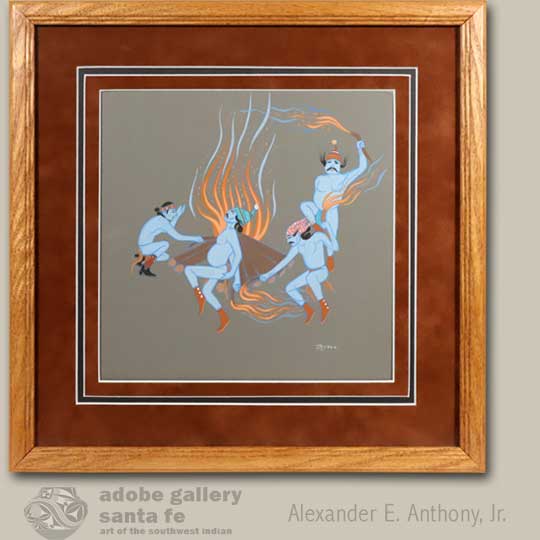
With “Clowns of the Fire Dance,” Yazz portrayed the ceremony in a pleasant, endearing fashion. Central to the image, of course, is the fire itself. One on side of the fire, a dancer crouches, reaching his stick into the flames to light it. On the opposite side and curving around into the foreground is a line of three dancers pursuing one another. The robust man in the back of the group will most certainly find himself being chased by flames at some point too, and so he looks just as focused as the man he’s chasing. An interesting (but undoubtedly realistic) detail is that each dancer wears a colorful ski cap or bandanna. With the exception of the colorful headwear, Yazz used just a few colors here: blue, brown, and a few variations of a warm orange. These color choices combine with the gray background to deftly recreate the magical glow of a midnight fire in the Southwest. That this fire is part of a sacred Navajo ritual makes the image even more appealing.
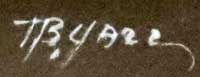 The painting is signed “B. Yazz” in its lower right corner. It is framed tastefully, underneath maroon and black mattes.
Condition: this Original Painting Titled "Clowns of the Fire Dance" is in excellent condition
Provenance: from a private New Mexico collection
Recommended Reading: Yazz Navajo Painter by Sallie Wagner, J. J. Brody, and Beatien Yazz
Note: when we say Diné, as opposed to Navaho or Navajo, we are referring to the people and not the government. Since 1969, their government refers to itself as the Navajo Nation.
- Category: Paintings
- Origin: Diné of the Navajo Nation
- Medium: watercolor
- Size:
9-½” x 9-½” image;
15-⅜” x 15-⅜” framed - Item # C4140D SOLD
 Click on image to view larger.
