



Cordero-style Male Storyteller with 5 Kids by Antonita Cordero Suina - C3688.30
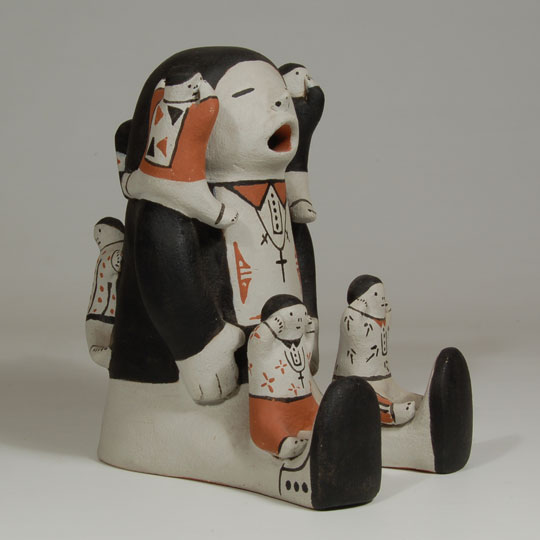 Antonita, or Toni, was a daughter of Fred and Helen Cordero. Her brother was George Cordero. Toni, George, George's daughter Buffy, and their cousin Tim Cordero all made storyteller figurines because of the influence of Helen Cordero. She taught all of them the fundamentals and any storyteller made by any of the younger generation is immediately recognizable as a product of a Cordero. They all resemble in some sense the work of Helen.
Cochiti Pueblo Male Storyteller with 6 Children by Buffy Cordero Suina - C3688.03
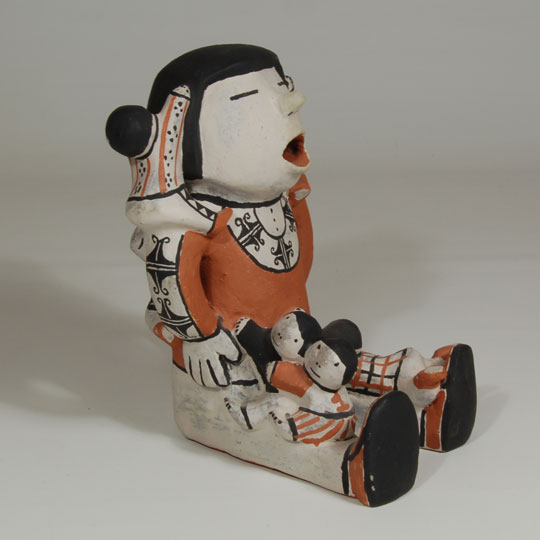 Buffy Cordero Suina (1969- ) was a granddaughter of Fred and Helen Cordero. Her mom and dad were George and Kathy Cordero. She credits her interest in pottery to her dad and her grandmother. It is most likely that Helen had more influence on Buffy as it appears that she quit potting following the death of Helen. Buffy started making storyteller figurines around 1985 while still a teenager.
Zuni Pueblo Four Row Snake Eyes Turquoise and Silver Bracelet - C3789A
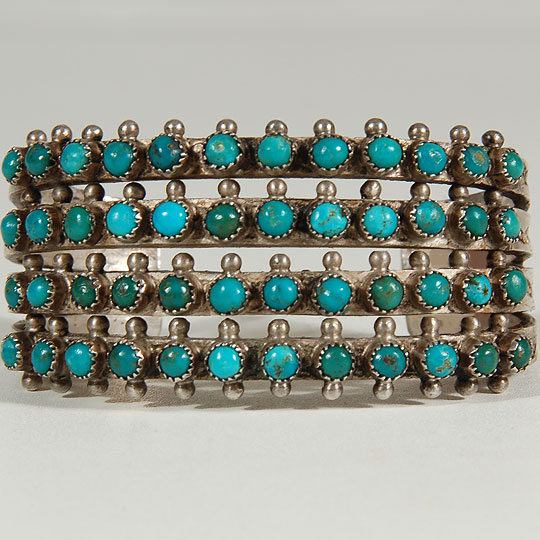 This bracelet was fashioned in a manner that took four individual silver bracelets and combined them into a single bracelet. They were attached at each end with solder. There are 12 silver drops between each row which serve as the anchor points to keep the bracelets separate. There are another 12 silver drops on the outer edge. The bracelet is topped with four rows, each containing 12 small round and domed turquoise cabs, commonly called snake eyes.
Hopi Pueblo Old Style Rugan Katsina Doll - C3784D
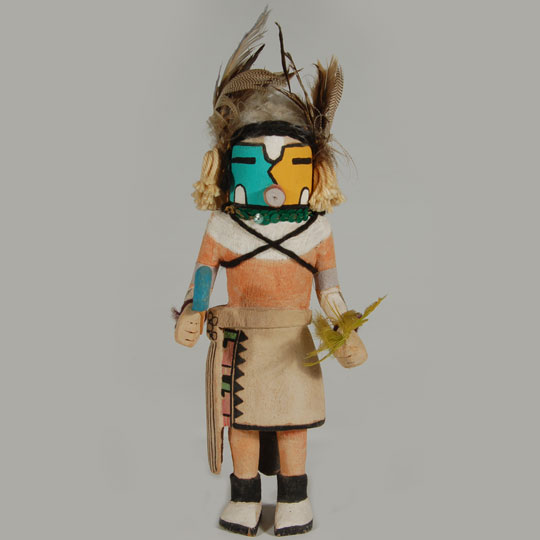 This is an older version of a Corn Katsina, the specific Hopi name may be Qa'ökatsina. Barton Wright referred to this as a Rugan, which is another group name for Corn Katsinas. Each of the Corn Katsinas has a specific Hopi name.
Large Oval Turquoise Stone and Silver Bracelet by Chief Sunny Skies - C3785F
 After a casual look at this bracelet, most knowledgeable collectors and dealers would identify it as having been made by a Navajo, as it is typically like the work of members of that tribe. This one, however, is clearly marked that it was made by Chief Sunny Skies of Acoma Pueblo. This one does not have a date stamped with the signature but the other two items we have had from this same collection that were signed by Chief Sunny Skies were dated 1938 and 1939, so it is presumed that this bracelet would probably have been made at that time.
Original Painting of a Navajo Rug Weaving Session by Harrison Begay - C3788F
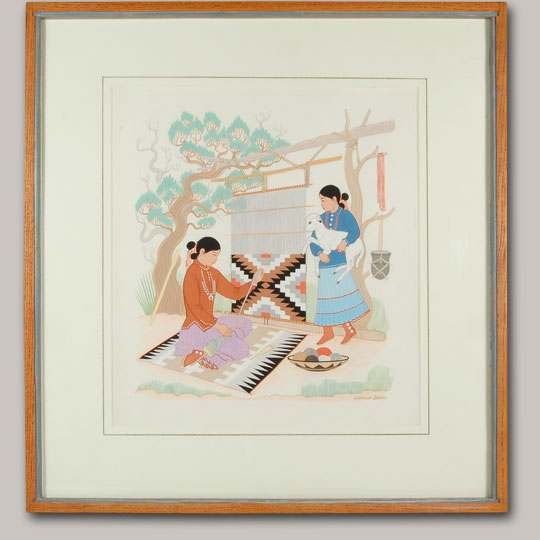 In 1951, an arts silk-screen printing business called Tewa Enterprises, was started in Santa Fe by Charles Barrows, a silkscreen printer, and Harrison Begay, the well-known Navajo painter. Tewa's mission was to hand silk-screen reproductions of Navajo and Pueblo paintings and make them available to a wide audience at low prices. Subsequently, the current owner, Cathie Sullivan purchased Tewa Enterprises.
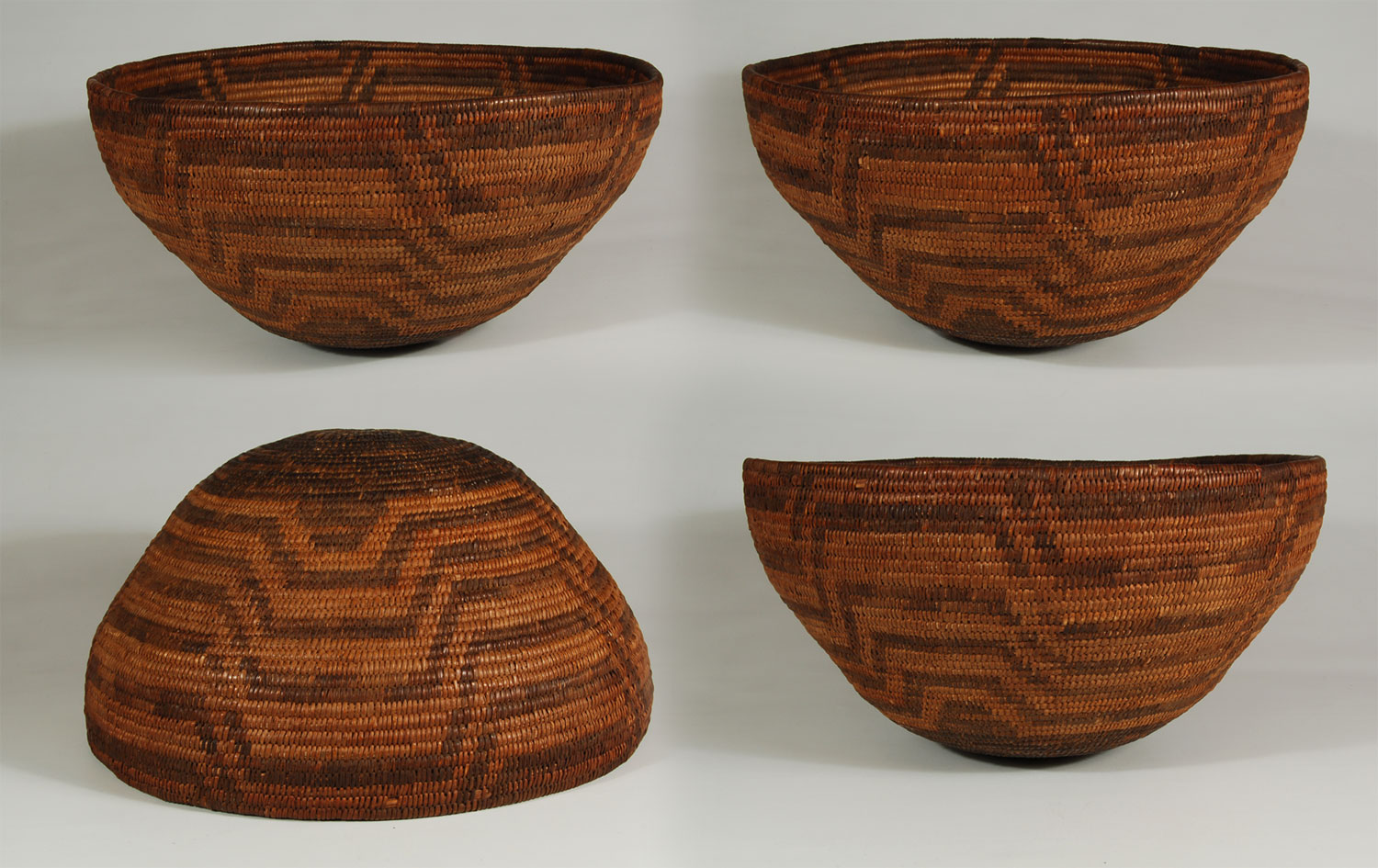
Very Deep Maricopa Reservation Basketry Bowl - C3776Y
 A number of tribes which speak the Yuman language have, for a number of years, been grouped together because their cultural patterns are similar. There are four Yuman-speaking tribes-one in California, one in Mexico, and two in Arizona. The Arizona Yuman-speaking tribes are known as the River Yuman tribe. They settled along the lower Colorado River and the Gila River, which provided for good farming. The three groups that make up the Arizona Yumans are Mohaves, Cocopas, and Maricopas.
According to Andrew Hunter Whiteford, "most River Yuman baskets have long since disappeared." He states that the Maricopas are now primarily pottery makers and no longer make baskets.
This Maricopa basket is a very deep bowl that dates between 1900 and 1910. It has been described as a wine bowl but certainly could have served many functions for the owner. It is in such excellent condition because it probably never served a function for the tribe. It was probably sold shortly after completion. It is a very rare basket from a tribe no longer making them.
#adobegallery #SouthwestIndianBaskets #Maricopa #PeeposhTribe #Baskets #IndianBaskets
#SantaFeNM #VisitCanyonRoad

Very Large Ohkay Owingeh (San Juan) Pueblo Polychrome Storage Jar - C3773M
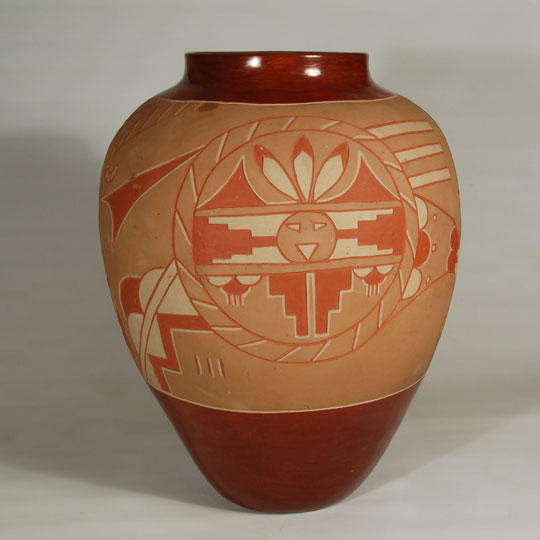 In 1930 Regina Cata organized a pottery study group at San Juan Pueblo with the intent of revitalizing pottery production. The group studied ancient potsherds of wares made at San Juan in earlier times and selected Potsuwi'i Incised Ware (1450-1500) as a basis for a contemporary pottery type. By the 1950s, further development resulted in deep carved polychrome wares, and incised wares, both of which are still being produced today.
Santa Clara Black and Sienna Small Jar with Sgraffito Design by Kevin Naranjo - C3790B
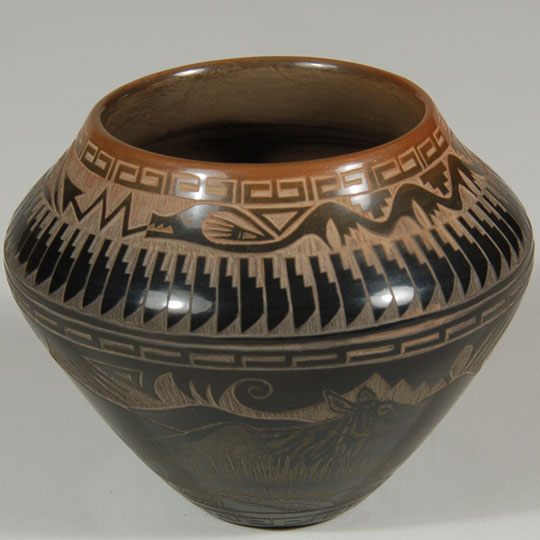 It is difficult to definitively establish the innovator of a pottery style or technique but it can be stated that Joseph Lonewolf of Santa Clara Pueblo was among the first, if not the first, to experiment with sgraffito designs in clay in the early 1970s. If there was another potter making sgraffito designs before then, I offer my apologies for not giving that person credit.
Santa Clara Drum Shape Polychrome Lidded Pottery Box by Dolores Curran - C3790A
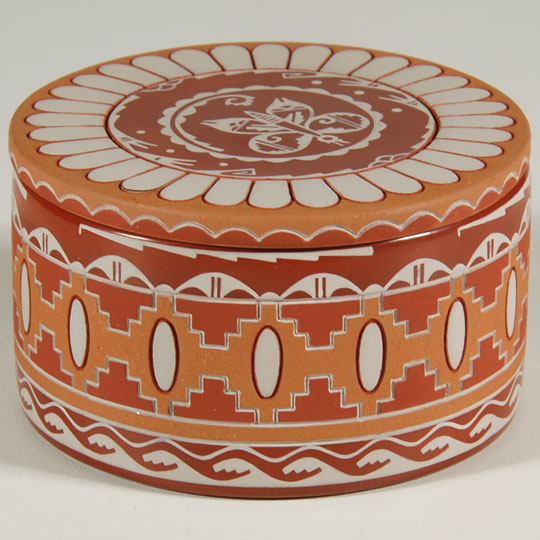 Dolores Curran, originally from Santa Clara Pueblo, married and moved to Ohkay Owingeh Pueblo around 1977. She has specialized in miniature pottery since her first piece at age 9. Her designs are each original to the piece of pottery on which she is working. She does not record her designs because she doesn't want to start copying herself. She prefers to fit each design to the pot on which it goes. She now designates her pottery as being from Santa Clara Pueblo.
Santa Clara Pueblo Polychrome Rectangular Box with Lid by Belen Tapia - C3790D
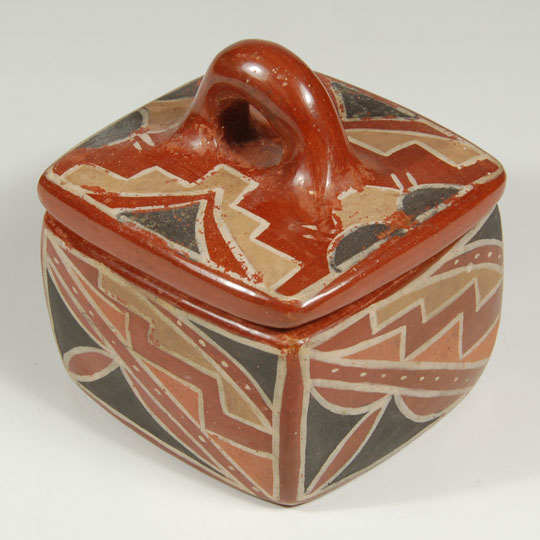 Lidded boxes such as this one might have been used in ceremonial functions at Tewa and other pueblos, but there is no information published as to the manner in which they were used. Such boxes also were made for sale to non-Native persons, mostly at the request of anthropologists, who were seeking them for museum collections. Individuals also liked to collect them for use as small storage boxes.
Jemez Pueblo Two-Piece Pottery Owl Figurine by Laura Gachupin - C3790C
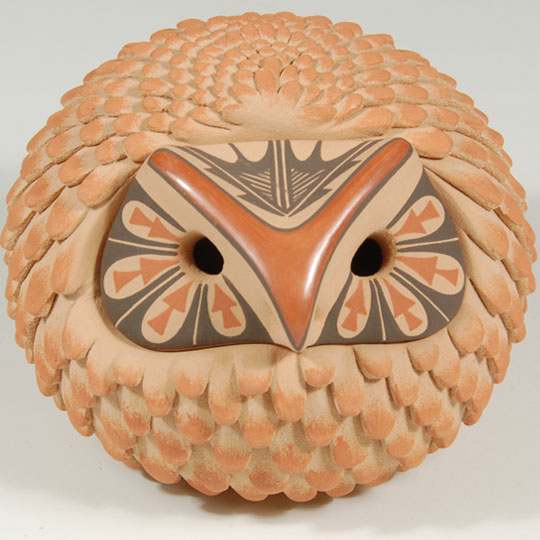 Laura Gachupin was born into a family of artists. Her sister is Maxine Toya, her mother was Marie Romero, and her grandmother was Persingula Gachupin. Her grandmother was her mentor. She also studied at the Institute of American Indian Arts in Santa Fe. She has won many awards for her work, and demonstrated both in and out of state.
Kewa Pueblo Inlay Shell Pendant Coral Necklace with Earrings by Percy Reano - C3777D
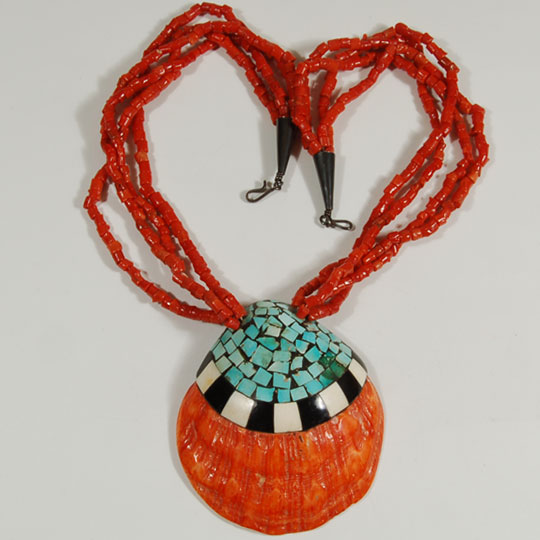 Over 65,000 pieces of turquoise were found at Pueblo Bonito at Chaco Canyon in New Mexico, leading archeologists to believe that Chaco was a turquoise manufacturing center. Both turquoise and shell were used for adornment by Ancestral Puebloans during prehistoric times, and both are still being used today.
Anyone who has had the opportunity to attend a Pueblo plaza dance has seen the beautiful turquoise and shell pendants worn by dancers. This particular pendant is especially lovely as it is suspended by four strands of rare red coral. The artist carefully and skillfully set turquoise, jet and shell mosaic onto a smoothed down Spondylus or Spiny Oyster shell.
Navajo Sandcast Pin - Pendant with Handmade Chain - C3777N
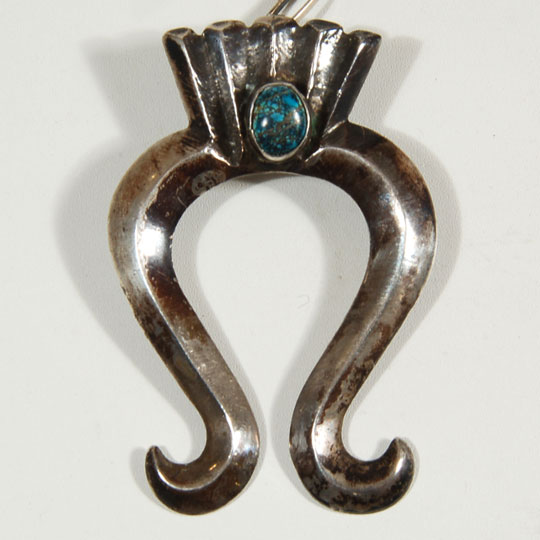 Sandcast silver jewelry is recognized as a distinctly traditional Navajo technique. To make sandcast pieces, molten silver is poured into a mold. The mold is good for only one item. It is a complicated process, with every piece unique.
Three Navajo Sterling Silver Stamped Converted Moccasin Buttons - C3777i
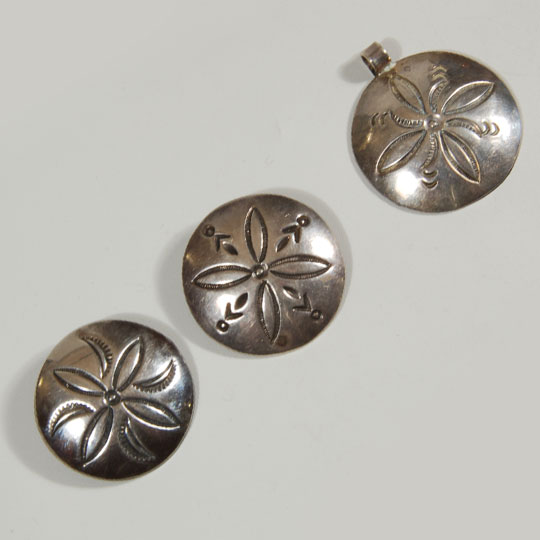 Among the first objects of adornment created by Navajo silversmiths in the mid-19thcentury were buttons and collar decorations attached to clothing. It was a way of displaying and protecting one's wealth. One either wore jewelry or took it to the trading post for safe keeping as pawn jewelry.
Historic Child Size Kewa (Santo Domingo) Pueblo Jar - C3783D
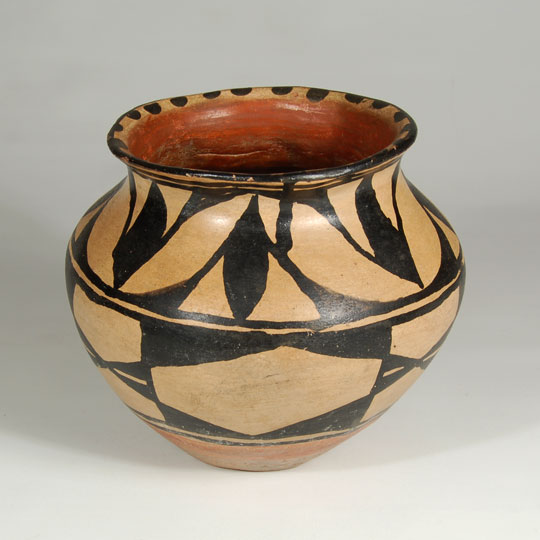 The designation "child's size jar" is not meant to demean the item but to more or less describe its size. It does not indicate that the jar was made by a child but perhaps was made as a training aid for a young female to use in practicing walking with the jar on her head, with or without water. Jars of this size also were made for storage of personal items and for sale to tourists. There could be many reasons for such a jar.
This jar is very typical of those made at Santo Domingo Pueblo in the first quarter of the 20th century when tourists were visiting the pueblo and the trading post that was located adjacent to the rail tracks. The daily traffic at Santo Domingo Trading Post necessitated many items of pottery, jewelry and curio items to satisfy the demand of many visitors. Jars of this size certainly would have been popular because of their convenience for easy transportation.
Zuni Pueblo Polychrome Historic Dough Bowl - C3783C
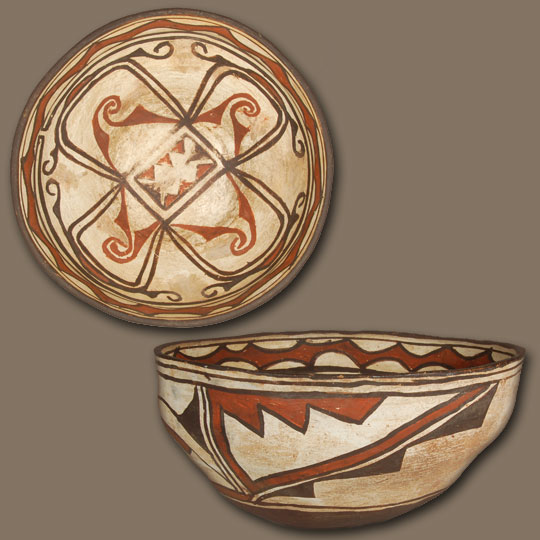 It would be interesting to share with you a little about the history involving Zuni Pueblo before giving details about this dough bowl. The Bureau of Ethnology (BAE) was created by an act of Congress in 1879 and put under the control of the Smithsonian Institution, with John Wesley Powell as its first director. He wasted no time in setting up his plans for the BAE. Within a few months, he sent an expedition to visit Zuni Pueblo to collect material from and information about the Zuni culture.
Colonel James Stevenson and his wife, Matilda Coxe Stevenson, departed for Zuni on August 1, 1879 also to collect for the BAE. John K. Hillers, photographer, and Frank Hamilton Cushing, ethnology assistant at the Smithsonian, accompanied the Stevensons.
Abstract Eagle and Rainbow Painting by Anselmo Martinez - C3789G
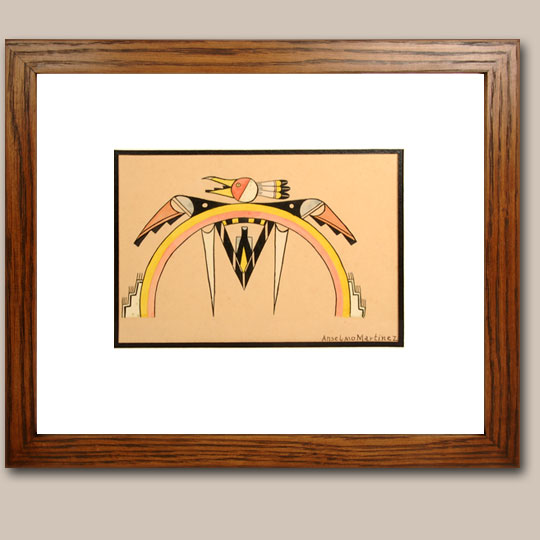 Occasionally a painting arrives at the gallery by an artist from whom we have never seen one before, and for which there is no published information in the standard reference books on Native artists. Anselmo Martinez was the son of Louis Martinez, the brother of Julian Martinez. He was married to Lupita Martinez, a potter. We found a reference to him because of his relation to Julian.
Hopi Pueblo Cottonwood Umtoinaqa (Thunder) Katsina Doll - C3784E
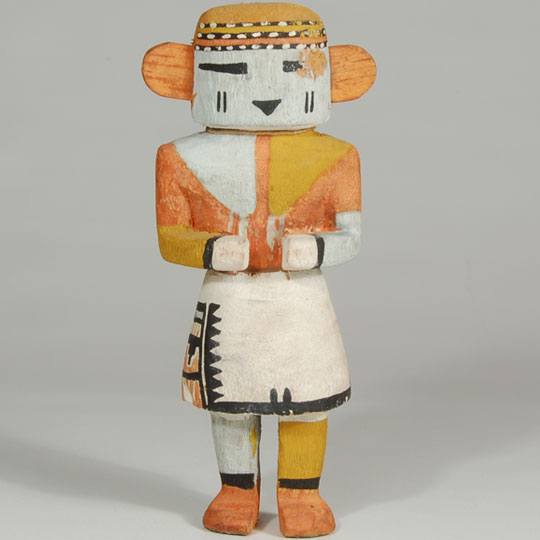 According to published information by Barton Wright "Umtoinaqa is the Shooting Thunder Kachina. He acts as a policeman or guard during the Bean Dance but is most commonly seen in the Mixed Katsina Dances. The bull roarer that he carries in his hand is used to imitate the sound of thunder."
Large Santa Clara Pueblo Polychrome Jar signed Lela/Van - 25861
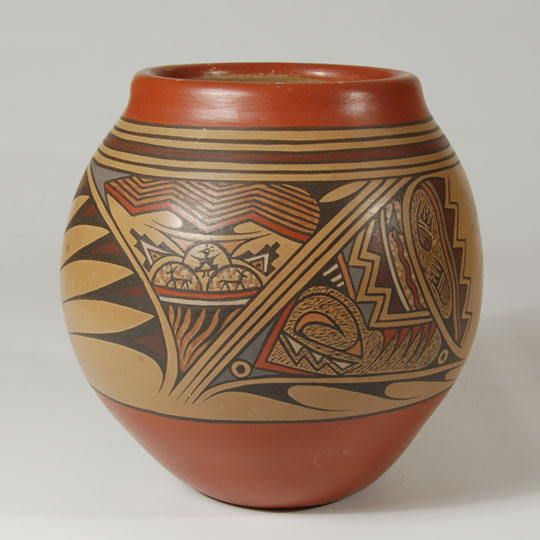 Lela Naranjo Gutierrez (1895-1966) and her husband Van (c1870-1956) tested many ideas in pottery making, but only after developing a decorative scheme featuring earth colors on a matte background did they achieve enduring success. Bold curvilinear designs on neutral tan or beige became the base for a new Santa Clara style.
The polychrome wares created by Lela and Van continued to be produced by younger members of the Gutierrez family, notably their children Margaret and Luther, and Luther's daughter Pauline. Following the death of his dad, Luther teamed with his mom and the two worked until Lela passed away, then Luther and his sister Margaret teamed until Luther passed away. Now Margaret works alone.