



Zuni Apache Gaan Dancer Bolo Tie by Lambert Homer Jr. - C3777J
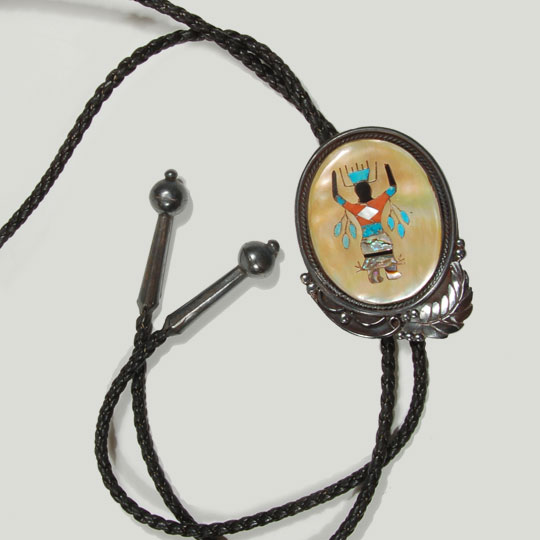 Lambert Homer Jr. was the son of well-known Zuni lapidary artist Lambert Homer and the grandson of Leekya Deyuse. Along with his father, Lambert Homer Sr., he worked for the legendary trader C. G. Wallace. Wallace became a trader at Zuni in 1920 and revitalized the jewelry making tradition at the pueblo by introducing new tools and working closely with the artists. He hired only the most talented artists and marketed their work to the tourists visiting the Southwest. The result of this endeavor was the creation of some of the most beautiful pieces of Native American jewelry made in the early 20th century. Lambert Homer Sr. is credited with being the first to incorporate the Apache Gaan Dancer as a motif.
Zuni Pueblo Inlay Sunface Bolo by Sadie and Morris Laahte - C3777F
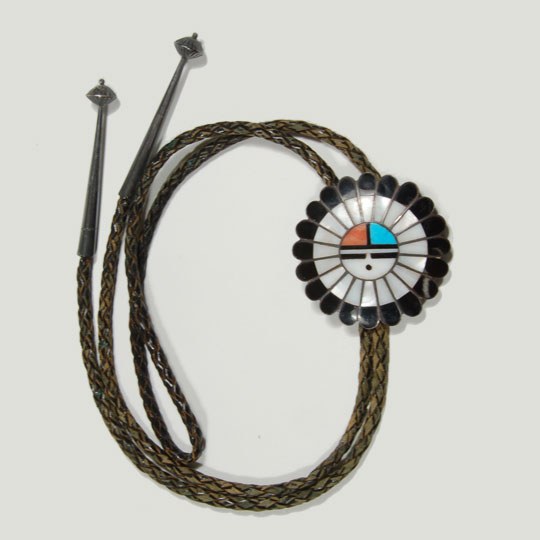 The Sunface is an important symbol for the Zuni as it represents the sun- the giver of all life. Traditionally, the Zuni have been an agricultural people and knowledge of the sun and its movements is of utmost importance. The sun is revered as the bringer of life and brings prosperity and joy to families.
This jewelry piece was made by Zuni Artists Sadie and Morris Laahte. They are a husband-wife team that are known for their precise mosaic inlay work. One of their favorite designs is the Sunface. Here, they have created a beautiful Sunface using perfectly cut and placed pieces of jet, mother of pearl, coral and turquoise. It has been set as a bola tie and has handmade sterling silver tips at each end.
Zuni Pueblo Inlay Sunface Ring - C3777L
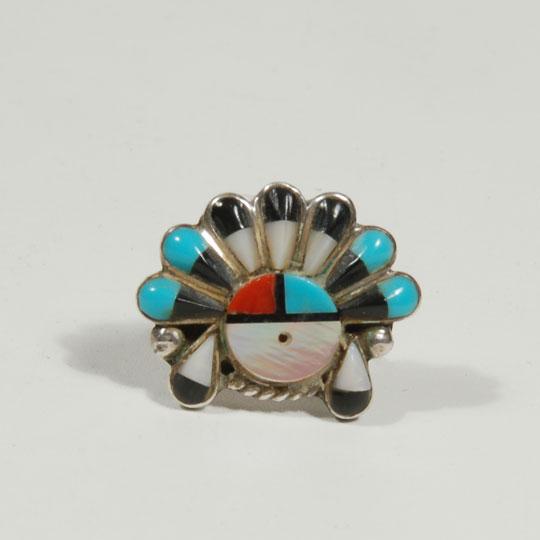 A symbol of joy and prosperity, the Zuni Sunface is a delightful motif used frequently by the Zuni. This well made little ring is comprised of expertly cut pieces of turquoise, mother of pearl, jet and coral. The stones are set within silver bezels. It is unsigned.
Hopi Pueblo Cottonwood Sio Hemis Katsina Doll - C3784C
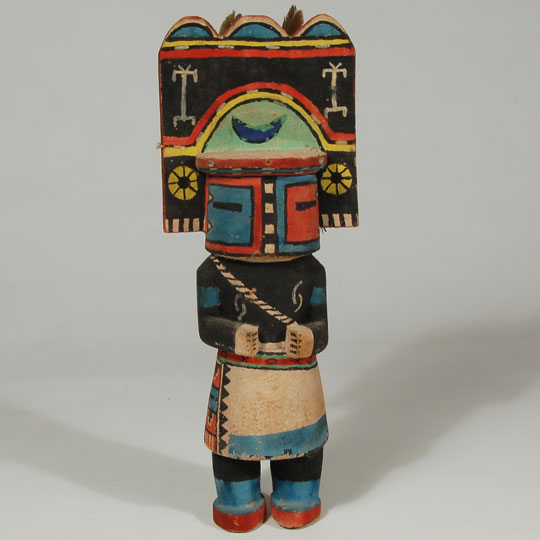 The Hemis and Sio Hemis Katsinas are probably the most beautiful and best known of all Hopi Katsinas. Their elaborate headdress, called a tableta, is partly responsible for their attraction. They both wear a kilt, and around the waist a Hopi embroidered sash.
The Sio Hemis Katsina is an import at Hopi from Zuni Pueblo, probably in the 1890s. He may substitute for the traditional Hopi Hemis during the Niman Ceremony of mid-July. There is very little difference between the Hemis and Sio Hemis except for the decoration of the tableta. The Hopi Hemis has towering clouds and rain depicted on the tableta, while the Sio Hemis has dragonflies and sunflowers with smaller clouds at the top.
Historic Ohkay Owingeh (San Juan) Pueblo Tall Black on Gray Water Jar - C3783E
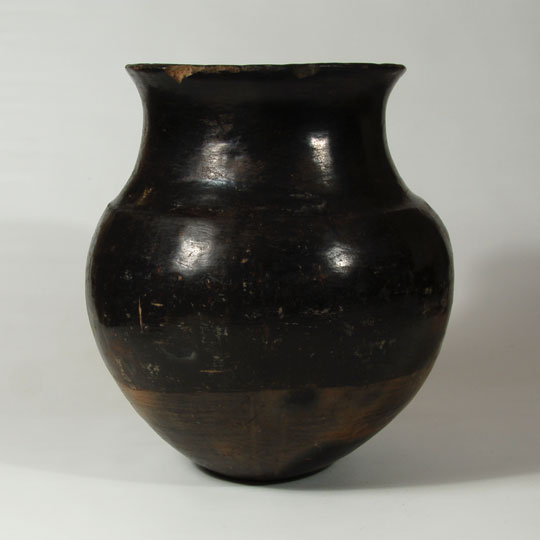 This is a traditional San Juan Pueblo olla or water jar with a polished black upper body and polished gray underbody, a style which has been made for centuries. In these jars, the red slip is wiped over the upper two-thirds of the vessel body and the lower one-third left without slip. Both upper and lower portions are then stone polished. When reduction fired, the red changes to black and the tan underbody changes to gray. The interior of the neck is matte finish. It probably dates to circa 1890-1910 period.
Very Large Cochiti Pueblo Pottery Dough Bowl by Elizabeth Trujillo - C3778
 Large pottery vessels are not often seen coming from potters at Cochiti Pueblo. It has not been a tradition at Cochiti for the last hundred or more years. It is quite likely that Cochiti families purchased from or traded with potters at Santo Domingo when in need of large vessels. Cochiti was quite well known in the late 1800s for making wonderful figurine pottery in the form of humans and animals, then in the 1970s, and forward, the potters became famous for making pottery storyteller figurines.
Hopi Pueblo Wakas Koyemsi Impersonating a Cow Katsina - C3784A
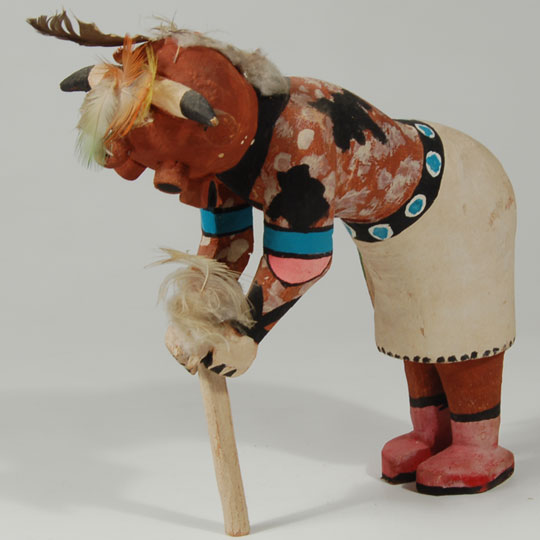 This personage has been known by several names-Mudhead, Koyemsi, Clown, Tachukti, and has been referred to as a Katsina. Barton Wright states that it is not considered a Katsina at Hopi and that Mudhead and Koyemsi are both nicknames and that Tachukti is the correct name but that he is not a clown in the sense we normally consider a clown. It will, however, always be called a Mudhead as that name has existed for a hundred years already and is not likely to go away.
Polychrome Kewa - Santo Domingo Pueblo Flower Pot Jar - C3753.68
 This is a marvelous jar that is traditional in every way except for the vessel shape. It was probably made circa 1930 and exhibits the classic traits of late Santo Domingo Polychrome. The neck interior is red-slipped and stone polished. It has a black rim top. The under body is stone-polished bare paste. The cream/off-white is rag-wiped bentonite slip with black and red vegetal designs. The off-white slip extends almost completely to the bottom of the vessel. There is the customary red band that was wiped on over a portion of the red underbody. There are double framing lines at the top and bottom of the design area. Both pairs have ceremonial breaks.
Hopi Pueblo Black-on-red Small Tile with Palhikmana Image - C3776S
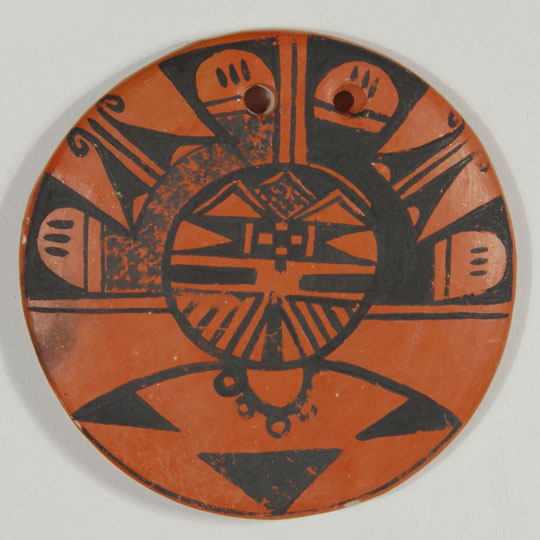 This exquisite round Hopi tile executed in black pigment on red clay features the image of the Palhikmana Katsina with her elaborate headdress. It has a pair of holes at the top so that it could be worn as a pendant or hung on a wall. It is not signed with the name of the potter.
Hopi Pueblo Polychrome Tile with Moth Design - C3776T
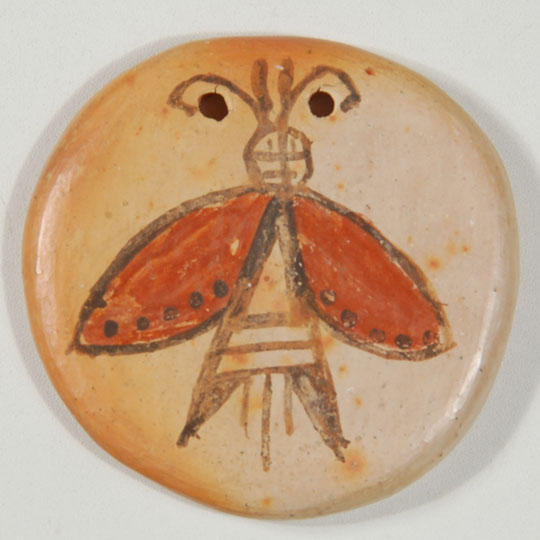 This small Hopi pottery tile is designed with a moth typical of that used by Hopi potter Grace Chapella, however, it is not signed so we do not attribute it to any specific potter. It has a pair of holes at the top to facilitate wearing it as a pendant or hanging it on a wall.
Historic Laguna Pueblo Double Headed Bird Effigy Jar - C3776C
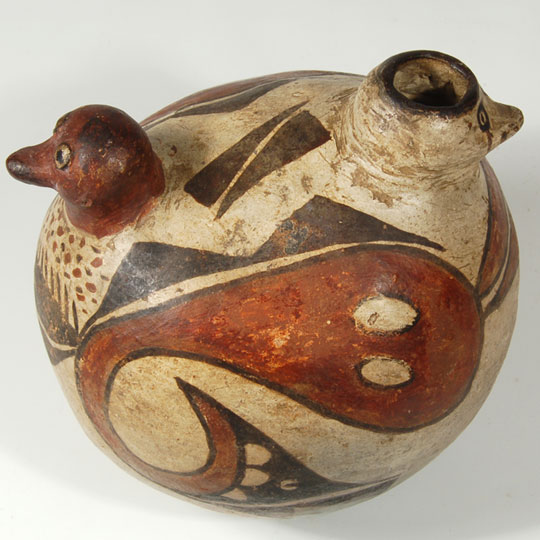 It is often difficult to make a determination of origin of Laguna Pueblo pottery because it is so closely similar to that from Acoma, for good reason. Laguna is, relatively speaking, a recent pueblo, having been established in 1699, although Laguna people say that the pueblo was previously occupied as early as circa 1400, however, the current villages date to 1699. Residents of Acoma, Zia, Zuni and other pueblos jointly settled the new pueblo. Because of its close proximity to Acoma, the pottery from Laguna resembles that of its neighbor. The same clay, same temper, and similar designs predominate between the two pueblos.
Zia Pueblo Pottery Tile with Floral Design by Benina Medina - C3776R
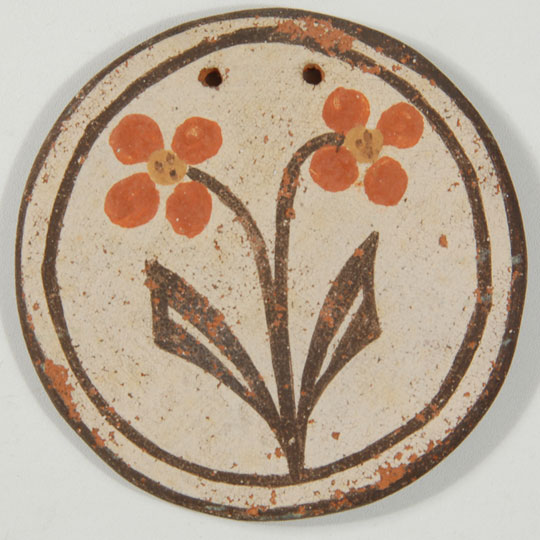 This floral design Zia Pueblo pottery tile has a paper label attached to the back that has the name Benina Medina written on it, presumably the name of the potter. According to her granddaughter, Reyes Madalena, Benina Medina was born at Zia Pueblo in 1873. She married Ramon Madalena from Jemez Pueblo in the late 1890s. She was an accomplished potter having won prizes at Santa Fe's Indian Market in the 1920's. After moving to her husband's pueblo, she was instrumental in reintroducing a pottery making tradition to Jemez Pueblo.
Hopi Tawaquaptewa Katsina Carving by Wilson Tawaquaptewa - C3753.65
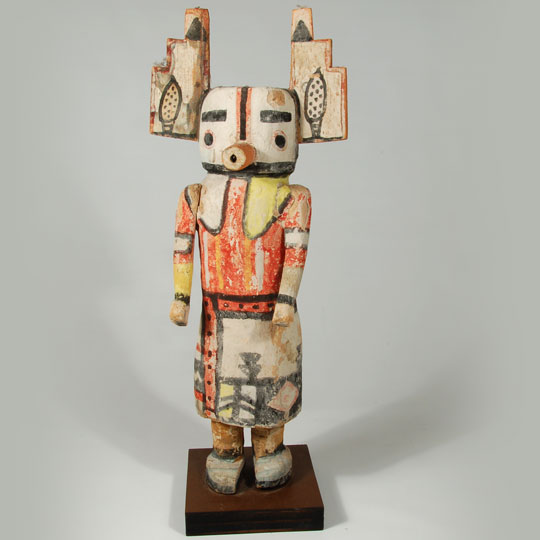 There was a time at Hopi when there were concerns by some of the older generation about making katsina dolls for sale to non-Indians. Yet, the allure of the financial aspect of selling them was appealing. To overcome this dilemma, a Hopi elder named Wilson Tawaquaptewa solved the concern for himself by making katsina dolls that were not true representations of Hopi Katsinas.
Santa Clara Pueblo Swirl Melon Jar by Linda Tafoya-Sanchez - C3779D
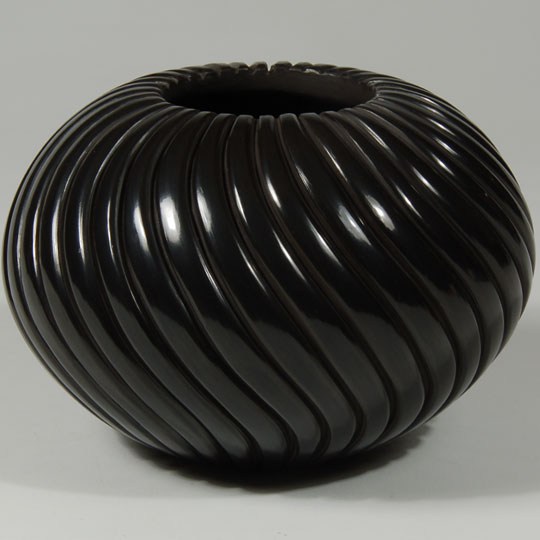 Melons were among the earliest plants to be domesticated in both the Old and New Worlds. Early European settlers in the New World are recorded as growing honeydew and casaba melons as early as the 1600s. A number of Native American tribes in New Mexico, including Acoma, Cochiti, Isleta, Navajo, Santo Domingo and San Felipe, maintain a tradition of growing their own characteristic melon cultivars, derived from melons originally introduced by the Spanish.
Small Polychrome Seed Jar by Nampeyo - C3776G
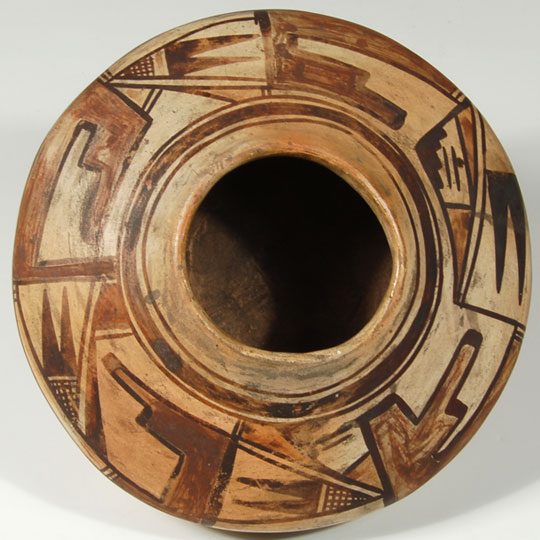 When Nampeyo was first making pottery, she was most likely making only utilitarian wares as that is what she had learned from her mother, White Corn, who passed away sometime between 1901 and 1909. Nampeyo's mother and grandmother were her mentors. It was not until Nampeyo's husband Lesso was working with the excavation party at the prehistoric Hopi Sikyatki Pueblo ruins, that Nampeyo was introduced to the magnificent prehistoric Sikyatki pottery shards that would influence her life's work and that of her descendants.
Navajo Coral and Sterling Serpent Ring with Large Stone by Charlie Morgan - C3777K
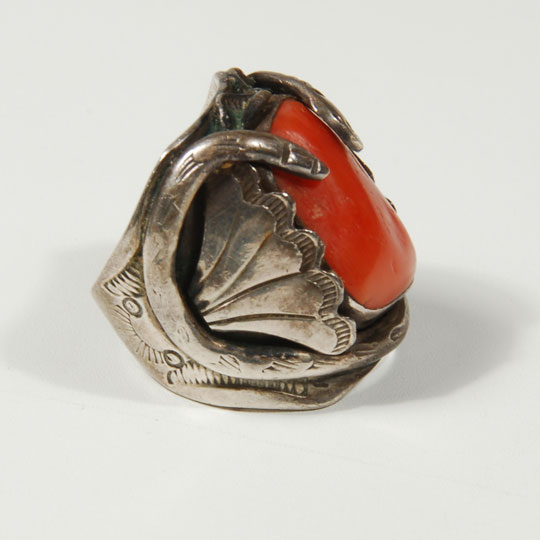 Serpents are often seen as symbols of water in the iconography of the Southwestern Native American. The curves of the serpent suggest the rolling waves of water. Water is essential to survival in the arid desert. This serpent ring features a large coral stone set in a silver bezel and surrounded by silver leaf motifs and a serpent wrapped around the coral with head and rattler overlaid over the coral. The initials CM are stamped on the ring.
Navajo Silver and Coral Necklace with Shadowbox Pendant - C3777H
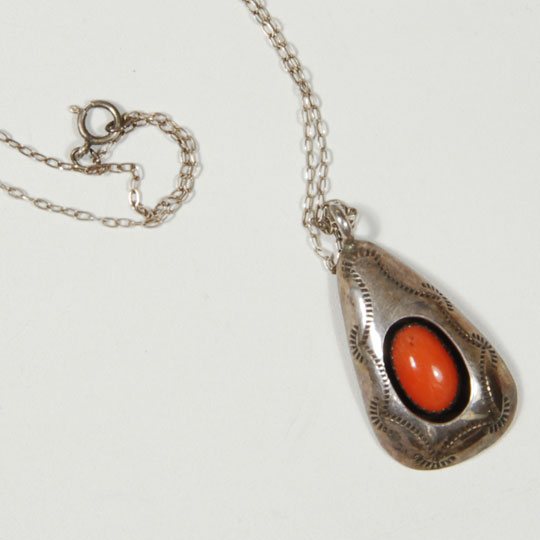 Navajo jewelry of the mid-20th Century was characterized by the use of silverwork and stamping to highlight the beauty of a single stone or stones. This small coral pendant is a good example of how Navajo smiths used silverwork to focus the eye on the stone.
Navajo Sterling Silver and Coral Floral Ring - C3777G
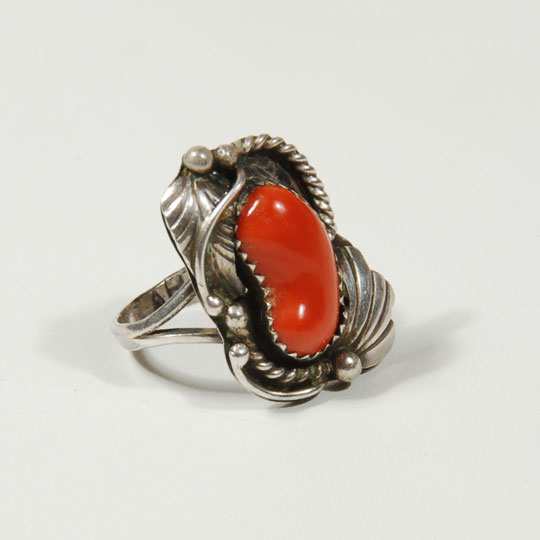 The earliest Navajo jewelry was made by filing designs into plain silver obtained from coins, flatware and ingots. By the 1920s, smiths began using sheet silver and the addition of dies and stamps became common. By the mid-20th Century the addition of floral motifs and leaves began.
Navajo Sterling Silver and Coral Shadowbox Necklace by Henry Clark Smith - C3777E
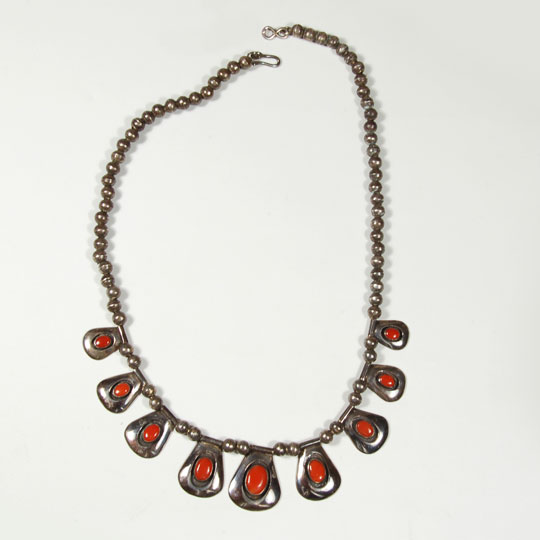 This silver and coral necklace is a significant piece for many reasons. The quality of the coral, the excellent craftsmanship, and the collection from which it came each alone would be a reason to make this a treasured item. The bright red coral cabs used in this necklace are considered to be quite rare as harvesting of coral has become limited. This necklace features nine beautiful coral cabs, each set meticulously in a hand-tooled silver shadowbox. The shadowboxes are spaced apart by hand made beads, both round and tubular. The excellent craftsmanship of artist Henry Clark Smith is evident.
Hupa Acorn Mush Serving Basketry Bowl - C3579G
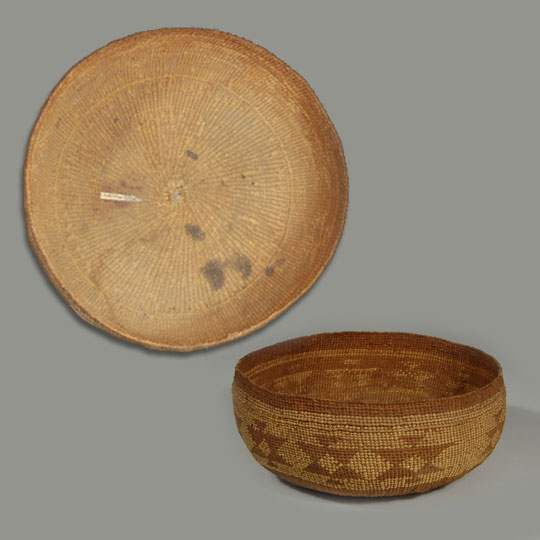 The Hupa live in the very northwest corner of California. They were relatively isolated until 1850 when gold was discovered and white settlers moved in. In 1864, the U. S. Government established the Hupa Reservation, moved invaders off the land, thus protecting their area for the future.