



Akimel O’odham - Pima Basket with Squash Blossom Design - C3579C
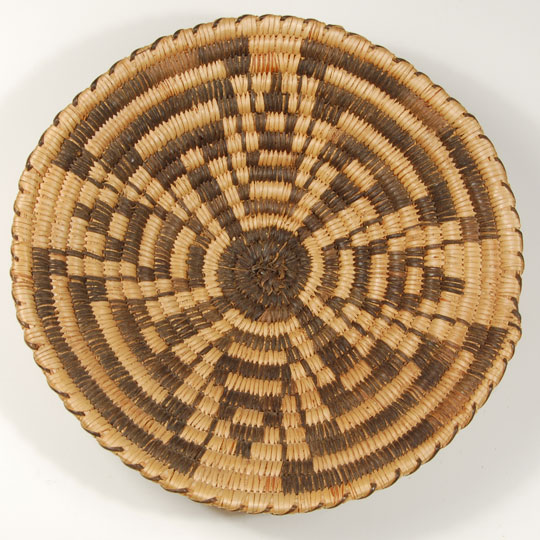 It was documented around 1900 that basket making was practiced in nearly every Pima home. Twenty years later it was stated that not one out of ten women could weave a creditable basket. In that 20 years, commercial utilitarian vessels became available so it is not unexpected that they would replace hand-woven baskets for home use. Since collectors and tourists were only willing to pay one to two dollars for a basket, the women realized that it was not worth their time to make them any longer. They could earn that per hour doing field work.
Acoma Pueblo Intricate Design Water Jar by Marie Zieu Chino - C3782
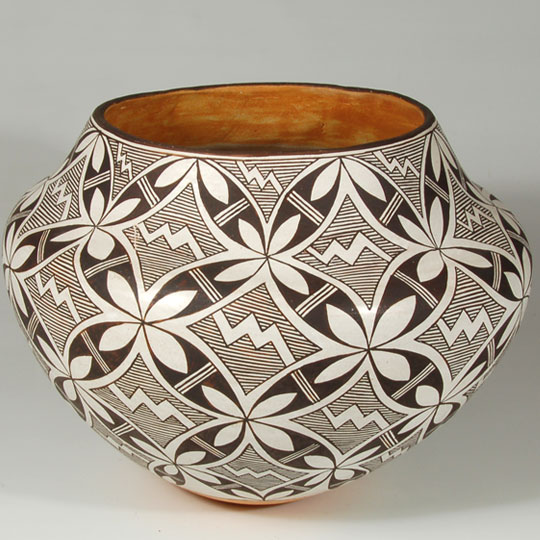 Much praise has been bestowed on Marie Z. Chino for the magnificent pottery she made in the fifty years she devoted to the craft and the praise is certainly earned. Chino was a master potter and it is understandable why collectors admire her work so enthusiastically. She was certainly one of the Acoma potters who made particularly important contributions to the art of pottery making in the period following World War II. Chino was making Southwest Indian pottery as early as the 1920s.
Maricopa Reservation Flared Rim Bowl with Five Female Images - C3776Z
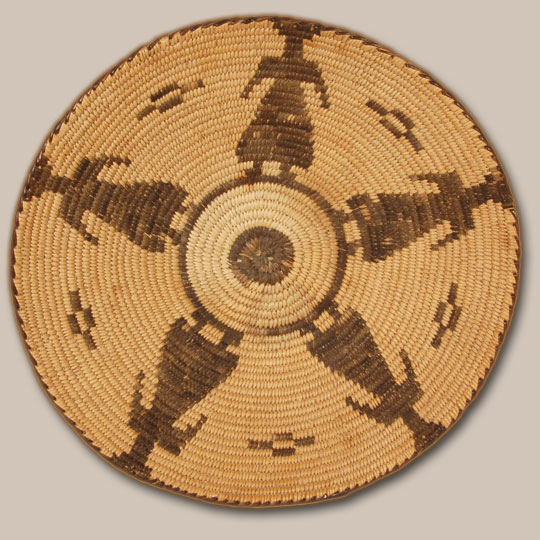 There are four Native tribes of Yuman-speaking people. They are known today as the Quechans (formerly known as Yumas) Mohaves, Cocopas, and Maricopas. All these tribes formerly made baskets but that has long since ceased. The Maricopa produce pottery today.
The Maricopa formerly consisted of small groups of people situated on the banks of the Colorado River for centuries. In the 16th century, they migrated to the area around the Gila River, to avoid attacks by the Quechan and Mojave peoples. During the 1840s, epidemics took a toll on the tribe. In the 19th century, the Maricopa formed a confederation with the Pima They became successful farmers, however, drought and water diversion by non-Indians brought widespread crop failures.
Historic Small Polychrome Bowl with Paper Label - C3776J
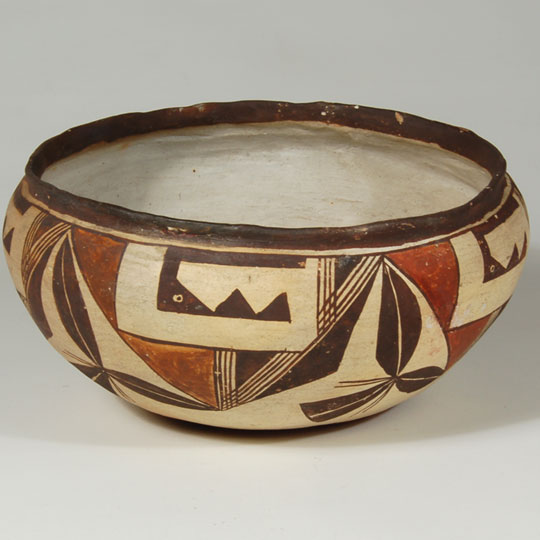 This is an exceptionally fine Acoma Pueblo Polychrome bowl, dating from around 1900 or earlier.. It was traditionally formed from native clay with ground pottery shard temper, coated with a rag-wiped white slip, painted black rim, and an orange/red underbody with a flat base, typical of Acoma pottery of that period. The design was painted in deep brown and dark orange/red pigments
Black Jar with Carved Eagle Feathers by Linda Tafoya-Sanchez C3779C
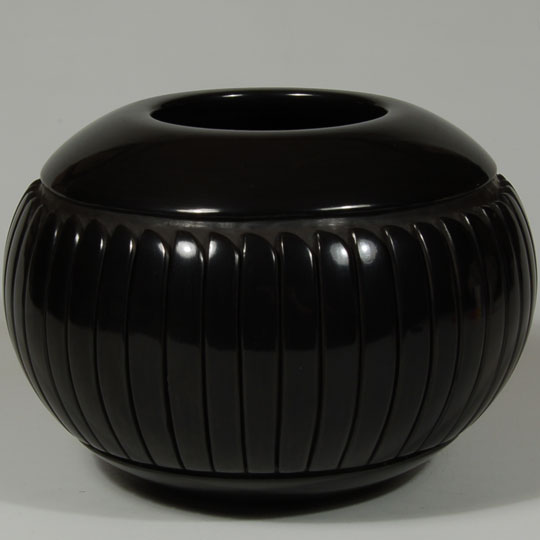 Julian Martinez of San Ildefonso Pueblo favored eagle feather designs for much of the pottery he painted for Maria. Santa Clara potters often used eagle feather design on their pottery as well. In this jar, Linda Tafoya carved eagle feathers in parallel lines encircling the body of the jar in an upright position. It is a sense of great respect and honor by Native Americans to include eagle feathers as design elements in pottery.
Hopi Large Seed Jar with Sikyatki Style Birds by Rainy Naha - C3779A
Hopi Large Seed Jar with Sikyatki Style Birds by Rainy Naha.
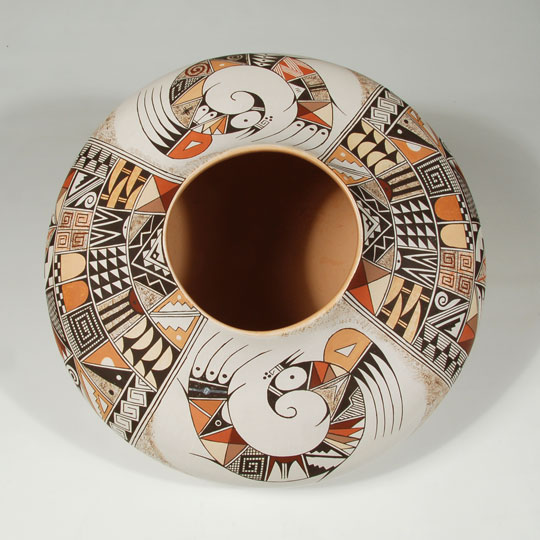 Rarely is Hopi-Tewa pottery as thin-walled as Acoma pottery but, in this instance, Rainy Naha has achieved that. Thin-walled is one attribute and finely constructed is another. The jar is well balanced and beautifully slipped in creamy white clay that has been stone polished to a beautiful burnish.
Laguna Pueblo Black on White Long Neck Jar by Robert Kasero - C3779E
Laguna Pueblo Black on White Long Neck Jar by Robert Kasero.
 At first glance, one might think of Dorothy Torivio when first seeing his pottery - but he is a new generation potter who is mixed heritage Hopi and Laguna Pueblos. He began his artistic career as a katsina doll carver but under the influence of Paula Estevan he became a potter.
Tall Polished and Carved Red Jar by LuAnn Tafoya - C3779B
Tall Polished and Carved Red Jar by Luann Tafoya.
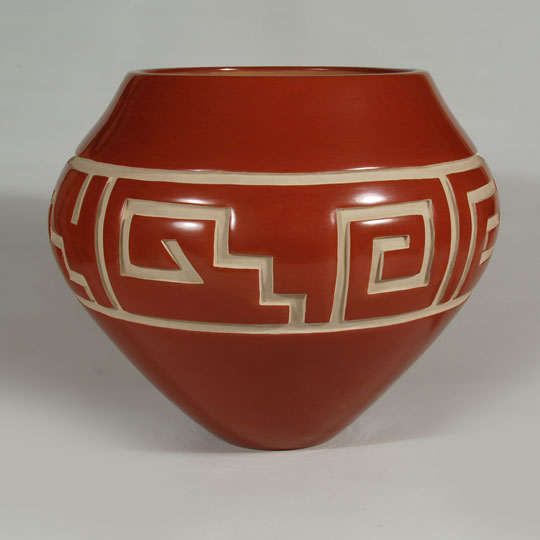 Lu Ann Tafoya, a daughter of Margaret Tafoya, certainly inherited the talent to produce beautifully sculpted jars with outrageously burnished surfaces. She has made jars almost three feet tall, a feat not easily accomplished. Her grandmother, Sara Fina Tafoya, was a masterful potter, as was her mother, Margaret Tafoya, who, in turn, passed on this artistic gene to nine children and numerous grandchildren.
Crystal Trading Post Alphabetical Pictorial Textile - C3756B
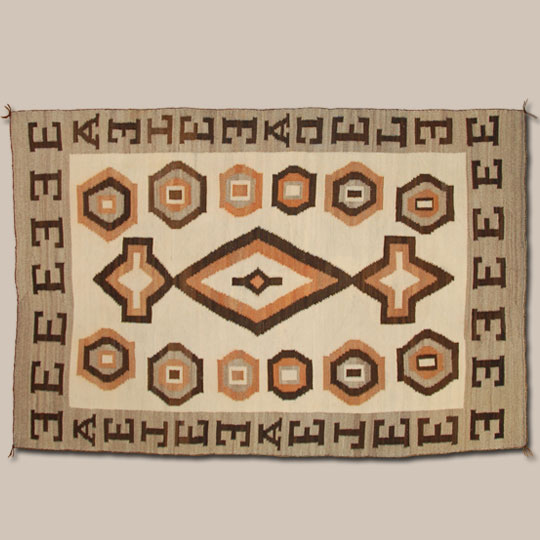 Traders on the Navajo Reservation in the late 1800s and early 1900s wrote, in their memoirs, how Navajo would come to the trading post, sit down and lean against the wall, never speaking a word, then several hours later, might point to a can of tomatoes, make the purchase, and walk out without further ado. Not able to read the English words on the canned or packaged products, they would study the labels and make their selection from the pictures on the packaging.
It is from the words they saw on commercial products that rugs of this nature came about. The letters were nothing more than symbols and a weaver would select a letter or letters she liked and repeat them on her textiles. This rug has a border composed of nothing but capital letters E, L, A, C, and I, some in the correct arrangement and some backwards. These were designs and their orientation was her decision.
Crystal Trading Post Rug with Cruciform Design - C3756A
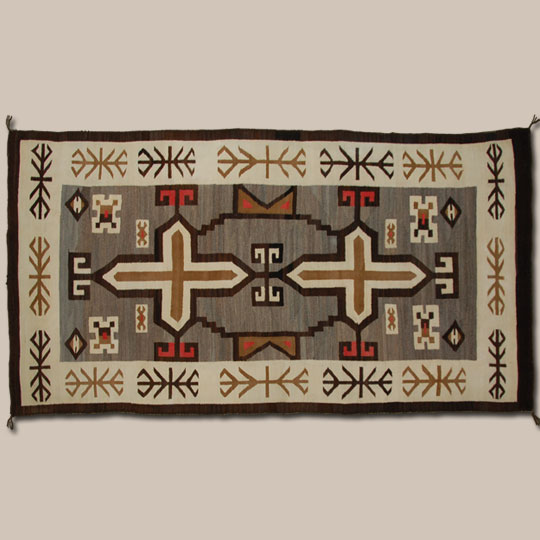 The Introduction to J. B. Moore's 1903 mail order catalog states "While this Booklet makes no claim of being a pioneer in its field, I think it may justly claim to be the first of its kind published and distributed from the very center of the Navajo Indian Reservation, by an Indian Trader living among and dealing directly with the Indians who make the goods which it illustrates and describes."
Moore was a trader who believed in helping the Navajo in his area of the reservation. He published catalogs of Navajo rugs, jewelry, baskets and curios for the purpose of generating a market for those crafts among people far removed from the reservation who may never visit it but, hopefully, would purchase their crafts from his catalogs. His catalogs featured 31 Navajo rug patterns from which to select. He specified grades of quality, sizes of rugs and patterns which could be specified by the client. If the client wanted a specific quality, say the best, then he would select the weaver who made the best rugs. If the client wanted to save money, he selected a weaver of lesser quality output.
Crystal Trading Post Rug with Vallero Stars - C3756D
 The years before 1864 were the Classic Period (1650-1863) in Navajo weaving. Navajo women wove textiles that ranged from thick utility blankets (diyugis) to extremely fine wearing blankets. The blanket that eventually became known as the "Chief blanket" was so named because it was a prized item of trade between high-status members of neighboring tribes and early traders. The Navajo during this period were producing some of the finest textiles ever to exist.
This period came to a sudden and traumatic end in 1863 when the United States Government, fed up with Navajo raids, had Kit Carson round up 7000 Navajo and walk them to Bosque Redondo in southern New Mexico where they were held captive for four years. Many died during the long walk and others died during the four years of captivity. Only one-quarter of them survived, and when they were released, they found their homes, pastures and flocks destroyed, and their homeland reduced to one-fifth its original size.
Crystal Trading Post Rug with Water Bugs and Whirling Logs - C3756E
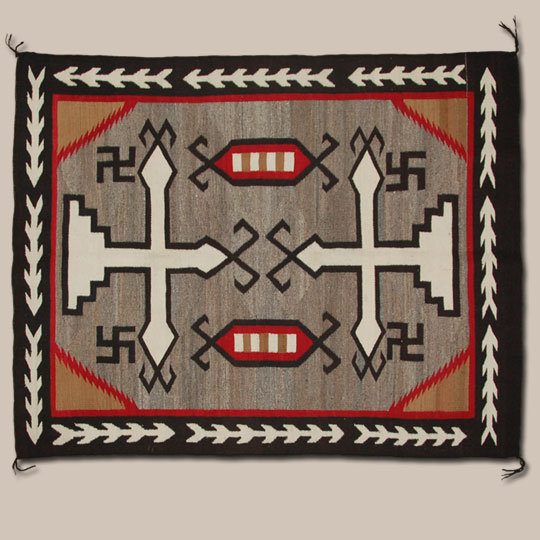 J. B. Moore of Crystal Trading Post in New Mexico, and J. Lorenzo Hubbell of Hubbell's Trading Post in Arizona were the two most important traders to the Navajo in the late nineteenth and early twentieth centuries. They not only supported Navajo families in the vicinity of their posts, they promoted the weavers and established a market away from the reservation for the rugs from their looms.
J. B. Moore was a resident of Sheridan, Wyoming, when he bought an interest in the trading post at Washington Pass in 1896. He changed the name to Crystal Trading Post when he took full ownership. Moore was only at Crystal for 15 years but he set into motion a long-term program to benefit the weavers of his area. Following in the footsteps of Sears, Roebuck & Co., he published catalogs from which anyone in the continental United States could purchase Navajo rugs without ever setting foot in the state.
Crystal Trading Post Rug with Whirling Logs - C3756C
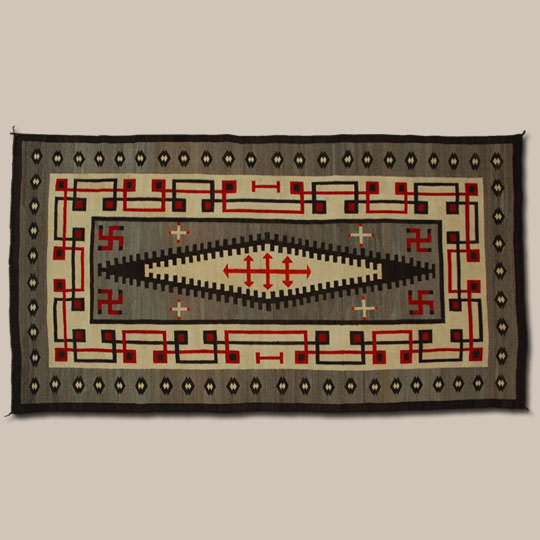 The central elongated diamond would normally be the focal point of this rug but the inner border of lines and blocks superimposed on the white background takes command. It is so architectural and reminiscent of something from the mind of Frank Lloyd Wright that one must wonder where the Navajo weaver got the idea for the design. J. B. Moore had departed the trading post in 1911 and this rug dates from circa 1920-1925, so it is not one he published in his catalogs but it could be a take-off from designs in plate VII of his 1903 catalog. If so, the weaver expanded the idea into something very dramatic and of her own creation.
Crystal Trading Post Storm Pattern Rug - C3781
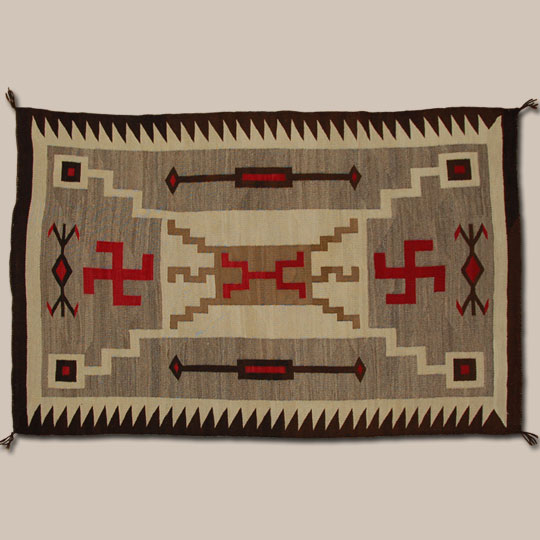 Between release of his 1903 catalog and his 1911 catalog, J. B. Moore published loose leaf sheets of Navajo rugs that could be purchased. The first one of the loose leafs was labeled Plate IX and it was an image of a Storm Pattern rug which Moore stated "Special Design and Weave by 'Dug-gau-eth-lun bi Dazhie.'" When he published his 1911 catalog, he replaced the Storm Pattern rug in the loose leaf sheet with a new design that he labeled Plate XXVIII and it was being made by the same weaver.
Diné - Navajo Crystal Trading Post Rug - C3554B
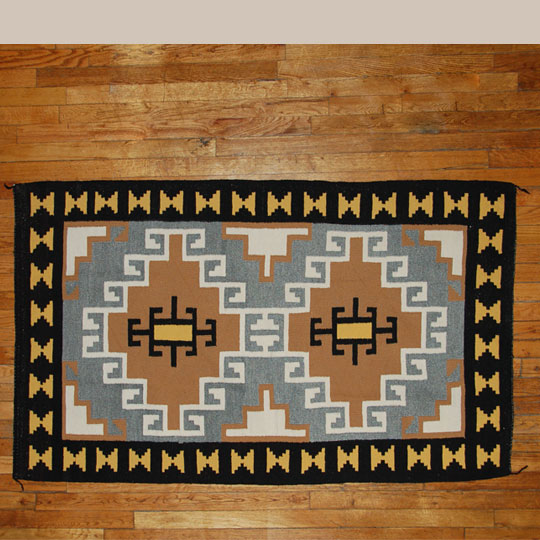 This delightful floor rug was woven from all native wools. It exhibits the qualities of the French Rambouillet wool that was introduced to the Navajo flock in the early twentieth- century. It was totally processed by hand: shearing, cleaning, carding, spinning and dying, by the weaver.
This textile is medium weight and canvas tight, as is typical for a mid-twentieth century rug. The outer border is worked in variegated brown homespun that appears black. The inner field is gray in color and supports two very strong diamond designs that are surrounded by typical Crystal Trading Post hooks executed in white. Within these diamonds is a water bug element in yellow outlined in black floating on a mustard background.
J. B. Moore Plate II Variant Crystal Trading Post Navajo Rug - 24162
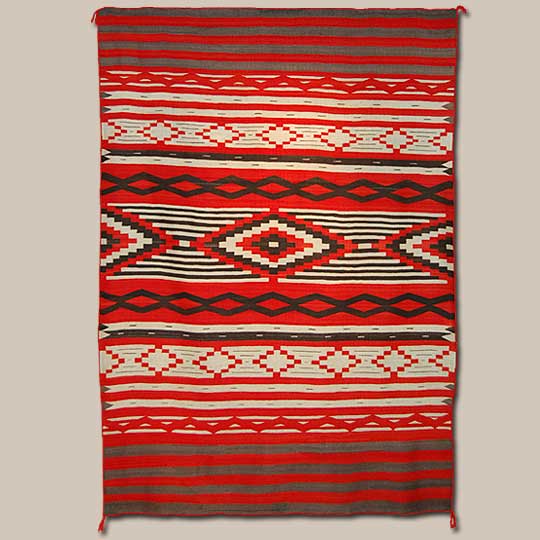 J. B. Moore, Trader at Crystal Trading Post in New Mexico from 1900 to 1911 is now famous for introducing to the weavers new patterns of textiles he felt would be saleable to Easterners for use as rugs. His early examples, published in a 1903 catalog, were more similar to classic Navajo textiles and those published in a 1911 catalog were more similar to Persian rugs.
J. B. Moore Plate XXVII Variant Rug, c. 1915 - C3756F
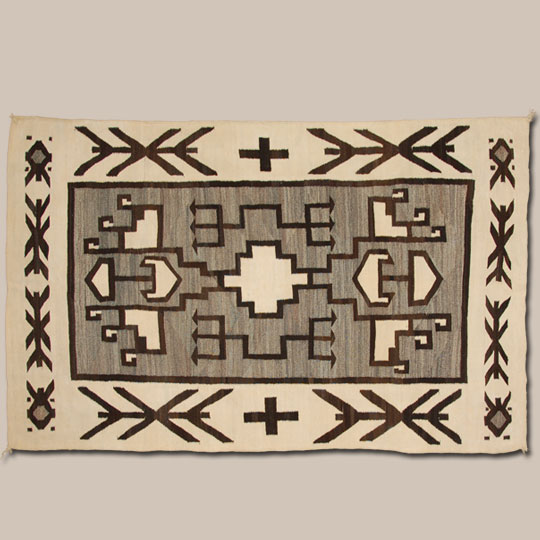 RJ. B. Moore offered his mail order clients options of purchasing a rug with color or black and white only, the choice being the décor in which it was going to be used. It could be the same pattern rug, as in this variant of Plate XXVII which, in the catalog, is shown in brown, black, red and white. The one pictured in the catalog has a whirling log symbol in the center of the rug and that element was omitted in this rug. Other variations to the pattern were made as well.
Sterling Silver Overlay Bolo with Antelope by Bobby Sekakuku - C3777B
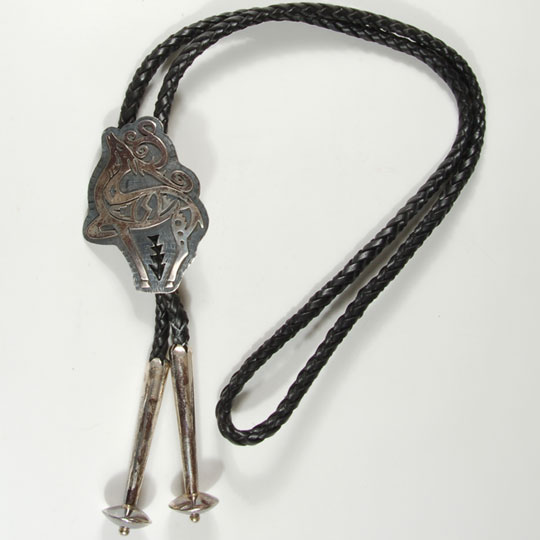 Bobby Sekakuku was the nephew of Lawrence Saufkie. He worked in the traditional Hopi overlay style which was developed by his great uncle Paul Saufkie and Fred Kabotie in the 1930s. His work is characterized by extremely fine detail.
Sterling Silver Overlay Pin and Pendant with Corn Motif by Lawrence Saufkie - C3777A
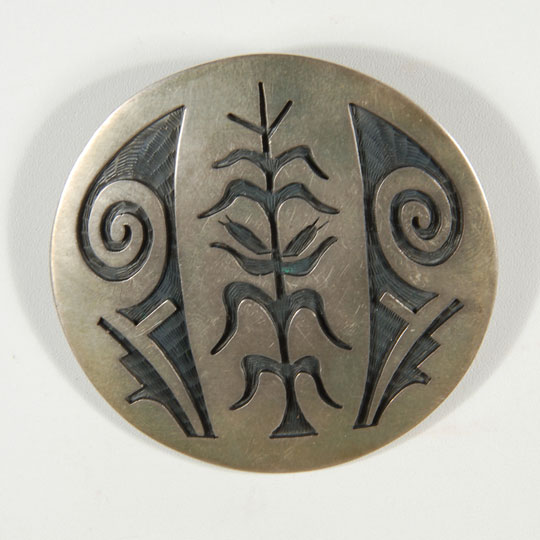 Lawrence Saufkie (1935-2011) was the son of Paul Saufkie. The elder Saufkie, along with Fred Kabotie, developed the Hopi overlay style of jewelry during the 1930s. After World War II, they taught this style to returning veterans at the Hopi Crafts Guild on Second Mesa at Hopi Pueblo. Lawrence Saufkie continued working in the style of his father and went on to influence a new generation of silversmiths.
Sterling Silver Overlay Ring with Sun Face by Bobby Sekakuku - C3777C
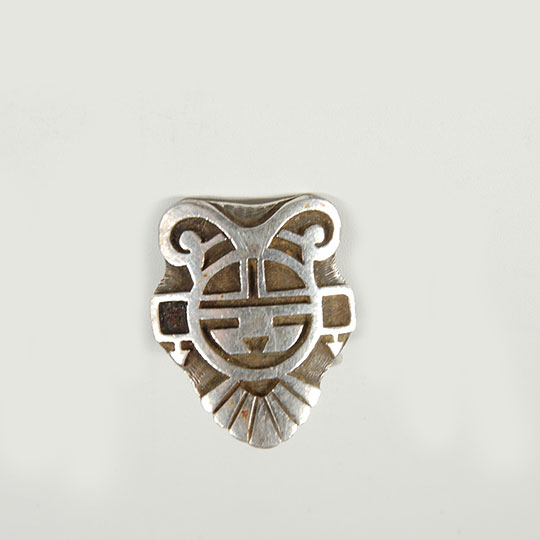 Bobby Sekakuku was the nephew of Lawrence Saufkie. He worked in the traditional Hopi overlay style which was developed by his great uncle Paul Saufkie and Fred Kabotie in the 1930s.