



An Amazing Squash Blossom Necklace from Zuni Pueblo - C3670A
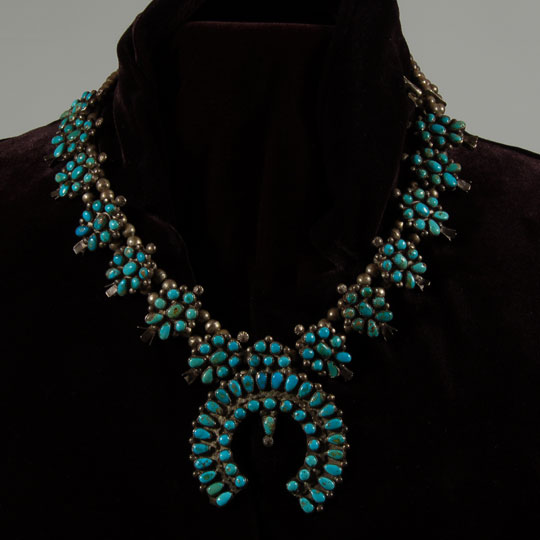 Sometime in the history of Native American jewelry from the Southwest, someone named a necklace, such as this one, a "squash blossom" necklace. Technically, the blossoms attached to the necklace were derived from the pomegranate. The area with the small turquoise cabs that looks like a blossom and the silver protrusions were copied from the silver pomegranate blossoms seen on the trousers of the vaquero from Spain and Mexico. Regardless of the name, these have been among the most popular Native necklaces for decades, certainly as early as pre-World War II.
Black-on-black Low Open Jar signed Marie & Julian by Maria Martinez - C3661A
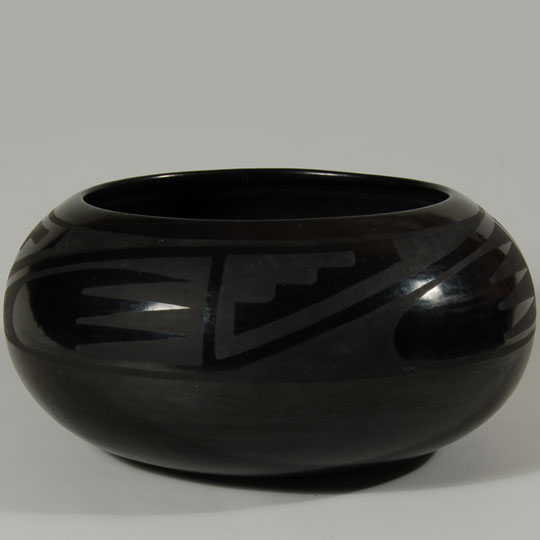 Maria Poveka Martinez (1887-1980) and Julian Martinez (1885-1943) worked together producing pottery from the early 1900s-she making the beautiful Tewa shape vessels and he painting beautiful designs in traditional Polychrome style. Because Maria was considered the best potter at San Ildefosno, she was selected to experiment on reproducing the prehistoric wares being excavated. She and Julian worked diligently for several years to recreate the earlier pottery and Julian painted designs in the traditional Polychrome style. It was not until around 1912, that they became interested in experimenting with the blackware of previous periods. It was another 10 years before they achieved satisfactory results.
Hopi Burnished Clay Seed Jar with Ear of Corn by Iris Youvella Nampeyo - C3658E
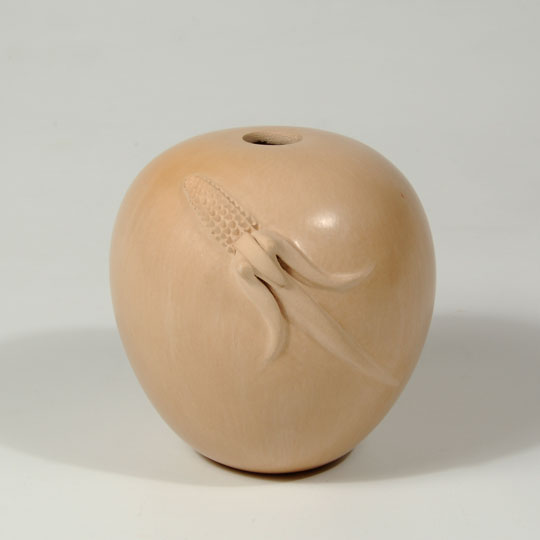 Iris Youvella Nampeyo is a daughter of Fannie Nampeyo and granddaughter of Nampeyo of Hano, who is known for her sculptural design pottery that she has mastered to the finest detail. This style of sculpture was first made by Elizabeth White - Polingaysi and further refined by her nephew, Al Colton - Qöyawayma.
A Pair of Pueblo Animal Dancers by Joseph Tapia - C3667B
 There are two individual paintings of pueblo animal dancers which have been framed together in a single frame. One is a Deer Dancer and the other a Ram Dancer. Both are similar in style and size and both by Joseph Tapia, a painter from Tesuque Pueblo who passed away in 1991 at the young age of 32 years. The paintings have been framed so that the two dancers face each other.
“Lady in the Corn Field” signed Tsa-sah-wee-eh by Helen Hardin - C3667A
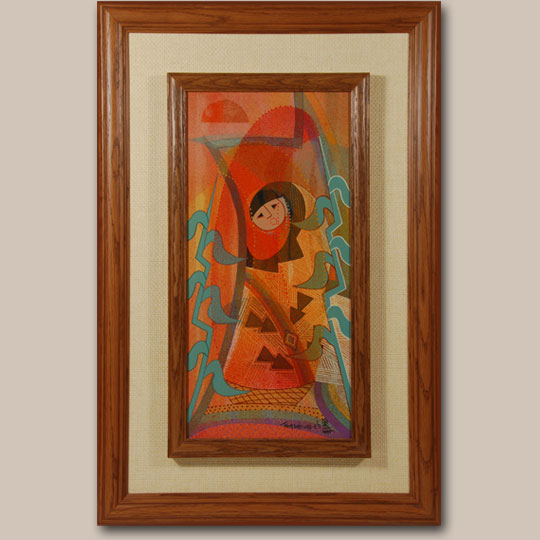 It has been observed that when Helen Hardin was involved in a painting, she was totally involved until that painting was completed. Her life was dedicated to her work as she retreated into the spirituality of what she was doing. Born of a Santa Clara Pueblo woman, Pablita Velarde, and a non-Indian man, raised in Albuquerque away from pueblo events, she nevertheless drew on her Native culture. She had no patience to follow the two-dimensional painting style of the Santa Fe Indian Schoolto which so many other artists were following.
Navajo Painting of a Deer and Fawn by Quincy Tahoma - C3652
 Realistic paintings of animals reflect much of his early life. No matter how violent his portrayals became in later years, Quincy Tahoma (1917-1956) Water Edge still painted animals with affection and great beauty. This pair of running deer is typical of his treatment of animals. They are romping around enjoying the snow.
This painting was completed in 1942 when Tahoma was 25 years of age. He had attended the Santa Fe Indian School for four years, from 1936-1940, entering in the seventh grade. He was a student at the same time as Harrison Begay, Pablita Velarde, Geronima Montoya, Andy Tsihnahjinnie, and Gerald Nailor, and studied under the tutelage of Dorothy Dunn at The Studio.
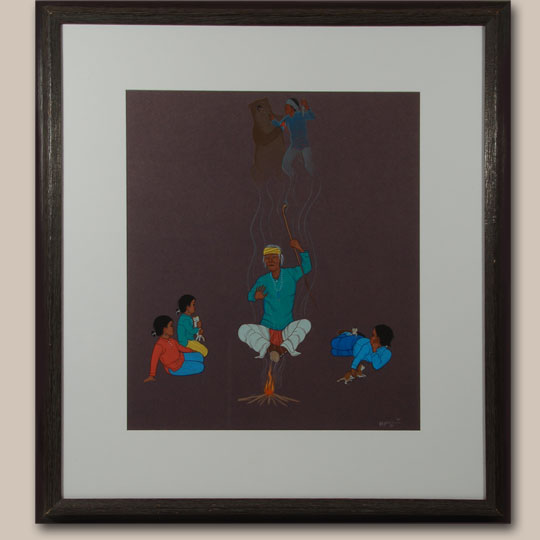
Grandfather Storyteller and his Enthralled Kid Audience by Beatien Yazz - C3665C
We are all familiar with the famous U. S. Marine battalion known as the "Code Talkers" and the reasons that they were so successful in communicating by code during World War II without the Japanese being able to break their code. They used Navajo words as substitutes for English words. As an example, the Navajo word for "turtle" was used for the military vehicle word "tank." Those Navajo young men, of whom Beatien Yazz was one, have been praised for their contribution to shortening the war in the Pacific. The reason this worked was that the Navajo language was only a spoken language at that time. Since, it has been given an alphabet and lexicon.
Navajo Painting “The Flute Player” by David Chethlahe Paladin - C3791A
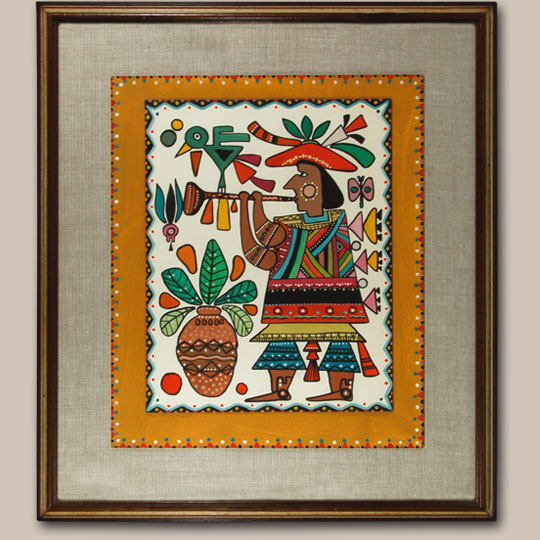 David Chethlahe Paladin was a student of the Santa Fe Indian School, where he learned the basic fundamentals of painting from Dorothy Dunn. Dunn encouraged her students to document and celebrate their cultures. As a young man, Paladin struggled with his identity as the mixed-race son of a Navajo woman and a visiting white missionary. As he developed as an artist, he began to display a genuine affection for his Navajo culture. His style evolved considerably over the years, and ultimately drew from a wide variety of influences while always remaining grounded in his Native American roots. Paladin was trained as a shaman, serving the Huichol and Tarahumara tribes in Mexico as well as his native Navajo people.
Untitled Painting of a Religious Procession by David Chethlahe Paladin - C3791B
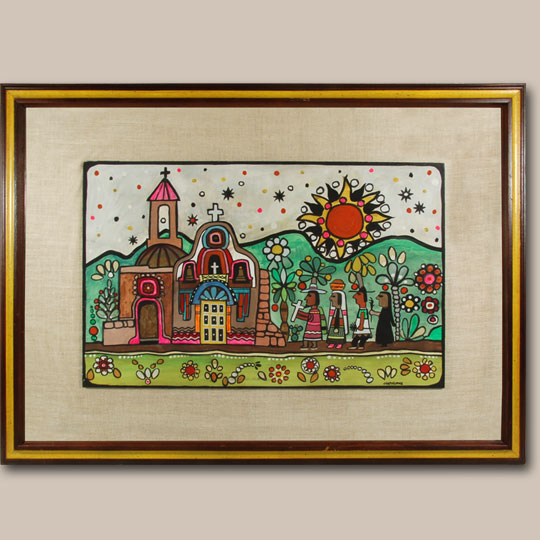 David Chethlahe Paladin's work evolved drastically over the course of his career, moving away from what was common among Native American artists of his time towards more abstract contemporary work. Though his methods changed over time, his themes remained the same: spirituality, creation, and rebirth. Paladin depicted the same rituals, ceremonies and symbols as many of his Navajo contemporaries, but did so with a uniquely creative perspective. He celebrated life, above all else, and this painting is a fine example of his singular style.
Original Navajo Painting of a Quail by Gerald Nailor - C3788C
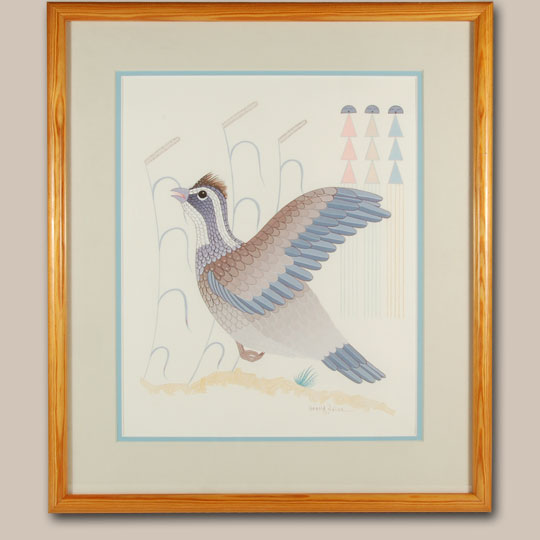 In 1951, an arts silkscreen printing business named Tewa Enterprises was started in Santa Fe by Charles Barrows, a silkscreen printer, and Harrison Begay, the well-known Navajo painter. Tewa's mission was to hand silkscreen reproductions of Navajo and Pueblo paintings and make them available to a wide audience at low prices. Subsequently, the current owner, Cathie Sullivan purchased Tewa Enterprises and now the business has ceased work.
Navajo Sterling Silver Sandcast Belt Buckle - 25864
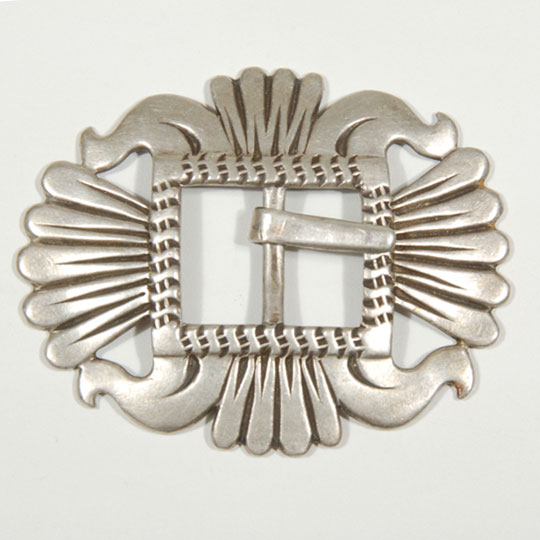 Tufa casting, often erroneously referred to as sand casting, is one of the earliest techniques used by the Navajo smiths. Today, it is still accomplished in the same manner as it was 150 years ago. Casting techniques among the Navajo developed about 1875. Volcanic tuff, or tufa, which is widely available on the Navajo Reservation, is used to create molds for casting. The artisan carves the desired design into a block of tufa, and cuts a matching piece of tufa to correspond to the carved one. Molten silver is then poured into the mold, created by putting the two pieces of tufa together, to fill the carved areas. The result is an item of jewelry that could now be refined and worked to make the desired piece.
Navajo Silver and Drilled Turquoise Ring - C3789C
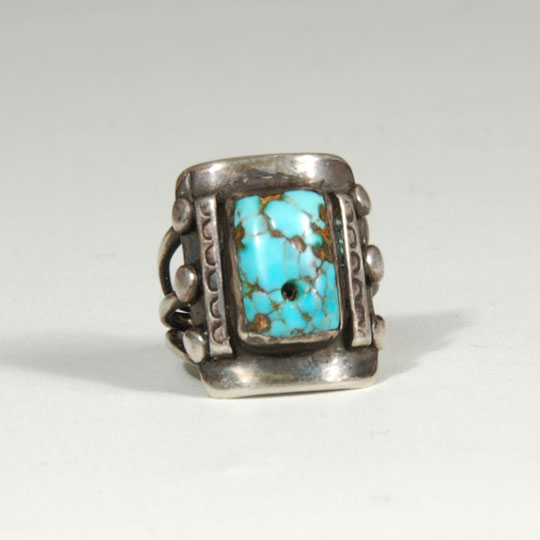 The base of this Navajo ring is a combination of three silver wires soldered together at the mid-point and individually soldered to a curved silver backing. Mounted on the backing is a beautiful sky blue turquoise cab that is drilled with a hole, which may indicate it was once a tab earring. The silver backing has the effect of a shield which visually elevates the turquoise stone to more prominence. The stone is a beautiful blue with an excellent array of copper-colored matrix.
Navajo Sterling Silver Bracelet with Oval Turquoise Stone - C3789D
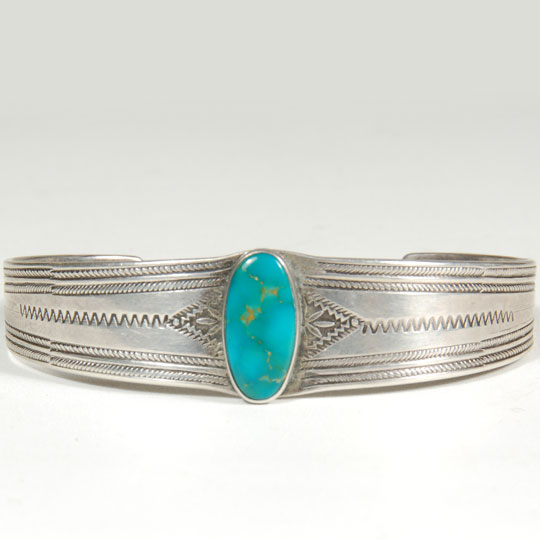 Elegant, dainty, lace-like could be descriptions of this bracelet. It is one of the most finely detailed works imaginable. It appears that channels were cut into the silver base and then strips of silver rope were inserted into the channels. The other option to consider is that it is silver overlay where a thin sheet of silver serves as the backing and then a second layer of silver with cut-out designs is overlaid on the backing. Regardless of the technique used, it is a beautiful bracelet with a deep blue/green turquoise stone at the center.
Navajo Three-stone Turquoise and Sterling Silver Bracelet - C3789B
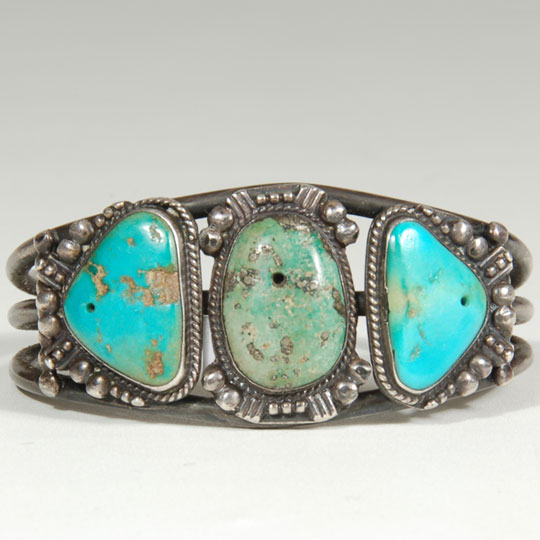 Recycling in the Native jewelry business is a relatively new procedure. It consists of taking very high quality turquoise stones from a tab necklace and repurposing them in another item of jewelry, overlooking the drill holes as being detrimental.
Much of the early turquoise jewelry had very high quality desirable turquoise. The stones used in older nugget necklaces were sometimes drilled off center, as are the two stones on the outer edges of this bracelet. The center stone was drilled in its center. The combination of the three stones is perfect for this bracelet.
Black on Red Hopi Pueblo Seed Jar by Mark Tahbo - 25863
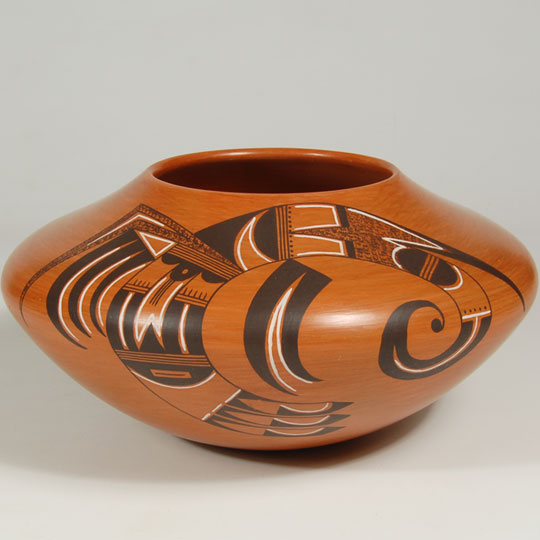 Mark Tahbo has surprised us again. He brought us a Hopi seed jar different from any he has shown us before. Normally, all of his jars are made in that beautiful orange blush that most Hopi potters produce. This jar, however, is one of the older styles executed in red. Mark said he got the idea of using a different clay to see if he could produce a jar in tribute to famous Hopi potter Garnet Pavatea. Garnet seemed to prefer using "yellow clay" that was available just below the mesa top at First Mesa, a source no longer accessible. It became necessary to construct a wall over the clay source to prevent that area of the mesa from collapsing.
Zia Pueblo Painting of a Single Figure Male Dancer by Rafael Medina - 25383
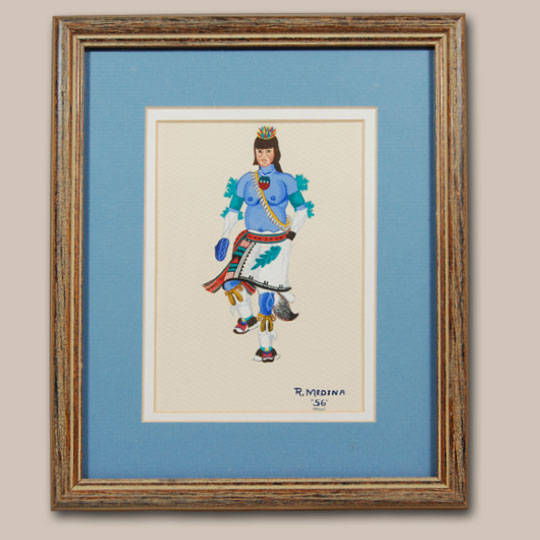 Rafael Medina (1929-1998) Teeyacheena of Zia Pueblo was known for painting in the typical traditional flat style. He received his education at the Zia Day School at Zia Pueblo, as well as at the Albuquerque Indian School. He also studied under the stewardship of Velino Shije Herrera, Jose Rey Toledo and Geronima Montoya at the Santa Fe Indian School.
A Pair of Paintings of Pueblo Corn Dancers by Tonita Peña - C3789E-F
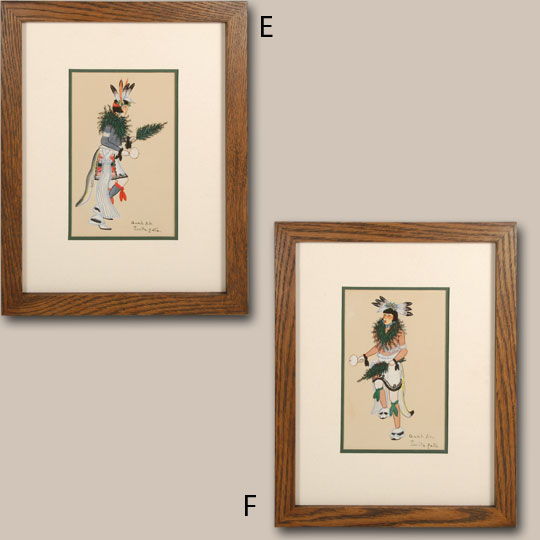 Tonita Vigil Peña (1893-1949) Quah Ah did not have an easy life. She lost her mother and sister when she was 12 years old and then was sent by her father from San Ildefonso, her native pueblo, to live with an aunt and uncle at Cochiti Pueblo. She essentially lost her father at that time as well. She had to learn new customs, dances, songs and even a new language, because Keres was spoken at Cochiti rather than Tewa, which was spoken at San Ildefonso.
Original Navajo Painting of Hummingbirds and a Yei by Gerald Nailor - C3788D
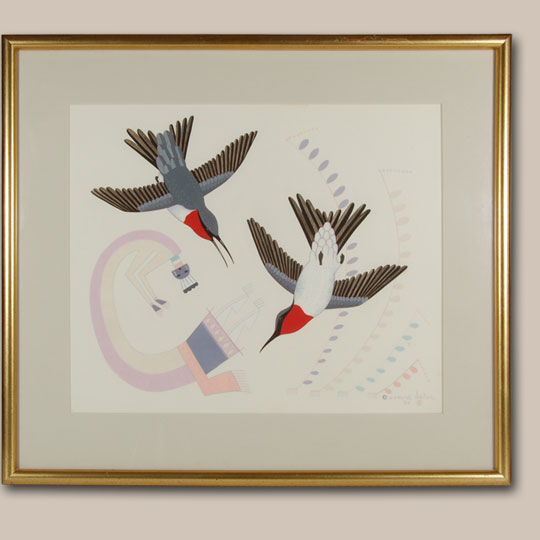 This original painting of hummingbirds and a Yei was among the last paintings made by Nailor, as he died the following year. At the time of his death, he was living with his family at Picuris Pueblo. Tragically, he was only 35 years old when he died from injuries received in an attempt to help a woman whose husband was brutally beating her. Dorothy Dunn's hope for his future would not happen. She stated "We hope this Navajo boy will keep to the proud Indian beauty, more and more, his eyes on the straight road. It must be hard in a world where garish lights beckon on all sides. He has humor as well as feeling for line."
Original Painting of Koosa, Avanyu and Rainbow by J.D. Roybal - C3788E
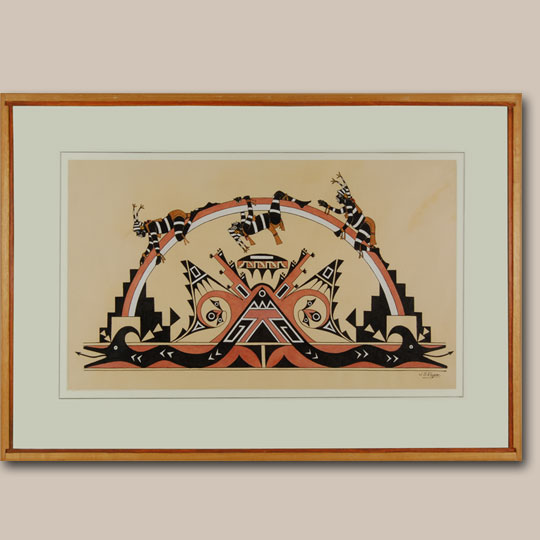 Having seen an original painting of Koosa, Avanyu and Rainbows by San Ildefonso Pueblo artist Awa Tsireh, printers at Tewa asked J. D. Roybal (Awa Tsireh's nephew) to paint something similar from which Tewa could make prints. Roybal practically copied his uncle's painting in detail, to the amusement of the Tewa staff. This painting is the original by J. D. Roybal from which Tewa did make silkscreen prints.
Cochiti Pueblo Pottery Storyteller with 2 Kids by Damacia Cordero - C3688.44
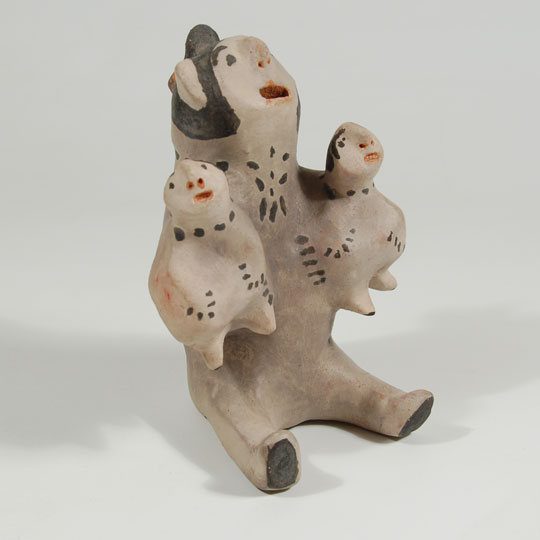 Damacia Cordero was a legend from Cochiti Pueblo. Her storyteller figurines and animal creations were unlike any other potter's work. This storyteller figurine, possibly a male, has the elongated torso, short legs, big ears, protruding nose and flat face of her traditional style.