



Black Polished Jar with Three Bear Paw Indentations by Severa Gutierrez Tafoya - C3771F
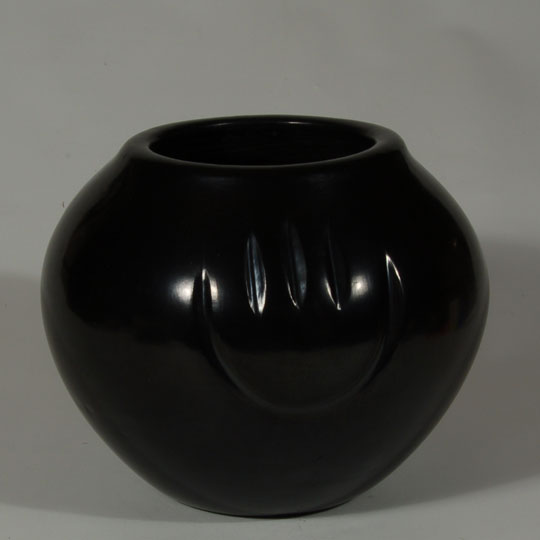 Black pottery from the northern New Mexico Tewa Pueblos has existed for a thousand or more years but it was brought into the realm of fine art in the 20thcentury. Pre-20th century black pottery was functional, fired to a harder temper and generally not decorated. When 20th century potters discovered an interest in black pottery in the 1920s, they began to be more particular about vessel shape, smaller sizes, higher burnish and overall improved appearance. Various designs were added to enhance the interest of collectors. One of the popular designs used at Santa Clara Pueblo was the bear paw-frequently used by Sara Fina Tafoya, Margaret Tafoya and family, and Severa Tafoya and family.
This round jar was beautifully fashioned into the shape of a melon and burnished to a brilliant sheen. Three bear paw impressions were imbedded into the clay on the upper half of the vessel. Legend has it that a bear can always find water so putting a bear paw on a water jar will insure it will never be empty of water.
Painting of Mimbres Human and Bird Figures by Tony Da - C3770
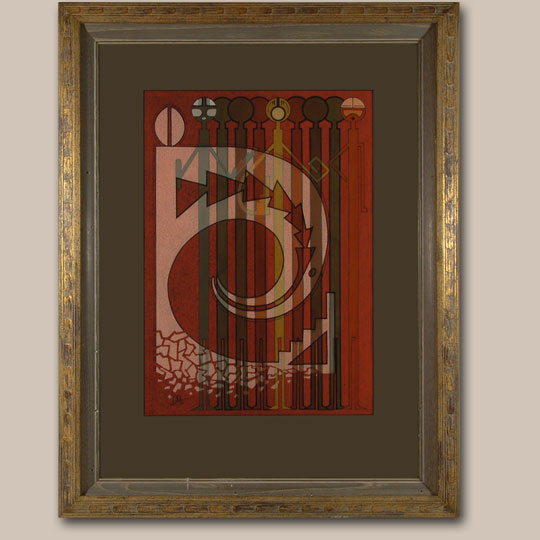 Overlaid on a solid red background that had been atomized with black spray paint, the artist painted the essence of the art piece-that is, he painted the nine human-like figures and the head of a stylized eagle. I will not attempt to explain in what manner each layer was added because I do not know the answer to that riddle. There is so much going on in the layering of this painting that one wonders how Tony Da managed to visualize each layer as he was painting it. Of course that is why Tony Da was considered such a major artist. This painting is dated 1964 at which time Tony was only 24 years old. He had already mastered the techniques of painting by then.
RARE Historic Tesuque Pueblo 19th Century Water Jar - C3753.05
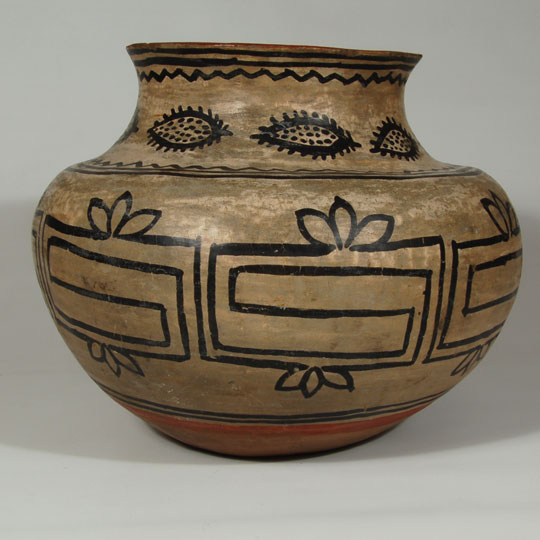 This is a traditional Tesuque water jar or olla. True to tradition, the jar was constructed of native clay, slipped with a rag-wiped bentonite slip and decorated with designs typical of the 1880 period.
Tesuque potters, because of their conservative nature, did not stray into the more commercial pottery that their neighboring pueblos fell into; rather, they kept to the traditional shapes and designs used by their predecessors. The red rim and red band near the underbody qualify this jar as a Tesuque Polychrome vessel.
Sterling Silver First Phase Style Concha Belt by Austin Wilson - C3776ZB
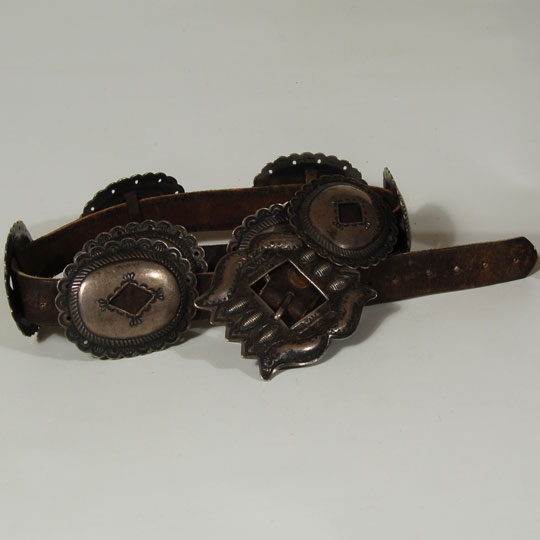 It has been postulated that the Navajo concha/concho belt had its origin among the Plains Indians, not as a belt, but, rather, as a hair drop. Plains Indian braves wore silver discs, usually made of German silver, strapped on a piece of rawhide and hung from their hair and down their backs. It was from these hair drops of round discs that the Navajo got the idea to make conchas of similar shape but to string them on leather and wear them as belts.
The earliest concha belts were made around 1868 after the captured Navajo were allowed to leave Bosque Redondo and return to a portion of their former location. These first ones were generally made from coin silver, were round and had a diamond-shaped hole cut in the center through which the belt was laced and was visible. These have been referred to as First Phase Concha Belts and that period lasted until around 1900. Subsequent designs and shapes followed this first phase.
Hopi Small Seed Jar with Punched Rim Design by Nampeyo of Hano - C3776E
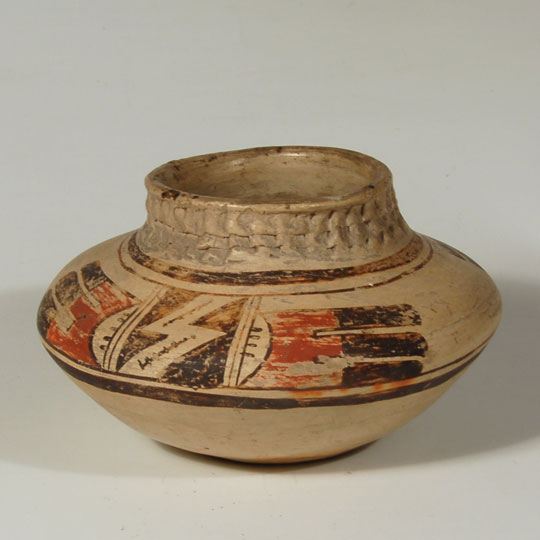 It is believed that as Nampeyo began losing her eyesight, she began to make more tactile decorations on her pottery. According to Kramer, "A photograph taken by Emry Kopta around 1920 is the earliest to show a jar with a corrugated neck; several other corrugated jars can be attributed to this period." It was about that time that Nampeyo began losing her sight. She had been treated about 20 years earlier for Trachoma but it began to reoccur in the 1920s and eventually clouded her vision.
Another quotation from Kramer states: "Three decades after visiting the potter during the summer of 1920, Neil M. Judd wrote that 'Nampeyo was already nearly blind.' Nearly five decades after studying pueblo potters in 1924 and 1925, an elderly Ruth Bunzel stated that Nampeyo had been totally blind at that time." So, it is generally accepted that Nampeyo's sight began to fail around 1920 and was completely gone by 1925. She, from experience, was very capable of forming pottery but beginning to lose the ability to paint designs. It was during this time that her daughters Annie and Fannie painted their mom's pottery.
San Ildefonso Pueblo Painting of Skunks and Chickens by Popovi Da - C3775E
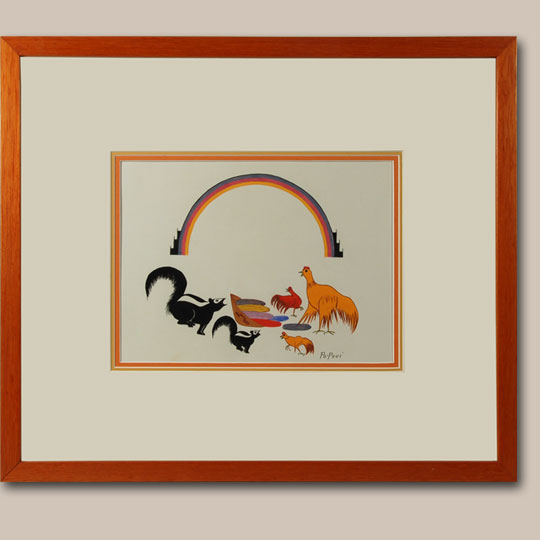 Popovi Da displayed special skills in producing beautiful, balanced, geometrical and symbolic designs. He had the delicate touch of a fine artist, whether in paintings or pottery. His name is synonymous with artistic genius, a trait he inherited from his famous parents. Popovi was baptized Antonio José Martinez but officially changed his name to Popovi Da, his Tewa name, in 1948. He attended San Ildefonso Day School and the Santa Fe Indian School, where he studied under the tutelage of Dorothy Dunn and Geronima Cruz Montoya.
Set of Five Polychrome Pottery Buttons from Zia Pueblo - C3776P
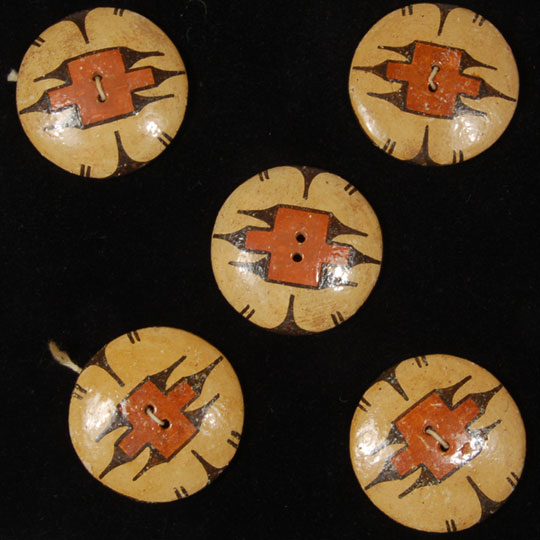 The potters at Zia Pueblo have long been recognized as the best potters in the region. Their sturdy, beautifully decorated pots and bowls have been in demand for hundreds of years. The discovery of Zia pottery in abandoned Jemez sites suggests that Zia potters were trading their wares to their neighbors before the Spanish arrived.
By the late 1800s, Zia women were exchanging pottery with the nearby traders for food, and other goods or money. After the influenza epidemic in the early 20th century, there were less than 200 people living at the pueblo. Some say the ability of Zia women to make fine pots for trade made it possible for the pueblo to survive the hard times.
#adobegallery #SouthwestIndianPottery #ZiaPueblo #ZiaPottery #PuebloPottery #SouthwestIndianArt #SantaFePottery #FinePuebloPottery #ContemporaryPottery
Kewa (Santo Domingo) Pueblo Globular Polychrome Olla - C3753.02
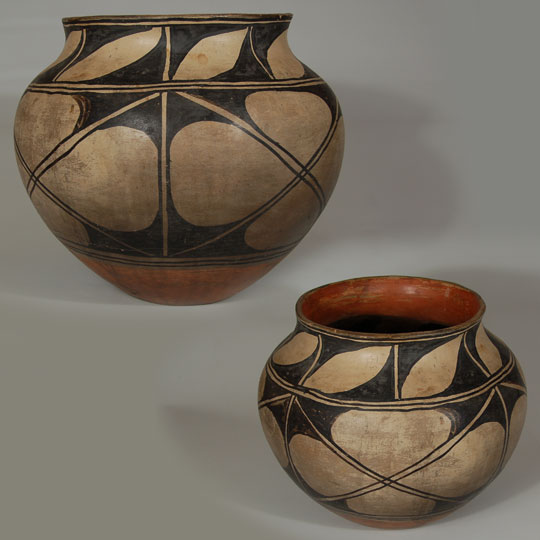 Today, we routinely accept painted pueblo pottery as the standard style that has existed forever, but, according to Dr. J. J. Brody, painted pottery only appeared about 1500 years ago. Before that time, all pottery was unpainted and totally utilitarian. Brody further states that Kewa and Cochiti painted wares more resemble eighteenth- and nineteenth-century Tewa pottery more so than that of other Keresan-speaking pueblos (Santa Ana, Zia, Laguna and Acoma), of which these two belong.
Original Watercolor entitled “War Dancer” by Pablita Velarde - C3775A
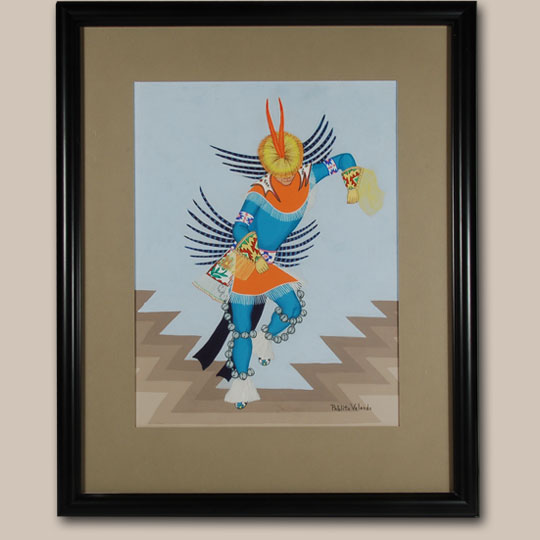 Pablita Velarde painted with mineral earth pigments that she prepared herself and also painted with casein paints. This painting was executed in casein paints and believed to have been completed in the early 1970s.
Very Old Navajo Deep Basket Bowl - C3776ZA
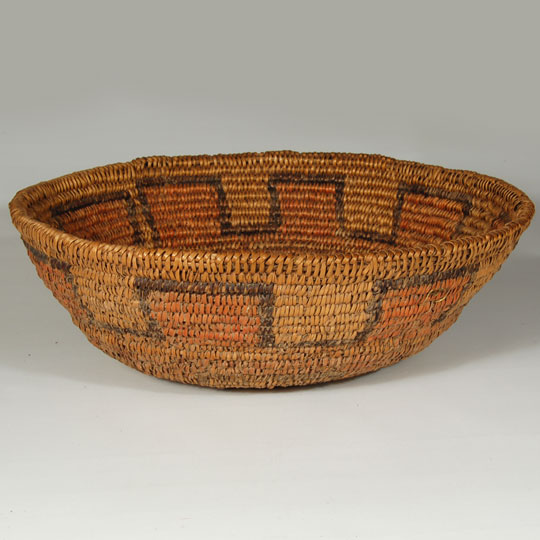 Navajo women made many baskets before they were rounded up by Kit Carson and forced to walk to Bosque Redondo in southern New Mexico where they were imprisoned for over four years. After their release and return to their homestead, baskets became important because natural materials for construction were free. They needed baskets for gathering seeds and roots, cooking, carrying burdens, parching and winnowing and for other domestic and ritual purposes.
Navajo Nation Sterling Silver Concha Belt - C3776ZC
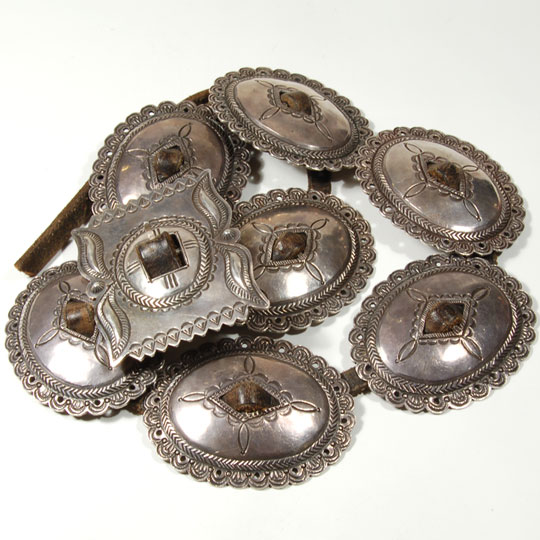 In the early twentieth century, banks were non-existent on the Navajo Reservation. As a result, the Navajo tended to invest their wealth into jewelry and if they needed money, they could pawn the jewelry at the local trading post. One popular form of jewelry that is distinctly Navajo is the concha belt. Conchas (named after the Spanish word for shell) are round or oval disks of silver. This provided a safe way to amass a large amount of silver.
Zia Pueblo Polychrome Pottery Tile by Reyes Gachupin - C3776o
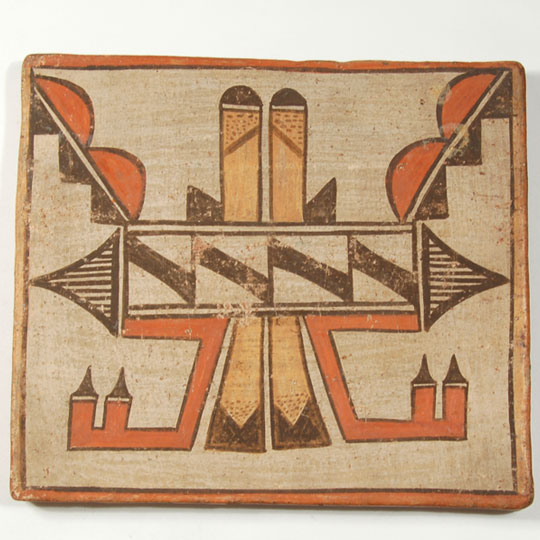 Reyes Gachupin was a sister of Trinidad Medina. Her first husband was Juanito Moquino (1904-1932) leaving her a widow with three children. She then married James Pino (1916-1998). She is sometimes listed as Reyes Gachupin Moquino/Pino. There are two jars by her in the School for Advanced Research in Santa Fe and one in the Museum of Indian Arts and Culture in Santa Fe, but no documented tile in either collection.
Hopi Pueblo Large Ho’ote Katsina Doll - C3776V
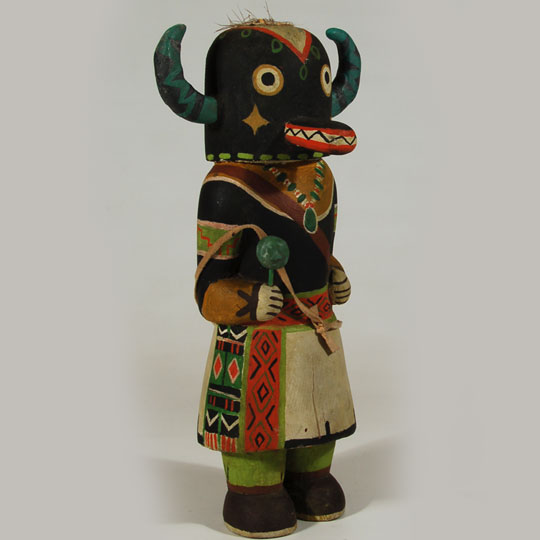 The katsina dances start in the early spring and continue into summer. Such dances are religious, their purpose being for rain. The katsina dances combine music, dance, and ornamentation in one art form providing for the greatest satisfaction of natives and visitors. During these dances, the katsina dancers show their affection for the Hopi children by presenting them with gifts. Having these dances open to the general public is the Hopi way of sharing their beliefs with non-Hopi and to demonstrate that these prayers are not just for the Hopi but for everyone in the world. Following a Katsina dance, Hopi families invite visitors to share in a meal, a display by the Hopi of their hospitality to visitors.
Navajo Spiny Oyster and Silver Necklace and Earrings - C3776ZD
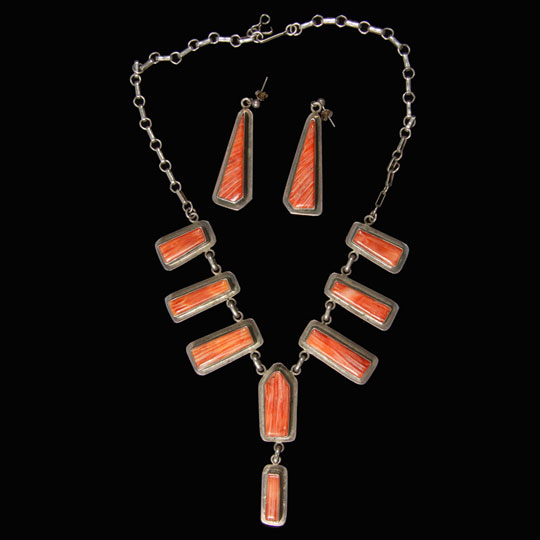 The official name of the shell used in this necklace is Spondylus and it is from a bivalve mollusk. Additionally, it is known as thorny oyster or spiny oyster. The many species of Spondylus are grouped in the same superfamily as the scallops. They are not closely related to true oysters, however, they do cement themselves to rocks, rather than attach themselves by a byssus. Like scallops, Spondylus have multiple eyes around the edges of their shells, and have relatively well-developed nervous systems. Spondylus shells are much sought after by collectors, and a lively commercial market exists for them.
Northeastern California Mono Indian Bottleneck Basket - C3776X
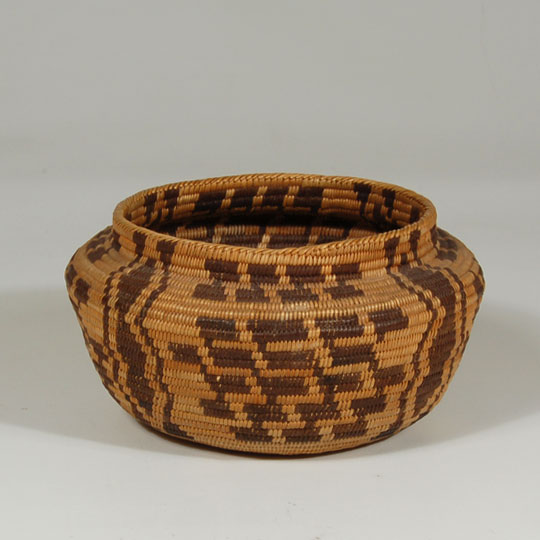 I am inclosing a quotation by George Wharton James from his book, published in 1903, because I feel it describes the Mono Indians and a particular basket maker in beautiful detail.
"Just below the Yosemite Valley, east and south, a nation of aboriginal basket-makers is to be found. One of the counties of California, as well as a noted lake, are named after them-Monos. Little by little the lands owned by their ancestors have been stolen from them, and now they are driven in every direction higher and higher into the mountains. With an indifference to their rights that is very different from the passionate rebellion of such people as the Apaches, they have allowed themselves to be dispossessed of their homes, and have climbed away further from the white man. Doubtless the reason for this seeming indifference is to be found in the fact that there is plenty more valuable land in the higher Sierras which they can use for their simple pastoral wants.
Original Painting “I am a Warrior” by Quincy Tahoma - C3775D
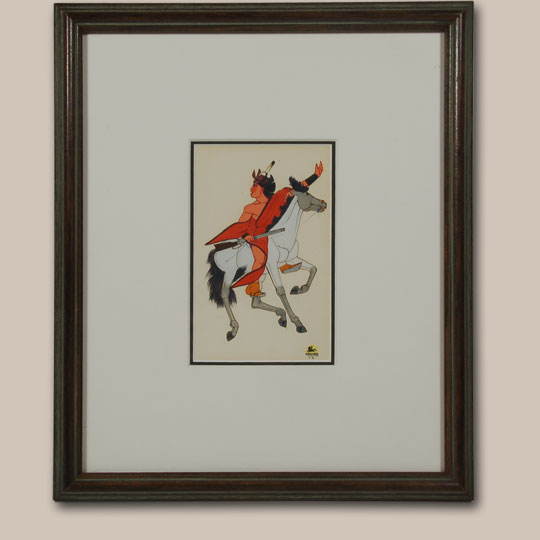 Quincy Tahoma loved action scenes and painted many such scenes during his career. This one is a good illustration of a young Navajo warrior wrapped in a red blanket. He holds a rifle in his right hand while he is glancing back at something which the viewer cannot see. The horse is very actively running. The young man has his left arm up in the air as if he is calling for others to join him.
Polished Black Rectangular Lidded Box by Rose Gonzales - C3776L
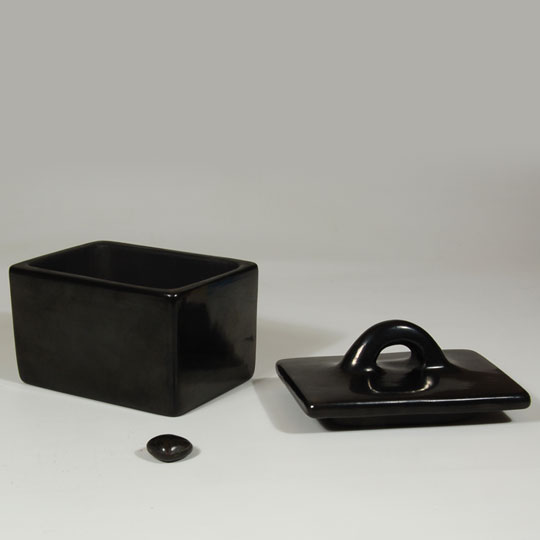 The use of cornmeal in pueblo ceremonials is well established as is the use by individuals at their homes. Cornmeal is used as a medium for bestowing blessings on something or someone much as holy water is used by the Catholic Church. There may or may not be a correlation between the two.
This rectangular black cornmeal lidded box was made by Rose Gonzales probably in the second half of the 20th century. It is a perfectly plain, undecorated stone-polished box finished to a beautiful sheen. The box is signed Rose on the underside.
Historic Zia Pueblo High-shoulder Storage Jar - C3753.01
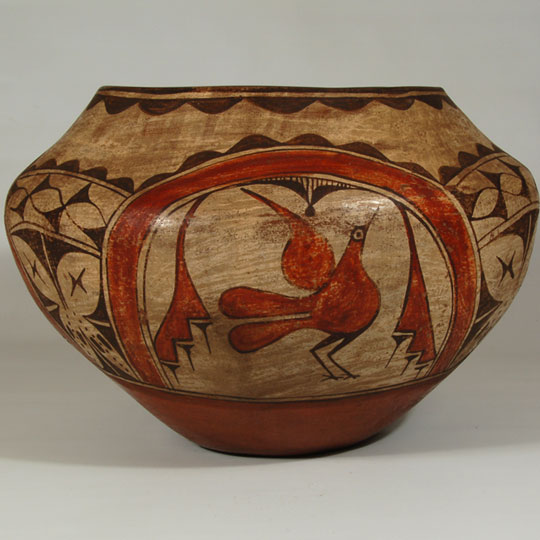 This is an excellent polychrome storage jar that dates to the first decade of the twentieth century (circa 1910-1920), as evidenced by the overall form: the high shoulder, typical of pieces created post 1900, the stone polished underbody of the vessel, as well as the traditional red banding at the top of the underbody, which fell into disuse circa 1930.
The piece is constructed of typical Zia basaltic black lava as paste-temper with the traditional polished red neck interior and a black rim top, though ceremonial breaks in the framing lines are absent. The design elements are faithful to the traditionally conservative Zia design system, which itself is relatively unchanged by the influence of Western ideas.
Tesuque Pueblo Head View of Deer Dancer by Patrick Swazo Hinds - C3720F
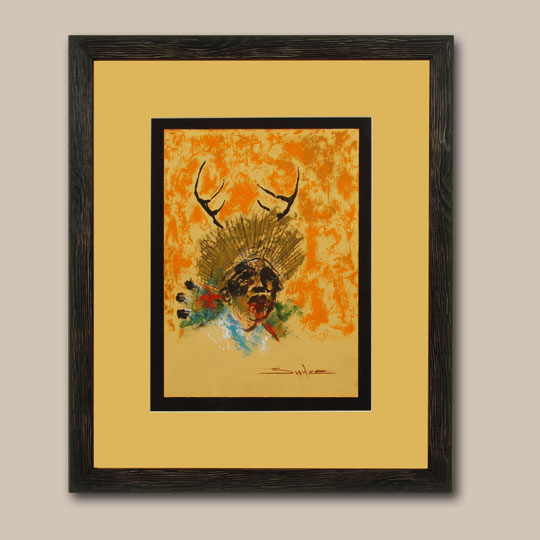 Patrick Swazo was born at Tesuque Pueblo in 1929 and given the name José Patricio Swazo. He was adopted by Dr. Norman A. E. Hinds, honorary member of Tesuque Pueblo and Professor of Geology at the University of California for 45 years. Not long after his adoption, Swazo moved to California where he resided until his death. He usually spent his summers at the pueblo. He served in the United States Marine Corps and served in Korea. His education included attendance at High School in Berkeley, California; Hill and Canyon School of Arts in Santa Fe, New Mexico; California College of Arts and Crafts in Oakland; Mexico City College, Mexico City; and the Art Institute of Chicago.
Swazo became a full-time painter after 1968 but most of his paintings are not dated. He died in 1974 so it can be assumed that most of his art was produced in the 6 years between 1968 and 1974. He also produced lithographs as well as original paintings.
Santa Clara Pueblo Original Painting “Mimbres Antelope” by Helen Hardin - C3775B
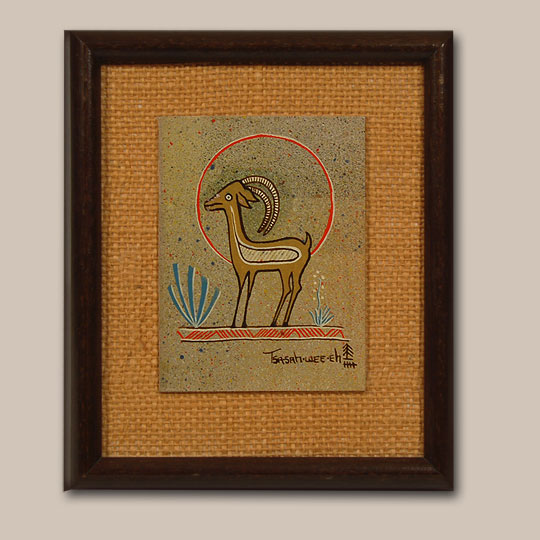 This wonderful acrylic painting depicts a Mimbres-style ram or antelope reminiscent of petroglyph drawings one would see on ancient rock walls. The background is a prototypical example of the detailed style in which Helen often worked. As is always the case with her, the execution of line and form is impeccable.
The warm earthy tones and charmingly intimate scale of this piece are assets of strength not normally associated with a work of this scale. The painting is signed in lower right in dark paint, Tsa-sah-wee-eh with the artist's cartouche.