



Watercolor Painting of a Native American Church Teepee by Billey Kochee - C3556D
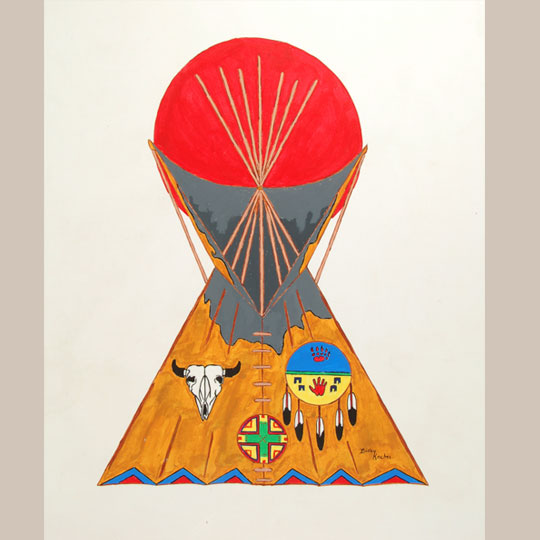 This painting by Billey Kochee contains an assortment of symbols important to Native Americans.
The teepee with a background of poles is an insignia of the Native American Church, or Peyote Religion. The Native American Church, and the use of peyote as a means of achieving a trance, began in Pre-Columbian Mexico and spread to the Great Plains in the late 19th Century.
The buffalo skull symbol is frequently seen on shields of the Plains Indians. The buffalo stands for all that is important to the people. It is a reminder to be grateful for the gifts that are given by the creator.
Historic Tesuque Pueblo Polychrome Pitcher - 25734
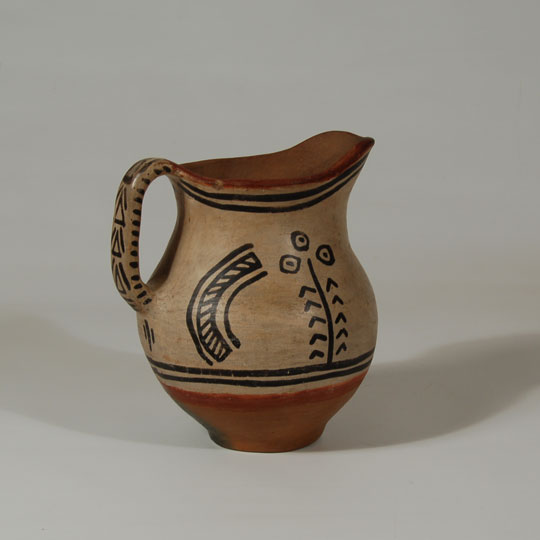 Tesuque Pueblo, Village of the Narrow Cottonwood Trees, is just north of Santa Fe. Its proximity to Santa Fe allowed potters to sell their work to merchants in Santa Fe who, in turn, sold to tourists visiting the southwest. The items made for tourist sale were made to appeal to the visitors and their ability to transport them back home, hence, the forms and sizes changed from the larger utilitarian ollas and bowls made for personal use to small pitchers, vases and jars for the collector to take back home as souvenirs of Indian Country.
Cochiti Pueblo Multi-colored Painted Drum - 25896
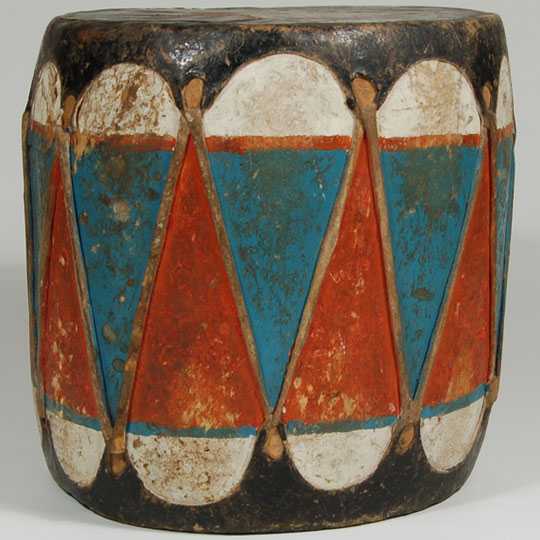 Painted and unpainted drums of all sizes are used in pueblo ceremonies. The drum suggests the thunder that comes with rain. The drum has two heads. Pueblo songs are written to start slowly and then go to a climax. At a certain point of the song, the drum is flipped over to achieve a higher beat. This lifts the dancers and gives them the impetus to continue dancing.
This drum is typical of Cochiti Pueblo drums. The wall is painted with red and blue triangles with their ends painted white.
Hopi Second Mesa Flared Rim Pictorial Basket - 25897
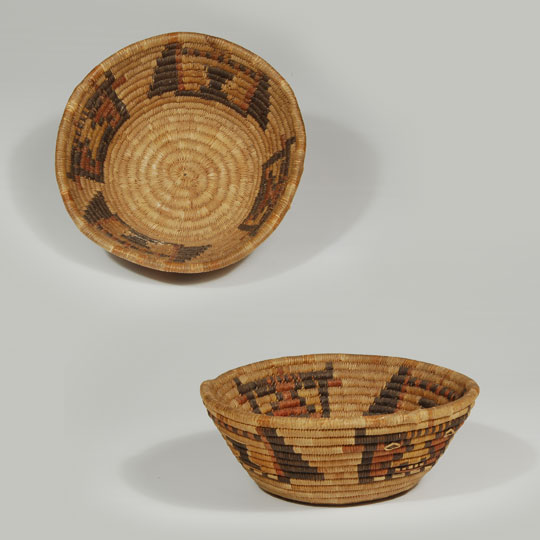 The Hopi Pueblo women of Second Mesa villages have been making coiled basketry for over a thousand years using the same materials and same techniques. None of the materials are from domesticated sources. They all are from wild plants. The leaf of the yucca plant is used for the weft design and grasses are bundled together for the warp foundation. The colors are limited to white, yellow, green, red and black. The first three colors are derived from the yucca leaves, the difference being in the time of year the material is collected. The rust and black colors are dyed yucca leaves.
Hopi-Tewa Tall Cylindrical Jar by Jacob Koopee (Jake Nampeyo) - C3822
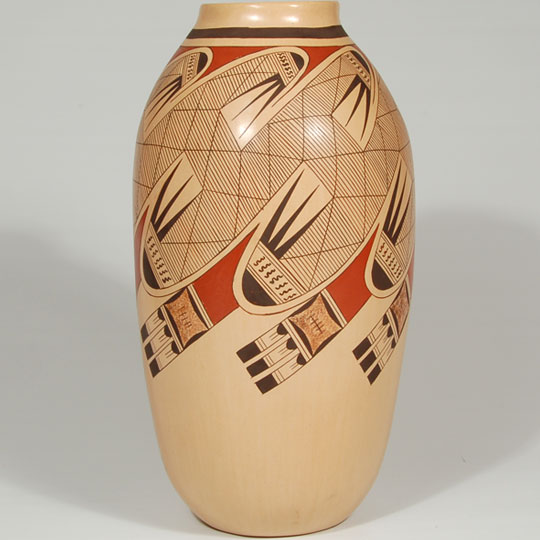 Early in his career, Jacob Koopee made traditional Hopi-Tewa pottery with traditional Nampeyo family design patterns. At that time, in the mid-1990s, he signed his pottery Jake Nampeyo. Later, he made traditional pottery vessel shapes but modernized the designs to those related to the Sikyatki-revival designs. He signed the later pieces Koopee.
This cylindrical jar is most certainly a traditional Hopi shape. Hopi-Tewa potters have made cylindrical vessels for over a hundred years. Koopee also applied a very traditional Sikyatki-revival migration pattern to the jar.
Hopi Pueblo Older Mastop Katsina Doll - C3821B
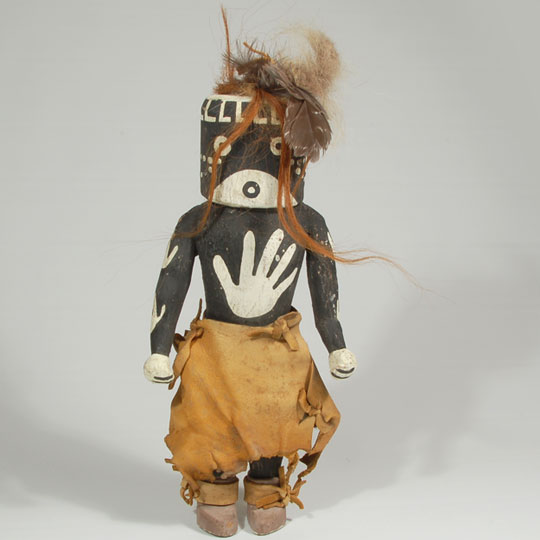 "The Mastop Kachina is the second kachina to appear on Third Mesa. He is not present on Second or First Mesa. These kachinas always arrive in pairs and come bounding out of the northwest on the next to last day of the Soyal. As they rush into the village they beat all the dogs that they encounter using the short black and white staff which they carry for that purpose.
"Leaping about with many antic gestures, they make their way to the Chief Kiva where they talk in disguised voices with the individuals inside and with each other. Then, as though suddenly becoming aware of the females in the audience, they dash madly into a cluster of women and grab their shoulders from behind and they give a series of small hops indicating copulation. Then they return to the kiva and converse for a while before again dashing over to another group of women, repeating the action until nearly every woman present from child to the very oldest has been approached. All women, even the shy ones, do not avoid this embrace as it is a serious fertility rite despite the antic touches, which are never directed towards the women."
Historic Laguna Pueblo Shallow Bowl Dated 1911 - 25717
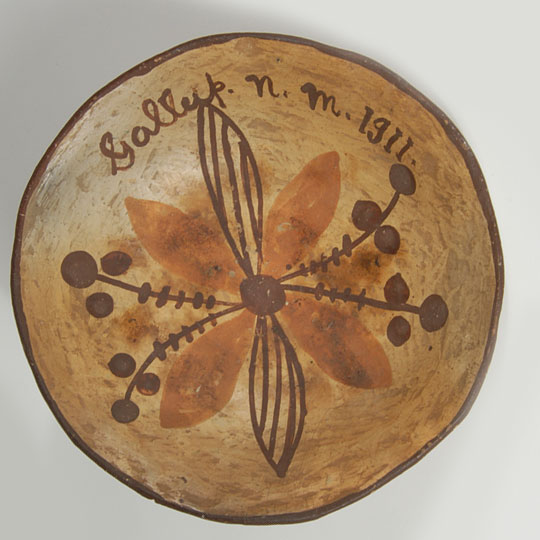 Laguna and Acoma Pueblos are relatively close to Gallup, New Mexico, and potters from those villages have always participated in the Gallup Inter-tribal Indian Ceremonial's arts and crafts fair held annually in August.
It is quite likely that a Laguna potter decided to increase her chances of a sale at the Ceremonial by making her dish a Gallup souvenir of that's year's event. It is amazing that this dish has survived without any damage for over a hundred years.
Hopi Pueblo Crow Mother Katsina Doll by Quanhoyeoma - C3821C
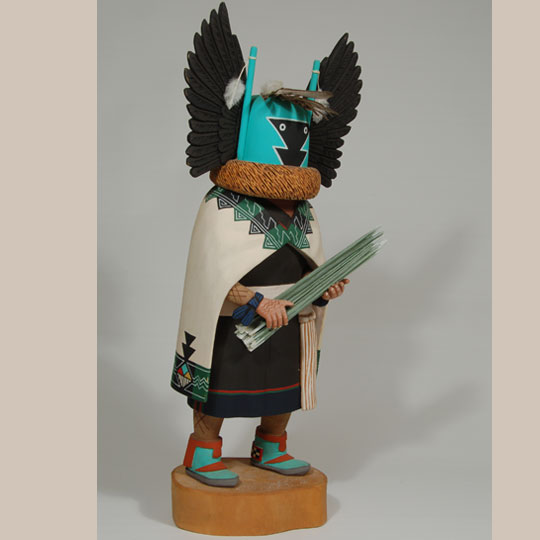 The Hopi consider Angwus-hahai-ie (Crow Mother) to be a Katsina Mother. She is also known as Angwusnasomtaqa, described as Crow Bride. She is presented as a stately personage, moving slowly and singing quietly. It is she who initiates the young boys into the Katsina beliefs and culture. In this function, she is more forceful so as to gain the attention of the boys and deliver her message of the importance of the Katsina culture.
Untitled Painting “In The Shade of the Tree” by Francis Livingston - 25686
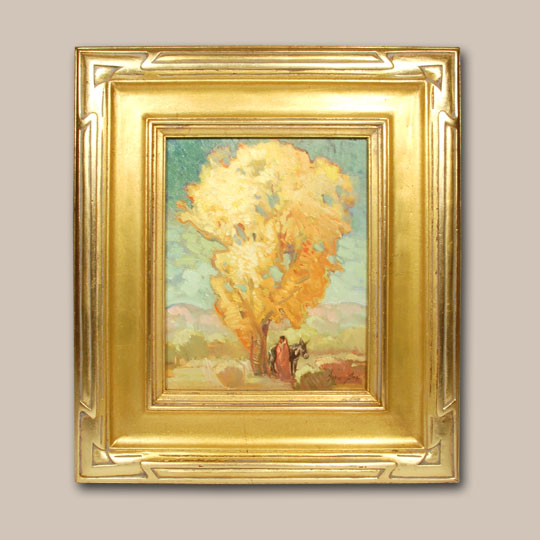 A Taos Pueblo Indian, blanketed in colorful splendor, enjoying a moment of shade, evokes for the viewer what it must have been like to live at Taos Pueblo a couple hundred years ago before the intrusion of the hustle and bustle of the newcomers.
The magnificent manner in which the artist filled the canvas with a colorful cottonwood tree in its fall splendor, illustrates how small humans are in the overall scale of the land. The fall colors of the tree and hillside and the cleanliness of the land bring to mind the Natives' respect for Mother Nature-something lost in the 20th century's disposable lifestyle.
Tohono O’odham Pottery Human Effigy Figurine Bank by Consuelo Julio - C3251J
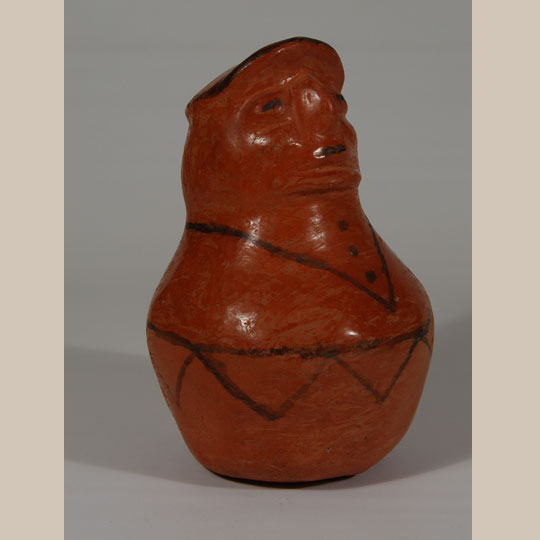 Pottery making by the Tohono O'odham women is a part-time effort as there is no significant market for it as there is for New Mexico pueblo pottery. Part of the reason is that the few potters mostly do not speak English but only speak their native language. Another reason is that most potters do not seek out buyers but wait for buyers to find them.
Effigy vessels, such as this, particularly ones made with a slot for deposits of coins, were made for sale to non-Indians. The outlets for such wares are the trading posts close to the reservation and the occasional Indian dealer who visits the reservation. Black-on-red wares are not evident in traditional pottery of the tribe before the mid-1800s so it is suspected that it was a style developed to sell to tourists and not for use by the natives.
Oval Deep Apache Basket with Handles - 25810
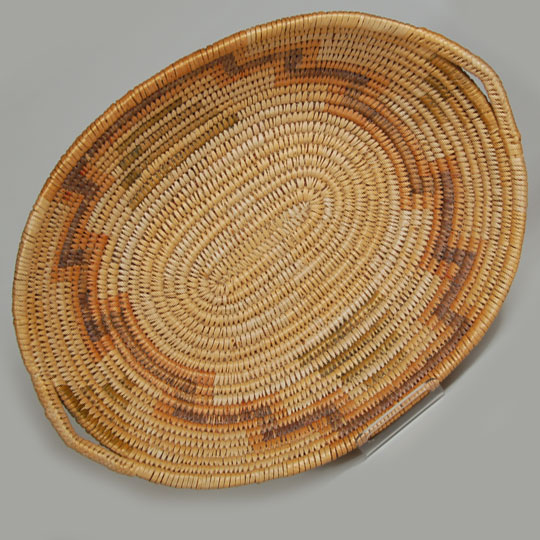 The Jicarilla Apache are known to have had contact with Plains Indians at some point in their history. They made raids on the Plains Indians but always returned to their Mountain home. They went on buffalo hunts and raids for horses and lived in teepees covered with skin or cloth, and they made parfleches like those of the Plains Indians.
They also had contacts with Puebloan peoples and is where they learned their agricultural knowledge and possibly learned pueblo basketry techniques. Yet, they were and are Apache and their lifestyle adheres closely with that of Apache tribes.
Painting of Northern New Mexico Mountain Vista by Arthur W. Hall - C3717
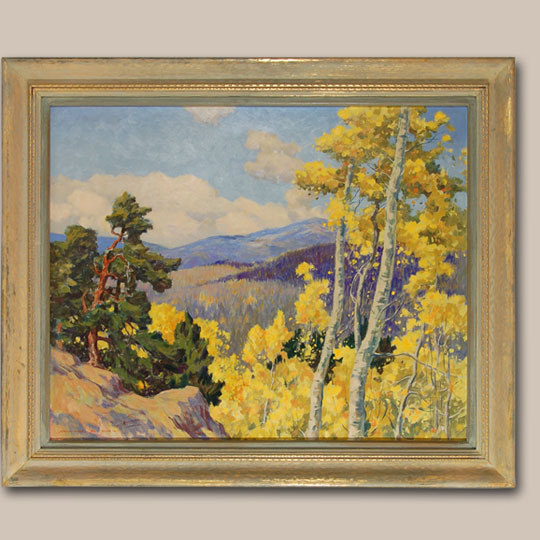 Although Arthur W. Hall specialized in etchings and dry point in his earlier career he was always adept at sketching and painting. He was greatly influenced by years spent in Europe as well as extensive travels in the United States. As an artist he found the scenery and light in Northern New Mexico too good to pass up and in 1942 chose New Mexico as his home. With the exception of a brief period spent in Arizona he would remain here until his passing in 1981.
Oil on Canvas Painting “Cottonwood Sanctuary” by Tony Abeyta - C3654G
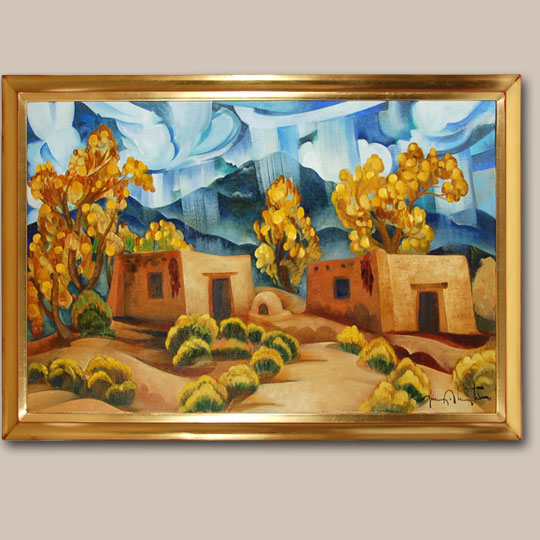 It has been said that Tony Abeyta paints landscapes from his emotional feelings. He does not portray them as actual locations but as an emotional experience one derives from earth meeting sky, color predominating, rain clouds intermingling with blue sky, trees and plants responding to wind and memories returning of past experiences. It is with this emotion that he painted this scene of a pair of small adobe buildings nestled among Chamisa and Cottonwood trees at the base of a mountain with rain falling in copious amounts from beautiful puffy white clouds. It is almost a dream home settlement.
Historic San Ildefonso Pueblo Polychrome Jar with Red Rim - SC3680E
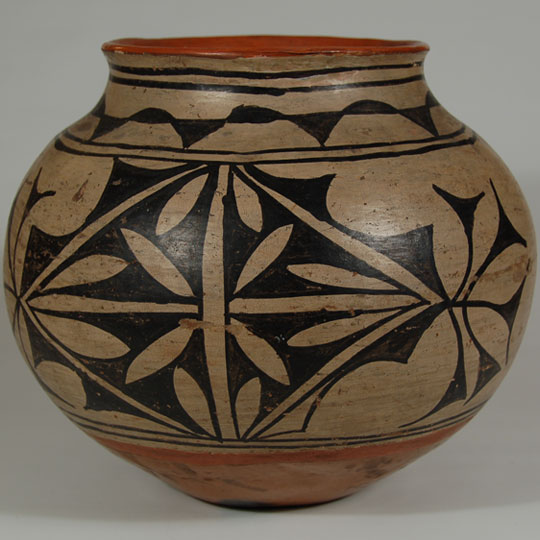 According to information published by the noted expert on historic Pueblo pottery, Frank Harlow, pottery production declined considerably at San Ildefonso Pueblo until, by 1830, its output was limited to large storage jars and a few smaller jars. Families at San Ildefonso traded food and other items to Nambe Pueblo potters in exchange for pottery needed for their use. This continued until around 1880, at which time pottery production at San Ildefonso underwent a revitalization sparked by the arrival of tourists on the newly instituted the Atchison, Topeka and Santa Fe Railway cross-country train. The new pottery being produced was designated as San Ildefonso Polychrome with a beginning date of 1880 and an end date that is yet to be determined.
Diné - Navajo Sterling Silver and Turquoise Triangular Shaped Ring - C3077J
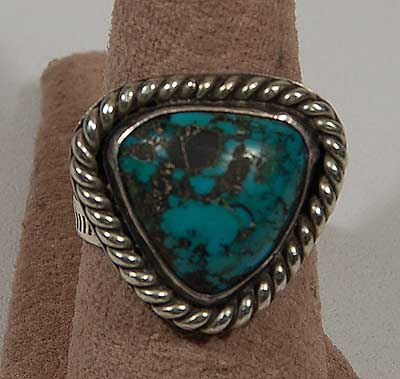 This ring consists of a beautiful turquoise stone with a chocolate brown matrix set in a triangular shaped twisted wire bezel. The split shank is hand stamped. The Southwest Indian Jewelry ring is unsigned and in very good condition.
Sterling Silver Spoon from the Estate of Mary B. Carter - 23612
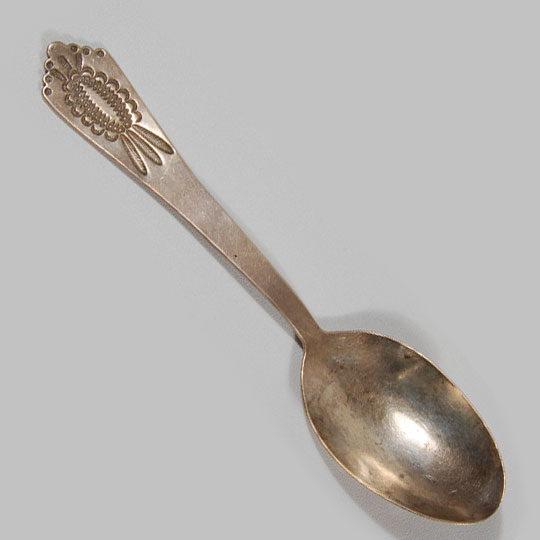 This sterling silver spoon has a stamp design on the handle that is typical of Navajo stamp work from the 1920-1930 period. It is not stamped with the name of a maker, which is not unusual for that period.
Original Painting “Autumn Sunset” by Carl Von Hassler - C3715
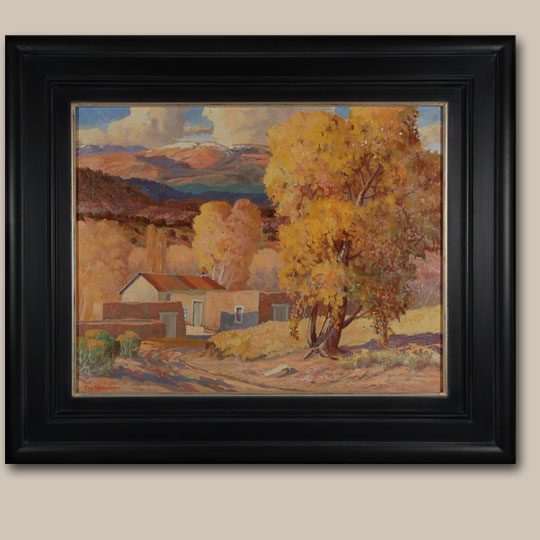 Carl Von Hassler specialized in painting scenes of Northern New Mexico villages, specifically selecting a single homestead in any of the four seasons. In this painting, he selected an adobe structure with a steeple nestled among cottonwood trees with their leaves turning yellow at the beginning of the fall season. The church or possibly school house has a pitched roof with painted tin as its cover. The other buildings are flat-roof adobe structures.
Diné - Navajo Silver and Turquoise Concha Belt by Billy Goodluck - 23987
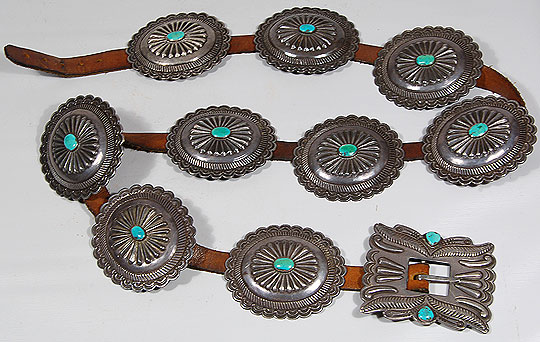 The Diné are a people who have added much beauty to their world and ours. Beauty is a quality they particularly appreciate; it is a repeated theme in their songs, ceremonies and in their rugs and jewelry.
The Diné lifestyle and arts are those of a nomadic. They depend heavily on the horse and lavish their creative talents in weavings and silverwork on them. Perhaps there is some correlation in living with nature that sparks their creativity.
In the early twentieth century, banks were non-existent on the Navajo Reservation. As a result, the Navajo tended to invest their wealth into jewelry and if they needed money, they could pawn the jewelry at the local trading post. One popular form of jewelry that is distinctly Navajo is the concha belt.
San Ildefonso Pueblo Polychrome Lidded Jar by Martina Vigil and Florentino Montoya - C3675Z
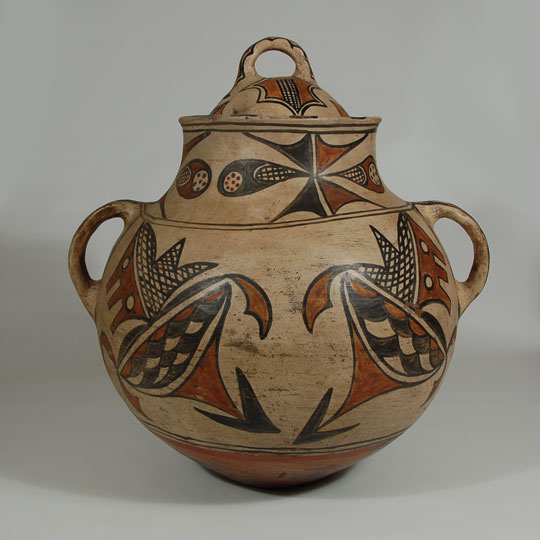 It is known that Maria and Julian Martinez, after their marriage in 1904, became known as the best pottery couple in the pueblo, but this might not have happened had another couple from San Ildefonso not moved to Cochiti Pueblo in 1905. That couple, Martina Vigil Montoya (1856-1916) and her husband Florentino Montoya (1858-1918), were the finest potters from there from as early as the 1880s. They were masters at creating magnificent Polychrome jars. Martina had learned pottery making from her mother, Toña Peña Vigil, who also was a very talented potter. Florentino had studied the designs of Toña's pottery and adapted his style on hers.
Acrylic on Canvas “Maize Maze” by Alice Warder Seely - C3689C
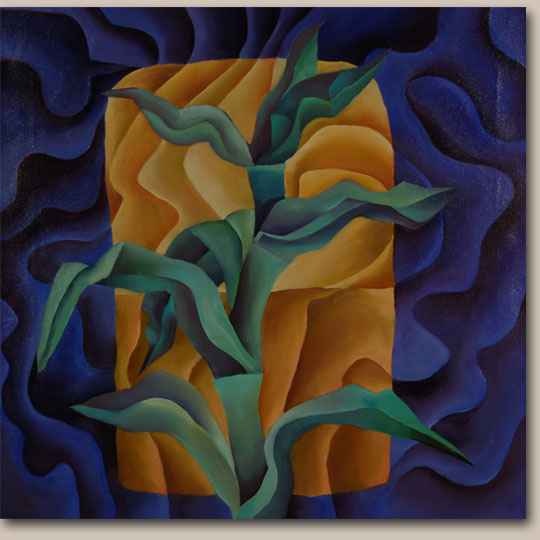 Alice Seely is an amazing woman and an amazing artist. She had a rewarding young life living in Santa Fe near Canyon Road and Garcia Street with her parents in a John Gaw Meem adobe home. The family was well off financially. Her family heritage is mixed Indian, Spanish and Anglo as were many Santa Fe residents of the time. Her paternal grandparents lived in a small Spanish village in Northern New Mexico and were descended from Pueblo and Comanche Indians. Her biological father was a New Mexico muralist and landscape painter. Her step father was Navajo artist Narciso Abeyta (Ha-So-De), father of artist Tony Abeyta. Alice is a painter, jeweler, and amateur horticulturist, raising hundreds of Iris on her farm in Ruidoso, New Mexico.