



Original Oil Painting “Buffalo Robe" by Ramon Kelley - 17437
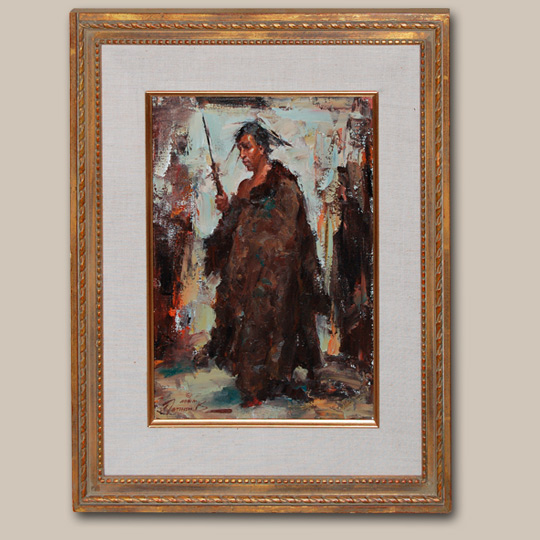 Ramon Kelley began his art career at an early age by drawing in the margins of his schoolbooks. He earned early recognition as a young artist and has continued to grow professionally. Kelley credits Russian artist Nicolai Fechin as a major influence on his strong figural paintings. Subject matter of primary interest to Kelley is Mexican and Southwestern scenes.
Although living in Denver, Colorado, Kelley goes on sketching trips around Taos, New Mexico. It is there that he paints some of his finest Southwestern landscapes and Indian subjects. He is regarded as especially successful with portraits of young people and older people.
Extraordinary Rare Historic Tesuque Pueblo Bowl - C3622
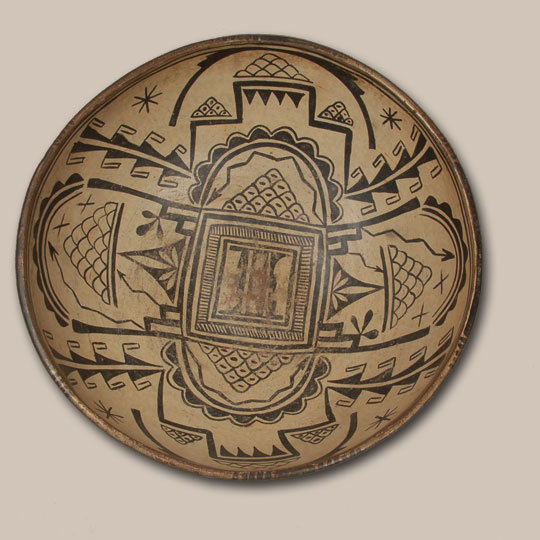 Occasionally one sees a piece of pueblo pottery which is above and beyond what one expects. That is the case with this bowl. Constructed of native clay mixed with native temper, coil formed in the traditional pueblo technique, and fired in an outdoor firing are all traditional traits one would expect. That is where the ordinary ends, and the unusual begins.
This is probably the rarest Tesuque bowl one could expect to see. It is profusely decorated on its interior and exterior to the point where one must study it seriously to absorb all the designs. There are cloud and lightning elements that are rarely used on secular vessels but mostly reserved for ceremonial ones. There are cornstalk motifs, parallel framing lines with diagonal hatching lines (only used by Tesuque).
Historic Acoma Pueblo Polychrome Used Water Jar - C3819A
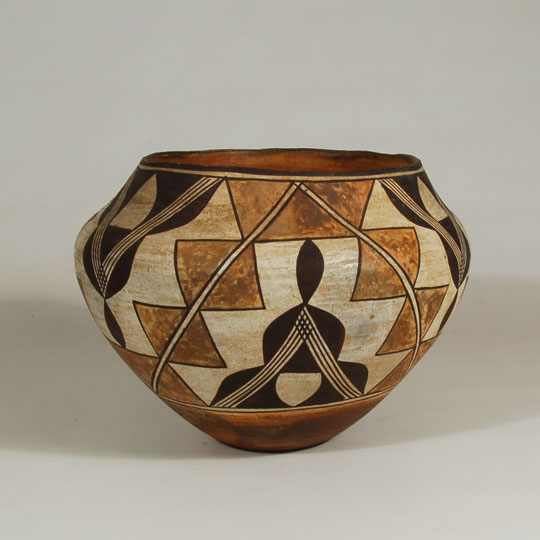 Every handmade pottery jar has its own charm and idiosyncrasies. Some teach us a lesson. The lesson learned from this jar is that a potter cannot erase a painted line once applied. This potter first drew a pair of lines and then realized that they needed to be about an inch from where she drew them, so she attempted to erase them but the telltale signs remain. Such a change of plans by a potter does not ruin a finished jar but reminds us that each one is handmade without use of any mechanical drawing instruments or computer programs. It is amazing that we see fewer of these change of plans by potters. That reinforces our admiration for the talent they possess.
The design layout on this jar starts with paired black lines that divide the painted area into six equal triangular quadrants. Within these triangles, the design is the same but anchored to a bottom framing line in some and anchored from a rim framing line in alternate triangles.
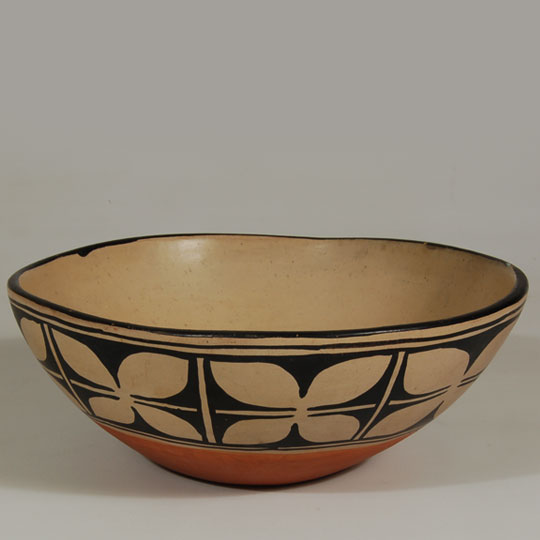
Kewa (Santo Domingo) Pueblo Interior and Exterior Design Serving Bowl - C3819F
 Santo Domingo Polychrome is a typology designation that has been used for over a hundred years. Now that the pueblo has gone back to using its ancestral name, Kewa, there could be some confusion as to whether Santo Domingo Polychrome or Kewa Polychrome is the correct typological designation. Most likely, Santo Domingo Polychrome will continue to be used until there is an official recognition of a typology name change, which is not likely.
This bowl is typical of the size of a food serving bowl. It is slipped on the interior with a polished cream finish, has a single design element in the bottom, has a black rim with the traditional ceremonial line break, and a red clay polished underbody. There is no rag-wiped red band just below the design field.
Zuni Pueblo Shulawitsi - Little Fire God Katsina Doll by Steven Comosona - C3535.43
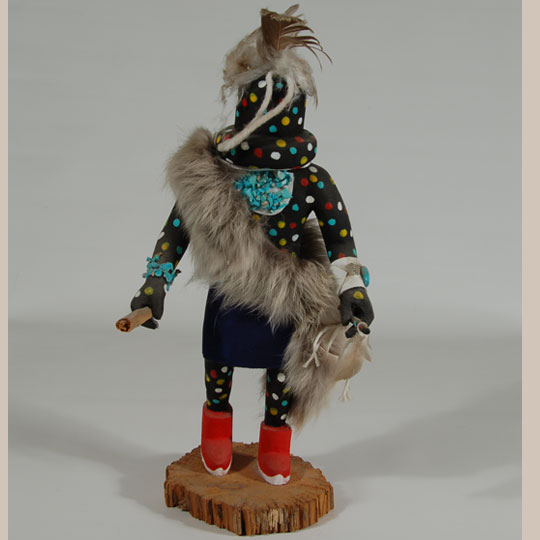 Shulawitsi is almost an exact duplicate of the Hopi Kokosori, but he is not related to Kokosori. A young boy who is innocent and pure of heart usually performs him. He carries a fire stick, signifying his responsibility as caretaker of one of the important physical elements of the universe: fire. He is responsible for lighting fires before the Shalako ceremony prior to the winter solstice. The lighting of these fires is the signal for the Shalako to begin their ritual.
Hopi Crow Mother - Angwushahai-i Katsina Doll by Todd Talashom - C3531F
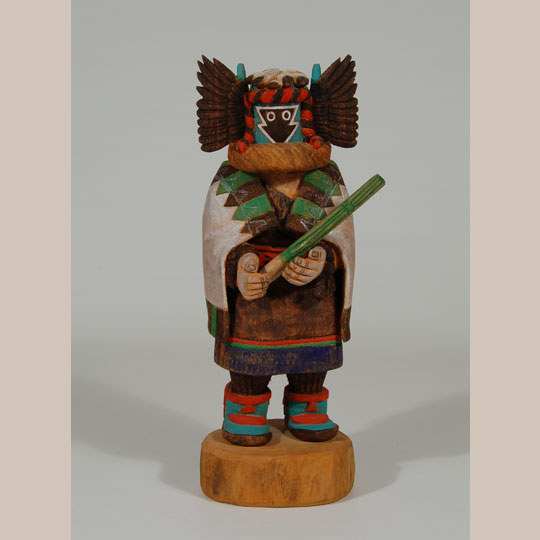 In the 1980s and 1990s, I made bi-weekly trips to the Hopi Reservation to purchase katsina dolls from specific carvers. One carver whose dolls I particularly liked was Lowell Talashoma who lived in the village of Shongopavi. Eventually, Lowell introduced me to his younger brother, Todd, who lived in the village of Moenkopi. I discovered that Todd was producing exceptional carvings but they were not like those of his brother.
Lowell was slim and his carvings portrayed slim images. Todd Talashoma was a beefy person, not fat, just beefy, and his carvings mirrored his body style. I found it interesting that each of them carved in the likeness of their own body styles.
Historic Zia Pueblo Small 4-color Polychrome Jar - C3482
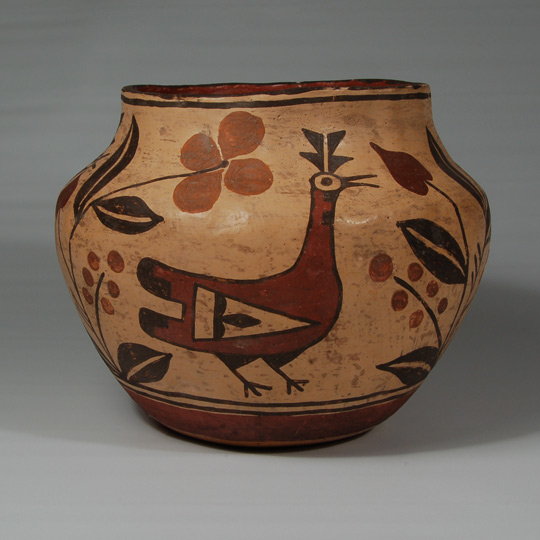 This rather primitive small Zia Pueblo jar is charming in its own way. The historic vessel wall is a little bumpy, meaning it has not been sanded smooth as have later jars. The cream Zia slip covering the jar has a yellowish tinge in color perhaps as a result of the potter mixing something with the clay she planned to use for the slip.
The Zia birds are absolutely charming and somewhat childish in execution which makes them even more likable. The birds have exquisite head feathers as crowns. The plants sport orange flowers and deep red flowers, contributing to the four-color designation on the historic jar.
Very Large Historic Isleta Pueblo Storage Jar - SC3816A
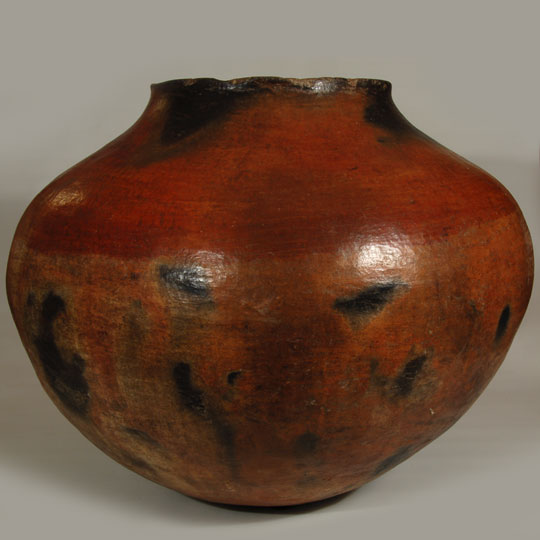 Without question, the first impression one has of this magnificent large storage jar is that it was made at Ohkay Owingeh (San Juan) Pueblo in the late 1800s. We have been conditioned to see such a jar as being made only at San Juan because the placement of the red slip only partially down the vessel wall and the numerous fire clouds are traditional to San Juan Pueblo.
Thanks to studies by Frank Harlow and Jonathan Batkin, we know to look more closely to the materials of the vessel rather than only to its surface manifestations. The paste of San Juan Pueblo pottery, and of its sister Tewa Pueblos, is tan in color and can be witnessed on the stone-polished un-slipped bases of most jars. An examination of this storage jar reveals that the paste is not of the type used at the Tewa Pueblos.
Historic Kewa Pueblo Polychrome Storage Jar, circa 1890 - 24344
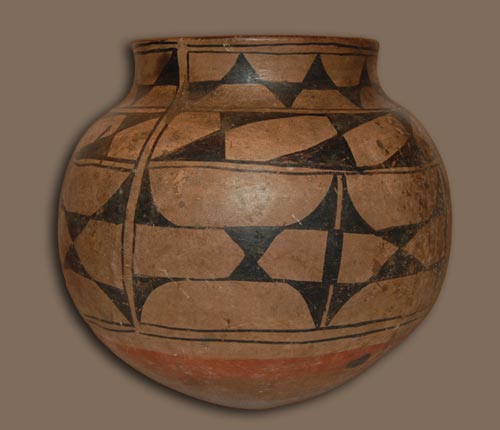 This Santo Domingo (Kewa) Pueblo polychrome jar dates to the 1890s. It has the traditional rag-wiped bentonite slip and a black rim around the top rolling over the edge. There are four pairs of black framing lines throughout the decorated areas. The first pair is at the rim, the second at the lower area of the neck, the third at the shoulder, and the fourth pair at the lower extremity of the decorated area. Ceremonial break lines divide all the pairs of framing lines.
The design at the area of the neck is comprised of black triangles connected to form a chain around the constricted neck. A second band of black triangles forms the decoration just below the neck.
Original Painting “The Navajo Woman Rider” by Quincy Tahoma - C3817
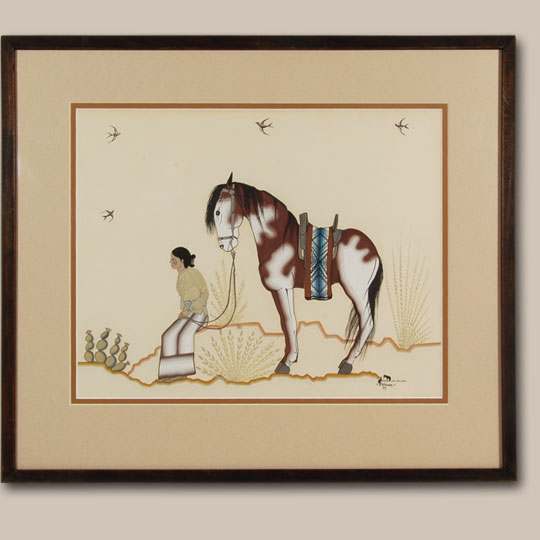 This early painting (dated 1939) clearly shows the influence of Quincy Tahoma's time at the Santa Fe Indian School. The style is typical of that established during the tenure of Dorothy Dunn as director of The Studio of the Indian School. Tahoma later evolved into more three-dimensional painting but this early one is of the flat style.
Tahoma had been sent by the Government to the Albuquerque Indian School in 1929 from his home in Tuba City, Arizona. A year later, he was transferred to the Santa Fe Indian School, entering in the 4th grade. Santa Fe contrasted sharply with his home on the Navajo Nation and this must have been difficult for a boy of 12 years of age. Not only was he taken away from his parents, he was taken away from familiar life of a Navajo on the Indian Reservation.
Hopi Pueblo Hon - Bear Katsina Doll by Otto Pentewa - 25542
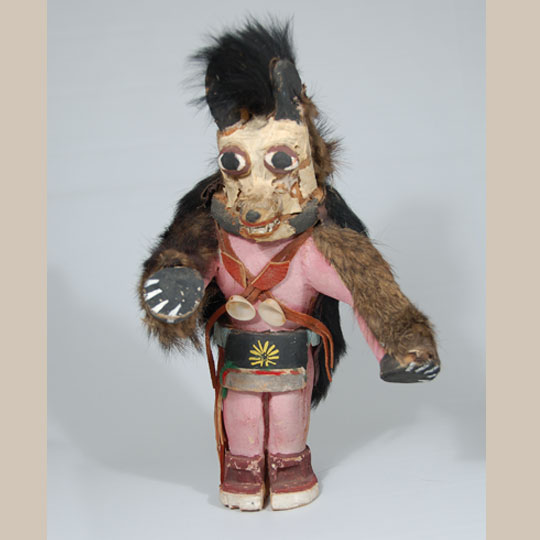 Otto Pentewa is a name any collector of Hopi Katsina dolls recognizes. They may never have seen him or seen his signature on a Katsina doll, but they recognize his work at a glance. He was born at the village of Oraibi on the Hopi Reservation at the end of the 19th century. He was of the Katsina Clan and his Hopi name was Sikovaya, which translates to Pumpkin Flower.
One of the distinguishing designs on his Katsina carvings is the pumpkin flower he generally painted on the loin cloth of the doll. It was his signature.
Navajo Storm Pattern Rug, circa 1940s - SC3816C
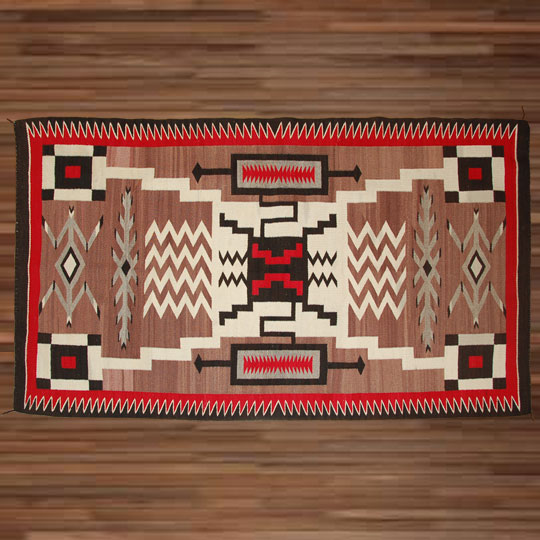 This is an excellent Navajo Storm Pattern rug-most likely from the Western part of the Reservation. It is a very nice specimen of the Storm Pattern textile. The central square, rendered in white natural wool, represents the Navajo Reservation and the four boxes at the extremities represent the four sacred mountains of the Reservation. The grey design at each end of the rug is defined as a "water bug." The zigzag elements emanating from the central square represent lightning.
Zuni Pueblo Nineteenth Century Polychrome Olla - 16208
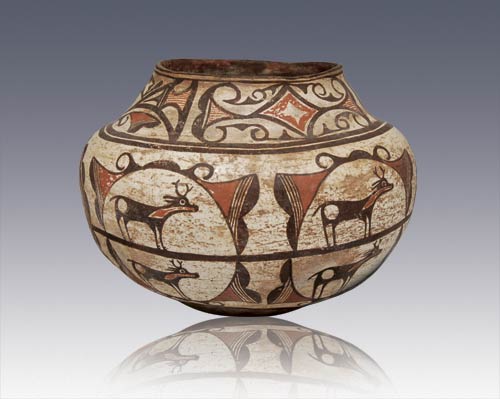 This is a superb nineteenth century vessel, dating to the last quarter of the 1800s. This olla has many distinctive Zuni design elements: the heart-line deer, spiral volute with fine-line embellishments and the "sunflower" rosette. The underbody is concave, as is typical of all ollas, or water jars dating after 1700. The base is slipped in brown, with distinctive flexure at the uppermost edge of the underbody, as well as a black-slipped, unpolished neck interior and rim top. The white slip is stone-polished with mineral-paint designs. The uppermost framing line is worked in black, overlaying the geometric/spiral volute fine-line elements worked in black and red.
Hopi Pueblo Small Polychrome Seed Jar by Nampeyo of Hano - C3801C
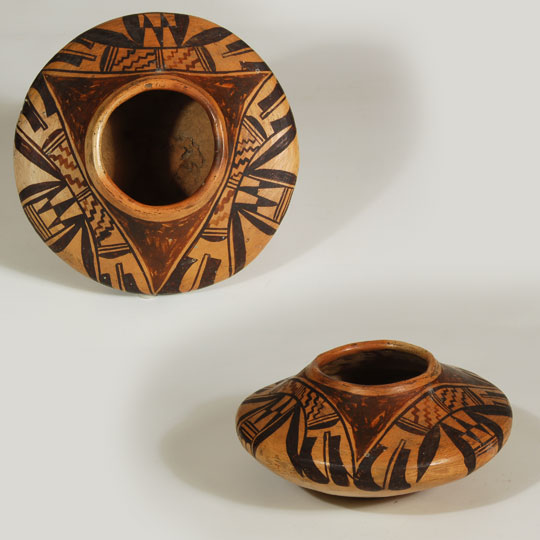 Nampeyo was handpicked by Hopi trader Thomas Keam to make pottery in the style of the prehistoric Sikyatki potters. He chose her because she was, to him, the best potter at Hopi. She never disappointed him by producing anything less than wonderful. She did not copy Sikyatki potter's work but used it as inspiration for her own designs.
This small polychrome seed jar is so typical of Nampeyo's fine craftsmanship. It replicates the Sikyatki vessel shape with a wide midsection and a graceful slope upward to the rim. An unusual departure from what one normally sees on jars of this style is her use of only three red triangles rather than four. It is Nampeyo exercising her creativity.
Historic Acoma Pueblo Polychrome Wedding Vase with Documentation - SC3816D
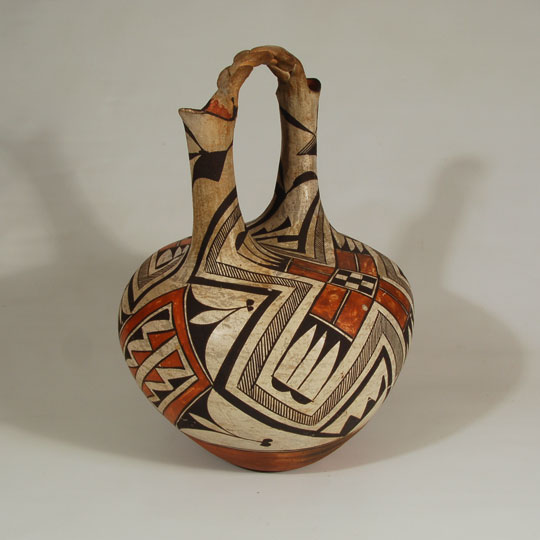 The famous Route 66 highway was a financial blessing in the 1930s for Acoma and Laguna Pueblo artisans who found it worthwhile to set up tables on the roadside to sell their wares to tourists traveling between Chicago and Los Angeles. They also sold pottery to merchants in the area, one of whom was Abdoo H. Fidel (1880-1947), a Lebanese immigrant, who set up a curio shop in San Fidel, only a few miles from Acoma Pueblo. A 1934 photograph of his shop showed over 500 Acoma pottery items on shelves, stacked atop each other, and scattered all over the floor. He obviously was a major buyer from the potters, having purchased thousands of potteries from them during the years he operated his curio shop.
Historic Cochiti Pueblo Painted Hand Held Drum - 25508
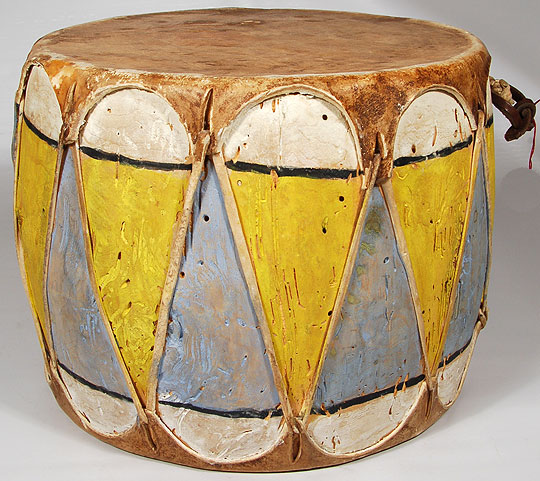 Painted and unpainted drums of all sizes are used in pueblo ceremonies. The drum suggests the thunder that comes with rain. The drum has two heads. Pueblo songs are written to start slowly and then go to a climax. At a certain point of the song, the drum is flipped over to achieve a higher beat. This lifts the dancers and gives them the impetus to continue dancing.
Kewa Pueblo Polychrome Pictorial Olla by Robert Tenorio - 25436
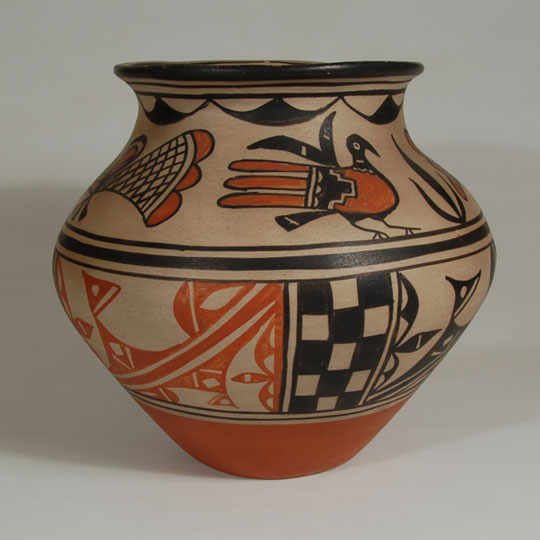 There is probably no collector of contemporary pueblo pottery who does not know Robert Tenorio or at least aware of him. He is the best-known potter from Santo Domingo Pueblo. Robert makes pottery that is as functional as pottery was a hundred years ago. He makes it for his own table use and makes functional pottery for many other pueblo residents.
Robert attended the Institute of American Indian Arts (IAIA) at the time that Otellie Loloma was a teacher and it was she who convinced him to enroll in ceramics class. She enrolled him in her class and taught him different techniques, including how to make wheel-thrown stoneware pottery. Robert has made some stoneware pottery in the past. He is best known, of course, for his traditional coil-formed pueblo pottery.
Santa Clara Pueblo Red Ribbed Melon Jar by Angela Baca - C3812C
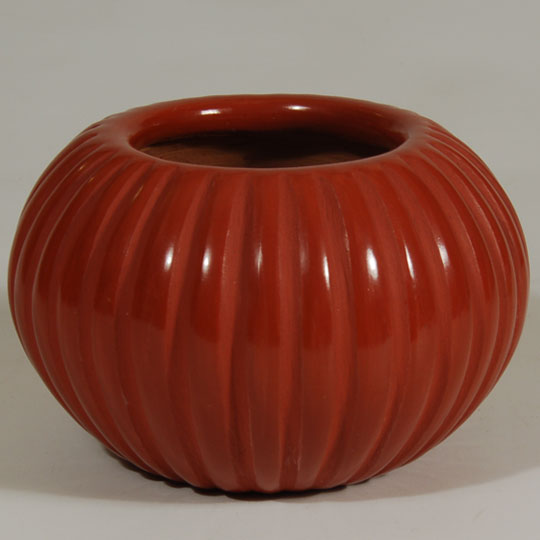 Angela Baca has long been associated with her ability to produce beautiful red and black jars with melon ribs. Works in the melon style are first coil-formed with a large diameter coil and allowed to dry to a leather-hard state. They are then carved with the distinctive ribs. After carving, the work is slipped in iron-bearing red slip, intricately stone-polished and then fired in either a smothered, reduction atmosphere to achieve the superb black finish or in an oxidizing atmosphere to achieve the red finish.
Traditional Hopi Puelbo Masha’n - Flower Katsina Doll - C3535.05
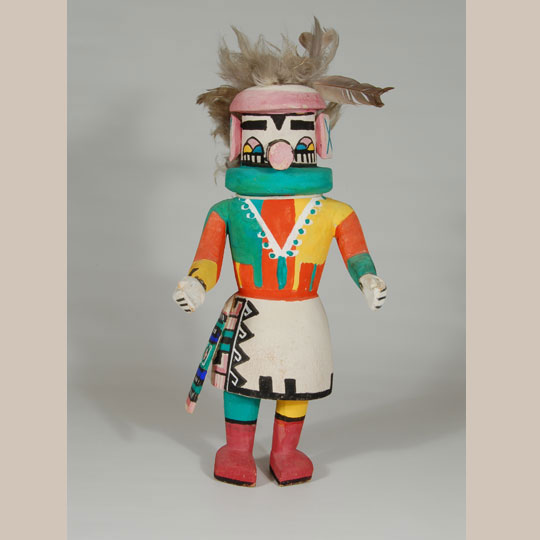 In Hopi Journal, Alexander Stephen provided an excellent accounting of spring and early summer Katsina dances that occurred in 1891 in which this katsina participated. Such dances are pleas for rain at the season of planting. There is a four-day ritual abstinence, mask preparation and prayer-stick making in the kiva before the dance commences. Dance practice and song rehearsal occur during these four days.
Magnificent Hopi Pueblo Pictorial Seed Jar by Mark Tahbo - 25892
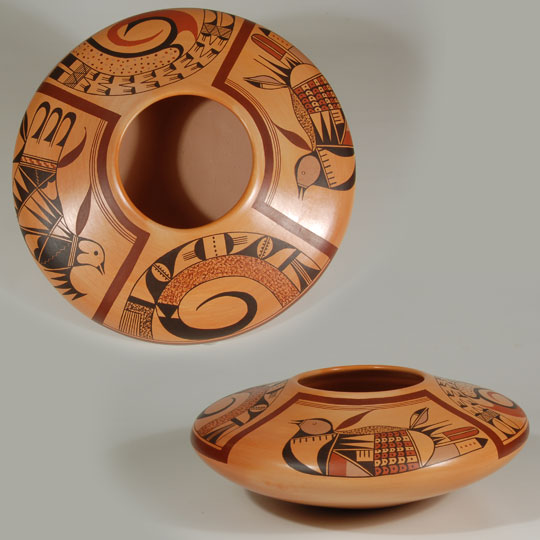 Mark Tahbo visited us again and surprised us with two innovations that were new in his artistic endeavors, but we will get to those a little later. Initially one needs only to take a look at the shape of this seed jar and admire the amazing pictorial designs on the upper portion. There are four design panels and each is different.
To start from the beginning, that is, the construction of the vessel, we listened to Mark explain where and why he chose the clay for this jar. Mark has always admired Garnet Pavatea and her production of pottery so he decided to visit the clay source Garnet used and to gather enough of that clay to make this jar. That clay bed is on the side of the road from the village of Polacca to the top of the mesa where Garnet lived.