



Turquoise and Hieshe Nugget Necklace with Leo Poblano Fetishes - 25883
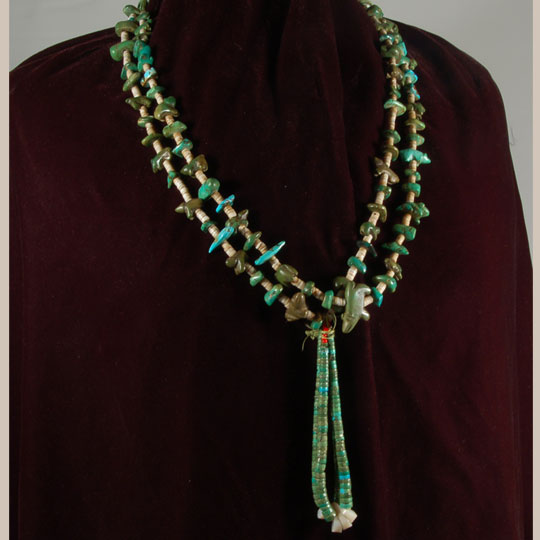 This necklace is comprised of two strands of shell hieshe interspersed with turquoise nuggets and turquoise fetishes. The fetishes have been identified as having been made by Leo Poblano. There are 30 fetishes on the necklace, some of which are bright green turquoise and some are dark green. Interspersed between the fetishes are drilled turquoise nuggets. A pair of jaclas is suspended from the necklace and the green turquoise of the jaclas compliments the green stones and fetishes of the necklace. The necklace is strung on string with a worn pueblo wrap at the neck. The necklace appears to be quite old but it is difficult to place a date on it.
Black Carved Jar with Avanyu Design by Margaret Tafoya - C3812B
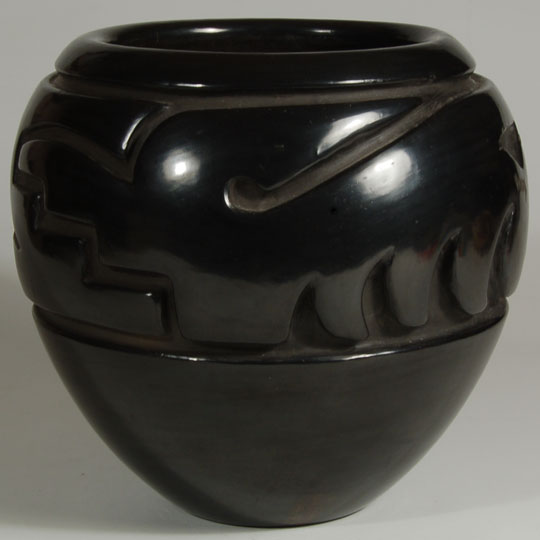 In the mid-twentieth century, Margaret Tafoya produced many very large pottery vessels and then in the 1960s-1970s, she produced many smaller vessels such as this jar. Not only was she capable of creating a beautiful vessel shape but she obtained a smooth finish and high burnish and then proceeded to execute a precise carved design.
The design is a stylized Avanyu (water serpent) rotating in a counterclockwise direction. The small triangle is the eye of the Avanyu and the curved part of the head is the plume on the head. The four wave-like carvings are part of the serpent's body.
Painting of Multi-storied Adobe Pueblo Building by Albert Lujan - C3814B
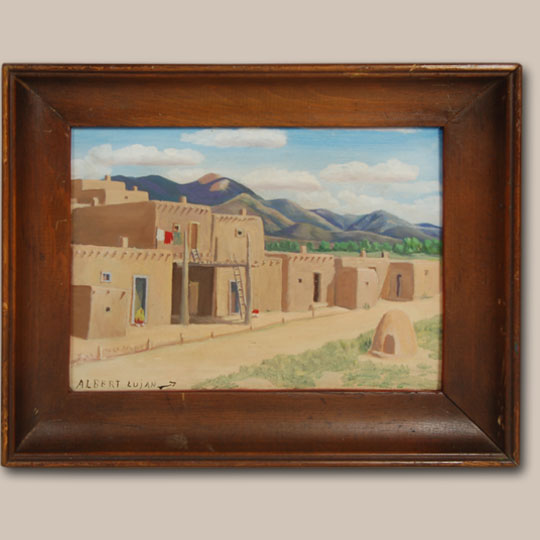 Albert Lujan was an early Taos Pueblo painter who was ahead of his time in painting European-American style art rather than the Santa Fe Indian School style being practiced by most of the other Native American artists of his time. He, along with Albert Looking Elk and Juan Mirabal, was greatly influenced by the Anglo Taos artists of the time.
The work of all three artists was shunned by collectors and the Museum of New Mexico Fine Art Gallery because it was too much like that which the Taos and Santa Fe artists produced. Now they have become very collectible.
Historic Tesuque Pueblo Black-on-red Figural Vessel - C3776N
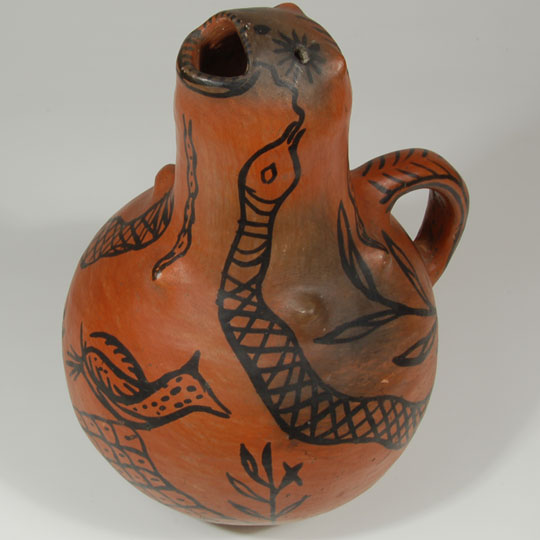 What generally comes to mind when one thinks of Tesuque Pueblo pottery are, first, Tesuque rain gods, then, secondly, garish poster paint tourist wares, and then, finally, very high quality Polychrome pottery. Potters at Tesuque were very talented and produced some truly outstanding jars and bowls. Probably the least pottery style from Tesuque, to come to mind for most collectors, would be Black-on-red Pictorial Animal Effigy Vessels. That's a long descriptive title but it accurately describes this vessel.
Hopi Pueblo Very Large Polychrome Seed Jar by Mark Tahbo - C3815
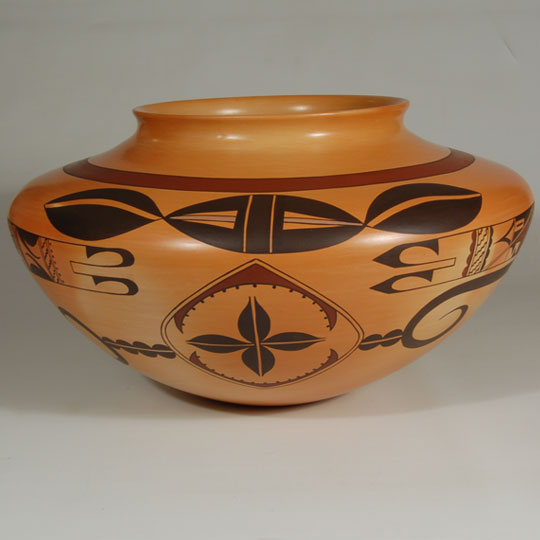 Mark Tahbo came in during Santa Fe's Indian Market season and beamed with enthusiasm when he unpacked this large and magnificent jar. He hardly knew where to start telling us what he had in mind as he made it and which elements of design he chose. He walked us through each design element and I hope I can recall all he said and pass it on in this presentation.
Original Painting of a Clown, Female Dancer and Drummer by Awa Tsireh - C3814A
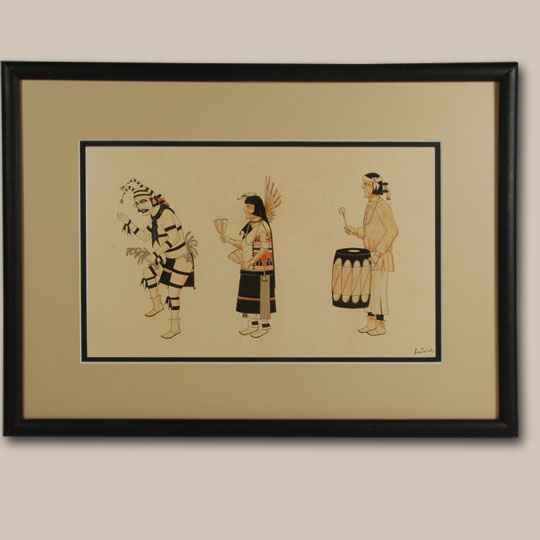 Alfonso Roybal (Awa Tsireh) was many things to his pueblo of San Ildefonso: he was a farmer, pottery painter, museum employee, painter and silversmith. He was born in 1898 and died in 1955. He was painting before 1917. He was the oldest of the early group of pueblo painters. His formal education had not extended beyond primary grades. He was versatile in his styles of painting. He was equally comfortable with representational, semi-realistic, conventional, and abstract.
Small Polychrome Hopi Pueblo Jar by Nampeyo of Hano - C3801B
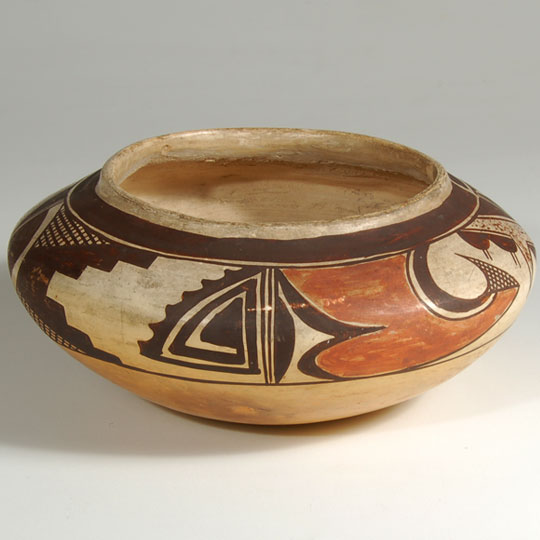 It was around 1880 when the transcontinental train passed through the Southwest. The Atchison Topeka and Santa Fe Railway teamed up with The Fred Harvey Company to enthusiastically promote the native cultures and the artists of Taos and Santa Fe. They also heavily promoted the Hopi, primarily because of the semi-annual Snake Dance ceremony. They must be given credit for changing America's attitude toward its native cultures, particularly in the Southwest.
Dark Green Turquoise and Sterling Silver Navajo Ring - 25887
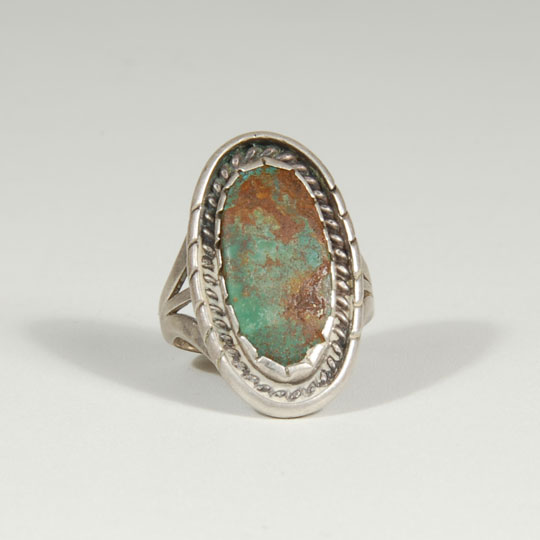 This very dainty silver framework holds a significantly beautiful very dark turquoise stone that has a beautiful copper color matrix interspersed within the turquoise stone. The turquoise is held in place with a silver bezel that is scored every eighth inch. In the shadow box surrounding the turquoise are raised silver dots. The outer rim of the silver top is scored on the edges.
Kewa - Santo Domingo Depression Era Earrings - 25891
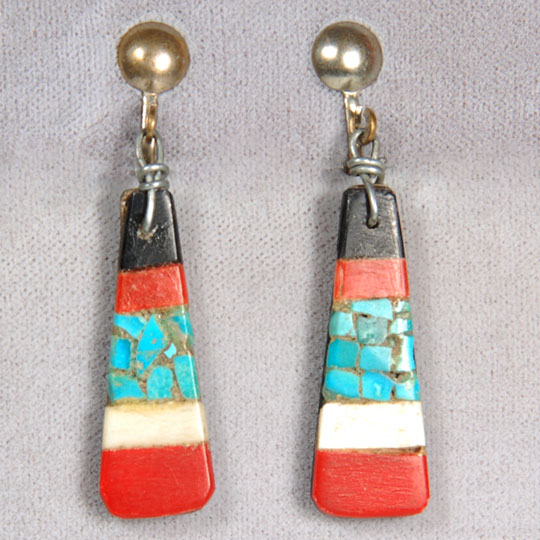 Santo Domingo Pueblo is located between Albuquerque and Santa Fe along the Camino Real, the old trade road between Mexico and Santa Fe. The people of Santo Domingo, now referred to as Kewa Pueblo, traditionally have been known as great traders. During the Depression, when the economy prevented them from being able to purchase high grade materials, the artists of Santo Domingo used less expensive materials to create jewelry to sell to tourists.
Navajo Oval Shape Cluster Silver and Turquoise Ring - 25886
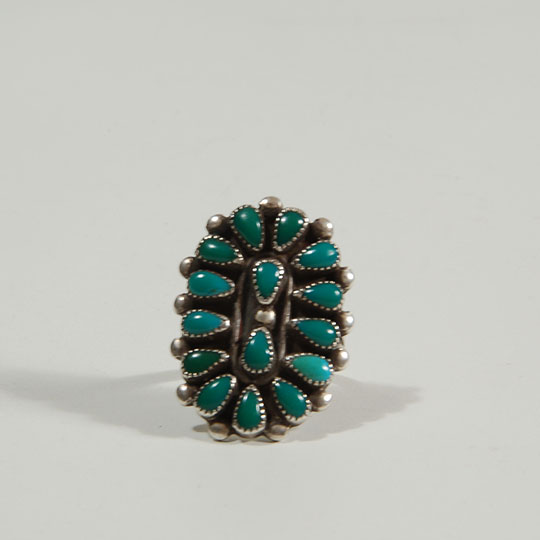 For their own use, many Navajo prefer jewelry arranged in cluster form. Large cluster bracelets are often seen on Navajo women at powwows and walking around Gallup, New Mexico. Cluster rings also share in this popularity.
This cluster ring has 15 tear-drop shaped blue and green turquoise cabs arranged on an oval silver backing. This ring is probably no more recent that the 1950s. All of the turquoise stones are in excellent condition.
Navajo Silver and Turquoise Very Old Bracelet - 25884
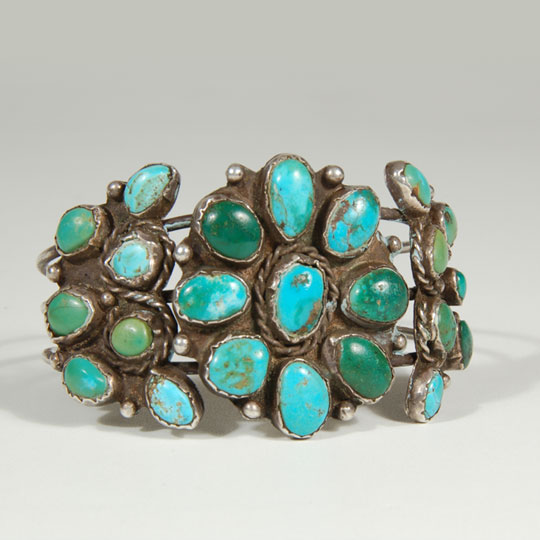 The foundation of this bracelet consists of three silver wires joined at their ends with a silver cross wire. The essence of the bracelet is the top which consists of three platforms with turquoise cabs in silver bezels.
The center of the bracelet is a flower design of 9 beautiful turquoise cabs of varying shapes and color. Flanking this center medallion are arrangements of 7 turquoise cabs displayed in two rows. Each of these has turquoise stones of varying sizes, shapes and colors.
Navajo Sterling Silver Squash Blossom Earrings - 25889
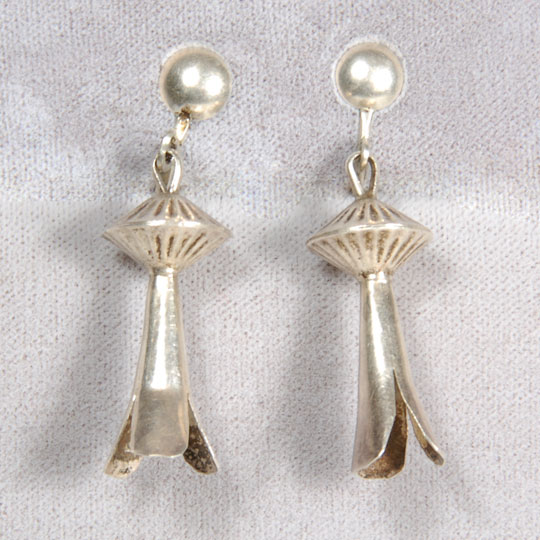 The Navajo learned silver working from the Spanish in the middle of the 19th century. One of the earliest designs they made was what is referred to as a "Squash Blossom." It resembles the blossom of a squash. The blossom that it was fashioned after was actually that of the pomegranate. The handmade blossoms of this pair of earrings dangle from sterling silver screw backs.
Sterling Silver and Turquoise Navajo-made Ring - 25888
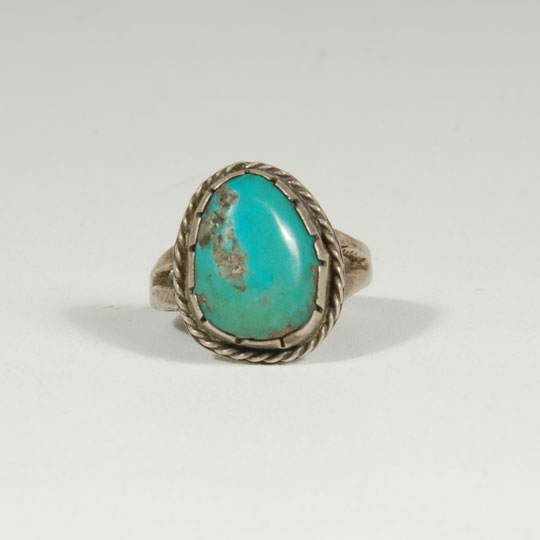 A beautiful green turquoise cab is securely held in place by a silver bezel that is sculpted around its edge. Around the bezel is a twisted silver wire rope. The ring is supported by a split shank silver band. It is these simpler silver rings that are the early ones. Later, it became popular to add silver adornments such as leaves around the stone. The simplicity of the early ones is responsible for their popularity.
Zuni Pueblo Petti-point Earrings - 25890
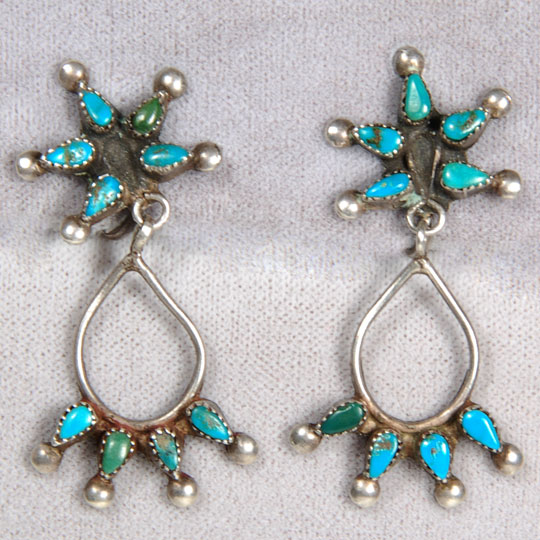 Zuni artists have been crafting turquoise for jewelry since prehistoric times. They are known as masters of stone cutting. After they learned silversmithing from their Navajo neighbors, they began to set small pieces of stone into intricate bezels to create delicate designs in jewelry.
Cochiti Pueblo Pottery Antelope Dancer Figurine - C3693T
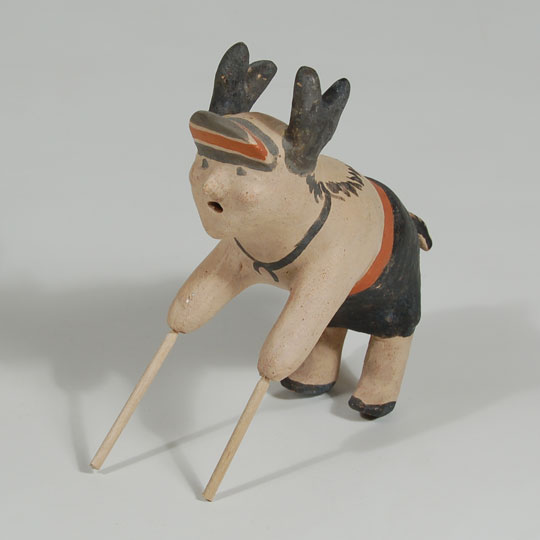 This pottery figurine represents an Antelope Dancer performing in the Pueblo's plaza. The two sticks serve as the forelegs of the antelope. The figurine is not signed with the name of an artist. It would be an excellent addition to a Cochiti Pueblo nativity scene or nacimiento.
Cochiti Pueblo Seated Female Figurine Holding a Child By Josephine Arquero - C3688.66
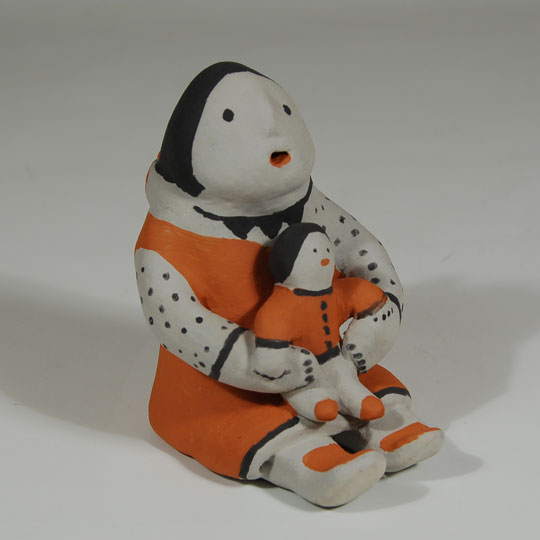 Josephine Arquero is a daughter of Damacia Cordero and sister to Martha Arquero, Marie Laweka and Gloria Herrera, all of whom are recognized potters. Josephine specializes in figurative pottery-mostly storytellers, nacimientos, and animals.
Historic Zuni Pueblo Small Terrace Rim Bowl - 25881
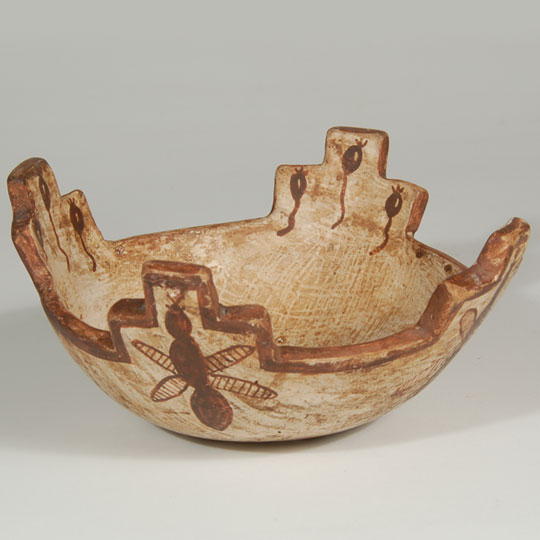 Vessels such as this small Zuni bowl suggest use in ceremonial functions but most likely that has not occurred. It is more likely that such were made solely to sell to tourists. Zuni elders would not have permitted ceremonial vessels to leave the pueblo and be sold.
An interesting story will illustrate the events that dealers would go to in order to sell pottery, and probably other Native items, in the early 1900s. Museums were eager to acquire ceremonial objects which, of course, were not generally available unless someone from the pueblo sold something without permission to do so.
Historic Zuni Pueblo Terrace Rim Bowl with Handle - 25882
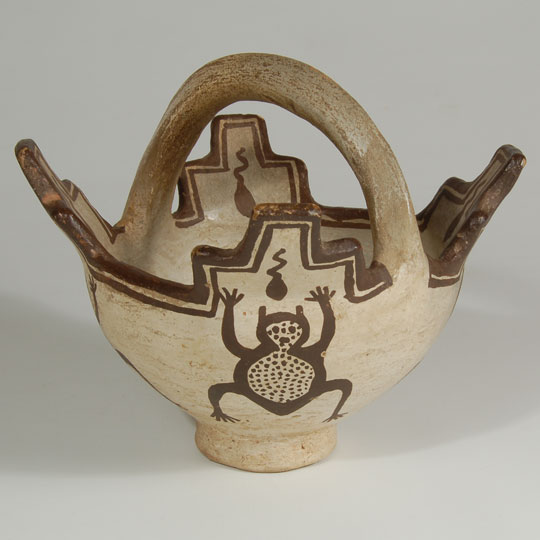 Bowls of this style generally have a handle in the form of a rainbow that crosses the bowl from rim to rim. Rarely, if ever, are the handles attached to a terrace structure. Most bowls of this style have a footed base and four terrace projections. Designs are always associated with water creatures-frogs, tadpoles, dragonflies and the Avanyu.
These style bowls are regularly used in ceremonial functions but are occasionally made for sale to collectors. I once witnessed a traditionally-dressed Mudhead Katsina at Zuni walking on the edge of the highway carrying a bowl similar to this one. It is presumed that he was sprinkling sacred cornmeal as he walked. Bowls similar to this one were collected in 1887 for the Smithsonian Institution.
Cochiti Pueblo Female with Child in Cradleboard by Seferina Ortiz - C3688.76
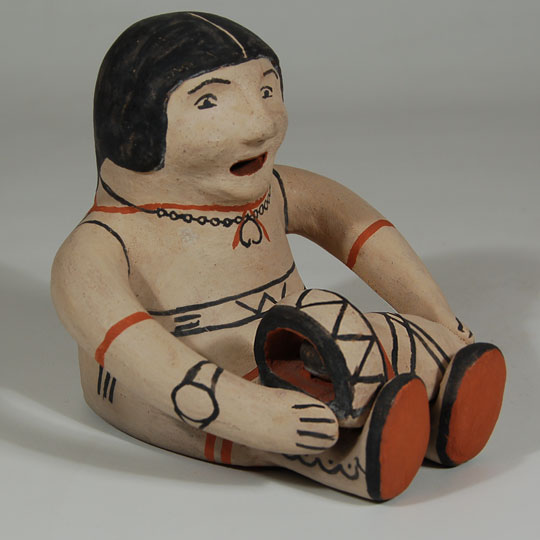 In the first decade following the creation of the storyteller figurine by Helen Cordero, only about eight potters at Cochiti Pueblo were producing such figurines. It was these eight potters that we featured in our first Storyteller Exhibit in the early 1980s. Among them was Seferina Ortiz. She is one of the earliest and long-lasting potters to make storyteller figurines.
Cochiti Pueblo Single Pottery Angel Figurine by Rita Lewis - C3688.58
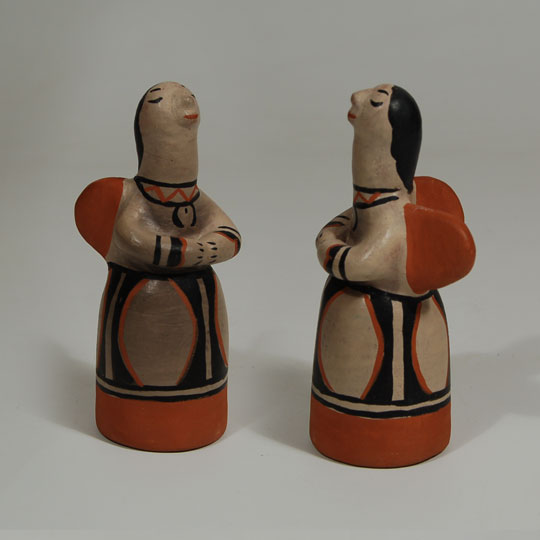 This figurine is a single pottery creation of an Angel. It is perfect for those who collect Angels or for someone who has a nacimiento by Rita Lewis and wishes to add another piece to the set.