



Kewa (Santo Domingo) Pueblo Turquoise and Shell Jaclas by Tina Montoya - 25814.2
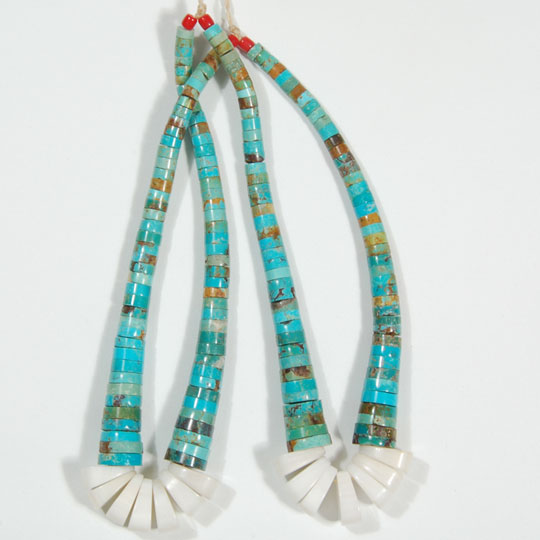 Jaclas are comprised of two loops of turquoise and shell strung individually and then tied together in a fashion by which they can be hung from a nugget necklace. Originally, in the 19th century, each of the units was made for use as earrings. When not being worn, they were hung on a nugget necklace for storage. Eventually, their use as earrings ceased and their use as a pendant on a necklace became permanent.
Historic Santa Ana Pueblo Dough Bowl, 1850-1900 - 25894
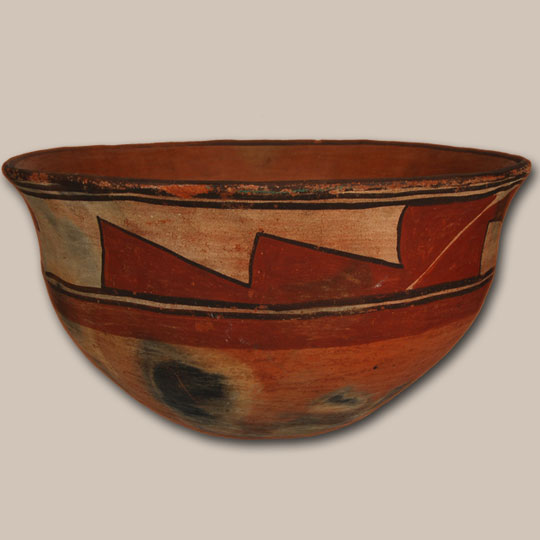 This Santa Ana dough bowl was originally in the Gallegos Collection which was sold in 1990 by Morning Star Gallery in Santa Fe. The collection was first published in a book entitled Two Hundred Years of Historic Pueblo Pottery: The Gallegos Collection with text written by Francis H. Harlow. The description by Harlow for this dough bowl is as follows:
"Despite the general decline in pottery quality at Santa Ana after about 1850 there were, nevertheless, a few vessels made that exhibit surviving skill in at least a few of the potters. This bowl is a good example.
RARE Black-on-black Shallow Bowl with Birds signed Marie & Julian - C3591
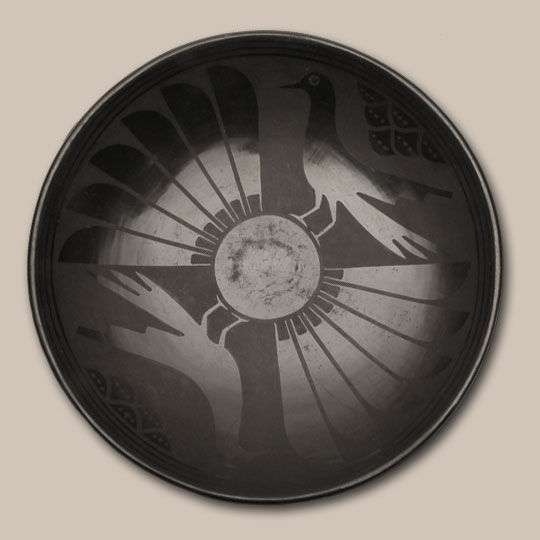 Maria and Julian were responsible for the revival of pottery production at San Ildefonso and largely responsible for the overall revival in interest in pueblo pottery from all pueblos. Maria was making beautiful pottery and Julian was adding to that beauty with his painting skills.
This shallow bowl features a combination of birds, rain clouds and eagle feathers in an almost identical arrangement as one in the Museum of Indian Arts and Culture which is dated circa 1940.
Young Diné Girl Sitting and Daydreaming Outdoors by Beatien Yazz - 25792
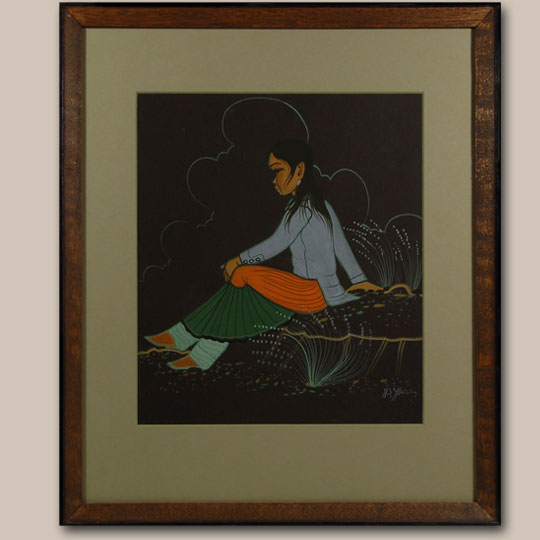 Beatien Yazz's paintings reflect his vision of reservation life, many of which include the activities of children and animals as well as Navajo ceremonies. For a time period his experiences with the Native American Church became the subject of some of his most interesting work.
Beatien Yazz was born in 1928 on the Navajo Reservation and spent his whole life there. He showed promise as an artist very early. At an early age.
Young Diné Boy Sitting and Dreaming Outdoors by Beatien Yazz - 25793
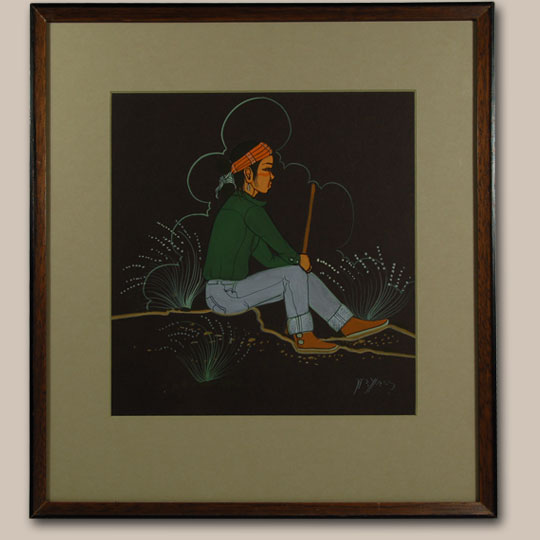 Most paintings by Beatien Yazz reflect the everyday lives of the Navajo. He has always been a master of detail; painting the special nuances that make reservation life unique. In the instance of this painting he is showing the innocence of youth. The young boy is dressed in traditional Navajo style, including moccasins and a headband. He appears to be enjoying the outdoors while daydreaming.
Navajo Traditional Ceremonial Basket - 25785
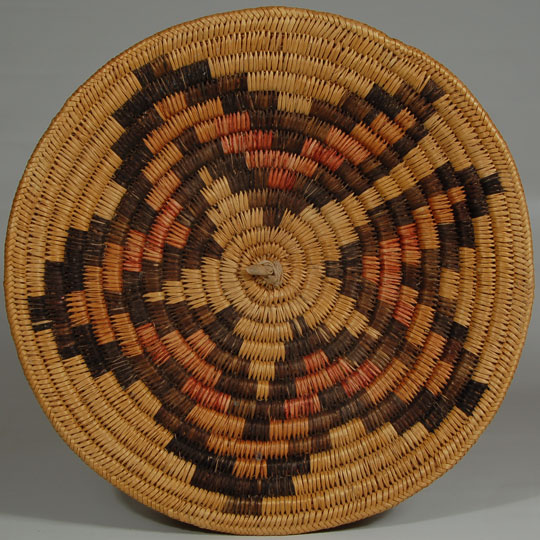 Navajo Ceremonial Baskets, commonly called Wedding Baskets, are constructed with a rod foundation of willow or sumac. The background or light color in the basket is natural sumac. The black and red are dyed. The black dye is derived from sumac leaves, twigs and berries crushed and boiled with a powder made from melted piñon and roasted ocher. The red comes from boiled mountain mahogany roots to which are added ashes of twigs of juniper and powdered bark of black alder.
Painting of a Navajo Horse Race - Rare Black and White by Beatien Yazz - C3589
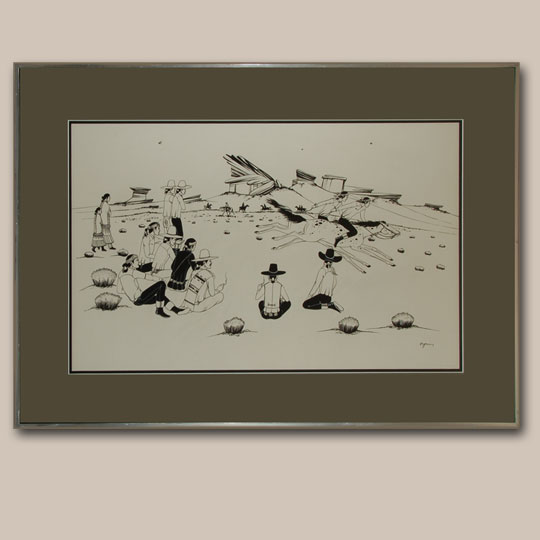 Judging by the paintings we have had at the gallery in the past 15 years, it appears that Beatien Yazz produced very few black on white paintings. In this painting, he portrays two young Navajo boys horse racing to the pleasure of the group of adults sitting around watching. In the background are more horses and riders.
The black pigment used in this rendering is very strong, producing a good contrast with the white background. His treatment of the rock formations in the far background is very modern in concept, something a little different from past paintings.
Acoma Pueblo Polychrome Design Jar - C3819B
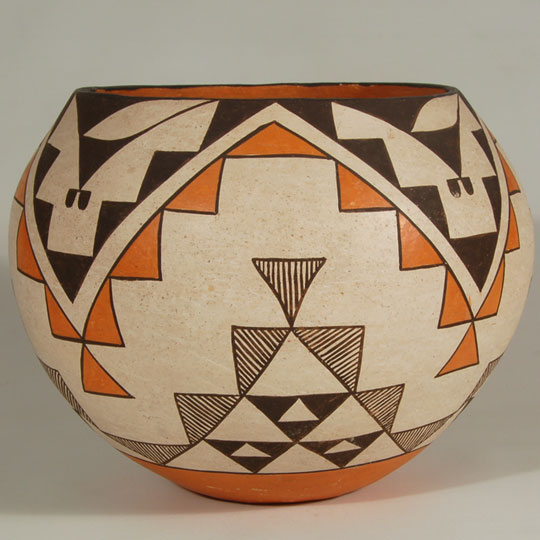 Pottery has always been a central feature of the pueblo people, both for ceremonial and utilitarian purposes. Everything about the daily lives of the pueblo people is of a religious nature. They do not look at jars such as this one as an "art object" as we do. To them, it is a utilitarian vessel or in some cases a ceremonial vessel. The fact that it is beautifully decorated is accepted as part of their history and their lives. Pottery is a sacred part of daily life.
Whether a jar was made for use by the potter in her home or whether it was made for sale to a tourist visiting the pueblo is of no consequence. What are important to collectors are age, condition and beauty. Also important to Acoma potters is that potsherds of prehistoric or historic or even contemporary pottery are ground up and added to the clay for making a new pot. Every Acoma pot contains some part of an older pot. This provides a continuum to the two-thousand-year history of Acoma pottery.
Acoma Pueblo Polychrome Bowl signed Leno by Juana Leno - C3819D
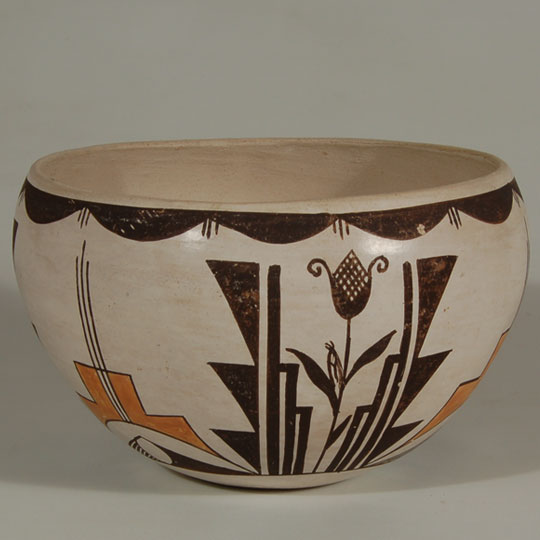 Juana Leno was one of the most accomplished potters at Acoma Pueblo in the 20th century. For the most part, she was unequalled. Her work was flawless. Of all the potters from Acoma whom I personally knew, she was my favorite. She quietly worked every day producing extraordinary pottery without seeking acclaim. She was a wonderful woman and very modest about her talent to produce such fine pieces. She may not have achieved the fame she was due, but it was not because of the lack of quality in her work, but because she chose to remain quietly at home and not seek fame.
Wood Carving in the Likeness of a Squash Katsina - C3805E
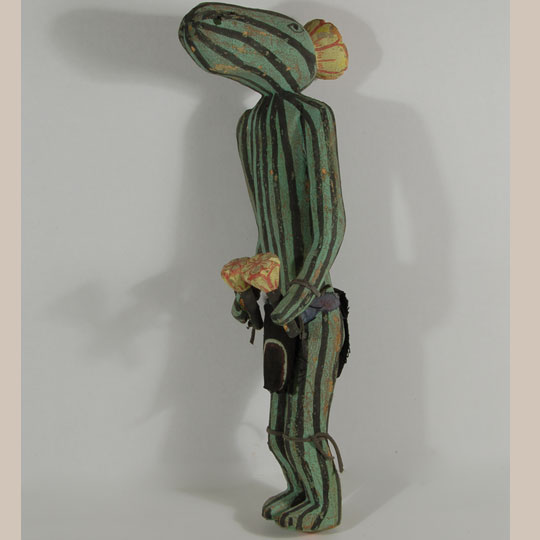 A number of years ago, it was noticed that a quantity of wood carvings began to appear that looked like authentic Hopi Katsina dolls, but they were not true to scale or style. It was determined that someone in Arizona, not a Hopi, was making these and distressing them to look like old katsina dolls.
I am convinced that this Squash carving is one of those. It is too long and skinny and has been distressed to appear old.
Hopi Pueblo Night Dance Panorama with Kasinas by Watson Namoki - C3383ZS
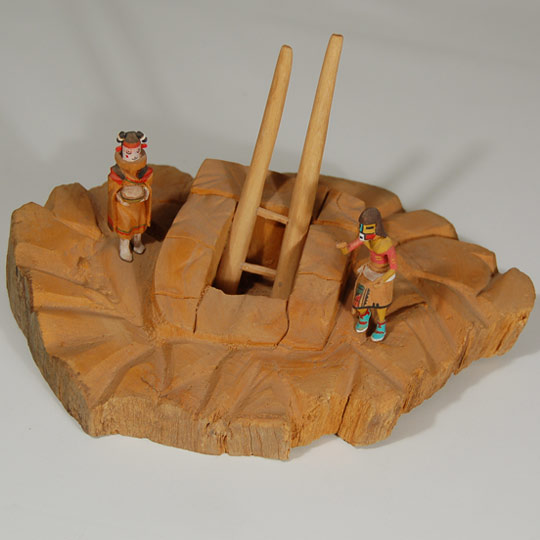 Watson Namoki has created a kiva scene with a ladder inserted from the roof top into the inside. On the roof, he placed Hahai-i Wuhti Katsina carrying a bowl of blue cornmeal and Tuma-uyi (White Chin) Katsina in a panorama of a Katsina Night Dance.
Hahai-i Wuhti is considered to be a sprightly Hopi grandmother. Whenever she appears she is usually very vocal, an attribute not common among the other katsinas. She is considered the mother of the Ogre Katsinas as well as the mother of all katsinas. Tuma-uyi Katsina is one of the very old katsinas. When he appears, he comes in a group, but can be impersonated at any time. His name means "white chin" and seems to derive from the white clay (kaolin) that is used to coat katsina dolls before they are painted.
Ohkay Owingeh - San Juan Pueblo Historic Large Black Storage Jar - SC3816B
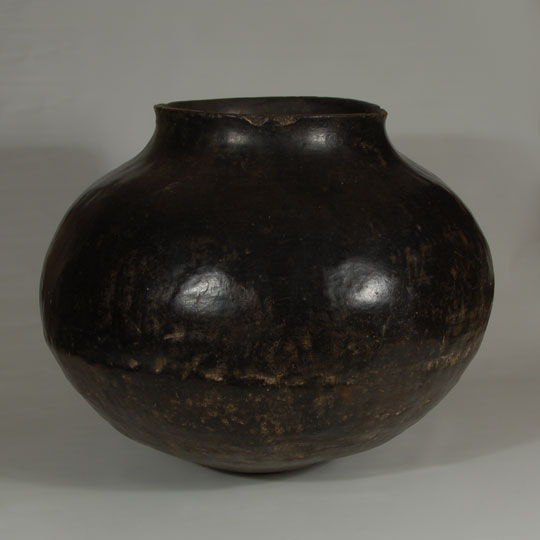 The arrival of the Spaniards in the late 1500s had very little effect on pottery production at the pueblos in either shape or design, but by the 1700s, there were noticeable changes. Still later, with the opening of the Santa Fe Trail in 1821 and the arrival of the transcontinental railroad in 1880, change became inevitable at pueblos located close to the non-Indian populations.
San Juan Pueblo is located only 6 miles from Espanola, New Mexico, and was the area chosen by the Spaniards as the first capitol of their northern territory. They eventually relocated their headquarters to Santa Fe. Even though San Juan was near a population center, there was very little, if any, effect on its pottery styles. The only effect was its almost complete cessation in the late 1800s, however, what little was produced stayed the same until the 1930s when change eventually appeared for commercial purposes.
Tesuque Pueblo Original Painting of a Snake Dancer by Tomás Vigil - C3437G
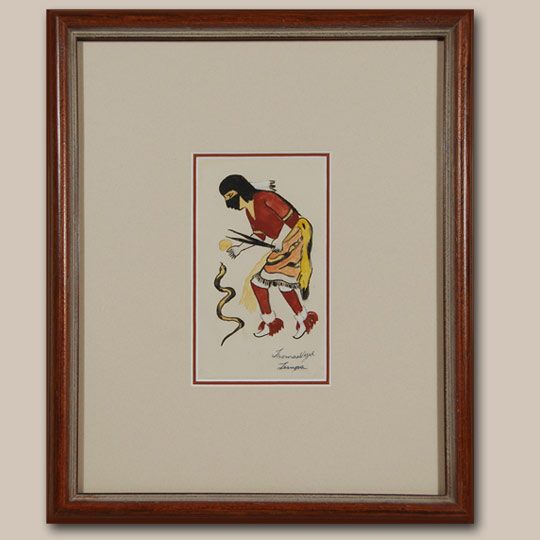 It can be said that Tomás Vigil (Pan-Yo-Pin - Summer Mountain) was of the style of most early 20th century pueblo paintings-that is it was simple, two-dimensional painting. He outlined his intention in pencil before beginning to paint. His colors are strong and show much contrast. His figures generally show considerable action.
He signed his paintings with this name Pan-yo-Pin (1889-1960). He was from Tesuque Pueblo and passed away before the resurgence in Native art occurred in the 1960s, with strong interest witnessed in the 1980s and again in 2005. This interest continues today but works of many artists who passed away around the mid-20th century are not often seen because many of those purchases were not considered important and were not sufficiently protected. Fortunately, this one by Pan-yo-Pin survived.
Painting of a Mountain Landscape signed Sabo by Betty Jean Sabo - C3818A
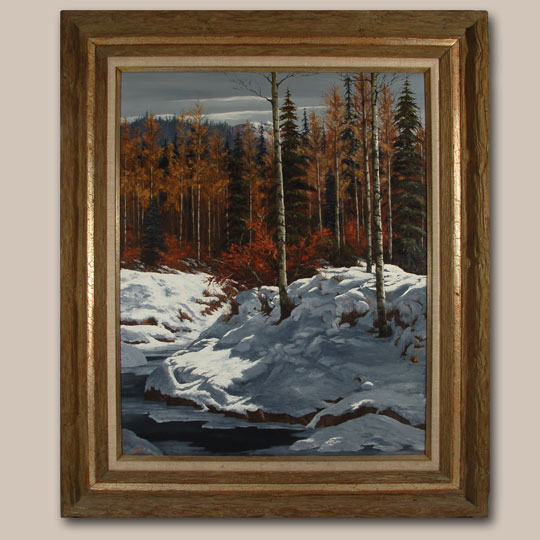 Although the location chosen by the artist for this painting is not noted, nor is the date she painted it noted, it appears to have been painted in a Northern New Mexico mountain area in the beginning of wintertime. Sabo loved painting mountain scenes, aspen trees, snow, and creeks or rivers. It is quite possible that this was painted in an area of the Sangre de Cristo Mountain range at Santa Fe. Her best paintings incorporate snow, a very difficult subject to paint. Achieving various colors of snow in shadows is extremely hard to achieve but Sabo was a master at doing so.
Betty Jean Sabo, who passed away only a couple months ago, was one of Albuquerque's most famous contemporary artists. She was a student at some point of Carl Von Hassler, probably in the early years of her career. She was best known as a painter until later in her career at which time she switched to sculpture. Her paintings were so popular they were snatched up before the paint dried.
Painting of a Stream in Winter signed Angelos by Betty Sabo - C3818B
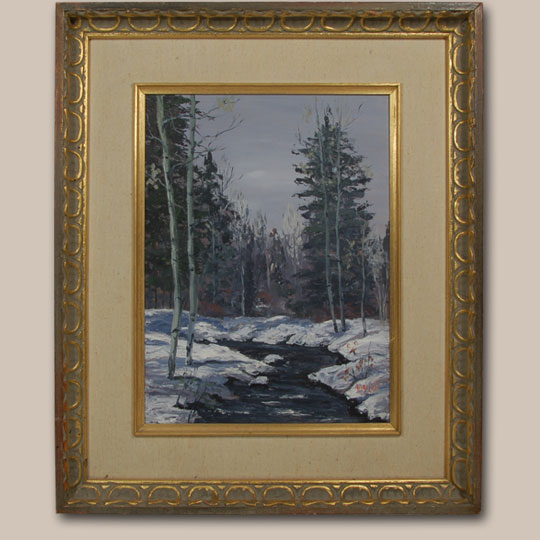 Betty Jean Beals, became Betty Jean Angelos when she first married, then Betty Jean Sabo when she married Dan Sabo who became her life partner. Her earlier paintings were signed simply Angelos. Later ones were signed Sabo. This is one of her earlier paintings. It is not dated but most likely dates to the mid-1950s. Following graduation from the University of New Mexico, she became a painter and continued painting until she reached age 60, at which time she switched to sculpture. Paint fumes were causing her to be sick.
Because of her extraordinary talent as a painter of oil paintings of New Mexico scenery and then her switch to sculpting bronze figures, most collectors have tended to retain those paintings in their collections as there are none after the 1970s when Sabo switched to bronze casting.
Hand Made Quarter Sawn Oak Frames with Historic U. S. Coins by Jack Holtman - C3773V
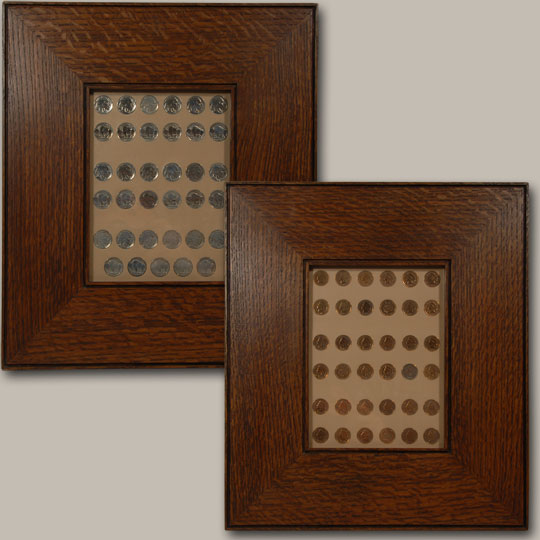 The Indian Head cent, also known as an Indian Head penny, was a one-cent coin ($0.01) produced by the United States Bureau of the Mint from 1859 to 1909. It was designed by James Barton Longacre, the Chief Engraver at the Philadelphia Mint.
From 1793 to 1857, the cent was a copper coin about the size of a half dollar. As rising copper prices made it impractical to keep striking them, in 1857 the Mint reduced the size of the cent, issuing a new design, the Flying Eagle cent. The new pieces were identical in diameter to modern cents, though somewhat thicker and made of copper-nickel. The design caused production difficulties, and the Mint soon looked to replace the coin. Mint Director James Ross Snowden selected the Indian Head design, and chose a laurel wreath for the reverse that was replaced in 1860 by an oak wreath with a shield. Cents were hoarded during the economic chaos of the American Civil War, when the metal nickel was in short supply. As Mint officials saw that privately issued bronze tokens were circulating, they induced Congress to pass the Coinage Act of 1864, authorizing a slimmer cent of bronze alloy.
Zia Pueblo Polychrome Stew Bowl by Candelaria Medina Gachupin - C3819E
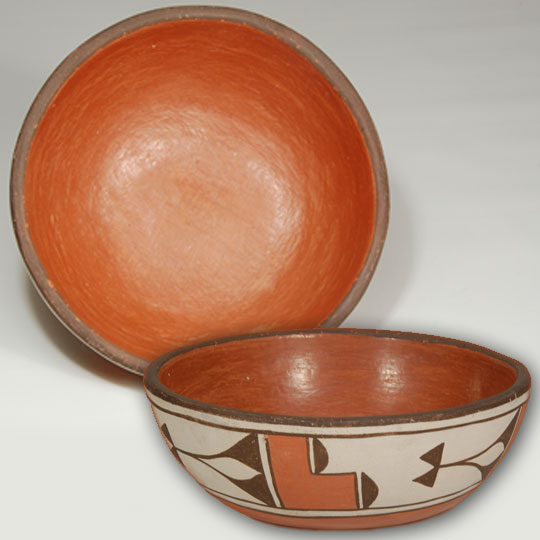 Candelaria Medina Gachupin (1908-1997), Zia Pueblo, was a mid- to late-20th century potter and was the mother of Dora Tse·Pe of San Ildefonso Pueblo. There is not a single example of Gachupin's pottery in the School for Advanced Research (SAR) in Santa Fe and but only one in the Museum of Indian Art and Culture (MIAC). (Harlow & Lanmon) This may not seem significant at this time, but a hundred years from now, it would be a shame that there were not more potters of the 20th century represented in these fine museums.
In checking over our records, we find that we have had only two pots by Gachupin in the last 15 years. Perhaps they are relatively rare. I understand that Dora does have several examples of her mom's work in her personal collection.
Glenna Goodacre Bronze of Young Girl Dancing - C3578
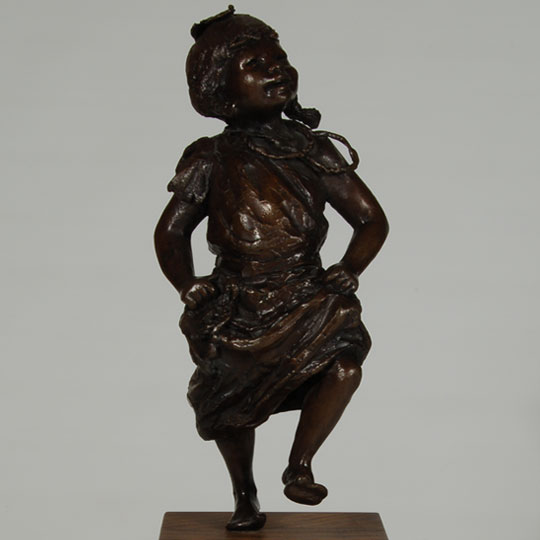 We have had a wonderful time trying to track down information on this bronze of a young girl that was made by Glenna Goodacre early in her career. The current owners purchased it from Forrest Fenn at Fenn Galleries in Santa Fe in 1978, so we consulted Nedra Matteucci Galleries because Matteucci purchased Fenn Galleries and its records. When we told the gallery who the purchaser had been, they verified from Fenn records that the bronze was sold to that couple in 1978.
Acoma Pueblo Polychrome Globular Jar - C3819C
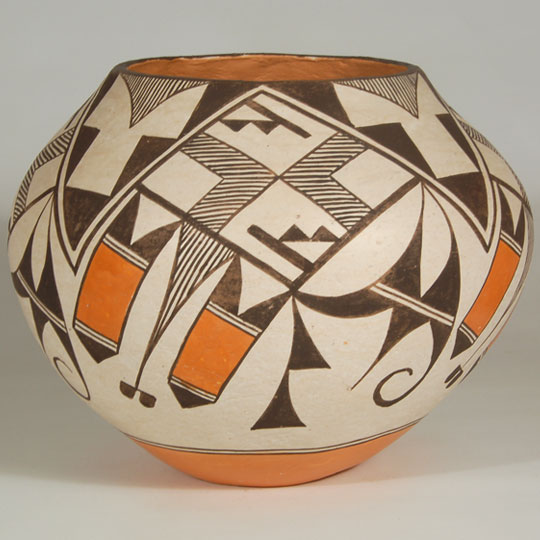 Emma Lewis Mitchell of Acoma Pueblo told Rick Dillingham that individual signatures on Acoma pottery began to appear around 1950. Other potters have stated slightly earlier dates. It has generally been accepted that signatures began appearing with the influx of tourists following the end of World War II. So, mid-1940s to late 1940s seems to be an acceptable date for the appearance of signed pottery.
This jar is not signed, even with the pueblo name. We feel it dates to the 1950s and is just probably one that never got signed. Every pottery did not begin to sign pottery at the same time. Surely it took years, maybe even a decade, before it became a general practice.
Navajo Indian Large Crystal Trading Post Floor Rug - SC3816E
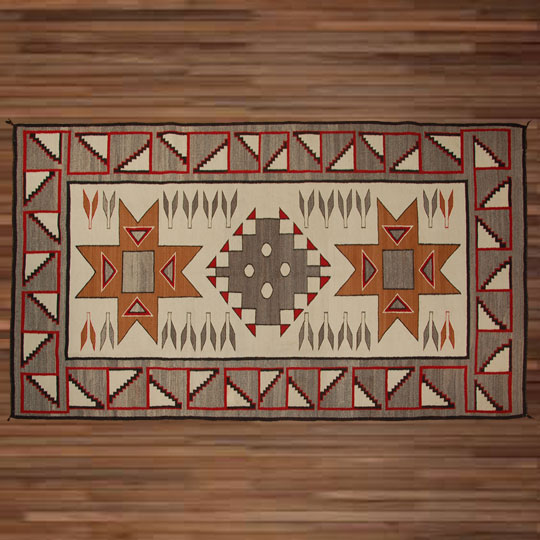 The names J. B. Moore and Crystal Trading Post go together like peanut butter and jelly. One rarely says one name without saying the other. Moore had a short tenure at Crystal Trading Post but his legacy lived on for many years. He had arrived there in 1897 and departed in 1911.
Moore determined to improve the quality of wool used in rugs by having it cleaned and dyed under his wife's supervision. For even better quality, he sent wool to a commercial scouring plant for preparation. Additionally, he strived to have the weavers make rugs that were marketable, rugs based on patterns that potential buyers would associate with their thoughts of how a rug should look.
Navajo weavers were making traditional blankets at that time which were devoid of borders. Moore wanted borders on the weavings so they would look more like rugs rather than blankets. The weavers found it difficult to add a border around all four sides of a weaving. The superstitious women were not comfortable enclosing their designs within a border from which their talent could not escape allowing for another rug to be made later. Whether Moore suggested it or whether the women implemented it by themselves, the weaver's pathway-a single strand of yarn from the inner part of the rug through the border-was developed. There was precedent for such as all Navajo ceremonial baskets had a break in the bands of design to allow for talent of the weaver to be freed.