


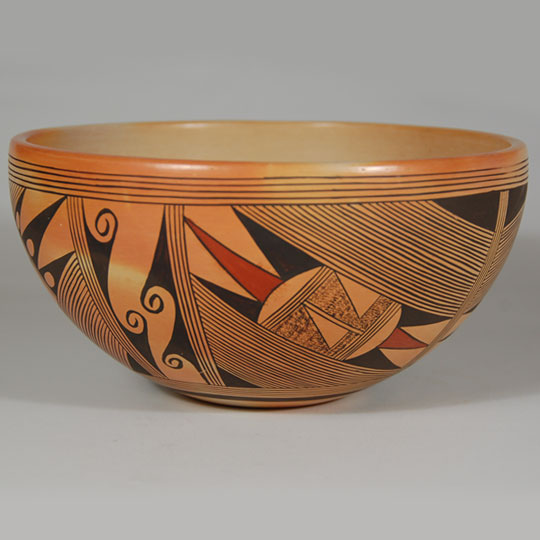
Subject: Hopi Polychrome Bowl with Beautiful Blush
Rondina Huma has been one of the most sought after Hopi potters for over a decade now. She has been featured in many publications and her work is represented in major galleries and museums throughout the country. There is no mystery as to why she has won many awards over the years for her exquisite work. She deserves every accolade bestowed on her. Her pottery is traditional in every manner. She hand coils all her vessels and uses only vegetal and mineral paints. Traditional firing is carried out as well.
I do not know the exact extent of her recent eye surgery or problems, but she has had problems with her sight for the past two years. Presumably, and hopefully, she will regain full use of her sight.
This bowl is an older one from a private collection and is absolutely a jewel from a master potter. Take a look at the large array of parallel black lines throughout the bowl and imagine the patience and experience one would have for doing such.
Condition: original condition
Provenance: from an Arizona resident
Recommended Reading: Hopi-Tewa Pottery: 500 Artist Biographies by Gregory and Angie Schaaf
Subject: Hopi Polychrome Bowl with Beautiful Blush
Artist / Potter: Rondina Huma (1947 - present)
Category: Contemporary
Origin: Hopi Pueblo
Medium: clay, pigment
Size: 4-1/8" deep x 8" diameter
Biography: Gustav Baumann (1881-1971)
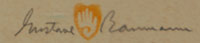
Born in Madgeburg, Germany, Gustave Baumann is best known for prints made from his detailed hand-carved wood blocks.
His family immigrated to the United States when he was a child, and he grew up in Chicago. He returned to Germany to study in Munich at the Kunstgewerbe Schule and then took further training at the Art Institute of Chicago. He spent time in Indiana, and is much associated with the artists who gravitated to Brown County. In that state, Bauman made woodblocks illustrating work by Indiana authors.
Baumann and several other artists decided to see firsthand the reportedly light, clear air of New Mexico that they had been hearing about from other Chicago artists, and in 1918, he settled in Santa Fe where, for over fifty years, he participated in the art community.
He created colored wood blocks from which he made prints, and also became a carver of saints and marionettes, working the Marionette Theater, and carving his 'little people.' He also did numerous paintings in bright colors.
His woodcut subjects are church figures, scenes of sacred Indian pictographs, and landscapes including the Grand Canyon.
During the 1930s, he was WPA coordinator for Santa Fe.
Source: Peggy and Harold Samuels, Encyclopedia of Artists of the American West
Biography: Garnet Pavatea (1915-1981) Flower Girl
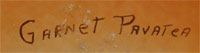 Garnet Pavatea was known as Flower Girl and she was a Hopi-Tewa from the Tewa Village on First Mesa on the Hopi Reservation, and also lived there. Her dad, Dewakuku, was Hopi and her mother was Tewa. Following tradition, Garnet was of her mother's clan.
Garnet had a long and productive career of pottery making and was a favorite of collectors of Hopi pottery. She was an active potter from circa 1940 to circa 1981. She is best known and was fond of making plain red bowls and jars with triangular indentations around the rim as the sole decoration. Often, she made ladles to accompany her bowls. The Museum of Northern Arizona in Flagstaff amassed a major collection of her work. She passed away in 1981.
Biography: Frances P. Torivio (1905-2001)
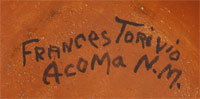 Frances Torivio was a sister of Lolita Concho and the mother of Lilly Salvador and Wanda Aragon. Frances was one of the important matriarchs of Acoma and she made large jars in the prime of her life. She was still attending Indian Market in 2001 at the grand age of 96, and proudly displaying smaller pieces of pottery.
Frances was listed in the book Nacimientos - Nativity Scenes by Southwest Indian Artisans in the "Additional Nativity Artisans" section. To quote the authors "Frances Torivio began making Nativities several years ago. The figures range from 1-1/2 to 4 inches high and are realistically modeled with clearly defined arms and legs and extensive detailing. She uses the typical Acoma clay with details in orange and black."
Subject: Historic Polacca Polychrome “Style C” Bowl, circa 1860-1880
Polacca pottery style began around 1740. It did not fully become the predominant type at Hopi until about 1800, and it continued until about 1890. Polacca wares were the predominant utilitarian wares of this time period. This bowl is typical of Polacca Polychrome, Style C, which existed in the late-1800s.
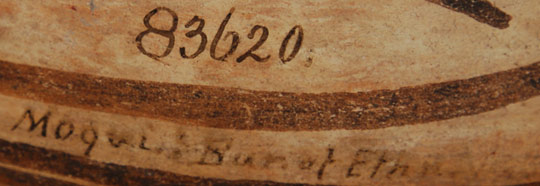
Victor Mindeleff at Hopi (Moqui) collected this bowl in 1883 for the Smithsonian. On the interior of the bowl, below the rim, is inscribed, in India ink, 83620 Moqui Bureau of Ethnology.
What we generally consider to be Zuni Pueblo designs were quite prevalent on Polacca vessels. The designs on this bowl are a good example of this. Two major volute design elements fill the interior of the bowl, and a proliferation of feather elements cover the exterior. A red underbody and a black rim complete the decoration.
Condition: The bowl was broken cleanly in half and reassembled without any attempt to conceal the break. A chip to the rim was professionally restored. Breakage on pottery of the significance of this one is not considered to be detrimental. The collection history overshadows the previous breakage which could have happened at the time of collection in 1882.
Provenance: "In 1882, Victor and Cosmos Mindeleff led an expedition to Zuni and Hopi villages to survey archaeological ruins and historic villages.....In November and December 1882 and January 1883, while Victor Mindeleff helped the Stevensons to survey Canyon de Chelly, Cosmos Mindeleff and Cushing traveled to the Hopi reservation and tried to collect on Third Mesa. Experiencing great opposition, they moved to Mishongnovi on Second Mesa and collected over 5000 pots, baskets, household objects, and agricultural tools, 4166 of which were accessioned."
Using the Smithsonian accession number painted on the interior of the bowl, the Smithsonian staff verified for us the bowl to be one of the pieces collected by Cosmos Mindeleff in 1882. The Smithsonian de-accessioned the bowl but their records do not indicate when or to whom. The Smithsonian at that time was overwhelmed with the sheer amount of items being collected in New Mexico and Arizona pueblos that it gave many items to other museums. Over the years, these museums have de-accessioned some of those items which accounts for their being on the market for sale.
Quotation from "The Formation of Ethnographic Collections: The Smithsonian Institution in the American Southwest," by Nancy J. Parezo, in Advances in Archaeological Method and Theory, 10, Michael B. Schiffer, editor (1987): 1-47.
Recommended Reading: Canvas of Clay by Edwin Wade and Allan Cooke
Title: Historic Polacca Polychrome "Style C" Bowl, circa 1860-1880
Potter Unknown
Category: Historic
Origin: Hopi Pueblo
Medium: Native Clay
Size: 5" deep x 11" diameter
Item # C3361A
Subject: Acoma Four-color Olla with Parrot Design
Frances Torivio was a sister of Lolita Concho and the mother of Lilly Salvador and Wanda Aragon. She was one of the important matriarchs of Acoma and made large jars in the prime of her life. She was still attending Indian Market in 2001 at the grand age of 96, and proudly displaying smaller items.
She was one of the important matriarchs of Acoma Pueblo pottery families and had gained fame as an outstanding potter. In 1976, she taught traditional pottery-making classes not only for her own family, but for many, many more at the pueblo. She once described how she and her sister, Lolita Concho, learned pottery making the hard way, without someone to teach them. Torivio gained fame as an outstanding potter, as did her sister.
Torivio never fell into the trend of other Acoma potters who started painting green ware pottery or firing in a commercial kiln. She always continued following ancient techniques of acquiring her clay from Mother Nature, grinding up potsherds for temper, hand coiling the pottery, using all native materials for paints, and firing the pottery in the traditional outdoors technique.
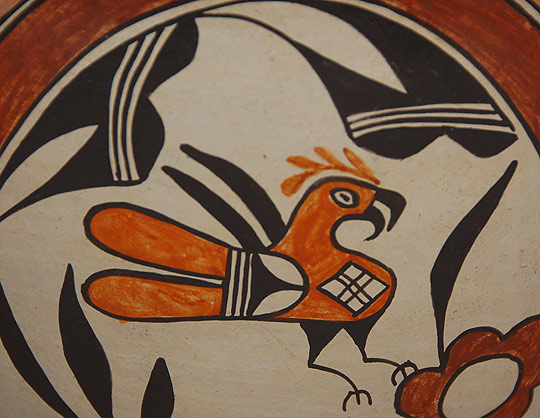
This jar is a small water jar with parrots and rainbows as the prime design. Rainbows of two different colors hover over parrots on opposing sides, and parrots perched on flowers appear of opposing sides. The standard three colors of white, black and red appear with a fourth color of rose. The jar is well constructed and beautifully painted.
Condition: very good condition
Provenance: from a gentleman in Colorado
Recommended Reading: Acoma and Laguna Pottery by Rick Dillingham
Subject: Acoma Four-color Olla with Parrot Design
Artist / Potter: Frances P. Torivio (1905-2001)
Category: Contemporary
Origin: Acoma Pueblo
Medium: clay, pigments
Size: 8-1/2" x 9-1/4" diameter
Item # C3354E
Title: Navajo Folk Art Wood Carving “Man on Motorcycle”
Harrison Juan has been carving the cottonwood he finds along the creek beds of the San Juan River for over 35 years. He was born in Lake Valley and became interested in making art while observing his uncle, Johnson Antonio, a Navajo folk art artist. He remembers that he cut wood for Antonio and ran errands for him in the beginning. Juan's goal is to become self-sufficient as an artist, but he has been working on and off in construction for support.
"I just try to keep it going," the artist explained to the Rosenaks, "showing the joys of reservation life and Navajo people at gatherings, ceremonies, and just the fun of friends being together at local posts. I carve the older people and show how they are dressed ... and sporting their best jewelry."
Juan's carvings can be more serious at times as he captures the older generation but also his generation at work, riding motorcycles, or just hanging out. In winter, when the Yeis are dancing, he will sometimes place his subjects at ceremonies-his goal is highlighting the stories of his people.
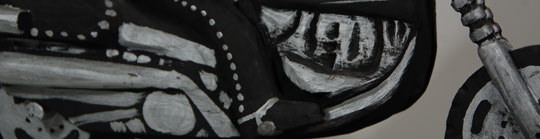
This carving of a Navajo male riding a motorcycle is an excellent example of the fine carving seen in Juan's work. The details shown in the tires and the engine compartment are exceptional. The overall proportion of rider and vehicle is to scale.
Condition: original condition
Provenance: from the collection of Jan and Chuck Rosenak. Published in Navajo Folk Art by Chuck and Jan Rosenak, page 63
Recommended Reading: Navajo Folk Art by Chuck and Jan Rosenak
Title: Navajo Folk Art Wood Carving "Man on Motorcycle"
Artist / Carver: Harrison Juan (1953-present)
Category: Other Items
Origin: Diné - Navajo Nation
Medium: wood, paint
Size: 13-3/4" long x 6-1/2" wide x 10-1/2" tall
Item # C3347K
Biography: Harrison Begay (1914-2012)
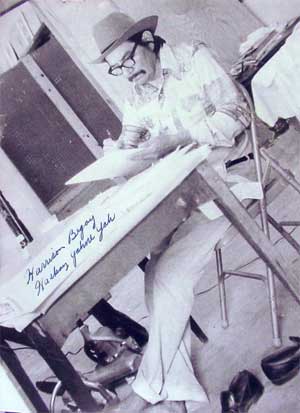 Harrison Begay, or Haskay Yahne Yah (The Wandering Boy*), to his knowledge, was born in 1914 approximately fourteen miles west of present-day Greasewood, Arizona, on the Dine` (Navajo) Reservation at a place known as Whitecone. His date of birth is often cited as a few years later, however, there are no records and Harrison prefers the year 1914.
When he was a boy of seven years, his mother died and soon after that he was sent off to government boarding schools. As he grew older he decided to study art in Santa Fe where an art school was organized by the government in the early 1930s. From 1934 until about 1940 he attended this school under Dorothy Dunn. Following art school, Harrison attended college and then enlisted in the U.S. Army during World War II. Serving under General Dwight Eisenhower, Harrison did not have much opportunity to pursue his painting. Soon after his discharge and return to Arizona he was able to begin once more his study of art. Then in the 1960s he again met General Eisenhower at the annual Ceremonials in Gallup, New Mexico. At that time Harrison presented General Eisenhower with one of his fine paintings which is in a permanent collection in Washington, D.C. "Begay's paintings have exerted greater influence on Navajo artists than any other person. His work is internationally known."
-Snodgrass 1968.
* Note: Most published references to Harrison Begay state that the translation of his name Haskay Yahne Yah is "Warrior Who Walked Up to His Enemy." The correct translation is "The Wandering Boy." Thanks to Jim C. Hunt for bringing this to our attention. Hunt's father spent the better part of his life on the Navajo reservation. He taught the Navajo language at Northland Pioneer College in Holbrook, AZ, and was beyond fluent in the language. It was he who told the younger Hunt the correct translation. Our thanks to the Hunts for this enlightenment.
Harrison Begay Obituary
We were sorry to hear today that Navajo artist Harrison Begay passed away on Tuesday of this week (August 21, 2012) at the age of 95 years. He is survived by his siblings Alice Clah, Anita Begay, Mary Joy Begay, Cecil Blackrock and Sarah Brown. His burial will take place at the Ft. Defiance Veterans Cemetery, Arizona.
Begay was one of the early 20th century Navajo artists and the last of a long line of Southwest Native American artists. We know of only two others of his generation who are still with us and they are Geronima Montoya (Potsunu) of Ohkay Owingeh Pueblo, who is now 97 years old and Navajo artist Beatien Yazz who is now 84 years of age. It is sad to see them go but they have all left us some remarkable art by which to remember them.
Biography: Glenna Goodacre (1939- )
 Glenna Goodacre is a well-known, perhaps the best known, female sculpture artist. Her sculptural works appear in public, private, municipal and museum collections throughout the United States. Probably her most well-known sculpture is the Vietnam Women's Memorial installed in Washington, D.C. in 1993. She was selected to create the monumental Irish Memorial in Philadelphia which was installed in 2003, a larger than life-size sculpture of Ronald Reagan for the Reagan Library in Simi Valley, California, the design of the Sacagawea dollar coin for the U. S. government, and many more monumental works.
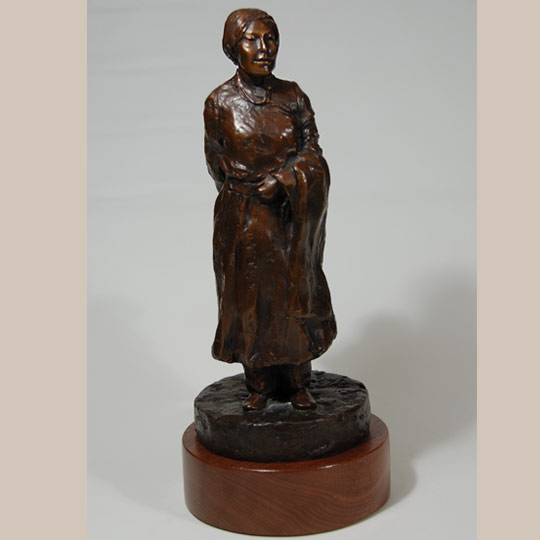
Goodacre was born in Lubbock, Texas, but lives in Santa Fe. She had been represented by Nedra Matteucci Galleries in Santa Fe for over a decade with annual exhibits of her works until her serious brain trauma following a fall at her home in 2007, which put a temporary end to her art career. Goodacre made many monumental bronze sculptures, larger than life, but also made table top or pedestal sculptures such as this one of a woman and child dancing.
Title: Bronze Sculpture “Dance Day”
Glenna Goodacre is a well-known, perhaps the best known, female sculpture artist. Her sculptural works appear in public, private, municipal and museum collections throughout the United States. Probably her most well-known sculpture is the Vietnam Women's Memorial installed in Washington, D.C. in 1993. She was selected to create the monumental Irish Memorial in Philadelphia which was installed in 2003, a larger than life-size sculpture of Ronald Reagan for the Reagan Library in Simi Valley, California, the design of the Sacagawea dollar coin for the U. S. government, and many more monumental works.
Goodacre was born in Lubbock, Texas, but lives in Santa Fe. She had been represented by Nedra Matteucci Galleries in Santa Fe for over a decade with annual exhibits of her works until her serious brain trauma following a fall at her home in 2007, which put a temporary end to her art career. Goodacre made many monumental bronze sculptures, larger than life, but also made table top or pedestal sculptures such as this one of a woman and child dancing.
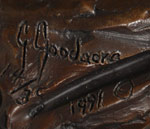
This sculpture was issued in 1991 in an edition of 35, of which this is number 14. It is signed by the artist.
Condition: original condition
Provenance: from the estate of a Colorado collector of fine art
Title: Bronze Sculpture "Dance Day"
Artist: Glenna Goodacre (1939-present)
Category: Bronze
Origin: European-American Artists
Medium: bronze sculpture, wood base
Size: 11-7/8" and 13-3/4" with wood pedestal
Item # C3356C
Subject: Oval Shaped Serving Basket with Handles
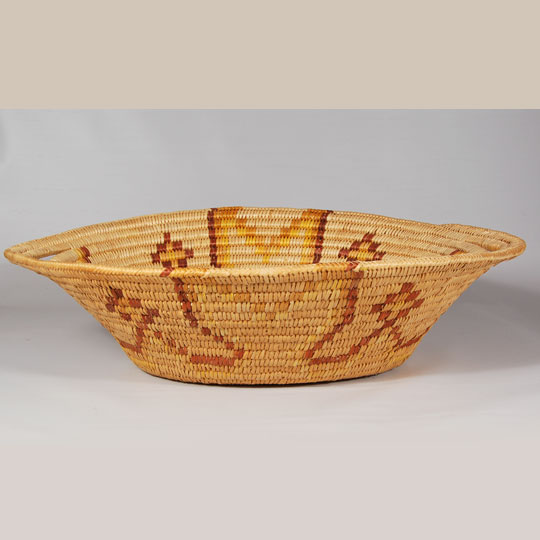
Jicarilla Apache basketry covers a long span of time, but very little is known of their work before they were settled on a reservation in 1887 in northern New Mexico. All Jicarilla baskets are of coil weave, usually of sumac, but sometimes of willow. The Jicarilla Apache women generally made large deep basket bowls for winnowing or storage. They were designed with elements of commercial dyes, so fading is quite normal on a basket of some age.
The Jicarilla Apache Nation is located in the mountains and rugged mesas of northern New Mexico. The landscape offers diverse scenery of Ponderosa pine forests in mountainous terrain and piñon (pine tree) mesas with sage brush flats. Dulce, New Mexico, is the Jicarilla Apache Nation Headquarters.
This basket is typical of the style made for sale to collectors and visitors to the Jicarilla village. It is oval shape and the outer two rows at the top of the basket were extended to form handles at the two ends. The edge of the rim was finished in a herringbone weave.
Condition: Very good condition
Provenance: from the collection of Katherine H. Rust
Recommended Reading: Southwestern Indian Baskets: Their History and Their Makers by Andrew Hunter Whiteford
Title: Oval Shaped Serving Basket with Handles
Weaver Unknown
Category: Bowls and Other Forms
Origin: Apache
Medium: natural materials
Size: 18-1/4" long x 13-3/4" wide x 5-1/4" deep
Item # C3218V
Title: Original Wood Block Print "Torrey Pine"
Gustav Baumann was born in Germany but immigrated to the United States as a child with his parents. He studied at the Art Institute of Chicago and had lived for a time in Indiana.
Baumann and several other artists decided to see firsthand the reportedly light, clear air of New Mexico that they had been hearing about from other Chicago artists, and in 1918, he settled in Santa Fe where, for over fifty years, he participated in the art community. He created colored wood blocks from which he made prints, and also became a carver of saints and marionettes, working the Marionette Theater, and carving his "little people." He also did numerous paintings in bright colors.
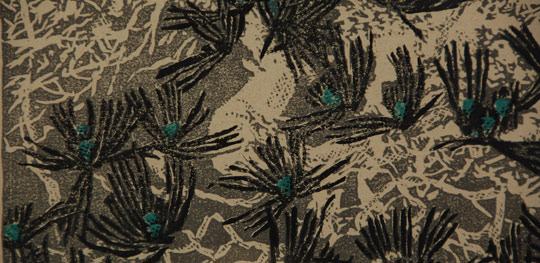
This woodcut is of a Torrey Pine of California. Torrey Pines State Natural Reserve is located within San Diego city limits and yet remains one of the wildest stretches of land on the Southern California coast. Because of the efforts and foresight of the people in this area, 2000 acres of land are as they were before San Diego was developed-with the chaparral plant community, the rare and elegant Torrey pine trees, miles of unspoiled beaches, and a lagoon that is vital to migrating seabirds.
Baumann captured the Torrey Pine in its splendid elegance. Most of the image is black but hints of green highlight the pine. The print is titled in lower left and signed in lower right. It is State I, #72/125 and dated -61.
Condition: appears to be in original condition but has not been examined out of the frame
Provenance: from the collection of a gentleman from Colorado
Title: Original Wood Block Print "Torrey Pine"
Artist: Gustav Baumann (1881-1971)
Category: Prints
Origin: European-American Artists
Medium: wood block print
Size: 13-1/2" x 13-7/8" image; 19-3/4" x 19-3/4" framed
Item # C3354F
Subject: Hopi Sikyatki-style Seed Jar
Garnet Pavatea was known as Flower Girl and she was a Hopi-Tewa from the Tewa Village on First Mesa. Her dad, Dewakuku, was Hopi and her mother was Tewa. Following tradition, Garnet was of her mother's clan.
Hopi artisans owe much to Mary-Russell Ferrell Colton, co-founder of the Museum of Northern Arizona in Flagstaff. She was instrumental in creating the Hopi Craftsman Exhibition in the early 1930s with the intent of fostering production of quality work. She was concerned that traders were content to accept and sell mediocre work from Hopi craftsmen and were not interested in educating the public on quality crafts. She organized the craft exhibit for the July 4th weekend every year and it has served her intent to greatly increase interest in quality Hopi crafts.
Garnet Pavatea was a long-time entrant in the craft exhibit and won many awards by doing so. She also seemed to be a favorite of the Museum of Northern Arizona. She was often a demonstrator at the Craftsman Exhibition. For a number of years, Adobe Gallery had a standing order from the Museum of Northern Arizona for any Garnet Pavatea pottery available.
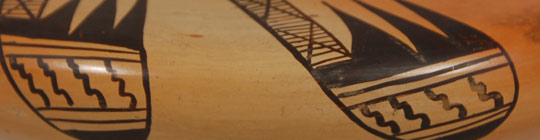
This seed jar of the Sikyatki-shape is a shining example of her expert craftsmanship in vessel construction and her artistic talent in designing and painting a jar. She extended the red paint on the rim down into the interior of the jar, a step not necessary, but one that demonstrates her attention to detail. The jar was constructed from all native materials and fired in a traditional outdoor firing. It is signed Garnet Pavatea on the underside.
Condition: the jar must be at least 40 years old and is in original condition.
Provenance: from a gentleman collector from Colorado
Recommended Reading: Canvas of Clay: Seven Centuries of Hopi Ceramic Art by Edwin L. Wade and Allan Cooke
Subject: Hopi Sikyatki-style Seed Jar
Artist / Potter: Garnet Pavatea (1915-1981) Flower Girl
Category: Contemporary
Origin: Hopi Pueblo
Medium: clay, pigment
Size: 2-3/4" tall x 8" diameter
Item # C3354C
Subject: Diné (Navajo) Pair of Original Paintings of Feather Dancers

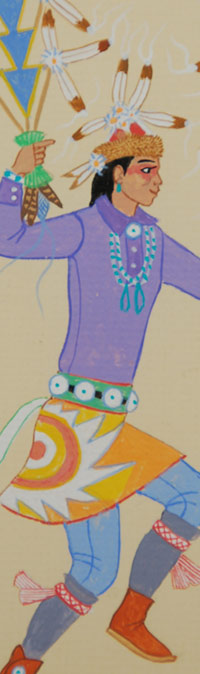
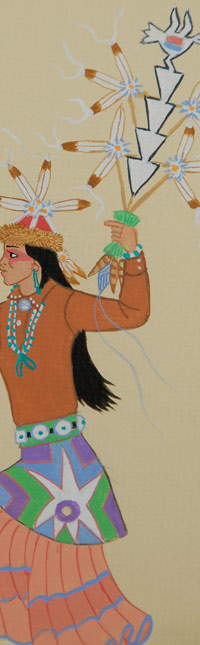
The Navajo Feather Dance is one that entails a drummer who, during the dance, beats upon an overturned basket to provide the beat for the dancer. To the rhythm of the basket-drum, dancers begin a dance beating time with a pair of square frames, hung with feathers. There can be any number of dancers, both male and female.
In this pair of original paintings, Begay has featured a single male and a single female, each its own painting and each framed separately in matched framing style. Both paintings are signed with Begay's Native name as well as his English name.
Condition: both appear to be in original condition
Provenance: from the collection of a gentleman from Colorado
Recommended Reading: Southwest Indian Painting: A Changing Art by Clara Lee Tanner
Subject: Diné (Navajo) Pair of Original Paintings of Feather Dancers
Artist: Harrison Begay (1914-2012) Haskay Yahne Yah - The Wandering Boy
Category: Paintings
Origin: Diné - Navajo Nation
Medium: gouache
Size: 9-3/8" x 6-1/4" image each; 16-1/2" x 13-3/8" framed each
Item # C3354G
Diné (Navajo) Wedding Vase with Yei and Hogan Designs by - Silas and Bertha Claw C3321E
Silas and Bertha Claw broke with Navajo pottery tradition and the customs of their fellow tradesmen. Their forms remained true to tradition but they used an appliqué technique for design elements and colorful oil or acrylic paints for highlights. They were of the Shonto/Cow Springs region of the Navajo Reservation. Silas passed away in 2002 but we have found no record of Bertha passing away.
Around 1968, Silas began working in clay even though pottery making, like basket making, was considered women's work. Bertha assisted him from the very beginning. The Claws made a variety of pottery shapes: traditional-style cooking jars, wedding vases, triple-spouted jars, and ceramic beads.
It is not known which one did which part of the production but it is believed Bertha would form the vessels and Silas would decorate them with a variety of appliquéd and incised plant and animal motifs-usually in high relief and occasionally in full round. These motifs depicted a wide range of subjects that included cactus plants and blooming yuccas, oak leaves with acorns, ears of corn, a menagerie of domestic animals, and horned toads. Silas often applied oil paint in a range of colors to portions of the appliqué to make them even more realistic. He then would coat the vessel with varnish.
This wedding vessel shows a procession of Navajo Yei dancers executed in appliqué on the body of the vessel. On the other side of the vessel is a Navajo hogan with smoke from the chimney. The wedding vessel is an older one by this couple and is signed S.B. Claw on the underside.
Condition: original condition
Provenance: from the John Barry collection of California
Recommended Reading:
- Navajo Folk Art: The People Speak by Chuck and Jan Rosenak.
- "The Navajo Pottery of Silas and Bertha Claw" by Ed Dobbins and Scott C. Russell, American Indian Art Magazine, Spring 2007. Vol. 32, No. 2.
Title: Diné (Navajo) Wedding Vase with Yei and Hogan Designs
Artists / Potters: Silas and Bertha Claw
Category: Contemporary
Origin: Diné - Navajo Nation
Medium: clay, paint
Size: 9-1/8" tall x 5" diameter
Item # C3321E
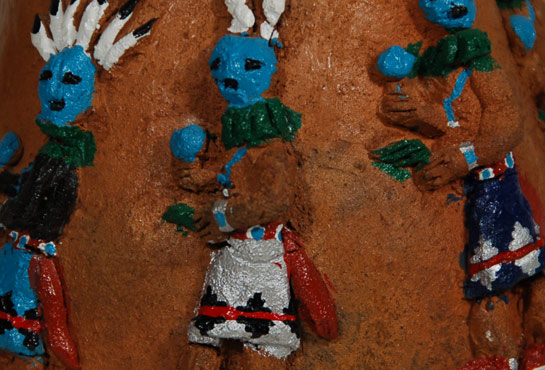
Subject: Cochiti Pueblo Male Storyteller with 3 Children
Ada Suina has always been recognized as one of the premier storyteller figurine potters. Her male figurines, such as this one, have a strong, chiseled face, and the children have happy carefree expressions. She still uses all natural materials and fires the figurines outdoors in the traditional manner.
Ada resumed making pottery figurines a few years ago after several years of not doing so following the death of her husband. She relied so much on his help in digging the clay and working it to a point where she could form the figurines. Now, at age 83, she has to do everything by herself, therefore it is taking significantly more time to complete a piece. She is not very actively making pottery at this time.
This figurine is an older one of hers, probably more than 10 years old, but is in original condition. It is an excellent example of her work. The male has his mouth open telling stories to the children on his lap. He is dressed in his finest traditional clothing and has a red headband over his hair. All three children are boys.
Condition: original condition
Provenance: from a gentleman from Colorado
Recommended Reading: The Pueblo Storyteller: Development of a Figurative Ceramic Tradition by Barbara Babcock, et al.
Title: Cochiti Pueblo Male Storyteller with 3 Children
Artist / Potter: Ada Suina (1930-present)
Category: Figurines
Origin: Cochiti Pueblo
Medium: clay, pigment
Size: 6" tall x 5" wide x 6-3/4" deep
Item # C3354A
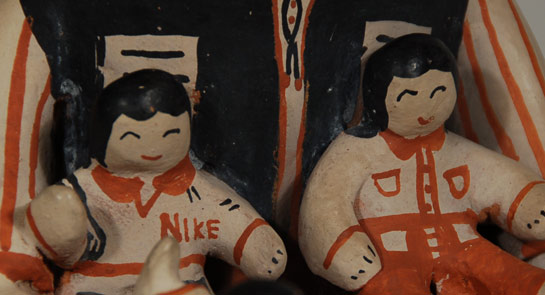
BOOK: Southwest Textiles: Weavings of the Navajo and Pueblo
The significance of Navajo and Pueblo textiles transcends simple artistic expression. Through the spiritual activity of weaving, male and female weavers beautify their world and integrate their art into the web of life. Both the Navajo and Pueblo believe that the culture hero Spider Woman has taught them to create with patience, understanding, and sensitivity. Yet over the centuries, Navajo and Pueblo textiles have developed along distinct paths that reflect the unique historical and individual experiences within each culture. The textiles collection of the Southwest Museum illustrates the rich interplay between these two peoples and their art.
Southwest Textiles tells the fascinating story of the history and evolution of Navajo and Pueblo fabric arts. Over 250 outstanding examples from the Southwest Museum's collection are reproduced in full color, along with 57 details of these works and 49 historical photographs. Also included are absorbing accounts of the early collectors of these superb textiles and some of the colorful individuals who were instrumental in founding the Southwest Museum and shaping its collections.
An accompanying CD-ROM includes comprehensive charts of the fiber and construction analysis performed on each of the textiles illustrated in the book. The charts are prefaced by an overview of the analysis. Also on the CD is a complete inventory of the museum's southwestern textiles collection.
-Excerpt from the inside cover
Title: Southwest Textiles: Weavings of the Navajo and Pueblo
Author: Kathleen Whitaker
Subject: Native American Textiles
Item # 0-295-98226-8
Date Published: 2002/08/01
Size: 432 pages
Subject: Original Painting of a Jemez Pueblo Buffalo Dance
The plan for a painting studio at the Santa Fe Indian School had been four years in the making before it finally opened in the fall of 1932. Dorothy Dunn was in charge of the art department. It was in the second year of The Studio that Dorothy Dunn first mentioned Emeliano Yepa and she described him as painting pageantry. He was one of three students selected to paint murals in true fresco for The Studio and one of the residence halls. One of the mural paintings by Yepa was "A Summer Dance" (Corn Dance).
 In the fourth year (1935-36), a Museum of New Mexico exhibit was organized to present to the public works by the students. Frederic H. Douglas's review of the show included the following statement "Much fine art will come from this area, with its strong tradition in painting. No.125 by E. Yepa, displays the work of a painter who clings, at least in his pictures, to a style seen in the first days of the movement. His conservatism is to be commended, for while progress is desirable, a brake is often useful."
An analysis of the works of all the students in the fifth year (1936-37) stated of Yepa "Emeliano Yepa had a somewhat stilted style which enhanced the formal patterns of ceremonial and small Jemez scenes he chose to paint. His brilliant palette brought animation and a note of daring to his balanced, conservative compositions."
The last mention of Yepa by Dorothy Dunn, in her book published in 1968, stated that "Emiliano Yepa, another fine artist of Jemez, is no longer living." There was no date given for his death. Jeanne Snodgrass, in her Biographical Directory published in 1968 lists the artist as Emilina rather than Emeliano but has no information regarding birth, death, or age. She states that the artist attended the Indian School from 1932 to 1937 and was included in a National Gallery of Art exhibit in Washington, DC in 1953.
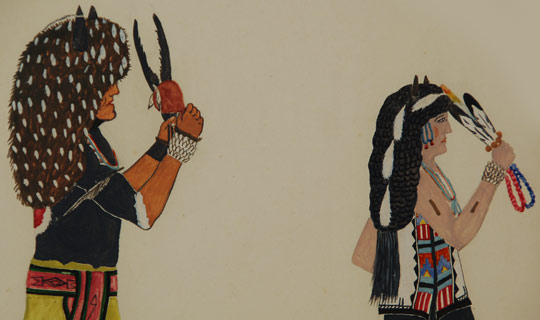
This painting is of a Jemez Pueblo Buffalo Dance, a dance often seen during the fall and winter seasons. The costuming presented by Yepa is a very good representation of what one sees today at a Buffalo Dance. The men wear buffalo head covers and canvas skirts with a serpent encircling the mid-section and tin cones dangling from the hem section. The female wears a traditional pueblo dress and carries feathers in her hand. The painting is signed E. Yepa in lower right and on verso is rubber stamped The Studio U. S. Indian School, Santa Fe, New Mexico.
Condition: very good condition with only a few minor flakes of missing paint
Provenance: sent to us by a gentleman from Colorado
Reference and Recommended Reading: American Indian Painting of the Southwest and Plains Areas by Dorothy Dunn
Subject: Original Painting of a Jemez Pueblo Buffalo Dance
Artist: Emeliano Yepa (c.1920s- c.1950s)
Category: Paintings
Origin: Jemez Pueblo
Medium: watercolor
Size: 11-3/8" x 15-1/2" image; 16-3/4" x 20-3/4" framed
Item # C3355
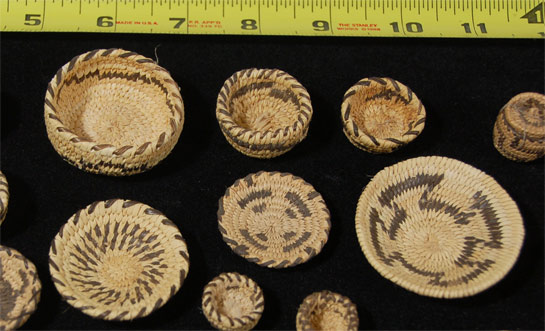
Title: Collection of 21 Miniature Southwest Indian Baskets
This collection of miniature baskets was assembled in the 1960s by a client from the Midwest. The collection represents weavers from Tohono O'odham, Akimel O'odham and Pomo tribes. The collection is being offered as a group for the stated price, which, it has been determined, is well below market value.
Condition: original condition
Provenance: from the collection of a Midwest collector
Recommended Reading: Southwest Indian Baskets: Their History and Their Makers by Andrew Hunter Whiteford
Title: Collection of 21 Miniature Southwest Indian Baskets
Unidentified Artists
Category: Miniature
Origin: Native American Basketry
Medium: grasses
Size: ¼" to 2" diameters
Item # C3353
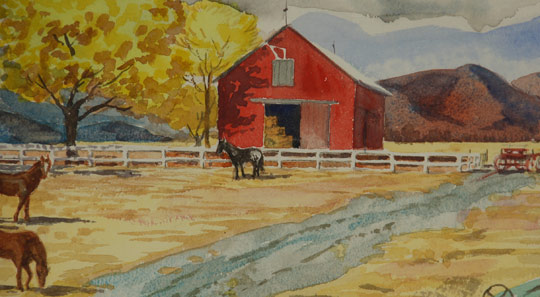
Title: Original Watercolor “Hondo Valley Landscape”
As an adult, at the time of joining the Navy during World War II, John Liggett Meigs (1916 - 2003) discovered that as a one-year old he had been "kidnapped" by his biological father and his father's mistress, moved from Chicago, and had his name changed to MacMillan. He never saw his biological mother again. Over the next several years, he and his family moved many times, finally settling in San Antonio, Texas, where Meigs first developed his interest in art, a career that lasted the remainder of his life, but not before many interruptions for various adventures.
Following the death of his father, he changed his name back to his original name of Meigs and moved to California with his foster mother and attended the University of Redlands. He worked as a newspaper reporter in Los Angeles, then a reporter in Hawaii, then architectural work in designing houses, then textile design which led him to become one of the first designers of aloha shirts. He then served in the Navy and following his discharge, lived in Florida for a couple years and established a lounge still in existence as the Trade Winds Tropical Lounge.
Meigs left Florida and went back to Hawaii, and that is when he met artist Peter Hurd from San Patricio, New Mexico. Meigs continued moving around, doing different jobs, but eventually settled down in San Patricio and became a lifelong companion and friend of Peter Hurd. When Meigs settled in San Patricio, he bought a small, old adobe house, which, over the next forty years, he expanded until it grew to twenty-three rooms; Peter Hurd dubbed it "Fort Meigs." His association with Hurd and his wife Henriette flourished, as did Meig's artistic accomplishments and his social connections.
In his artistic pursuits, Meigs worked in a variety of mediums, to include oil, watercolor, ink and photography. He had over fifty, one-man exhibitions, to include in Santa Fe, New Mexico; New York City; Lubbock, Texas; Roswell, New Mexico; and Honolulu, Hawaii. His subject material was primarily either landscape or architectural. In early 1960, he was commissioned by the Society of California Pioneers to paint a series of watercolors of Victorian homes in San Francisco, those paintings being exhibited at the Society's headquarters in San Francisco in June 1960. In 1997, the Honolulu Academy of Arts hosted an exhibit of aloha shirts with his designs from the late 1930s and 1940s. His art, to include his aloha shirts, is in private, corporate and academic collections.
This watercolor painting is typical of his work during his association with Peter Hurd. One familiar with Hurd's paintings can clearly see a similar style in this work. It is signed and dated 1969 in lower right. Research into auction records of Meig's sales indicated that only two of his paintings have been auctioned in the past. That is an indication that fans of his art, who have collected over the past 40 years, are keeping his paintings in the family and not interested in selling them. One cannot say anything more complimentary about an artist than that.
Condition: appears to be in original condition but has not been examined out of the frame. The mat material does appear to be acid-free so there should be no damage to the painting from acid-burn.
Provenance: brought to us by a client from Albuquerque
Reference Material: biographical information provided above was excerpted from the website of AskART.
Title: Original Watercolor "Hondo Valley Landscape"
Artist: John Liggett Meigs (1916 - 2003)
Category: Paintings
Origin: European-American Artists
Medium: watercolor
Size: 16-1/4" x 21-1/2" image; 26-1/2" x 31-7/8" framed
Item # C3351