


Subject: Navajo (Diné) Folk Art Wood Carving "Evil Pleasures"
 This sculpture is of a Female Skinwalker, which, in Navajo legend, would be much rarer than a male Skinwalker. There are several varieties of Navajo witches, one of which is using his (rarely her) powers to travel in animal form. In some versions, men or women who have attained the highest level of priesthood are called "pure evil."
They are human beings who have gained supernatural power by breaking a cultural taboo. Specifically, a person is said to gain the power to become one upon initiation into the Witchery Way. Both men and women can become skinwalkers, but men are far more numerous. It is generally thought that only childless women can become witches.
Larry Jacquez (pronounced Hackus) is a Navajo folk art carver who specializes in the unusual. He is known to have carved and painted extraordinary objects, accurately depicting the Yeis, Navajo mythology, and the dances and escapades of skinwalkers. The Rosenaks stated that they were surprised by the appearance of skinwalkers in his work, and doubtful of their very existence, but Jacquez told them that "evil witches do exist."
Some Navajo also believe that skinwalkers have the ability to steal the "skin" or body of a person. The Navajo believe that if you lock eyes with a skinwalker, they can absorb themselves into your body. It is also said that skinwalkers avoid the light and that their eyes glow like an animal's when in human form, and when in animal form their eyes do not glow as an animal's would. Some Navajos believe that if you make eye contact with a skinwalker, your body will freeze up due to the fear of them and they then use that fear as energy against the person.
A skinwalker is usually described as naked, except for an animal skin. Some Navajos describe them as a mutated version of the animal in question. The skin may just be a mask, like those which are the only garment worn in the witches' song.
This carving of a female skinwalker is naked as skinwalkers are thought to be. She has the body, from the waist down, of an animal including a tail. She is elaborately decorated with turquoise jewelry. Her face is painted a ghostly white.
This carving is signed on the underside "Evil Pleasures" Navajo female skinwalker '01 L. Jacquez.
Condition: very good condition with only one string on the right bicep partially missing.
Provenance: from the collection of Jan and Chuck Rosenak
Recommended Reading: Navajo Folk Art by Chuck and Jan Rosenak
Referenced Material: the information on female skinwalkers was excerpted from the online source of Wikipedia.
Subject: Navajo (Diné) Folk Art Wood Carving "Evil Pleasures"
Artist / Carver: Lawrence Jacquez (1965- )
Category: Other Items
Origin: Diné - Navajo Nation
Medium: wood, paint
Size: 9" tall x 4-3/8" diameter of base
Item # C3347B
Subject: Santa Clara Matte Black Lidded Jar
Dolores Curran, originally from Santa Clara Pueblo, married and moved to Ohkay Owingeh Pueblo around 1977. She has specialized in miniature pottery since her first piece at age 9. Her designs are each original to the piece of pottery on which she is working. She does not record her designs because she doesn't want to start copying herself. She prefers to fit each design to the pot on which it goes.
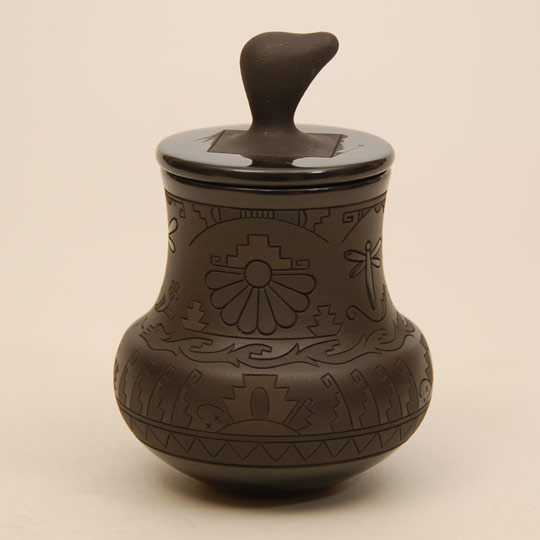
This exquisite small jar is a miniature version of a storage jar. The exception to that would be the lid as a standard storage jar would generally not have a lid. In her incomparable fashion, she reversed the normal pattern of burnishing the entire jar and then painting a design in matte paint. Here she has left the entire jar in matte finish except for the burnished rim and base and the top of the lid. Her designs were carved with the utmost care and precision. Dolores stated that she applies as many as five coats of slip to each design. In her scale of work, she is unmatched by any others.
Dolores Curran and Geri Naranjo are sisters and both work in miniature scale. Dolores's daughter, Ursula Curran, also makes miniature pottery. The entire family is very talented.
Condition: new
Provenance: from the potter through an intermediary
Recommended Reading: Pueblo Indian Pottery: 750 Artist Biographies by Gregory Schaaf
Subject: Santa Clara Matte Black Lidded Jar
Artist / Potter: Dolores Curran
Category: Contemporary
Origin: Santa Clara Pueblo
Medium: clay
Size: 3-3/4" tall without lid; 5-1/4" tall with lid; 3-3/4" diameter
Item # C3369E
Subject: Male Storyteller with 5 Children made by Alma Concha
Alma Concha is one of six Loretto sisters originally from Jemez Pueblo. Her sisters are Mary Toya, Fannie Loretto, Lupe Lucero, Edna Coriz and Dorothy Trujillo. She began learning the techniques of making pottery as a child and has continued during her adult life. Her first storyteller was made in 1969 after she married and moved to Taos Pueblo.
 Her style of storyteller figurines and nacimientos may be classified as minimalist in that there are few decorations on the figures. The natural orange clay used for the base structure is covered with cream clay paint for clothing and hair. The faces are without eyes and sometimes without mouths-resulting in the most minimalist of features. This is a style developed completely by Alma and not copied by others. This storyteller was made in 2003.
Alma has been known as Alma Loretto, Alma Concha, and now, Alma Maestas. In 1979, she was a part of the landmark Albuquerque Museum exhibit "One Space: Three Visions." Three years later, she was included in an article in National Geographic Magazine.
Condition: original condition. It appears that Alma left a fingerprint on the right side of the head of one of the children. That's as good as a signature! Generally, if a potter touches the clay before firing, a fingerprint, which is not visible at the time, will reveal itself after firing.
Provenance: from the collection of Jeffrey Trent of Las Vegas, NV
Recommended Reading: The Pueblo Storyteller by Barbara Babcock
Subject: Male Storyteller with 5 Children made by Alma Concha
Artist / Potter: Alma Concha (1941 - present)
Category: Figurines
Origin: Jemez Pueblo
Medium: native clay
Size: 8-1/2" Tall
Item # C3310K
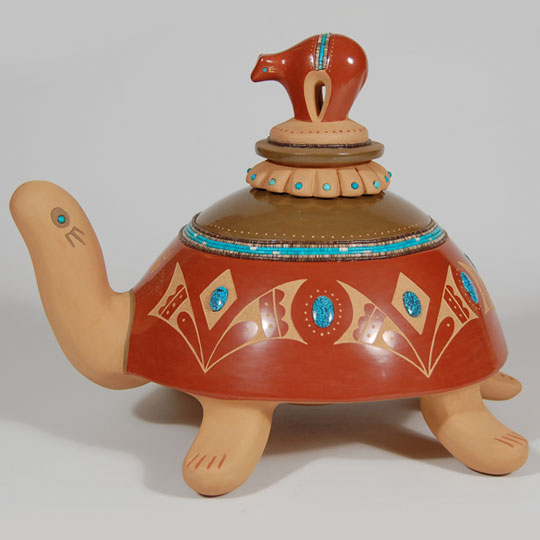
Subject: San Ildefonso Multi-colored Turtle Figurine
Innovation by the small population of potters at San Ildefonso Pueblo is a well-established fact. Maria Martinez could be the first considered to be a true innovator. Having been accustomed to producing, with her husband Julian, traditional San Ildefonso Pueblo Polychrome pottery, she easily took to experimenting and producing blackware in the 1920s and 1930s. Maria's and Julian's son Popovi Da continued the family penchant for innovation when he experimented with sienna ware and inserting turquoise into pottery in the 1960s. His son, Tony Da, took the whole idea of innovation to the limit when he created his masterpieces of pottery during his short career.
The potter Blue Corn also was an innovator. After blackware became the predominant pottery production at the pueblo, she singly reintroduced traditional Polychrome wares. Rose Gonzales introduced the carved pottery style to the pueblo. Tse-Pé Gonzales may have been the first to introduce green slip to black pottery. It goes on and on. I am sure there are others who have slipped my mind at this time.
Today, the indisputable true innovator at San Ildefonso is Russell Sanchez. An innovator in pottery styles but a traditionalist in pueblo culture and life style. Russell is a strict disciplinarian when teaching the younger generation the dances and religious customs of the pueblo to the point that he says the young ones fear him and yet respect him.
When making pottery, Russell stretches the envelope to incorporate ideas from his fertile mind. He says, when some question his strict adherence to tradition in life styles but innovation when it comes to pottery, that his pottery is traditional in every phase of manufacture but contemporary in style and creativity. There is no conflict.
This turtle was begun by Sanchez two years ago. It is the third one he tried and the first of this scale to succeed. He worked on it slowly, letting his mind mature on it as he selected style, slip, and techniques. He discovered, by the time he got to this one, how to keep it from destroying in the firing process. As non-potters, most of us do not realize the talent and knowledge potters must possess to be successful. Proper clay, proper temper, and proper techniques all contribute to success as do talent and creativity.
The selection of green and red slips, the finest of turquoise and shell hieshe, and the absolutely beautiful turquoise cabs add immeasurably to the overall appeal of the figurine. The fan-like designs on the body are traditional San Ildefonso designs from the earlier Polychrome wares. Just above the neck of the turtle, in the red slip, what appear to be needle-point pricks in the slip actually represent sacred corn meal.
Turtles have a place in pueblo mythology, as do bears. In this instance, the bear represents the pueblo people and the turtle is rescuing them, a legend shared by several pueblos. The inclusion of the bear and the sacred cornmeal design signify the significance of the figurine as a serious traditional item of religious intent rather than simply an art object. All pueblo items that are considered as art objects by non-natives are considered as religious or ceremonial by pueblo peoples. From the first step in gathering clay for pottery, the potters thank Mother Earth and offer sacred cornmeal for her giving them the clay. This thought is carried forth throughout the entire process. There is no term for art in the native languages. Pueblo pottery has always carried a religious significance to the potters and still does today even if the size and style do not lean themselves to traditional use as did the older pottery.
This turtle is absolutely flawless and magnificent. I was overwhelmed when Sanchez brought it to the gallery. The scale, design, execution and beauty are just beyond belief. His pride in completing it after two years of work was quite evident when he unwrapped it at the gallery. Our compliments go to Russell Sanchez for such a monumental object.
Condition: new
Provenance: from the artist
Recommended Reading: Art of Clay: Timeless Pottery of the Southwest by Lee. M. Cohen
Subject: San Ildefonso Multi-colored Turtle Figurine
Artist / Potter: Russell Sanchez (1966-present)
Category: Contemporary
Origin: San Ildefonso Pueblo
Medium: clay, turquoise, hieshe
Size: 10" long x 8-1/4" wide x 8" tall
Item # 25554
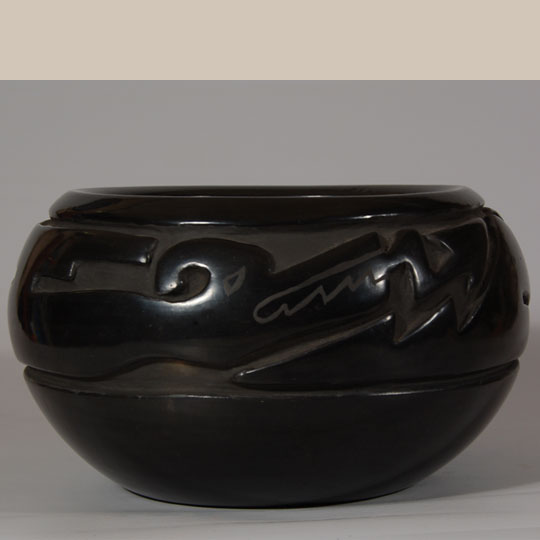
Subject: Santa Clara Pueblo Black Carved Bowl with Avanyu
Starting sometime in the 1950s, Margaret Tafoya made smaller bowls, such as this one, for sale to tourists visiting the pueblo as well as to take to Royal Gorge for the summer. Margaret and her family spent their summers-from Memorial Day to Labor Day-at the Royal Gorge near Canon City, Colorado, selling pottery and entertaining the tourists with dances and permitting them to photograph the family members-all for a fee. She had made enough pottery before going to Royal Gorge to take with her to sell. She did not make pottery on site.
It was during the 1950s that pueblo pottery underwent a revival in interest by collectors and tourists. Following the lean years of World War II, both from a buyer's standpoint and that of the seller as well, the 1950s saw a renaissance. Americans had sacrificed during the war, skimping and saving for the war effort and now gasoline and tires were again available and travel was possible.
The Southwest was once again of interest and New Mexico saw a tremendous influx of tourists willing and anxious to purchase souvenirs to take back home. Fortunately for the pueblo potters, there was great interest in their pottery.
This medium size black carved bowl is typical of many that found their way out of the Southwest and into collections from coast to coast. It is a marvelous jar and is beautifully designed.
Condition: The jar is in really outstanding condition for a piece of its age. There are no significant scratches and no chips or any other damage. It is signed Margaret Tafoya on the underside.
Provenance: from a gentleman in Albuquerque
Recommended Reading: Born of Fire: The Pottery of Margaret Tafoya by Charles King
Subject: Santa Clara Pueblo Black Carved Bowl with Avanyu
Artist / Potter: Margaret Tafoya 1904-2001
Category: Contemporary
Origin: Santa Clara Pueblo
Medium: clay
Size: 5-3/8" tall x 9-1/2" diameter
Item # C3233A
Subject: Zia Pueblo Polychrome Canteen with Zia Bird Design
Water-carrying canteens have been made by the pueblo people for several hundred years, long before the arrival of Europeans. Interestingly enough, the shape of canteens has changed very little in this time. Apparently, the users were quite satisfied with the vessel shape as it was.
 The design field is slipped in a creamy white slip on which is prominently displayed a wide-eyed Zia bird above which is a red design that could represent rain clouds. A single flower sprouts up in two branches below the bird. Two handles are on the sides of the body, pierced to provide for lacing a leather strap through.
It appears that the canteen is as old as the 1930s but a date cannot be absolutely stated. It is not signed, but the matte wiped-on red band below the design panel is indicative of an earlier age when pottery was not signed by the maker. A metal stand has been fabricated to permit the canteen to be displayed in a forward facing position.
Condition: the handle on the right side of the canteen has been broken off and glued back in place in a very professional manner and the break is not easily noticeable.
Provenance: from the collection of a Santa Fe resident
Recommended Reading: The Pottery of Zia Pueblo by Francis Harlow and Dwight Lanmon
Subject: Zia Pueblo Polychrome Canteen with Zia Bird Design
Potter Unknown
Category: Contemporary
Origin: Zia Pueblo
Medium: clay, pigment
Size: 6" tall x 7" wide x 3-1/2" deep
Item # C3364B
Subject: Acoma Pueblo Bowl with Appliqué Rim
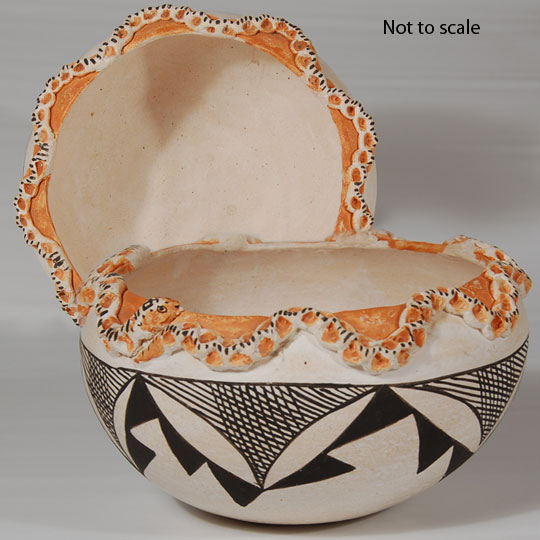
This exquisite Acoma Pueblo bowl is signed with the initials of the potter and not revealing a first name. I have been unable to locate a potter with these initials. The only one is Annie Cerno, whose real name is Santana Cimmeron Cerno, the mother of Joseph Cerno. Since there is no middle initial of "L" in her name, I doubt she is the potter of this bowl.
Regardless, the bowl is truly well made, finely painted, and has a serpent in appliqué around the rim. Quite often, appliqué attachments do not adhere well to the body of the vessel, but an experience potter knows how to achieve the near to impossible task.
Condition: original condition
Provenance: from the Katherine H. Rust collection
Recommended Reading: Acoma & Laguna Pottery by Rick Dillingham
Subject: Acoma Pueblo Bowl with Appliqué Rim
Artist / Potter: Potter Unknown
Category: Contemporary
Origin: Acoma Pueblo
Medium: clay, pigment
Size: 3-3/4" deep x 6-1/2" diameter
Item # C3235H
Subject: Hopi Monochromatic Low Bowl
Garnet Pavatea was known as Flower Girl and she was a Hopi-Tewa from the Tewa Village on First Mesa on the Hopi Reservation. Her dad, Dewakuku, was Hopi and her mother was Tewa. Following tradition, Garnet was of her mother's clan.
 Hopi artisans owe much thanks to Mary-Russell Ferrell Colton, co-founder of the Museum of Northern Arizona in Flagstaff. She was instrumental in creating the Hopi Craftsman Exhibition in the early 1930s with the intent of fostering production of quality work. She was concerned that traders were content to accept and sell mediocre work from Hopi craftsmen and were not interested in educating the public on quality crafts. She organized the craft exhibit for the July 4th weekend every year and it has served her intent to greatly increase interest in quality Hopi crafts.
Garnet Pavatea was a long-time entrant in the craft exhibit and won many awards by doing so. She also seemed to be a favorite of the Museum of Northern Arizona. She was often a demonstrator at the Craftsman Exhibition. For a number of years, Adobe Gallery had a standing order from the Museum of Northern Arizona for any Garnet Pavatea pottery available.
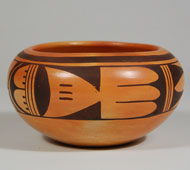
This small bowl is a fine example to illustrate the careful craftsmanship of Pavatea. The bowl was beautifully formed, polished inside and outside and painted with the utmost care. It is an excellent example of this potter's work.
Condition: excellent condition
Provenance: from an Albuquerque family
Recommenced Reading: Contemporary Hopi Pottery by Laura Graves Allen
Subject: Hopi Monochromatic Low Bowl
Artist / Potter: Garnet Pavatea (1915-1981) Flower Girl
Category: Contemporary
Origin: Hopi Pueblo
Medium: clay, pigment
Size: 2-7/8" deep x 5-1/8" diameter
Item # 25579
Subject: Santa Clara Small Red Sgraffito Seed Jar
Golden Rod is a daughter of Petra Gutierrez and sister of Minnie Vigil, Lois Gutierrez and Thelma Talachy. The ancestral family home is Pojoaque Pueblo, but most now live at Santa Clara Pueblo. All of the siblings are outstanding potters and all are active today.
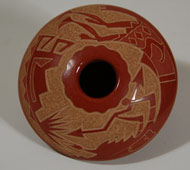 This small mushroom-shaped seed jar is stone-polished over its entire surface, then decorated with a petroglyph-style design in sgraffito carving. There are two petroglyph-style human-type figures, one of which is carrying a spear and wearing a buffalo-type head cover. The other is hard to interpret.
Condition: original excellent condition
Provenance: from a family in Santa Fe
Subject: Santa Clara Small Red Sgraffito Seed Jar
Artist / Potter: Gloria Garcia (b.1942) Golden Rod
Category: Contemporary
Origin: Santa Clara Pueblo
Medium: clay
Size: 1-1/8" deep x 2-1/2" diameter
Item # C3367C
Subject: Santa Clara Matte Black Lidded Jar
Dolores Curran, originally from Santa Clara Pueblo, married and moved to Ohkay Owingeh Pueblo around 1977. She has specialized in miniature pottery since her first piece at age 9. Her designs are each original to the piece of pottery on which she is working. She does not record her designs because she doesn't want to start copying herself. She prefers to fit each design to the pot on which it goes.
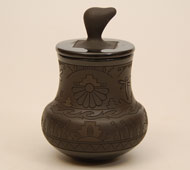 This exquisite small jar is a miniature version of a storage jar. The exception to that would be the lid as a standard storage jar would generally not have a lid. In her incomparable fashion, she reversed the normal pattern of burnishing the entire jar and then painting a design in matte paint. Here she has left the entire jar in matte finish except for the burnished rim and base and the top of the lid. Her designs were carved with the utmost care and precision. Dolores stated that she applies as many as five coats of slip to each design. In her scale of work, she is unmatched by any others.
Dolores Curran and Geri Naranjo are sisters and both work in miniature scale. Dolores's daughter, Ursula Curran, also makes miniature pottery. The entire family is very talented.
Condition: new
Provenance: from the potter through an intermediary
Recommended Reading: Pueblo Indian Pottery: 750 Artist Biographies by Gregory Schaaf
Subject: Santa Clara Matte Black Lidded Jar
Artist / Potter: Dolores Curran
Category: Contemporary
Origin: Santa Clara Pueblo
Medium: clay
Size: 3-3/4" tall without lid; 5-1/4" tall with lid; 3-3/4" diameter
Item # C3369E
Subject: Black Carved Round Jar with Intricate Carved Design
Lucy Year Flower married into the Tafoya family. She married Joe Tafoya who was brother to Joseph Lonewolf and Grace Medicine Flower, the three of whom were the children of Camilio Tafoya and Agapita Silva Tafoya.
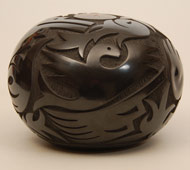
Year Flower is an extraordinary artisan and very precise in execution of her work. This seed jar was exquisitely formed and provided a well-balanced surface to support the intricate design chosen. There is an Avanyu over whose head is a radiant sun, a kiva with a tall protrusion that may be a ladder, a dove, flower, and a bear paw. Interspersed between all these elements are other floral-like designs. On the top of the seed jar is a flower executed in red-a symbol used by the artist reflecting her name.
The jar is signed on the underside Lucy Year Flower Pojoaque and Santa Clara Pueblos with the addition of a carved-in small flower above her name.
Condition: appears to be in original condition
Provenance: from a gentleman in Albuquerque
Subject: Black Carved Round Jar with Intricate Carved Design
Artist / Potter: Lucy Year Flower Tafoya (1935-present)
Category: Contemporary
Origin: Santa Clara Pueblo
Medium: clay
Size: 4-5/8" tall x 6-1/2" diameter
Item # C3369D
Subject: Original Painting of Apache Warriors
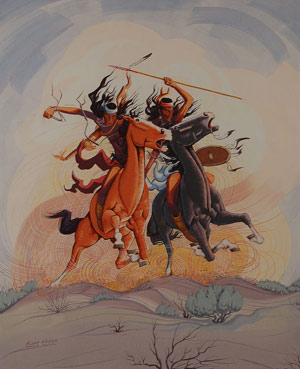 Allan Houser, a Chiricahua Apache, was indisputably one of America's foremost artists in mediums of sculpture, drawing, paintings, wood carving or whatever medium he chose to try. He was a modernist as well as a traditionalist and was certainly one of the most famous Native American artists of the 20th century. By the 1980s, his reputation was firmly established. His paintings were featured in a celebration of Native art at the Kennedy Center in Washington DC in 1981 and included in a Smithsonian exhibit that traveled to South America. That same year, he exhibited in the legendary Salon d'Automne in Paris, France.
Houser is most known for his sculptures because that is the medium he worked in in the latter part of his career when he was best known as the artist he was. His paintings are rarer than his sculptures and are highly desired by collectors of Native art.
This painting of two Apache warriors in pursuit of animals or enemy is an extraordinary representation of his truly outstanding talent as a painter. The nostrils of the horses and the fear in their eyes are evidence of the speed the riders are forcing on them and their intent on carrying through with their mission. Houser's interpretative manner in representing the dust being raised by the action of the horses is artistic in itself.
To state that this is an exceptional painting is an understatement. Any accolades one could add to that are well deserved.
Condition: appears to be in original condition, but has not been examine out of the frame.
Provenance: from a Santa Fe couple
Recommended Reading: Allan Houser: An American Master (Chiricahua Apache, 1914-1994) by W. Jackson Rushing III
Subject: Original Painting of Apache Warriors
Artist: Allan Houser (1914-1994)
Category: Paintings
Origin: Chiricahua Apache
Medium: casein
Size: 23-1/2" x 19-1/2" image; 33-1/2" x 29-1/2" framed
Item # C3248
Subject: Bronze Sculpture of Talavai - The Morning Katsina
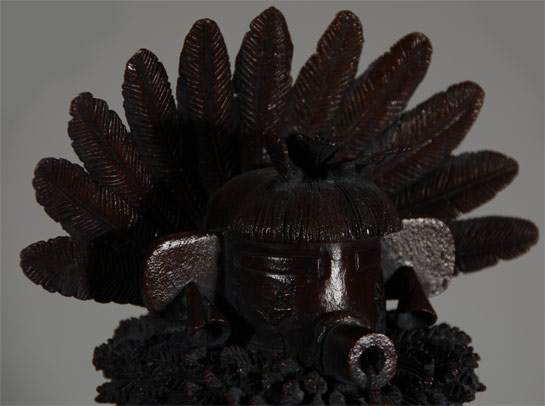
This bronze of a Talavai (Morning) Katsina is entitled "For a Better Brighter Tomorrow" and is the representation of a Hopi Katsina. In the early morning, as the sun bursts from behind the hills in Hopi lands, morning songs spread their sound: calling birds, barking dogs, and the raised, bell-like voices of early risers greet the new day. The spruce, the first tree touched by the sun's rays, turns from dark shadow into green life with the illumination.
The symbols of the Morning Katsina-his bell that serves to rouse its hearers to a new day, the young spruce tree representing a new beginning, and the headdress feathered out like rays reaching in all directions-all recall the dawning of hope and excitement for a better, brighter tomorrow.
This limited edition bronze by Hopi artist Lowell Talashoma, Sr. is a manifestation of an artistic eye and vision that spans two cultures, for Talashoma is unusual in having spent many of his childhood years in the care of foster parents who raised him in a mainstream American home. Becoming Hopi meant for him accepting a new reality and set of beliefs as well as coming to understand the traditions, ceremonies, languages and social custom implicit in his choice. Giving form to this historically-rich culture is a task he set for himself with pleasure and excitement: what is ancient and inherently true to the Hopi people is newly rediscovered and revered through Talashoma's dawning awareness of what it is to be Hopi.
Lowell Talashoma became a very famous carver of one-piece cottonwood katsina dolls and was selected by American Indian Life and Legends, Ltd as one of two Hopi artists to convert cottonwood katsina dolls into everlasting bronze sculptures. Each of these bronzes was inspired by Hopi beliefs and is "liberated" from cottonwood root-the Hopi traditional carving material-through the vision of the artist of what lies within. Although he could work faster in preparation for bronzing by using wax or clay, Talashoma preferred to interact with the wood, a material he respected for its life and character. The castings made from his carvings via the lost wax method retain that spirit. Even the grain of the original wood can be discerned in the finished bronze.
This bronze of the Morning Katsina was cast in an edition of 35 of which this is number 1. It was completed in 1980. The pedestal on which the bronze stands is on a turntable system to allow for the bronze to be viewed in various positions.
Condition: original condition
Provenance: from the estate of a California family
Recommended Reading: Kachinas: a Hopi Artist's Documentary by Barton Wright
Subject: Bronze Sculpture of Talavai - The Morning Katsina
Artist: Lowell Talashoma, Sr. (1950-2003)
Category: Bronze
Origin: Hopi Pueblo
Medium: bronze casting, wood pedestal
Size: 19-3/4" tall including pedestal
Item # C3365C
Subject: Ohkay Owingeh Child-size Water Jar
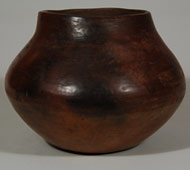 Pottery making at this pueblo almost died out around 1900 except for a few women who made pottery for their own use. There was no market for these rather plain undecorated vessels. It is believed that this small jar dates to around 1900 or a little earlier but it is difficult to date pottery from Ohkay Owingeh because there was little to no change in them over the decades.
The arrival of the Spaniards in the late 1500s had very little effect on pottery production at the pueblos in either shape or design, but by the 1700s, there were noticeable changes. Still later, with the opening of the Santa Fe Trail in 1821 and the arrival of the transcontinental railroad in 1880, change became inevitable at pueblos located close to the non-Indian populations.
San Juan Pueblo, now Ohkay Owingeh Pueblo, stuck to its original pottery traditions of simple undecorated utilitarian wares that were so beautiful in vessel shape and simple slipped surfaces highlighted by fire clouds. Even today, a hundred years after the pueblo abandoned its traditional style for a more modern style to appeal to tourists and collectors, the beautiful undecorated wares of the pueblo are still capturing the eyes of collectors.
The red-slipped upper half of the jar is a deeper red color than that seen on jars of a slightly later period. The underbody is the natural, un-slipped, tan clay of the full vessel that was stone polished without the addition of slip. The natural un-slipped interior of the jar was stone polished as well.
It is quite possible this jar was made for sale and not for use at the pueblo as it is generally believed that there was no use for vessels of this size at the pueblo, but that cannot be verified. It certainly could have been made as a teaching aid to a young potter or could have served as a container for small collectibles. The slight off-center of the opening and slight slant to the top rim would lean to attributing it to a beginning potter or one who had not fully matured into an accomplished artisan.
The jar has a wonderfully rich dark red to almost brown upper half with fire clouds on one side.
Condition: structurally in very good condition with some surface slip abrasion
Provenance: from a gentleman in Santa Fe
Recommended Reading: Pueblo Pottery of the New Mexico Indians: Ever Constant, Ever Changing by Betty Toulouse
Subject: Ohkay Owingeh Child-size Water Jar
Potter Unknown
Category: Historic
Origin: Ohkay Owingeh Pueblo (San Juan)
Medium: clay
Size: 5-3/8" tall x 7" diameter
Item # 25613
Subject: San Ildefonso Pueblo Buff-on-red Bowl
 Albert Vigil (1927 - ?) and Josephine Cordova Vigil (1927 - ?) worked together producing pottery their entire married life. Josephine made the pottery and Albert painted them. Albert Vigil was the son of famous San Ildefonso painter Romando Vigil (Tse Ye Mu) and a nephew of Maria Martinez. It was Maria who influenced him to specialize in redware.
Josephine Cordova Vigil was originally from Taos Pueblo but moved to San Ildefonso when marrying Albert. Josephine credits Albert's aunts, Maria Martinez and Clara Montoya, with helping them get started in pottery making. She learned by watching Maria make pottery and having Clara show her how to stone polish the pottery.
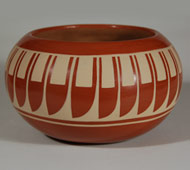
This beautifully shaped bowl with an incurving rim is decorated with the traditional eagle feather design made popular at San Ildefonso by Julian Martinez. The matte beige color was applied to the red stone-polished slip in a think and luscious coat. The bowl is large and beautiful.
Condition: structurally in original condition with only one very minor abrasion spot.
Recommended Reading: Pueblo Indian Pottery: 750 Artist Biographies by Gregory Schaaf
Subject: San Ildefonso Pueblo Buff-on-red Bowl
Artists / Potters: Albert and Josephine Vigil
Category: Contemporary
Origin: San Ildefonso Pueblo
Medium: clay
Size: 4-7/8" tall x 8-1/2" diameter
Item # C3367B
Subject: Santa Clara Pueblo Buff-on-red Jar
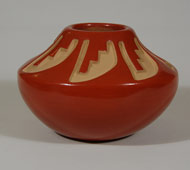 Belen Tapia was Sara Fina Tafoya's niece and Margaret Tafoya's first cousin. She had a long and productive life as a potter and achieved fame for her work. Mostly, she is recognized for her use of several color pigments in designs on her pottery, but she also produced traditional carved pottery of the style familiar to collectors.
This deeply carved design is illustrative of her ability to achieve clean-cut designs in straight line or curved forms. The burnishing of the red slip is flawless. Tapia was an accomplished potter and that is evident in this jar.
Condition: The buff color matte clay of the design element has some grey spotting that is not dust and does not rub off, so I do not know what it might be.
Recommended Reading: Pueblo Indian Pottery: 750 Artist Biographies by Gregory Schaaf
Subject: Santa Clara Pueblo Buff-on-red Jar
Artist / Potter: Belen Tapia (1914-1999)
Category: Contemporary
Origin: Santa Clara Pueblo
Medium: clay
Size: 5-1/4" x 7-3/4" diameter
Item # C3367A
Subject: Acoma Pueblo White Corrugated Pottery Owl
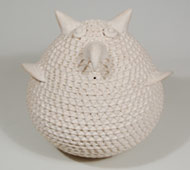 This is a very traditional white corrugated owl figurine that was built up from coils of clay left in roll form, not smoothed out. The rows were then impressed with a stick or other tool to achieve the design. This is similar to prehistoric utilitarian wares in which the rows of coils of clay were left visible.
Stella Shutiva spent most of her career making pottery in the fashion of pre-historic corrugated utilitarian wares, a style revived by her mother, Jessie Garcia. She said she admired her mother's corrugated pottery so much that she vowed she would learn how to make it herself. It took her four years to master the technique, but master it she did.
Jessie Garcia, Shutiva's mother, is given credit for reviving the ancient art of corrugated pottery, but instead of the earth-colored clay generally used for the prehistoric corrugated wares; she chose to use the white, un-slipped Acoma clay, thus marrying the style of the old ways with a look of the new.
 Shutiva brought her mother's creation to fruition and spent her career almost exclusively devoted to making white corrugated wares. Adding painted designs to small portions of her pottery was an addition late in her career as was the addition of animal and reptile forms in bas-relief.
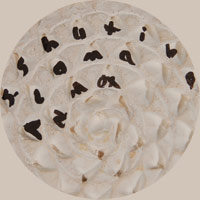
This owl figurine was probably made in the 1980s. The corrugated rows of clay are continuous from the bottom of the vessel to the top. There is no flattened bottom to the vessel. The artisan's name is painted on the underside.
Condition: appears to be in original condition but perhaps with a little more dust.
Recommended Reading: Southern Pueblo Pottery 2,000 Artist Biographies by Gregory Schaaf
Subject: Acoma Pueblo White Corrugated Pottery Owl
Artist / Potter: Stella Shutiva (1939-1997)
Category: Contemporary
Origin: Acoma Pueblo
Medium: clay
Size: 8-3/4" tall x 9-5/8" diameter
Item # C3367D
Subject: Acoma Pueblo Black-on-white Seed Jar by Rose Chino
 Rose Chino and her sisters, Carrie Chino Charlie, Vera Chino Ely and Grace Chino, are daughters of Marie Z. Chino and all of them are exceptional potters, as was their mother. Garcia's pottery is in the collections of the Peabody Museum at Harvard University, Heard Museum in Phoenix, Philbrook Museum of Art in Tulsa, and numerous private collections. She has won awards at Santa Fe Indian Market since 1975-one award was for "most creative design."
Rose Chino Garcia learned pottery making from her famous mother and has used some of her mother's designs, however, she has also been very creative in developing designs of her own, designs that have proven most successful as recognized by the Santa Fe Indian Market award mentioned above.
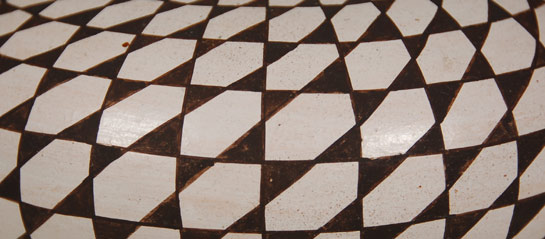
One must look at the design on this seed jar very carefully to notice the geometrics involved. First, straight lines of longitude traverse from the opening at the top of the jar to the base. Second, another series of lines swirl and cross over the longitudinal lines, then the triangles formed by the intersection of the lines are painted black. After viewing the design in that manner, take another look at a group of black diamonds surrounding a white block and one can see a star pattern. This is a good reason to encourage students of pottery to study geometry.
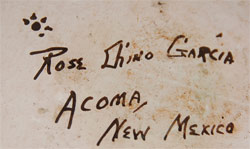
The jar appears to date from the last quarter of the 20th century-probably the 1980s. It is signed Rose Chino Garcia Acoma, New Mexico and has an animal paw hallmark.
Condition: structurally in excellent condition. It has about three small spall marks
Recommended Reading: Southern Pueblo Pottery 2,000 Artist Biographies by Gregory Schaaf
Subject: Acoma Pueblo Black-on-white Seed Jar by Rose Chino
Artist / Potter: Rose Chino Garcia (1928-present)
Category: Contemporary
Origin: Acoma Pueblo
Medium: clay, pigment
Size: 3-7/8" tall x 8-1/4" diameter
Item # C3367E
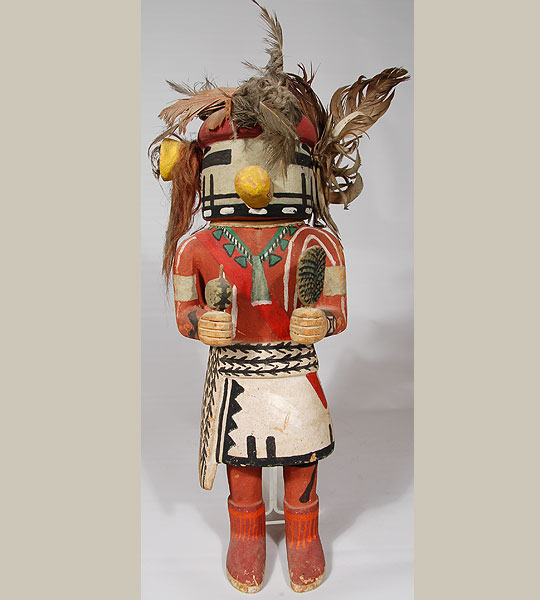
Subject: Large Hopi Tasap Katsina Doll
This is an exceptional Hopi Tasap Katsina doll carved from a piece of cottonwood root. Tasap is a Hopi representation of a Navajo God. There are Hopi versions of katsinam that honor and depict other tribes, such as the Navajo, Havasupai, Comanche, Zuni and other Pueblos.
This is the Hopi version of what the Navajo katsinam might look like. These katsinam are not borrowed from the Navajo, as they are unique to the Hopi. They have the same purpose and functions as all the Hopi Katsinam. They are messengers and/or intermediaries to the rain gods. Since they are katsinam in every respect, they are afforded the same reverence and dignity during their visits.
This Tasap male katsinam wears a ceremonial kilt and rain sash, and has a blue face and red hair. The male, along with a companion female, appears during Angak'wa and the summer katsina day dances. Since they depict the Navajo, their songs may have some Navajo words speaking of the good things of life and/or words representing moisture.
Condition: The carving is in excellent condition.
Subject: Large Hopi Tasap Katsina Doll
Carver Unknown
Category: Traditional
Origin: Hopi Pueblo
Medium: Cottonwood root, Feather, Paint
Size: 13" tall
Item # C3145.01
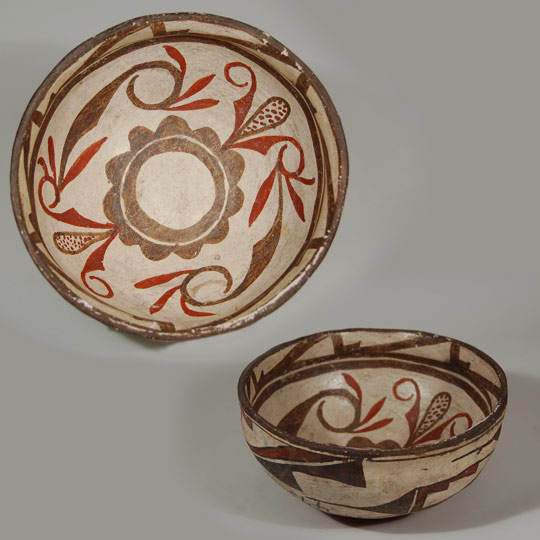
Subject: Historic Nineteenth Century Polychrome Bowl, circa 1870s
One can almost feel the peacefulness at sunset as the sky turns from a fiery red to yellow. Rarely do we see Zuni bowls with a red underbody. Since the late-1800s, most potters have used black. According to Batkin, "Zuni Polychrome vessels retained the red rim and underbody slip of Ashiwi Polychrome until the late eighteenth or early nineteenth century, when it was replaced by dark brown paint..." ¹
The paste materials are typically Zuni; white and chunky in texture with the centuries old temper material of ground pottery shards. The use of old shards for temper evidences the regard of the pueblo peoples for the old works made by their predecessors. To add these remnants to the new work is a sign of respect.
The rim of the bowl curves inward slightly, imparting a graceful shape to what could otherwise be an uninteresting one. The interior of the rim flexes slightly, an unnecessary added feature that enhances its shape. The bowl is slipped in traditional fashion with cream-colored clay, over which is painted the designs in mineral and vegetal paints. The exterior is decorated with the traditional prayer stick design used on every Zuni bowl made in the nineteenth century. It is thought that this was a woman's way to place her prayers since women do not make prayer sticks.
The interior decoration begins with a brown rim, below which is a series of rectangles divided into triangles encircling the bowl that are rendered solely in brown. Below this are two wide parallel framing lines with a very distinctive ceremonial break. Two Zuni volute design elements in brown paint fill the interior of the bowl. These are attached to two corn-like elements, executed in red without outlining. The bottom has a double circle, one of which is cloud-like, outlining an otherwise undecorated center. On the exterior of the bowl is written the numbers 39975 in beautiful hand Script. This is most certainly an acquisition number placed there by one of the earlier expeditions to Zuni.
UPDATE INFORMATION: Dwight Lanmon so kindly provided the following information. The numbers 39975 are BAE accession numbers indicating that Stevenson collected the bowl in 1879 on the Powell Expedition. He confirmed with the Smithsonian that the numbers 475 are Stevenson's field numbers.
Subject: Historic Nineteenth Century Polychrome Bowl, circa 1870s
Potter Unknown
Category: Historic
Origin: Zuni Pueblo
Medium: native clay and pigments
Size: 7-3/4" diameter x 3-1/2" deep
Item # C3361B