



Southwest Sterling Silver Bear Paw Belt Buckle - C3852T
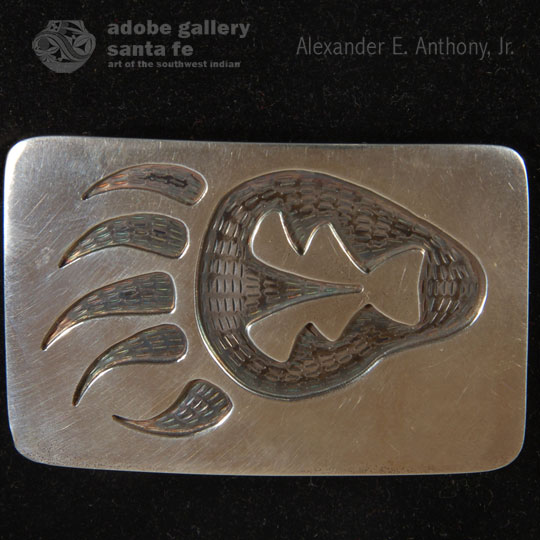 The bear paw is an iconic symbol in Native American art. It has been associated with strength, protection and healing.
This well-made buckle is done in the Hopi overlay style. It is fabricated on a heavy gauge of silver with a cut-out image of a bear paw. We have been unable to find any information about the artist, Jere Moody.
San Ildefonso Pueblo Painting Comanche Dancer on Horseback by Tse Ye Mu - C3827i
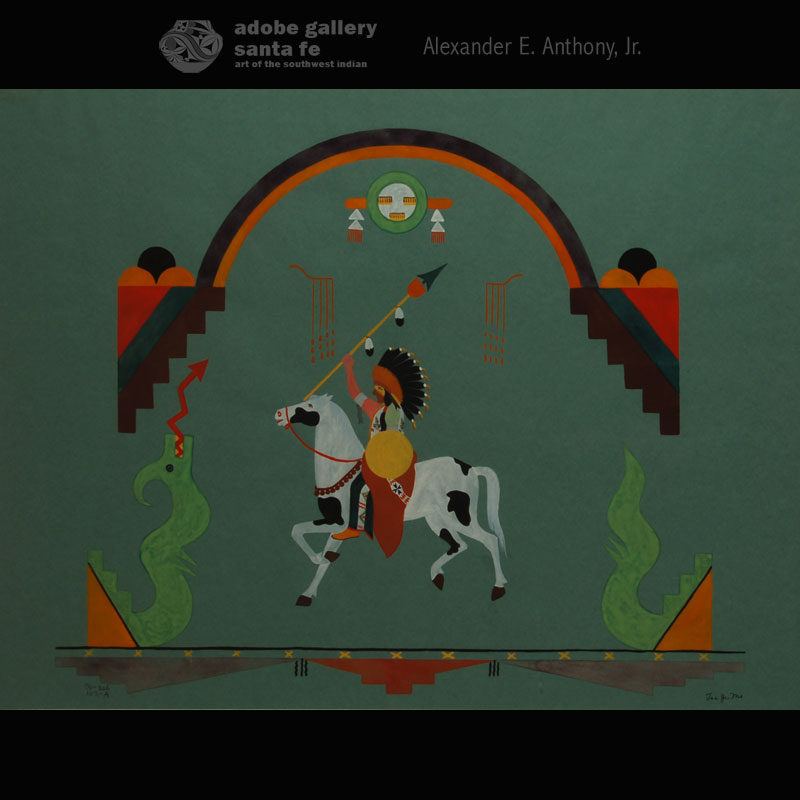 San Ildefonso Pueblo members dance the Comanche Dance every year on January 23rd, which is the pueblo's feast day. The peaceful Pueblo Indians of New Mexico and Arizona never wore feathered headdresses popular with tribes believing in the virtue of warfare. The Navajo, Apache, Ute and Comanche were the ones who raided the pueblos.
San Ildefonso Pueblo celebrates the Comanche Dance to honor the end of hostilities between the tribes and their peaceful co-existence. The dancers have painted faces, wear a feathered head bonnet, and some carry a flag that has meaning in Plains Indian custom; a warrior proved his valor by planting his flag in the ground during battle, tied himself to it, and defended it to the death against all-comers. He earned a feather bonnet after accomplishing this feat.
Navajo Silver and Turquoise Bracelet with two Large Discs - C3864.30
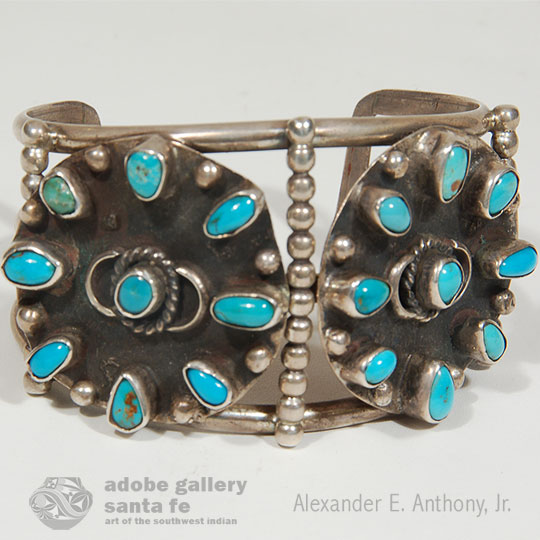 The foundation of this bracelet consists of three flat strips of silver connected at each end. Two round flat silver discs each support nine small turquoise stones, some green and some blue. The center stone of each disc is surrounded by silver wire.
Historic Ohkay Owingeh Pueblo Large Red Bowl with Fluted Rim - C3889C
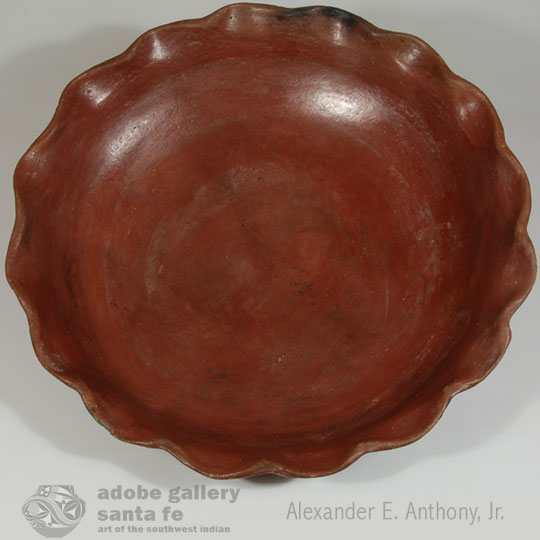 Ohkay Owingeh Pueblo had a strong tradition of plainware pottery production prior to 1900. Pottery styles included Black-over-gray and Red-over-tan, the difference being only from the firing technique. Pottery was slipped only partially, usually the upper half, in red clay. If fired in an oxidizing atmosphere, the result was Red-over tan, the tan being the natural color of the clay body. If fired in a reduction firing, the result was Black-over-gray, the gray resulting from the firing effect on the natural tan clay body.
Those two styles of pottery were the extent of pottery production at the pueblo. The lack of painted designs was the reason such vessels were so beautiful. Vessel shape and high burnish were the traits that brought out the beauty of each jar or bowl.
Hopi Pueblo Hand Tanned Painted Deer Hide Painting - C3577
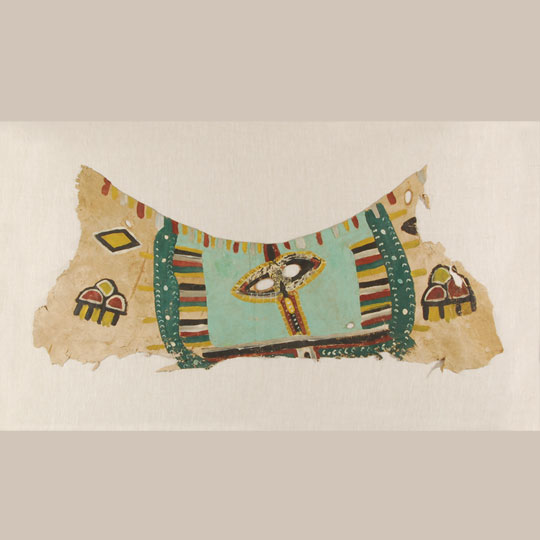 When the current owner purchased this item decades ago, she was told that it was hand-tanned hide from a Hopi tribal member and that it dated to circa 1920s. There is no written documentation to back this up but there is no reason to doubt it either.
The rain cloud symbols are certainly a pueblo design and are seen on some of the Hopi Katsina masks. The lower edges of the hide show some fragility which would help substantiate the age. The hide has been mounted on a fabric backing and then framed in a 3-1/8"-deep Plexiglas box. The paint colors are still very vivid and well preserved.
Hopi Pueblo Third Mesa Wicker Plaque with a Butterfly Image - 25459
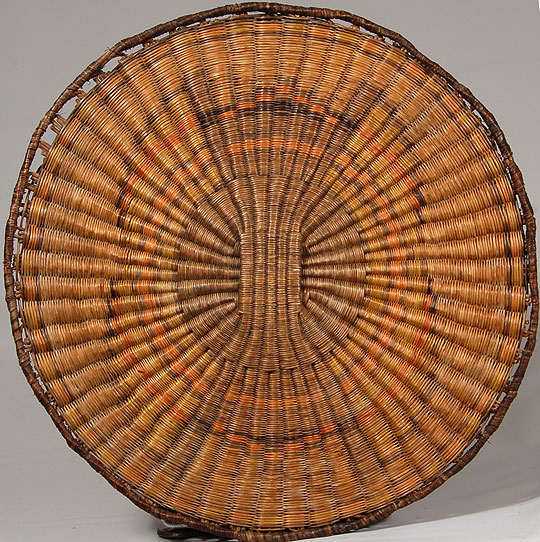
Butterflies are captivating in nature and just as beautiful on Hopi wicker basketry. This plaque exhibits a very tight weave and multiple colors.
Hopi Pueblo Left Handed Katsina Doll, circa 1950s - C3535.24
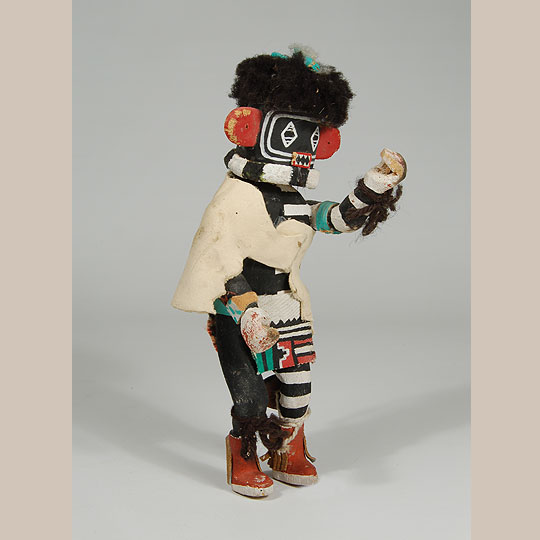 The Left Handed Katsina is so called because he carries his bow in his right hand rather than in his left. In fact, he generally does everything backwards. The reason for this is not clear. The Hopi say he came to them from the Chemehuevi Indians. He appears quite frequently in a great many dances, like the Mixed Kachina, in groups in the kivas or separately as a warrior in the Powamu Ceremony. He may act as a prompter in a dance or be found making odd little bows and taking small mincing steps at the edge of a procession. A great deal of the time he has trouble with Hó-e when they appear in the same dance. - Wright 1973
#adobegallery #HopiPueblo #Katsina #Kachina # #Doll #SouthwestIndianArt #PuebloArt #SantaFeNM
Painting Montezuma Calls the Animals to Feed his People by Richard Martinez - C3224AT
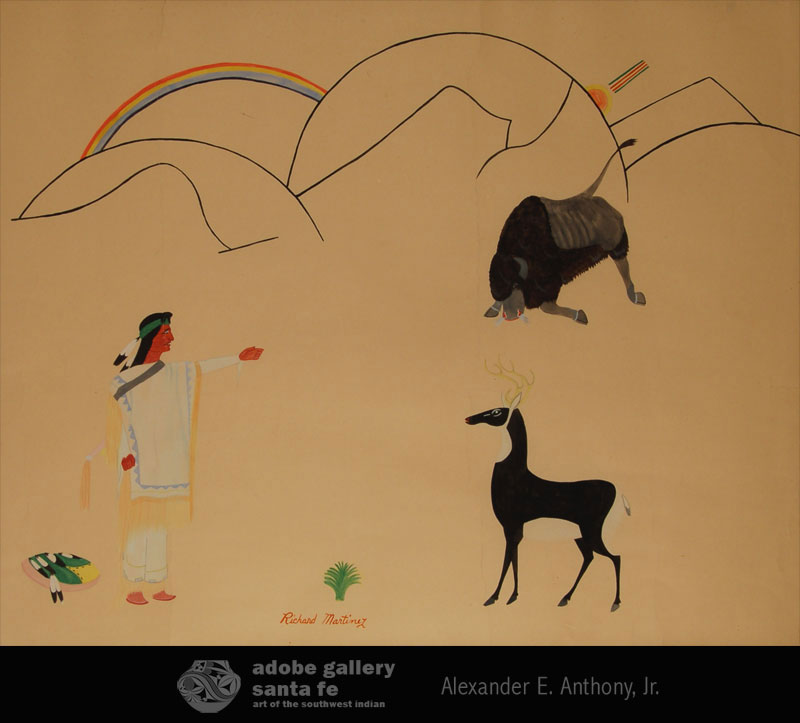 San Ildefonso Pueblo Artist Richard Martinez (1904-1987) Opa Mu Nu wrote the title of this painting on the back so it is not a title made up by us but one selected by the artist, so perhaps there is a Pueblo legend that supports this painting. Montezuma is asking the game animals to make themselves available as food for the Pueblo peoples. In the background are mountains, over which are a rainbow and partial sun. It is signed in lower center.
Kewa (Santo Domingo) Pueblo Deep Chile Bowl with Bold Arrow Designs - C3885B
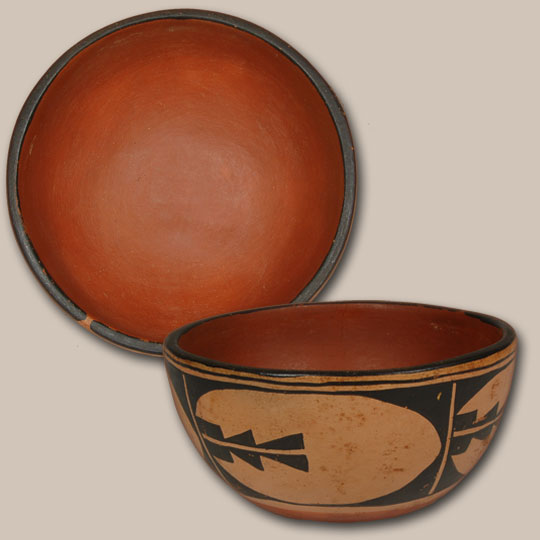 This chile bowl bears the name of Torivio Calabaza on the underside that was painted and fired in so it would be the name of the maker of the bowl. A paper label on the base states a date of c1950s. The bowl appears to have been made to sell and not for use at the pueblo. It has a modernist design of bars of black triangles and rectangles in mirror image offset to one side of the oval cream background. The rim is black and has a ceremonial line break that penetrates the design panel completely. The interior is polished red slip.
Historic Zia Pueblo Large Polychrome Dough Bowl - C3888B
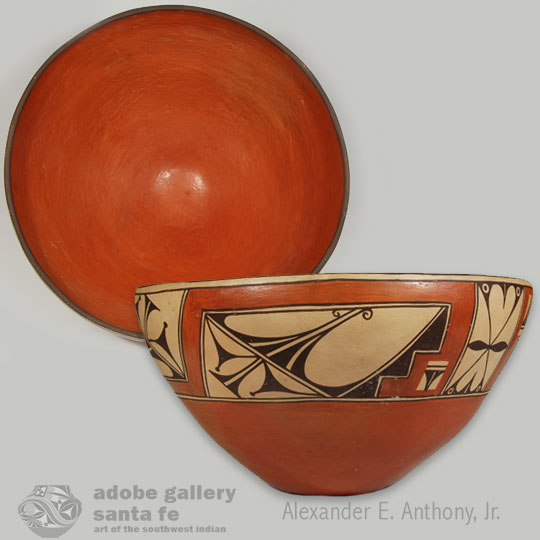 Jonathan Batkin once pointed out what should have been obvious had one taken the time to think about history. There was no need for large dough bowls or for the outdoor ovens called horno prior to the arrival of the Spaniards. The reason being that the Spaniards brought flour to the pueblos from which they made oven bread-thus the need for the bowl and for the oven.
Even though the Spaniards came in the late 1500s, it was close to the mid-1700s before the pueblo people accepted the white flour from the Spaniards. Maybe it took 150 years for the pueblos to accept the change, but gradually they did. Dough bowls seemed to appear at Zia Pueblo in the late 1700s.
Zia Pueblo New Chile Bowl - C3885D
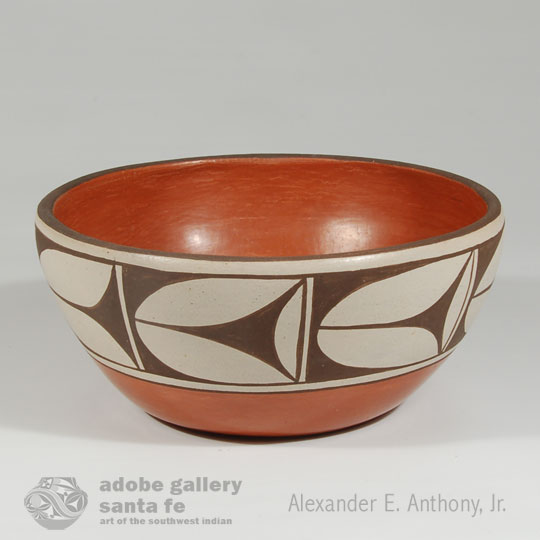 This pristine Zia Pueblo New Chile Bowl chile bowl is relatively new and has not been used for serving food. It is in excellent original condition. If one looks at the white as the design, then it appears to be tulip-shaped. If one looks at the brown as the painted design, then it appears to be a cloud.
Zuni Pueblo Polychrome Jar Attributed to Tsayutitsa - C3888A
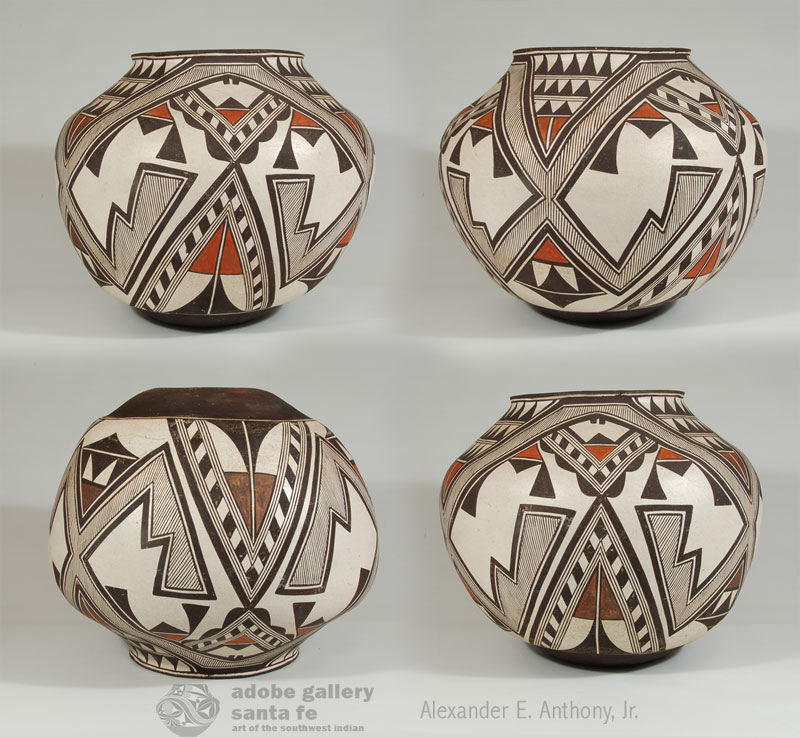 Zuni Pueblo potters, except for a few, have never been appreciated for outstanding application of design, unlike their closest neighbors, the Acoma potters. Zuni clay is more porous than that at Acoma and more difficult to obtain a smooth egg-shell hard surface on which to paint designs. The slip used does not appear to respond to a hard burnish, leaving a poorer surface on which to paint.
It is recognized that, by 1920, there were only a dozen good potters at Zuni making excellent pottery. Most other potters had been convinced by the new trader, C. G. Wallace, who opened a trading post at the pueblo in 1918, to make small beaded items. He was reluctant to ship pottery so this was his solution. He was purchasing over 600 beaded items daily at one point. Pottery production suffered seriously because of Wallace's actions.
San Ildefonso Pueblo Red Sgraffito and Micaceous Jar by Tse-Pé Gonzales - 25951
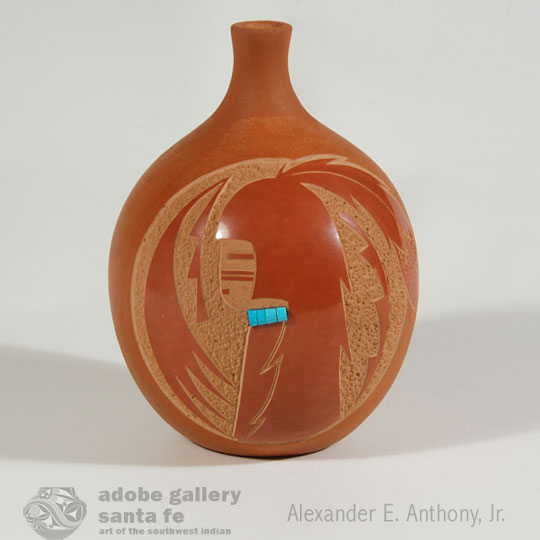 Tse-Pé Gonzales (1940- 2000) was generally known by his singular name. His mother was Rose Gonzales, the potter who introduced carved blackware pottery to San Ildefonso Pueblo. Tse-Pé followed the tradition of carved pottery, but chose sgraffito carving rather than the deep carving of his mother's style. In the early 1970s, Tse-Pé was among the first potters to participate in the sgraffito movement, along with Tony Da, Popovi Da, Joseph Lonewolf, Art Cody and other male potters. Perhaps because pottery was traditionally a woman's craft, the sgraffito technique was adopted by males as a way not to produce woman's work.
Small Zia Pueblo Serving Bowl - C3885E
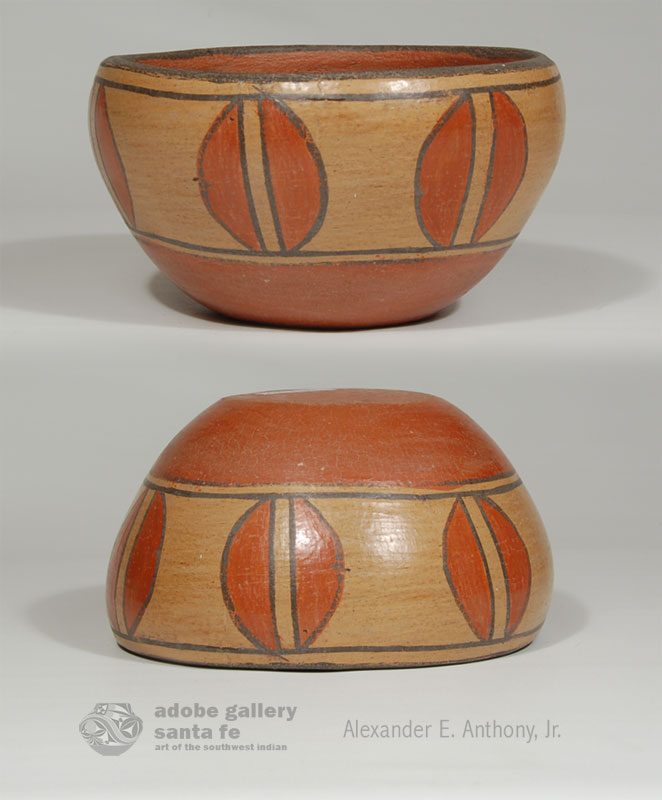 Bowls represent the lower half of the earth and, as such, represent the area where food is grown for nourishment of the people. They are used for food preparation, for serving food, and for use as a lid or covering to be placed over another container for protection of the contents. Such a concept adds immensely to our appreciation of what we normally consider as just a bowl.
This small bowl appears to have been sold before ever being used at the pueblo. There is no evidence that it was used for serving food. One explanation of the design on the exterior is "deer hooves" but that is probably just an interpretation that may or may not bear fruit.
Zia Pueblo Polychrome Serving Bowl with Floral Design - C3885A
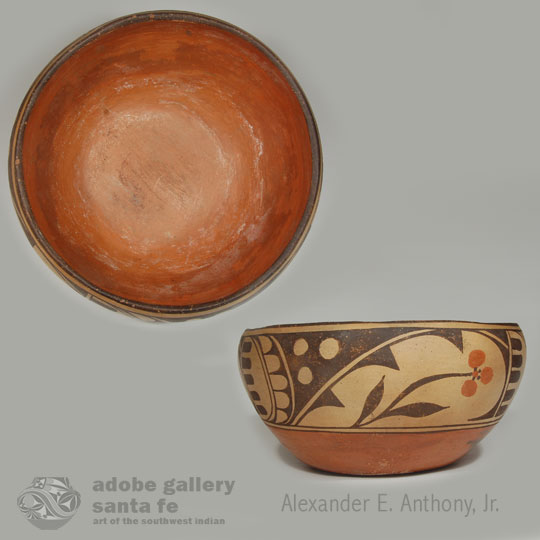 When we post an item of pottery as Contemporary, we do not mean to indicate that it is new, but that it dates to after 1940. There has been considerable disagreement among scholars, dealers, and collectors about the end of the historic period and the beginning of the contemporary period in pueblo pottery production. Earlier scholars, such as Francis Harlow, set the end of the historic period at 1880 to coincide with the arrival of the intercontinental train to New Mexico and its influence on pottery styles. Others have set the end date of the historic period as 1920s because that was the beginning of the black-on-black pottery and publicity by the Museum of New Mexico on pueblo pottery. Lastly, Jonathan Batkin selected 1940 as the end of the historic period which would set the beginning of the contemporary period at that time.
Zuni Pueblo Wide Silver Band with Mosaic Inlay Knifewing Images - C3864.29
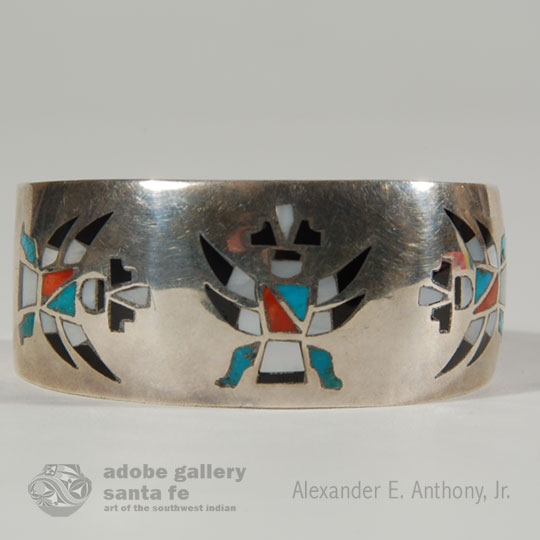 Zuni Pueblo artisans are known worldwide as phenomenal lapidary artisans and jewelry makers. They are masters at cutting stones and fitting those stone-to-stone to form mosaic imagery in jewelry. The three Knifewing images are imbedded into the silver band in a manner that the stones are smooth and level with the silver.
Hopi Pueblo Palhikmana - Butterfly Girl Katsina Doll - 25952
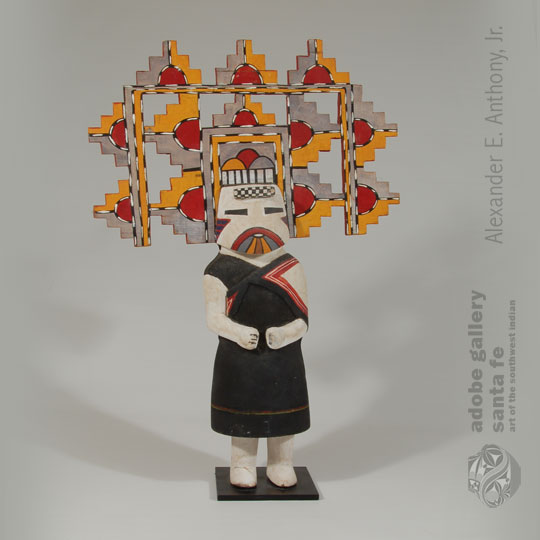 Palhikmana is a female katsina or katsina maiden to whom is inscribed several functions. She appears during Angk'wa as a Butterfly maiden or Corn-Grinding maiden. She also appears in the performance of a special dance.
Angk'wa is a ceremony which encompasses the entire month of March during which a series of night dances is performed in each Hopi village. These rituals will continue until sometime in July when the katsinam season ends and the katsinam return to their home in the San Francisco Mountains.
Sikyaqöqlo Flat Style Hopi Pueblo Katsina Doll - 25953
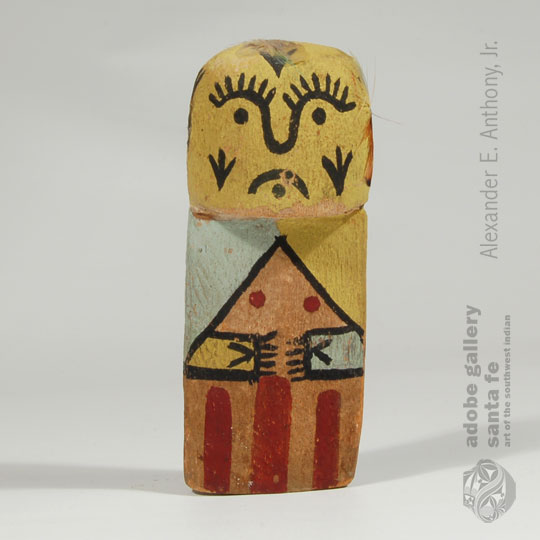 Qöqolo Katsinam appear in various colors representing the colors of the six directions-north, west, south, east, universe, and the underworld. The Sikyaqölo is the yellow one and he "is the artist, practicing the art of agrarian culture and producing the colorful gifts that he brings for children at the Powanuya ceremony." Secakuku 1995
Powamuya is a ceremony imploring the katsinam to appear among the Hopi for the benefit of life for all mankind. It begins in February at sunrise when Ahöla blesses the village and prepares it for the arrival of the katsinam.
Southwest Heavy Silver Content Navajo Bracelet - C3864.26
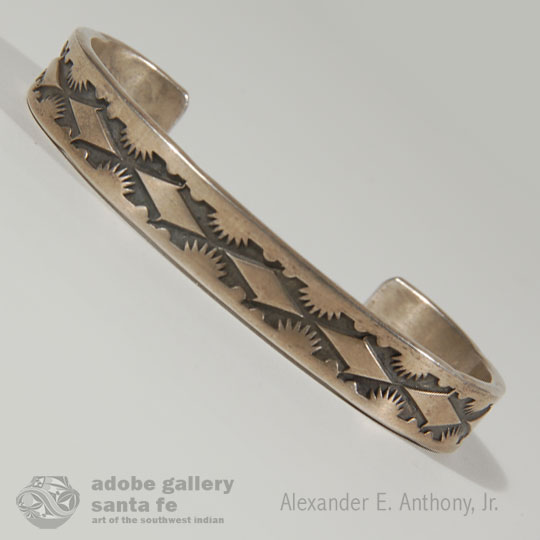 This bracelet is stamped NORA. None of our reference books on jeweler's hallmarks lists anyone by that name. Perhaps that is a first name, not a last name. The bracelet was beautifully constructed and stamped. It appears to be from ingot silver and has a significant thickness.
Heavy Silver Content Navajo Bracelet with Stamping - C3864.25
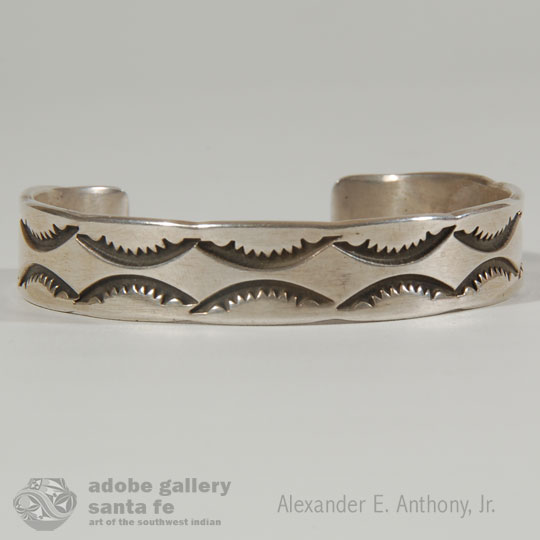 This Navajo-style bracelet is stamped with the name NORA, a name not found in any reference books relating to silversmiths. The band appears to be from ingot silver, is wide and sturdy. The stamping resembles Hopi silver overlay but is believed to be of Navajo origin.