



Ohkay Owingeh (San Juan) Pueblo Red-on-Tan Serving Bowl - 25707
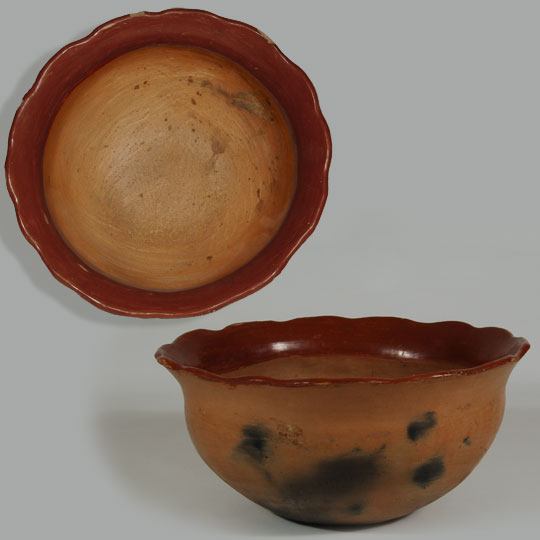 Ohkay Owingeh Pueblo has a long history of producing plainware pottery of the most striking beauty. There are several vessel shapes and styles that are traditional to the potters of the pueblo. Large storage jars are globular in shape and traditionally slipped with red clay on the upper half and with no slip on the lower half. Large dough bowls are generally slipped in the same manner, with red slip on the upper half and without slip on the lower.
Serving bowls tend to be of two styles. Both styles feature concave rims that flare out at the top. Some of these have red slip applied to the top few inches on the exterior of the rim and others on the interior of the rim. Those with red slip on the interior, such as this bowl, generally have a rim that flares outward slightly more than the rim of one decorated on the exterior. The rim on this bowl is scalloped on its edges. The interior of the bowl is without slip and has a stone-polished finish. The bottom of the bowl is flat.
Would you like to buy or read more about this pottery?
San Ildefonso Pueblo Corn Dance Celebration Painting by Tonita Vigil Peña - C3904A
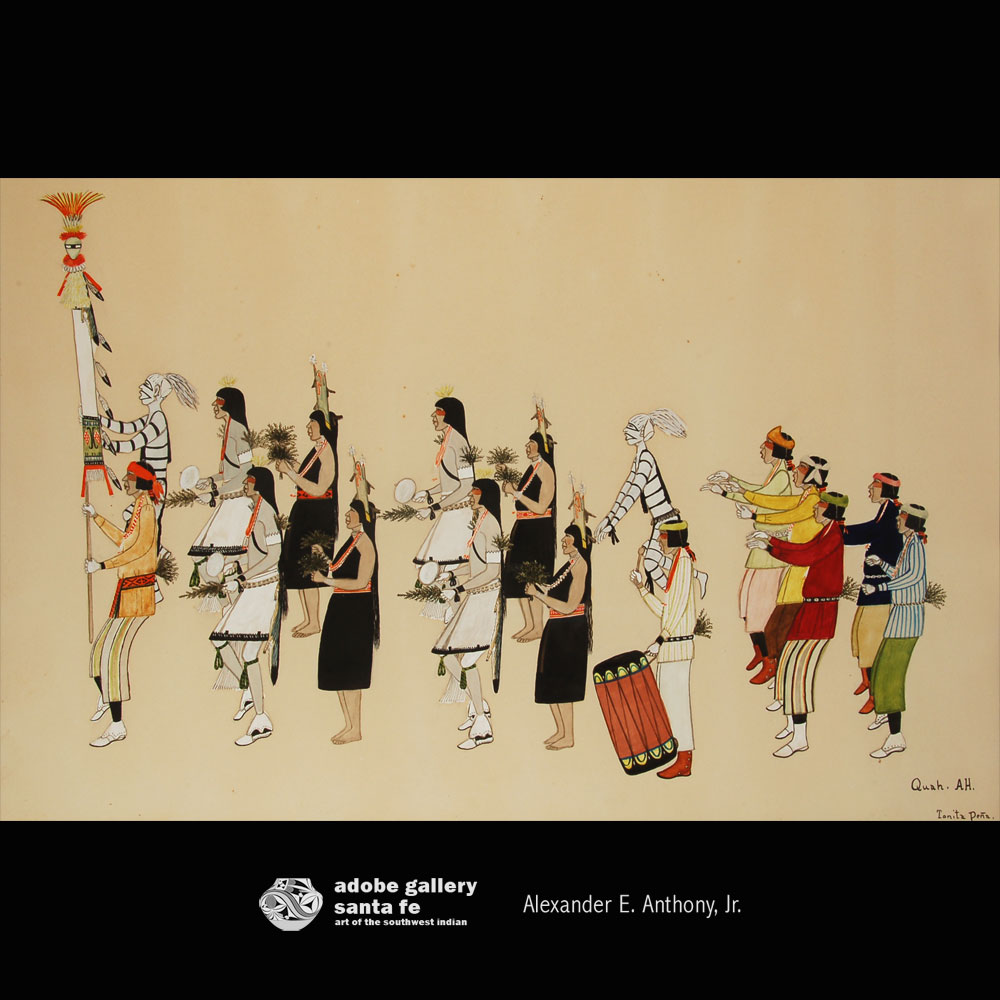 This is a major presentation by Tonita Peña of a Corn Dance Celebration, with 17 participants. The procession is led by a banner carrier and trailed by a drummer and five chanters. The dancers are paired by two men, followed by two women, followed by two men and followed by two women. There are two Koosa Clowns. San Ildefonso celebrates the Corn Dance in September, harvest time.
Peña's usual treatment is concerned with several dance figures in a line led by a Corn Dance Banner Carrier and followed by a drummer, as shown in this painting. Generally, there are women in her paintings, as shown here, and, as a rule, these women are taking a definite part in the dance as shown in the sensitive action of the feet. She presented the men with more active steps. This type of action, peculiar to Peña, is well illustrated here.
Would you like to buy or read more about this painting?
Very Large Papago Man in the Maze Plaque - C3903J
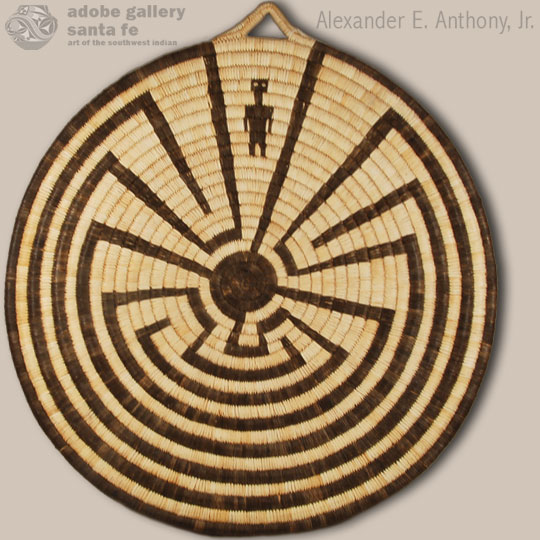 According to O'odham oral history, the man-in-the-maze labyrinth design depicts experiences and choices we make in our journey through life. In the middle of the "maze," a person finds his or her dreams and goals. When one reaches the center, there is one final opportunity (the last turn in the design) to look back upon our choices and path, before the Sun God greets us, blesses us and passes us into the next world.
A CENTURY OF PUEBLO PAINTERS: SAN ILDEFONSO PUEBLO 1900—1999
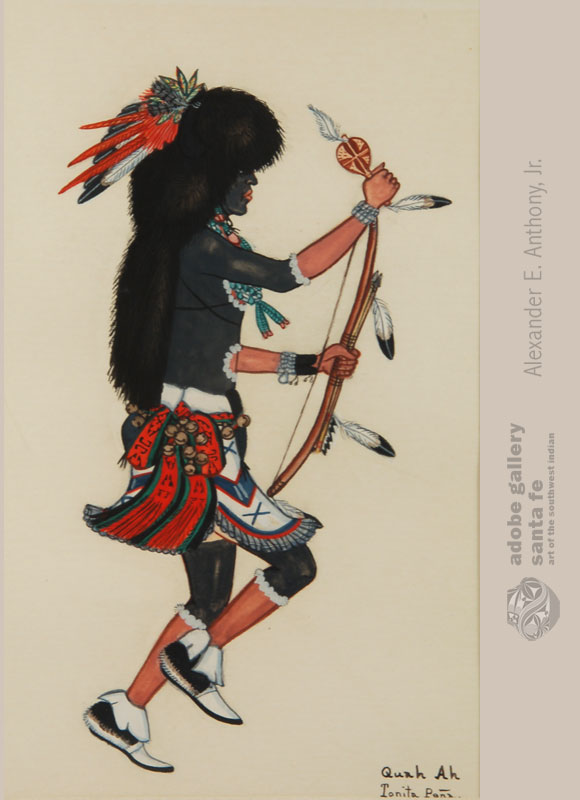 Adobe Gallery's enormously popular exhibit "A CENTURY OF PUEBLO PAINTERS: SAN ILDEFONSO PUEBLO 1900-1999" has been expanded and extended through the summer of 2017 by popular demand.
Adobe Gallery will host a reception on Friday, May 12 from 5 to 7 p.m. to showcase new additions to the exhibit and give locals and visitors another chance to enjoy this historically significant collection of paintings.
This event is part of the Canyon Road Spring Arts Festival, which will feature gallery openings and artist demonstrations all weekend long. On the afternoon of Saturday, May 13, Adobe will host three Native artists: Myron Denetclaw (Diné- Navajo Nation), Lorraine Gala-Lewis (Laguna-Taos-Hopi), and Carol Gala (Laguna-Taos-Hopi).
Please join us for an exciting weekend on historic Canyon Road.
San Ildefonso Pueblo Black-on-black Jar signed Marie and Julian - C3901D
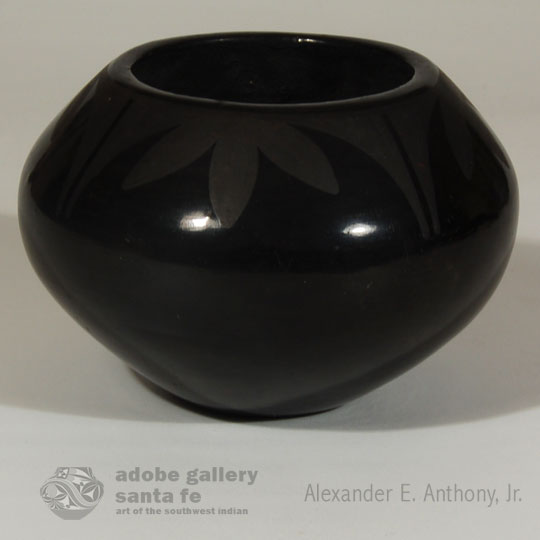 Maria Poveka Martinez (1887-1980) and Julian Martinez (1885-1943) worked together producing pottery from the early 1900s-she making the beautiful Tewa shape vessels and he painting beautiful designs in traditional Polychrome style. Because Maria was considered the best potter at San Ildefosno Pueblo, she was selected to experiment on reproducing the prehistoric wares being excavated at nearby ruins. She and Julian worked diligently for several years to recreate the earlier pottery style and Julian painted designs in the traditional Polychrome style. It was not until around 1912, that they became interested in experimenting with the blackware of previous periods. It was another 10 years before they achieved satisfactory results.
Zia Pueblo Very Large Polychrome Water Canteen - C3903C
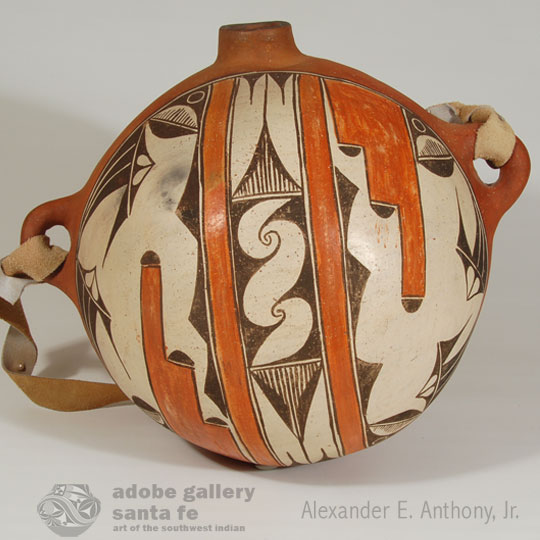 This is an extraordinarily large canteen from Zia Pueblo, created most probably in the first quarter of the twentieth century. This fine piece is coil-formed in native clay with the addition of crushed basaltic temper. The underbody is stone-polished red-slipped paste in a warm brick red color. A very wide red band is wiped on as a dividing line between the underbody and the decorated upper body, and it encompasses both handles and the spout.
Award Winning Santa Clara Pueblo Bear Paw Jar by Angela Baca - 25967
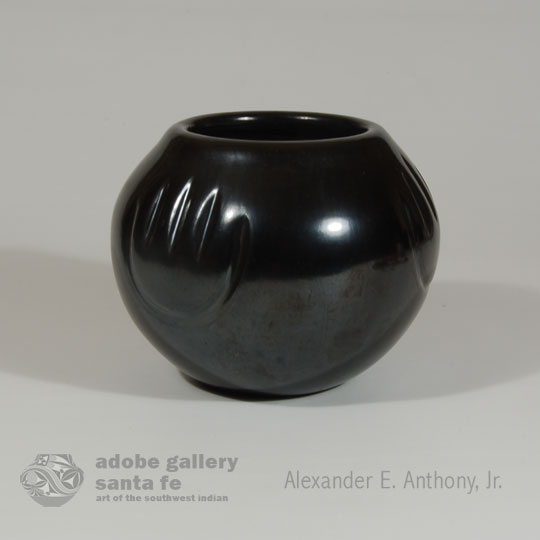 This black stone-polished jar by Angela Baca was awarded a First Premium award at the New Mexico State Fair in 1974.
Angela Baca started making pottery professionally around 1955 and continued for the next fifty years or so. She was the daughter of Severa Tafoya (1890-1973) who was the sister of Van Gutierrez of the Lela and Van Gutierrez family. Angela followed in her mother's style of shape and design. They both became famous for melon jars and bear paw jars.
Would you like to buy or read more about this pottery?
Hopi Pueblo Kiva Night Scene Ceremony by Raymond Naha - C3906B
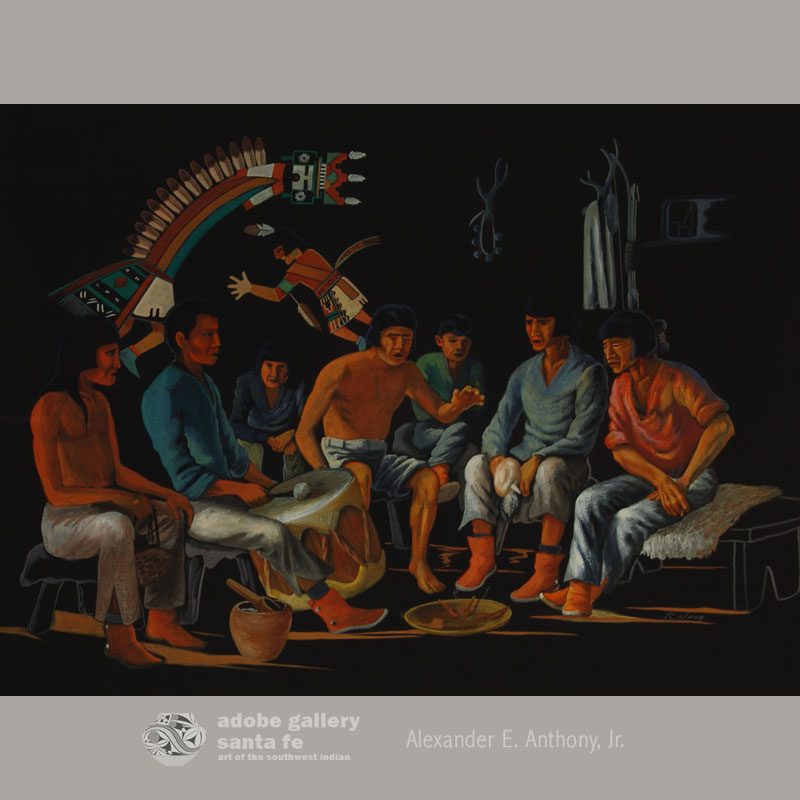 When one visits the Hopi villages to witness a Katsina Dance in the plaza, it is generally the culmination of a 9-day ceremony that has been secretly on-going in the kiva and not open to the public. This is a kiva scene pictured by Raymond Naha (1933-1975). A drummer is beating his drum and a chanter is singing. The young men sitting around are probably initiates. There is a bowl and ladle next to the drummer that probably contains sacred cornmeal or other medicine. The basket on the floor appears to hold smoking pipes and a feather. On the kiva wall is painted a Rainbow Man and a Hopi boy. Other items hang on the wall.
Hopi-Tewa artist Raymond Naha was born in the village of Polacca, which is at the foot of First Mesa, on the Hopi Reservation in Arizona on December 5, 1933. He studied under Fred Kabotie at Oraibi High School. Kabotie recognized Naha's talent and encouraged him to continue his studies. Naha then took correspondence courses and studied at the Phoenix Indian School, which was the end of his formal art education. His progress from then was purely self-motivated.
Would you like to buy or read more about this painting?
Traditional Hopi Pueblo Sio Hemis Katsina Doll, circa 1940s - 25970
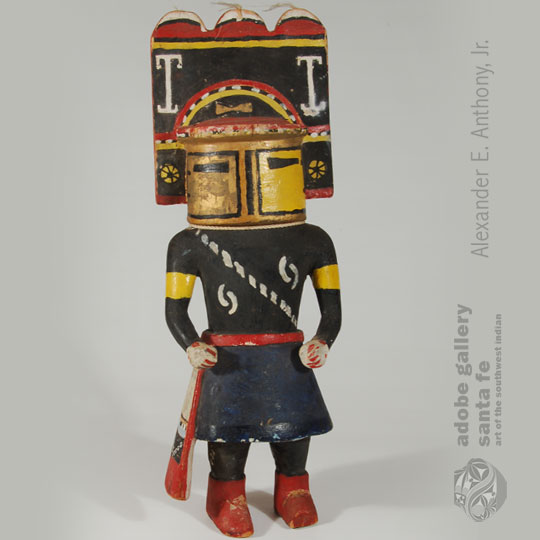 The Hemis and Sio Hemis Katsinas are probably the most beautiful and best known of all Hopi Katsinas. Their elaborate headdress, called a tableta, is partly responsible for their attraction. They both wear a kilt, and around the waist a Hopi embroidered sash.
These katsinas appear in the Home Dance or Niman Ceremony. No other katsinas, neither clowns nor side dancers appear with the line of Hemis except the Hemis Manas. It is interesting to note that at Hopi, they refer to the Sio Hemis Katsina as having come from the Rio Grande Jemez Pueblo of New Mexico. At Jemez Pueblo, they refer to a similar dance as a Hopi dance.
Would you like to buy or read more about this Katsina doll?
Original Abstract Painting with Humans and Animal by Jaune Smith - C3895B
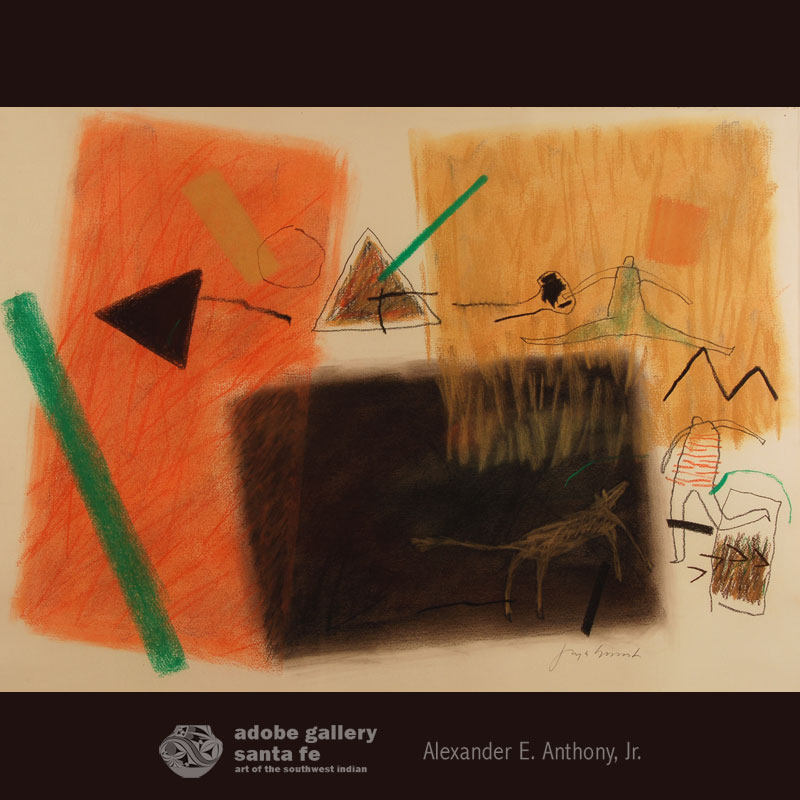 This untitled oil pastel is part of Jaune Quick-To-See Smith's Camus series, which was completed around 1980. Geometric shapes of squares, triangles, rectangles, human and animal figures, and pastel and dark colors combine for a striking image.
The image was painted on handmade paper which has been framed so that the full view of the paper is visible.
Would you like to buy or read more about this painting?
San Ildefonso Polychrome Dish with Turquoise by Marie Gonzales Kailahi - C3903E
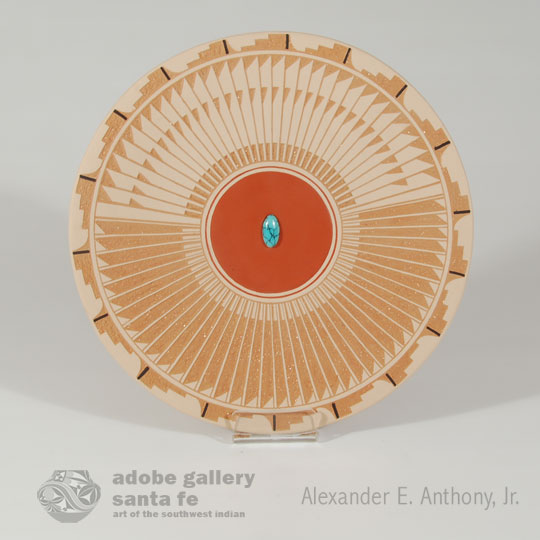 Marie has been a constant winner at Santa Fe Indian Market since 1984. She has participated in Santa Fe Indian Market, Inter-tribal Indian Ceremonial in Gallup, and Eight Northern Indian Pueblos Arts & Crafts Show.
This jewel of a dish was constructed of traditional San Ildefonso clay and temper agent and highlighted with micaceous clay. Half the feathers are natural beige slip with micaceous highlights; and the other half are micaceous slip with a darker slip color. The center is a beautiful dark red stone-polished slip on which floats a beautiful oblong turquoise cab.
Central Plains Beaded Hide Moccasins, circa 1900 - 25230
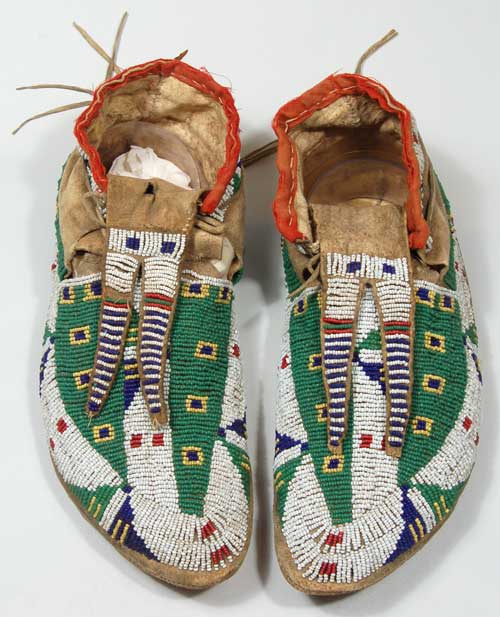 The Lakota are the western-most of the three Sioux groups, occupying lands in both North and South Dakota. The Lakota were originally referred to as the Dakota when they lived by the great lakes, however, because of European settlement they were pushed away from the great lakes region and later called themselves the Lakota which became part of the Sioux.
Hopi Pueblo Upright Polychrome Water Canteen by Jean Sahme Nampeyo - C3903G
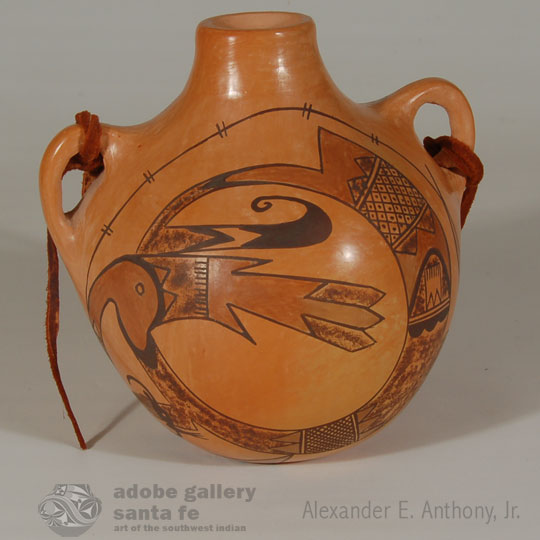 Jean has a very artistic style of creating designs on pottery. She does not hesitate to select parts of traditional Sikyatki design elements and to arrange them in a most artistic and pleasing manner. The designs she chose for this jar are selections from Sikyatki pottery and appear to be bird-like in form with an insect added as a surprise element. Her arrangement of the design in a non-structured pattern provides for interesting viewing. The canteen is decorated on front. It is provided with a twisted rawhide strap for use in hanging. It sits upright in a secure manner. It is signed J. Sahme Nampeyo.
San Ildefonso Miniature Black Carved Canteen by Rocky Martinez - C3903F
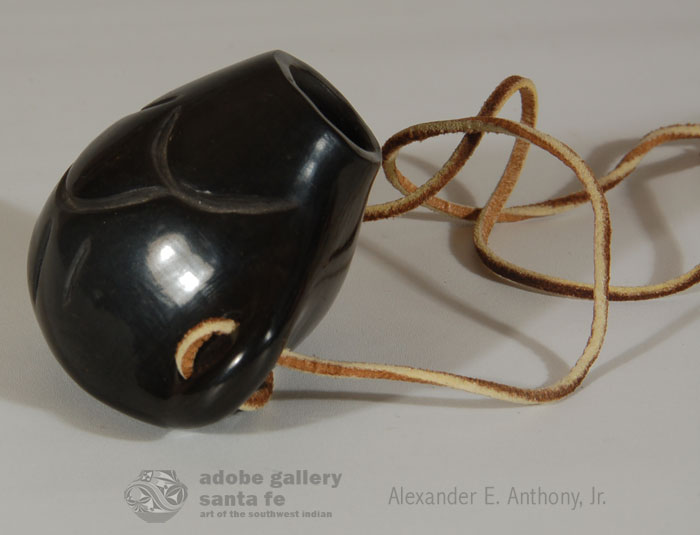 We tend to think that all San Ildefonso pottery is either plain black or black-on-black and that all Santa Clara pottery is black carved. Generally, that is the case, however, there are always exceptions to the rule to enlighten us.
This miniature black canteen has a carved design of clouds and rain. It is signed with the name Rocky Martinez, a name I was unable to locate in any of my references, but I inquired of Elvis Torres of San Ildefonso to see if he could provide information on the family of Rocky Martinez so that we could place him accurately in our data. Elvis consulted with Adelphia Martinez (1935-present), daughter of Juanita and Wo-peen Gonzales, who told him that Rocky would sometimes make pottery with his grandmother, Juanita Wo-peen.
Would you like to buy or read more about this pottery?
Zuni Pueblo Small Polychrome Canteen - C3903H
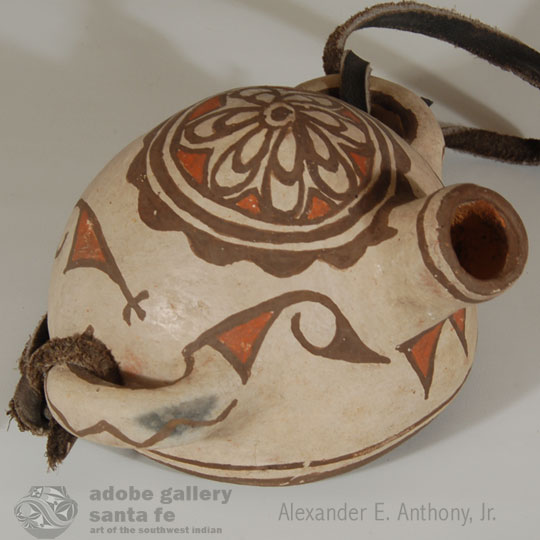 The primary design on this canteen is a rosette, located on top center of the body. This rosette is the same design used on most Zuni Pueblo Polychrome jars. Presumably, it is a design influence from the medallions seen on Spanish men's clothing. The other designs surrounding the medallion on this canteen are designs seen frequently on the neck of Zuni water jars. The potter used designs with which she was familiar.
Original Oil Painting "Northern New Mexico Aspens" by Carl Von Hassler - 20516
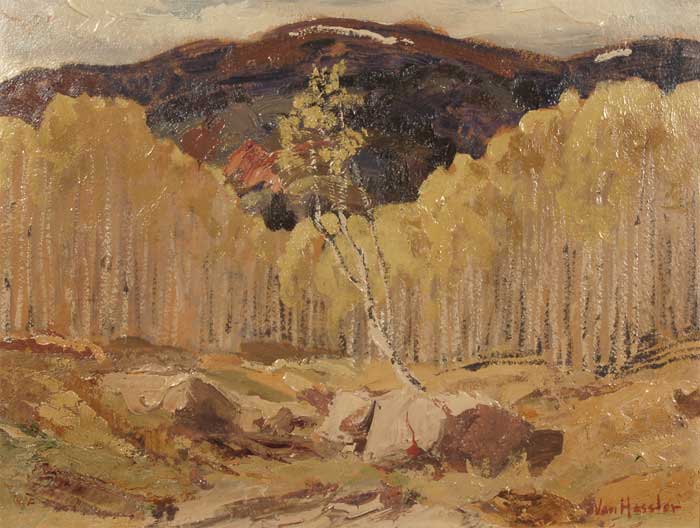 This is an oil painting executed in the Sangre de Cristo Mountains north of Santa Fe near the Tesuque River. Von Hassler often painted on site in areas in Northern New Mexico. He particularly liked the small Northern villages between Santa Fe and Taos.
In his early years in Albuquerque, Von Hassler's studio was in the original Casa de Armijo (now La Placita Restaurant) in Old Town Albuquerque. He is best known for his traditional realistic landscapes of New Mexico and his Indian portraits.
Would you like to buy or read more about this painting?
Navajo Sterling Silver and Turquoise Ring with New Moon Shaped Stone - 24864
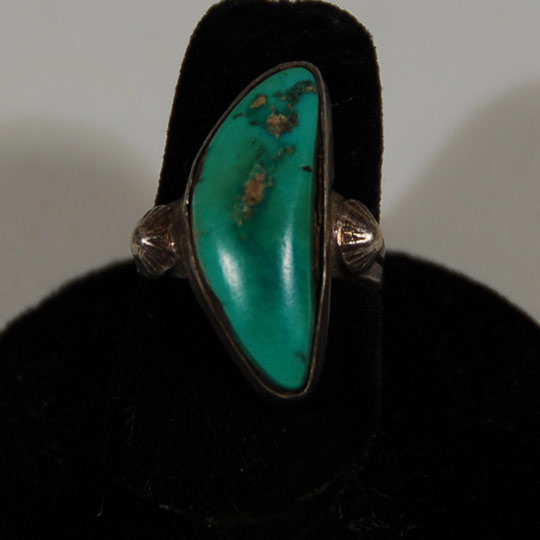 This beautiful green turquoise stone was cut into the shape of a new moon and simply surrounded by a silver bezel. The turquoise is devoid of copper matrix and is a solid color with minor shading. There are no cracks in the stone. The silver shank has two domed silver buttons attached at the ends. The shank is heavy silver which would indicate a date of 1950s or earlier.
Hopi Pueblo Corrugated White Jar with Award Ribbon by Polingaysi - C3903A
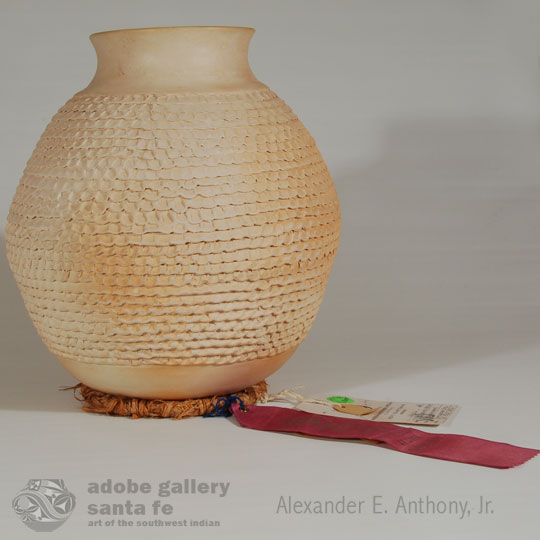 Hopi potter Polingaysi Qöyawayma, also known as Elizabeth White, studied ceramics under the tutelage of Charles Loloma, famous Hopi jeweler, who taught ceramic classes at the University of Arizona, Arizona State University and at the Institute of American Indian Arts in Santa Fe. Polingaysi was a teacher who began making pottery after she retired from that career in 1954. Once she learned the techniques, she began searching for a style that suited her taste and personality. When she found uniquely special clay that needed no painted design to bring out its beauty, she decided to use only the unadorned clay.
Hopi Pueblo Hairknot Clown Katsina Doll by Ronald Honyouti - C3383N
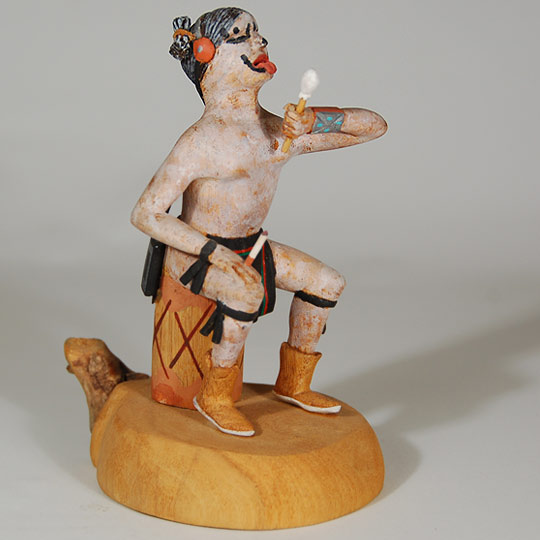 There is a group of Hopi Clowns named Tsutskutu. Some of them have yellow body paint and are known as Sikya Tsuku and others have white body paint and are known as O-oto Tsuku. The Na'somta Tsutsukutu clown illustrated here by Ronald Honyouti is one of the O-oto Tsuku clowns. Their name derives from the manner in which they have their hair tied in a knot.
Would you like to buy or read more?
#adobegallery #HopiPueblo #Katsina #Kachina # #Doll #SouthwestIndianArt #PuebloArt #SantaFeNM #RonaldHonyouti
Original Taos Pueblo Painting “The White Horse” by Juan W. Mirabal - C3514.10
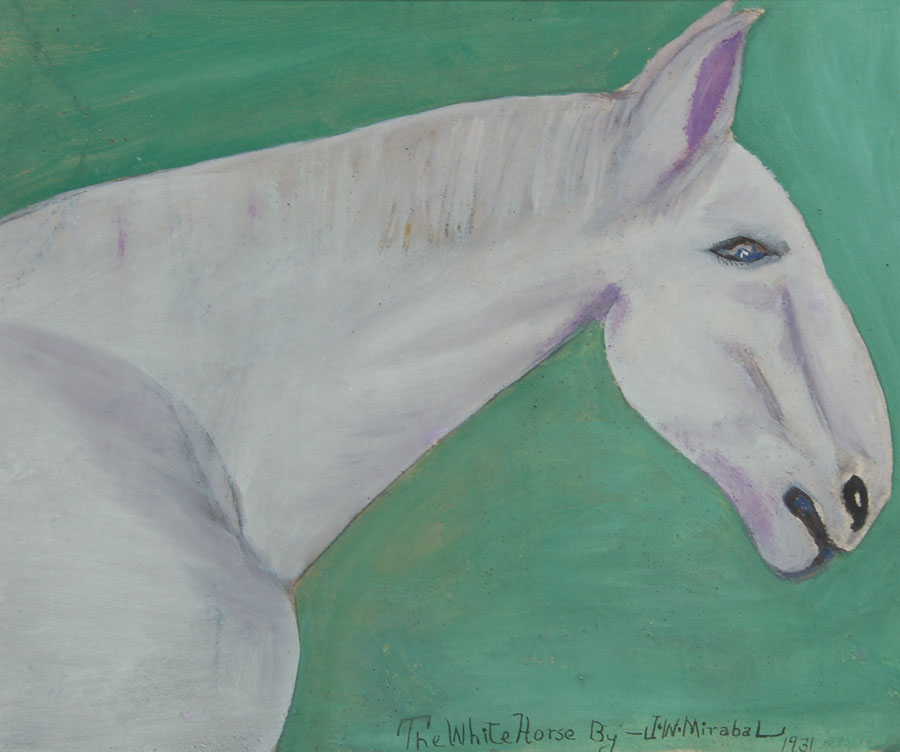 Juan Mirabal, an artist from Taos Pueblo, was joined by two other Taos Pueblo artists, Albert Lujan and Albert Looking Elk, in painting in a realistic three-dimensional Euro-American style in the 1915 to 1920 period. Lujan and Looking Elk mostly painted scenes of Taos Pueblo buildings and surroundings and sold their art directly to tourists visiting the pueblo. Because they did not paint in the flat style other Natives were producing, their work was considered "not Indian."