



Hopi Pueblo Overlay Sterling Silver Belt Buckle by Philbert Poseyesva - C3852M
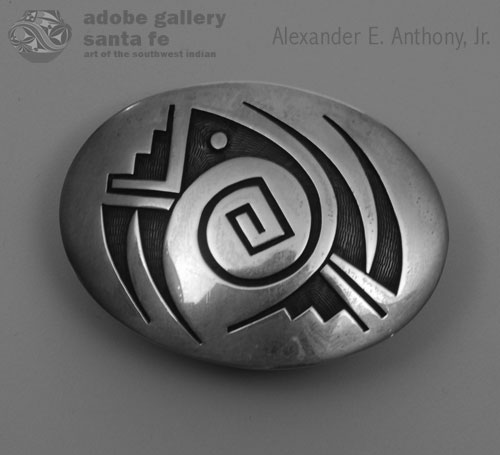 Phil Poseyesva's hallmark is a bear paw with his last name superimposed. He is one of the recognized Hopi jewelers whose works are sought by collectors. He has been an active jeweler since circa 1973 and is still producing. He learned the processes of Hopi overlay through instructions at the Hopi Silvercraft Cooperative Guild on Second Mesa. He has lived in the villages of Mishongnovi, Oraibi and Kykotsmovi.
Poseyesva has won awards for many years at Santa Fe Indian Market. His work has been exhibited at Eiteljorg Museum in Indianapolis, Southwest Museum in Los Angeles, and Gilcrease Museum in Tulsa.
Would you like to know more? (Click here)
Navajo Silver and Turquoise Wide Band Ring - C3864.38
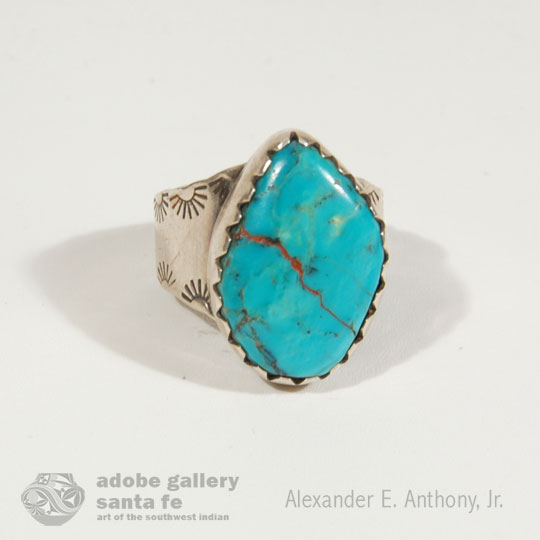 A beautiful wide silver band with "rising sun" stampings on its edges is the foundation for a beautiful blue turquoise cab which is anchored in a wide silver bezel with serrated edges. The Silver and Turquoise Wide Band Ring imparts a feeling of massiveness and strength. The dark line crossing the turquoise is the natural matrix of the stone. The ring is not signed with the name of the Navajo Nation artist.
Zuni Pueblo Saiyatasha Katsina Doll by Duane Dishta - C3535.62
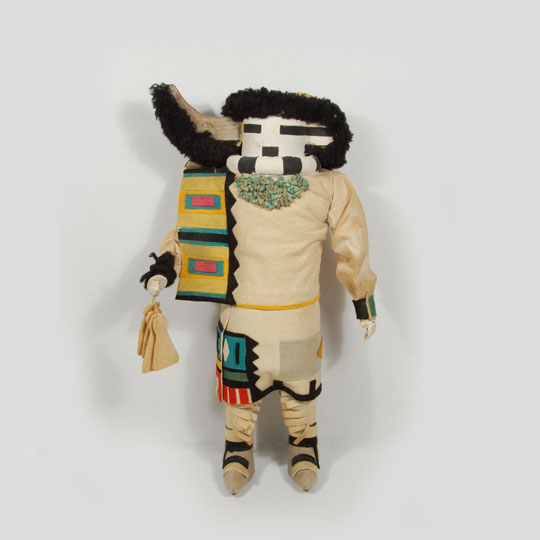 During his period of impersonating Saiyatasha, the Zuni man holds a position of great responsibility, power and prestige and assumes the rank and importance of one of the major priests of Zuni. It is he who must decide the ceremonial calendar for the year and must watch over the phases of the moon for the full year. He sets the date of the Shalako Ceremonies and insures that they do not conflict with other ceremonial events. He must learn all of the lengthy prayers, chants, and speeches while attending nightly meetings that last from the Zuni New Year until Shalako. In addition, he is required to make journeys to springs from four to eight miles distant to offer prayers each month during the year. He must also pray to the sun each day and work to prevent the frosts of spring and fall since he represents a katsina who makes the days warm.
The above information was excerpted from the out-of-print book Kachinas of the Zuni by Barton Wright with original paintings provided by Duane Dishta. This Zuni Long Horn Priest of the North - Saiyatasha Katsina Doll is not signed, but was shown to Dishta who identified it as one he made in the 1960s.
Zuni Pueblo Kianakwe Thlian Kachina Doll by Duane Dishta - C3535.61
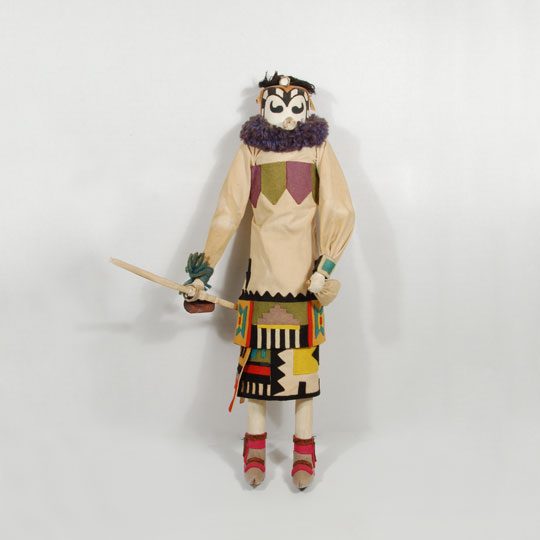 One of the oldest of Zuni legends describes how the Zuni overtook and conquered their enemy, the Kainakwe, a group of Indians far to the South. In observance of this event, the Zuni perform a one-day dance called the Kianakwe Ceremony that follows an eight-day retreat. It is unique in that it is performed only by the Corn Clan and is a dance involving the distribution of large amounts of food and goods.
The above information was excerpted from the out-of-print book Kachinas of the Zuni by Barton Wright with original paintings provided by Duane Dishta. A much more detailed explanation of this Zuni Katsina may be found in the book. This Katsina doll is not signed, but was shown to Dishta who identified it as one he made in the 1960s.
Hopi Pueblo Sterling Silver Butterfly Belt Buckle by Steven Sockyma - C3852P
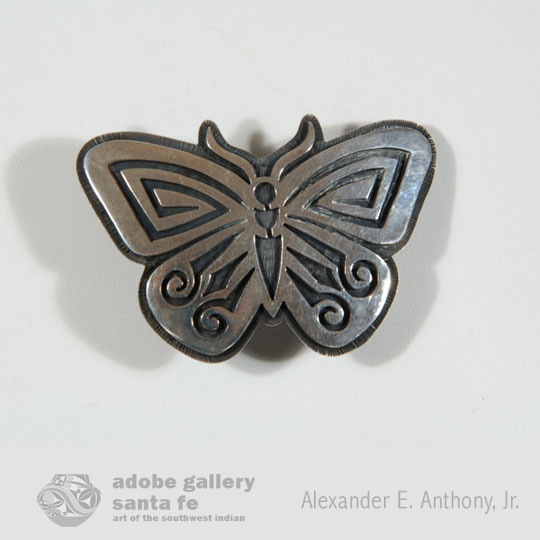 The Hopi Arts & Crafts Co-op Guild was formed in 1947, after World War II, when returning Hopi Pueblo servicemen were trained at a silversmithing school founded under the G.I. bill. The late Paul Saufkie, Sr. was the technical instructor and the late Fred Kabotie, noted Hopi artist and designer, taught design. Although many techniques of silver work were used, the overlay style gradually emerged as the dominate style. This simple, unique, elegant jewelry is now considered essentially the Hopi style of jewelry.
Steven Sockyma is a Hopi member of the Corn Clan. He has been actively making jewelry since 1969. He was born in the Third Mesa village Hotevilla and now lives in Glorieta, New Mexico.
Hopi Pueblo Sterling Silver Kokopelli Belt Buckle by Steven Sockyma - C3852o
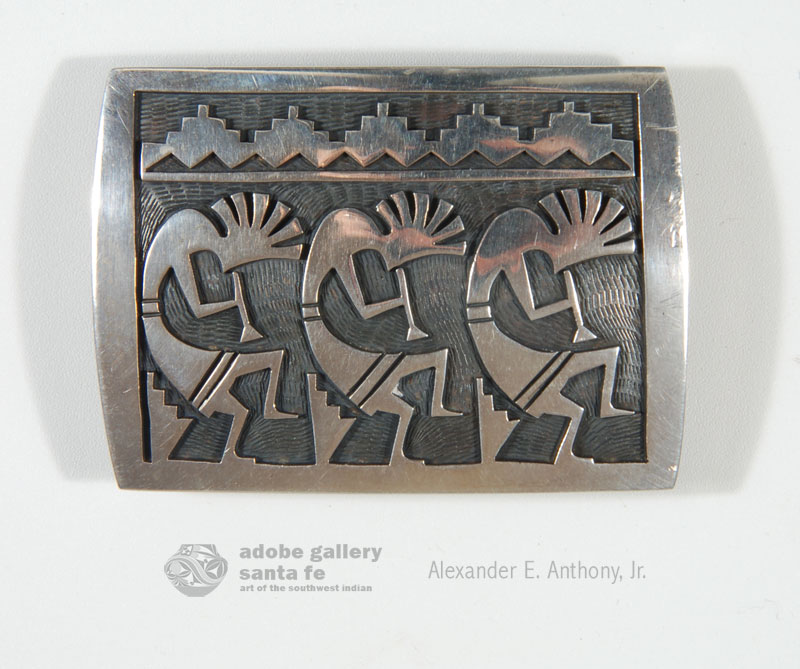 Steven Sockyma is a Hopi member of the Corn Clan at Hopi Pueblo. He has been actively making jewelry since 1969. He was born in the Third Mesa village Hotevilla and now lives in Glorieta, New Mexico. He has been a 1st place winner at Santa Fe Indian Market. Overlay technique consists of an upper layer in which the design has been intricately cut out with a saw.
Navajo Sterling Silver Earrings in Style of Conchas - C3864.44
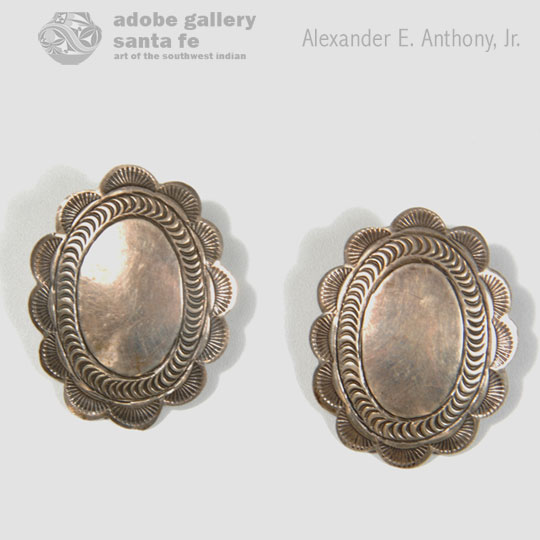 This is the perfect pair of earrings to wear with an all-silver concha belt. They are designed in the shape of conchas as seen on belts. They are equipped with posts for pierced ears.
Navajo Sterling Silver Stamped Cruciform Earrings - C3864.45
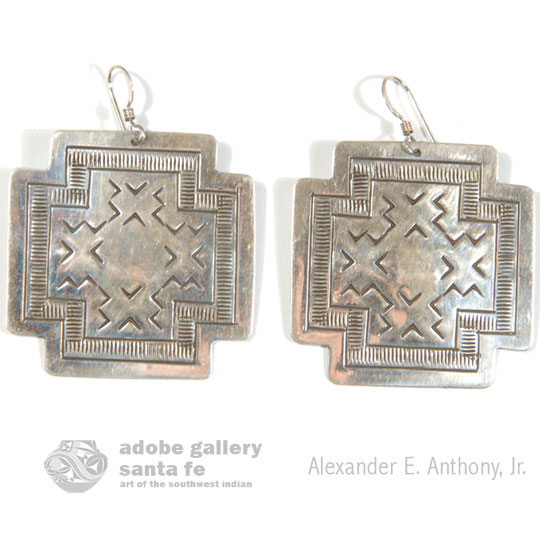 This pair of sterling silver earrings is stamped with designs that reflect those seen on Navajo rugs. Perhaps the females in his family are rug weavers.
Hopi Pueblo Four Color Polychrome Jar by Mark Tahbo - 25931
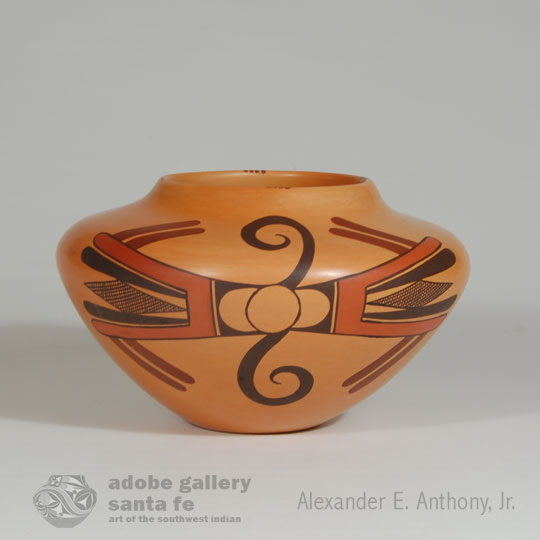 Mark Tahbo often places his designs within framing lines, but chose not to with this jar because the original image worked so well as a free-floating design inside Nampeyo's bowl. The most notable difference between Nampeyo's and Tahbo's versions is that Nampeyo's design featured feather designs, which Tahbo chose to replace with his own elaborate diamond hatchwork.
Navajo Cast Silver and Turquoise Belt Buckle - C3864.31
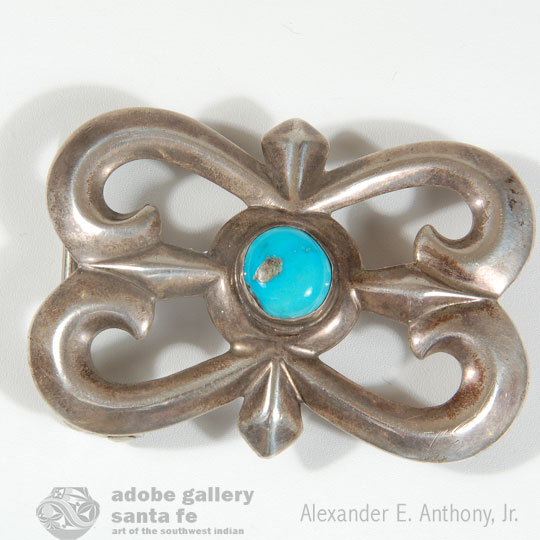 Tufa casting, often erroneously referred to as sand casting, is one of the earliest techniques used by the Navajo smiths. Today, it is still accomplished in the same manner as it was 150 years ago. This buckle was cast in silver, and then painstakingly polished and refined to a smooth finish.
Before a cast buckle such as this one can be made by an artisan, he or she must first fashion a mold from a whitish sandstone rock, hard enough to withstand the hot metal without splitting and yet soft enough to be grooved into the wanted design. Today, these can be purchased at local jewelry supply stores, but in earlier days, the artisan searched the Reservation for suitable rock and carved the desired design himself. When one of these molds broke, perhaps from not having been warm enough to receive the molten silver, it was a minor tragedy. Today, it is a slight inconvenience. Now, a new one can be purchased on the next trip into town.
Oil on Canvas Painting of Mountain Landscape by Tony Abeyta - 25938
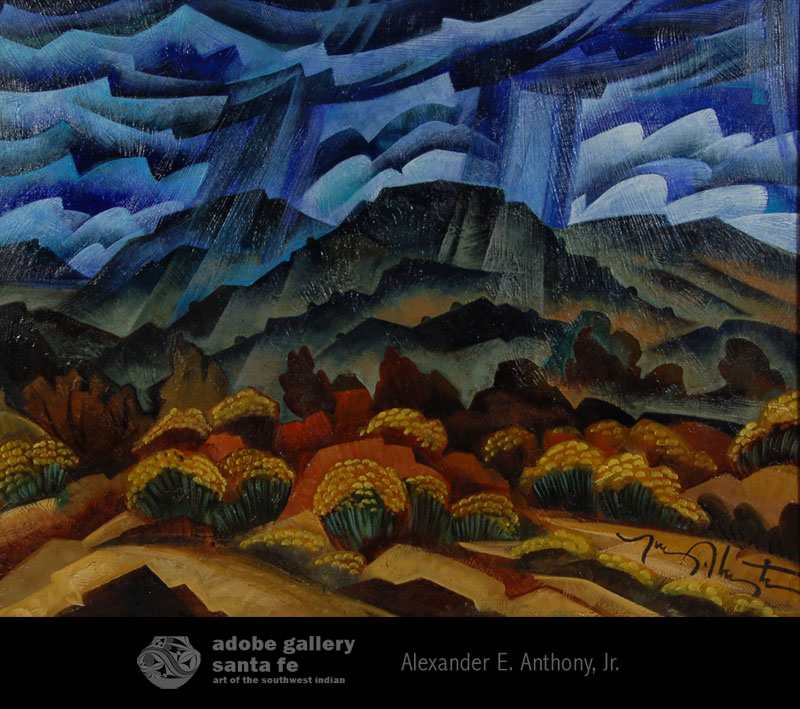 Santa Feans know that the annual rainfalls will start in early July and continue through August. That is referred to as the monsoon season even though the rainstorms last only about 30 minutes in late afternoon, followed by the return of the sun. The downpour can be significant in that half hour. Rain falls in isolated regions rather than all over the area.
In this Oil on Canvas Painting of Mountain Landscape, Tony Abeyta has placed the rain storm in the mountains and foothills. The clouds are various shades of blue and cast a darkness over the area. The mountains are green from previous summer storms. In the foreground, the chamissa is blooming in a beautiful yellow hue, the ground is yellow and brown, and the small bushes in the background are dark red.
Navajo Sterling Silver Tufa Cast Bracelet with a Turquoise Cab - C3864.08
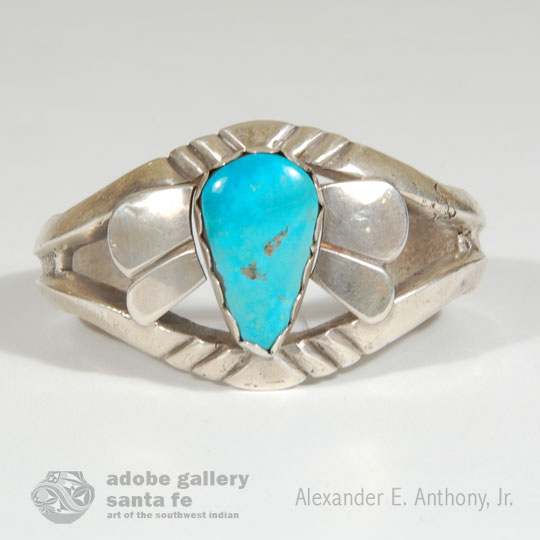 The silver band was formed in the tufa-casting manner by which molten silver was poured into a tufa mold that had been carved in the desired shape and pattern. Once removed from the mold, the band was then heated and curved to its present shape. The four silver rays around the stone appear to be hand hammered and soldered onto the band. A large tear drop turquoise cab was then set in a scalloped silver bezel and attached to the bracelet. There is no artist stamp or signature on this Sterling Silver Tufa Cast Bracelet with a Turquoise Cab.
Hopi Tewa Large Polychrome Seed Jar by Mark Tahbo - 25929
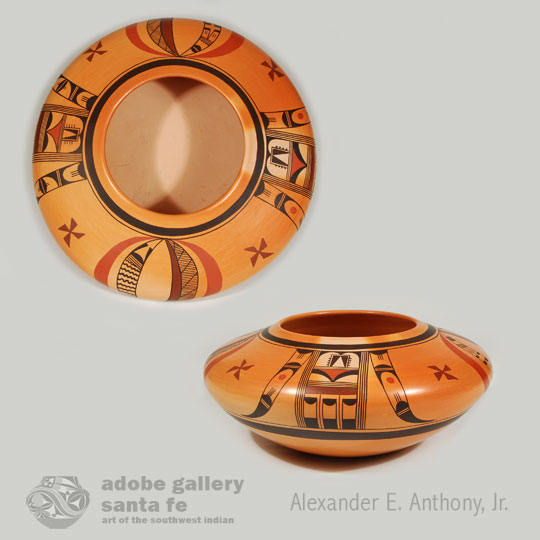 It is no surprise that Mark Tahbo's work appeals to collectors of contemporary pottery. He is an excellent potter whose creations, while varied in form and design, always display a mastery of his craft. What is interesting is that his pottery has begun to attract the attention of collectors who focus primarily on historic pottery. This is most likely because he so gracefully blends his own ideas with the classic Hopi Pueblo designs that inspired him to begin potting in the first place.
This jar is an excellent example of Mark Tahbo doing just that-seamlessly blending his own designs with those made famous by Hopi matriarch Nampeyo of Hano. He explained to us that the ovular designs, which include "curled feathers," were inspired by Nampeyo's corn designs. Here, they have been turned upright. Instead of using the crisscrossing migration pattern lines, he used a simpler set of horizontal lines which are crossed diagonally-his own interpretation of a master potter's designs.
Here is a video of Mark talking about this pot.
Isleta Pueblo Painting Houses on a Hill by Ed Jojola - Shirpoyo - C3872
 Some of Shirpoyo's exhibits were with the Santa Fe Indian Market, Colorado Indian Market, Glenwood Springs Fall Arts Festival, Colorado, and New Mexico State University. He was featured in articles in the Denver Post, Albuquerque Journal, and Dallas News, along with various travel section magazines throughout the United States.
Many of Shirpoyo's paintings are owned by patrons throughout the United States as well as Canada, England, France, Germany, Australia, Switzerland, and South America, to name a few. It was with much pleasure that we accepted this large watercolor brought to us by a resident of Santa Fe.
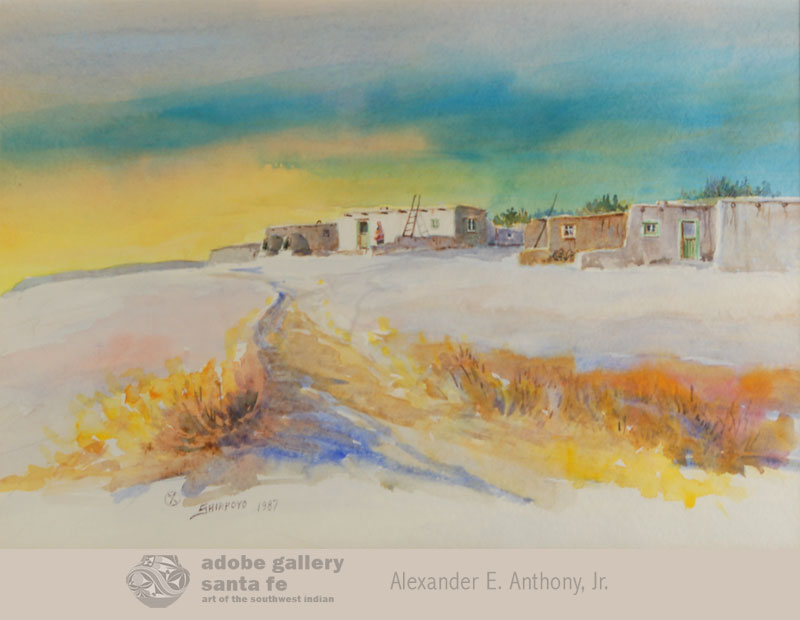
Shirpoyo basically painted scenes in and around his village of Isleta Pueblo. This watercolor features a couple of adobe houses on a hilltop at the pueblo. There are ladders leaning against the buildings, horno ovens outside in the yard, and a female in colorful clothing heading toward one of the houses. The foreground is awash in beautiful fall colors as the native grasses began their annual sleep.
Original Painting Entitled Swallow Dancer by Po-qui-Tsireh - 25937
 Identity of early 20th-century Native artists is not always documented in the standard reference books but sometime can be uncovered in more unusual places. There is no mention of Tomacito Vigil (c.1923-) Po-qui-Tsireh in any of the published books on Native artists that we have consulted, however, his name appears in a PhD Dissertation to the University of Texas, Austin, in 2011. It is simply a line entry with his name and that he attended the Santa Fe Indian School in 1936-37.
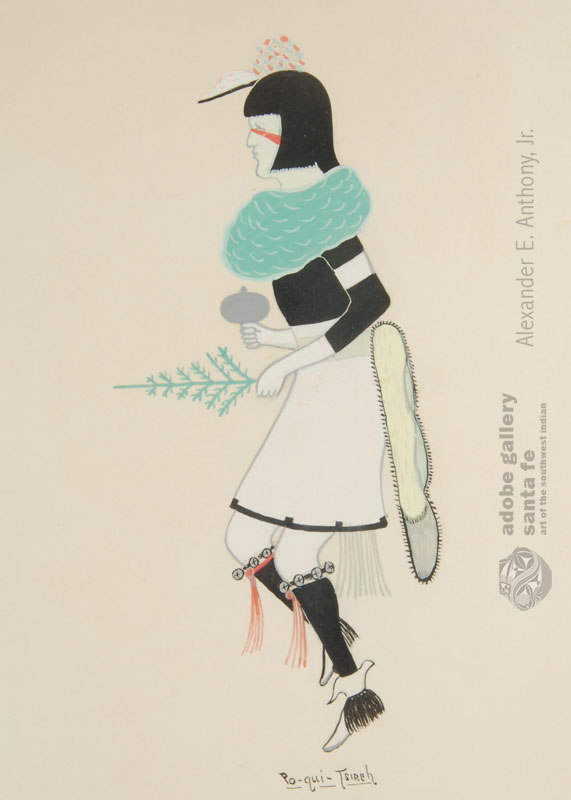
The Original Painting Entitled Swallow Dancer is marked on verso: "Swallow Dancer" by Tomacito Vigil, age 13, San Ildefonso Pueblo. It is signed in center right on the front Po-qui-Tsireh, his Tewa name. It is a single figure dancer with no background design, in typical fashion of The Studio of the Santa Fe Indian School. The dancer has a large green ruff around his neck, black body paint, white kilt with a fox tail, black stockings, and white moccasins.
San Ildefonso Pueblo Polychrome Jar with Red Rim - SC3680F
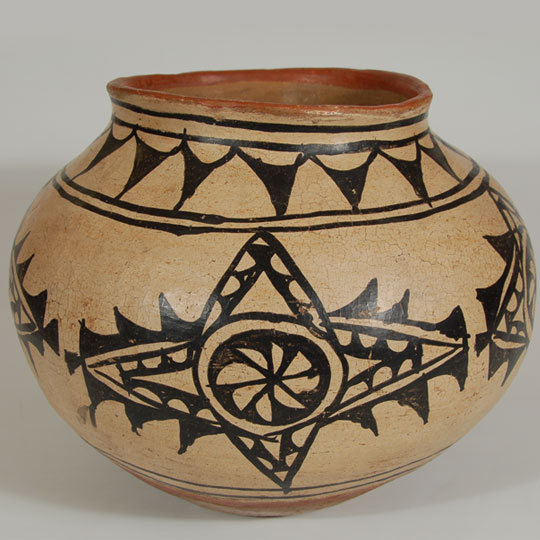 Tesuque and San Ildefonso Pueblo are somewhat neighbors. The people speak the same language and their historic pottery is similar in shape and design. It is sometimes difficult to make the determination which pueblo was responsible for a specific jar. Batkin (see reference), stated that collections made at Tesuque in the 1870 to 1880 period showed that the designs were of recent evolution. Is it likely that Tesuque potters styled their designs on those seen at San Ildefonso? Of course, we will never know for sure but it is quite possible that was the sequence.
San Ildefonso switched from its traditional cream slip, that required stone polishing, to the bentonite slip used by Cochiti Pueblo potters, around 1905. Tesuque switched also, but probably did not start to do so until a decade later and some potters did not change until the 1940s. Potters at San Ildefonso began changing the color of the rim from red to black as early as 1897. Tesuque potters switched rim color from red to black in the 1880s.
Male and Female Pair of Cochiti Pueblo Squash Dancers by Quah Ah - C3868L
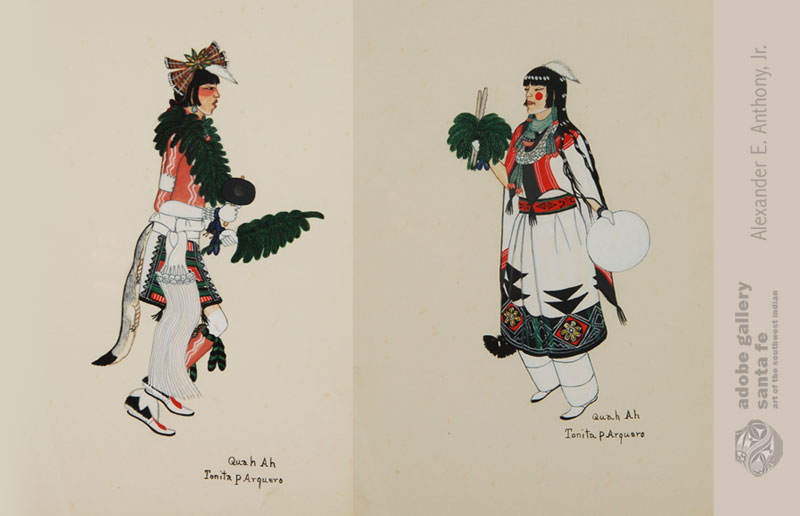 A few of Tonita Vigil Peña (1893-1949) Quah Ah's works, painted in 1922 and 1923, were signed:
Tonita P. Arquero
as on this Male and Female Pair of Cochiti Pueblo Squash Dancers, in honor of her husband, Epitacio Arquero. This signature is quite rare.
Tonita Peña labeled each of these paintings on verso Cochiti Pueblo Squash Dance $5.00. Whether the Squash Dance is still being performed a hundred years after these paintings were completed is not publicly known.
Navajo Squash Blossom Necklace with U S Coins - C3871
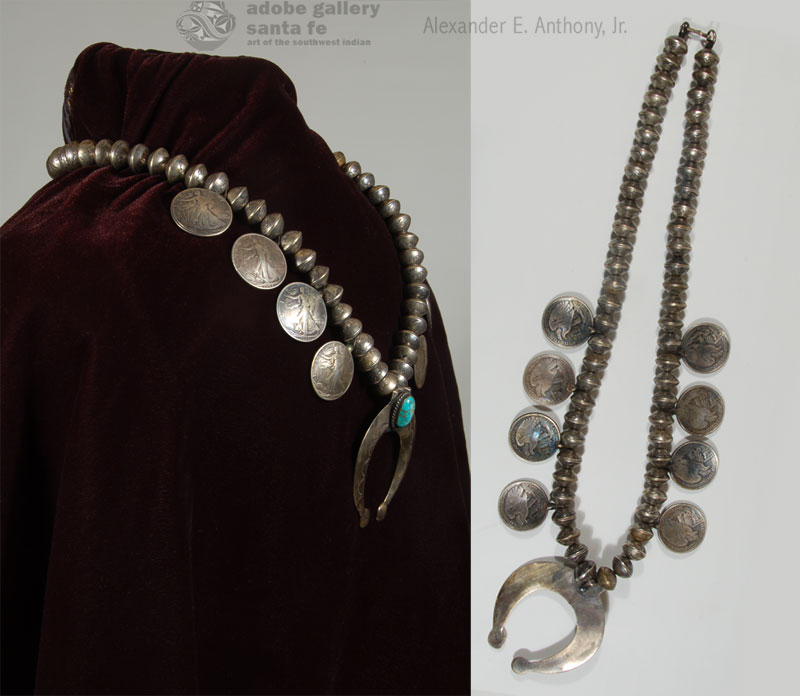 It was ingenious of some unknown Native artist to create a squash blossom necklace using repurposed materials-United States dimes and half dollars. I do not know who was the first to do so or exactly when the first one was made, but it was probably in the late 1970s. Supposedly it is illegal to deface United States coins but that did not stop the creation of this and other similar necklaces.
Each bead in the Navajo Squash Blossom Necklace with U S Coins was made by forming two United States dime coins into hemispheres and then soldering them together, drilling them in their center, and stringing them for a necklace.
Historic Acoma Pueblo Polychrome Olla with Zuni Pueblo Designs - 25164
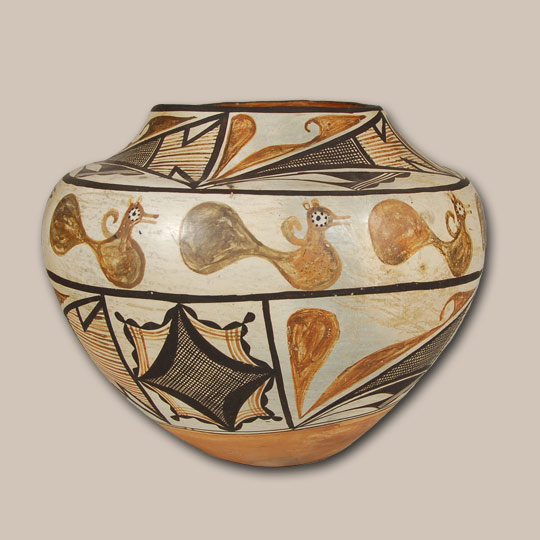 This early 1900s Acoma olla was decorated in its entirety in Zuni designs. For over a hundred years, Acoma potters have borrowed and reproduced Zuni designs. This trend seemed to be favorable in the 1890 to 1915 time period. Designs moved rather freely between Zuni and Acoma, no doubt due to their geographical proximity and probable historic connections.
Acoma Pueblo Hawikuh Style Olla, circa 1920s by Dolores Estevan Ascencion - C3123
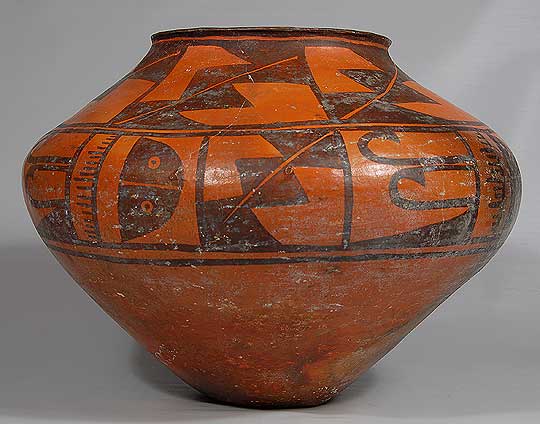 "Dolores Estevan Ascencion was married to Juan Estevan Ascencion; they had one daughter, Lita. A woman named Juana Dolores Estevan, who may have been the same person, was enumerated in the 1910 Federal census and identified as a pottery maker; she was the mother of Juana Maria Yousiewa, wife of Juan Estevan Yousiewa.
"The authors know of four examples of pottery identified as the work of Dolores Ascencion. One, a black-on-red jar was purchased by Kenneth M. Chapman at Acoma in 1928; his record indicates it was made by Dolores Ascension. This jar is in the SAR collection (IAF.1031). The same jar however, was identified as the work of Santana Sanchez by Marie Z. Chino in 1963. It is a copy of a Hawikuh glaze-on-red dating from about 1670 in the SAR collection (IAF.996), which Dr. Harry P. Mera purchased from Dolores Ascencion, also in 1928). Chapman may have commissioned the copy. A closely similar jar by Ascencion is in the MIAC collection (7757/12); it also has matte white pigment in the decoration.