
Sterling Silver “Spirit of Rabbit” Pin by Jan Loco - C3763
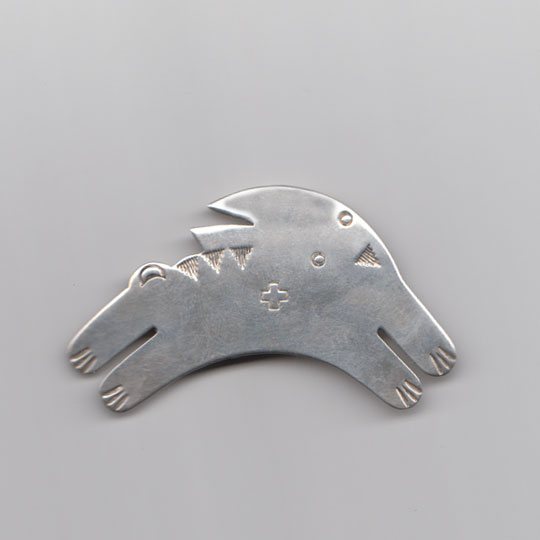
Jan Loco is a member of the Warm Springs Apache tribe. She began making jewelry in 1988. She has developed a method of making jewelry without the use of hand tools. After cutting the silver to the desired shape (with heavy-duty poultry scissors or something similar), she hammers it with a specially selected rock until she achieves the texture she desires. This is a laborious task, but she feels it honors her ancestry to use items of nature rather than power tools.
Want to know more?
Pair of Hopi Pueblo Painted Men’s Moccasins - C3753.54
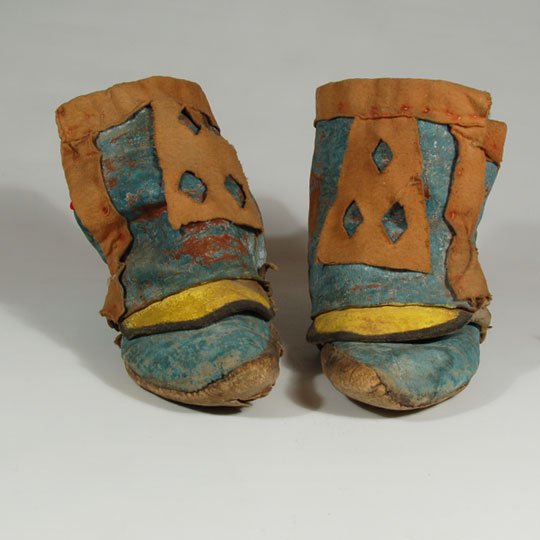
Pueblo moccasins are made with hard soles and soft uppers. The soles are traditionally cut from rawhide or tanned, thick, neck skin of the deer. Both Hopi and Zuni make dance moccasins of this style. The moccasin is painted with blue paint and the front tab painted with yellow paint. The sole is painted black.
Do you want to know more?
Pair of Zuni Pueblo Women’s Wood Dance Wands - 25853
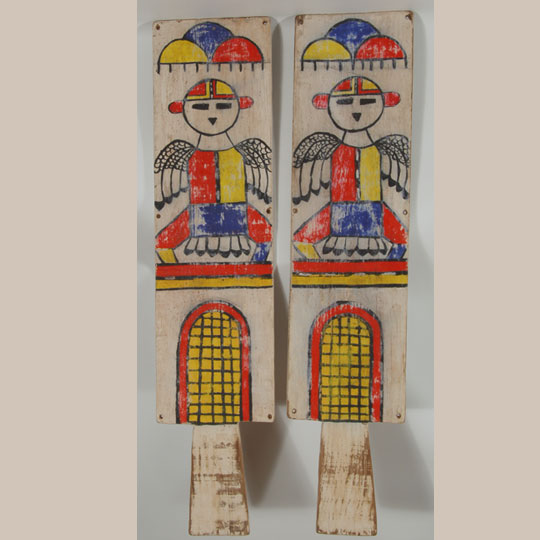
Dance wands are part of women's ceremonial paraphernalia. They are rectangular wood tablets with a handle at one end. When used in dances, one wand is carried vertically in each hand. On one side of the wand is painted a figure of a rain god or other ceremonial personage. Rain clouds hover above the figure and a corn symbol is below. There are two holes drilled at the top corners of the wand from which downy feathers are tied. A series of parallel lines is painted on the backs.
Very Small Hopi Pueblo Kahaila Katsina Doll - C3753.47
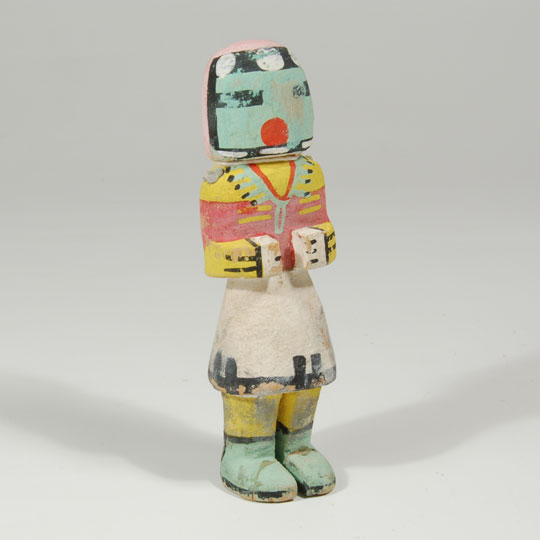
This katsina, sometimes call the Mak Katsina, is considered to be an import from Laguna Pueblo to the Hopi Mesas. This katsina was illustrated by Jesse Walter Fewkes in Plate XLVII of his publication Hopi Kachinas but Fewkes referred to him as Kwacas Alex Taka, which translates to "eagle feathers erect man" which is based on the two erect feathers on the head, which this doll is missing.
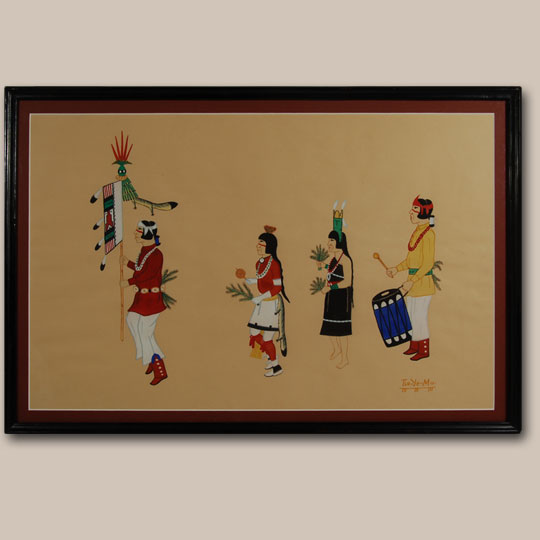
Fred Kabotie, famous Hopi artist, illustrated a pair of this katsina in his 1938 watercolor painting Hunting Dance from Laguna. The katsina is sometimes referred to at Hopi as a Hunter Katsina.
Canyon Road Spring Arts Festival, May 6th and 7th 2016
Adobe Gallery will devote this weekend to the final viewing of its current exhibit:
Tradition & Innovation: the art of Pablita Velarde and Helen Hardin
This very powerful and important Special Exhibit opened in March and will close on Saturday, May 7th. Adobe Gallery is the premier gallery for displaying Fine Art of this famous mother & daughter, formerly of Santa Clara Pueblo.
Pablita was one of the very first female Pueblo painters. She even made her own painting medium by grinding up earth minerals into a fine powder.
You don't want to miss viewing this one! Currently on display, the closing reception will be Friday evening from 4 to 6 pm. Questions may be referred to the gallery at 505.955.0550 or by email: info@adobegallery.com.
Previews of all paintings may be seen online: https://www.adobegallery.com/shows/pablita-velarde-helen-hardin-tradition-innovation
Check out Adobe Gallery on Twitter

We've got potent amounts of information about Adobe Gallery in just 144 characters (tweets).
Send us a tweet: @adobegallery

Check Adobe Gallery out on Pinterest

View pins of fine art that we have/had in Adobe Gallery's inventory. The website is set up to help you pin. So give it a try. You know you want too.

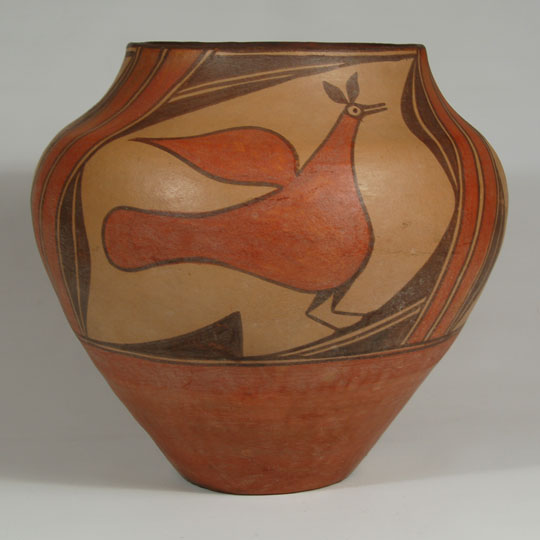
Exquisite Historic Zia Pueblo Polychrome Jar - C3758D
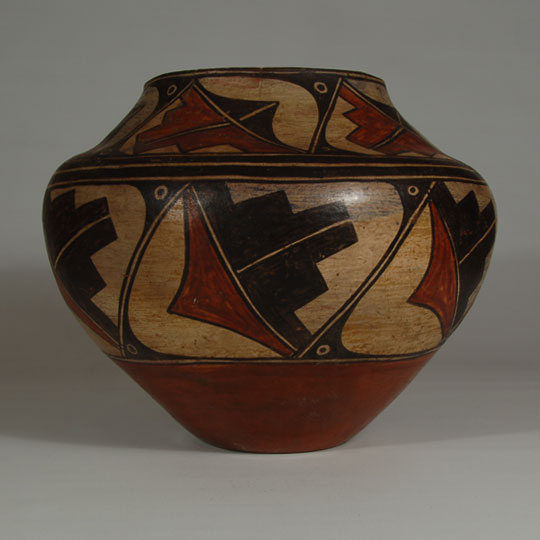
Zia Pueblo has existed at the same location for over 700 years. It is located in a heavily volcanic area of Northern New Mexico, situated near Santa Ana Pueblo, Jemez Pueblo, and about 30 miles northwest of Albuquerque. The spelling of the pueblo's name originally was Tsia, but corrupted to Zia in the 20th century.
The potters of Zia have consistently produced outstanding vessels, made particularly strong by the use of crushed powdered lava for a tempering agent. They spent considerable effort in providing beautiful decoration executed in precise detail on the vessels made for their own use and those made for trade to the people of Jemez Pueblo for crops from the Jemez fields.
Would you like to know more?
Histroic Zia Pueblo Square Shape Chile Bowl - C3753.30
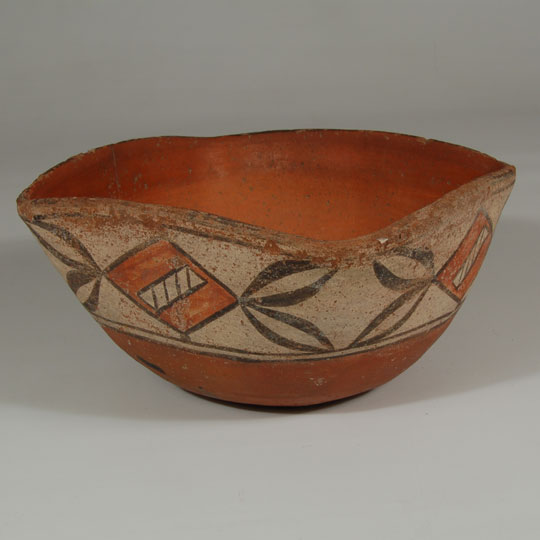
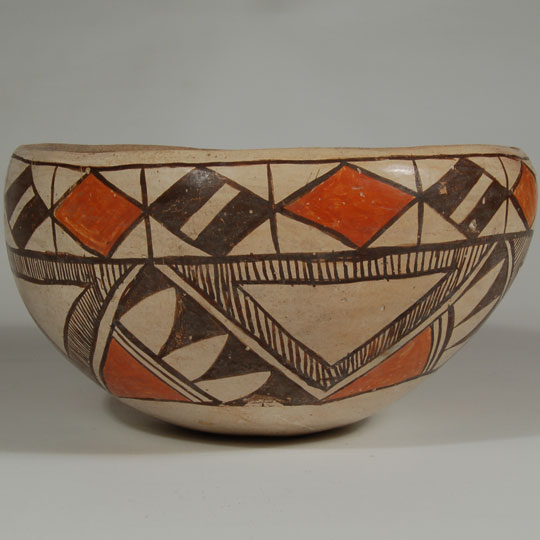
We have designated this bowl to be historic because we believe it to pre-date circa 1940. It is unusual in a couple aspects-it expands upward from a round shape to a square shape and it has a wiped-on red band on the interior rim in lieu of placing such under the decorated section on the exterior. It is a wonderful bowl in both shape and design. The rim was black but the color has mostly abraded away from use. There are double framing lines at the rim and near the underbody.
Would you like to know more?
Acoma Pueblo Small Polychrome Olla by Delores Juanico - 25852
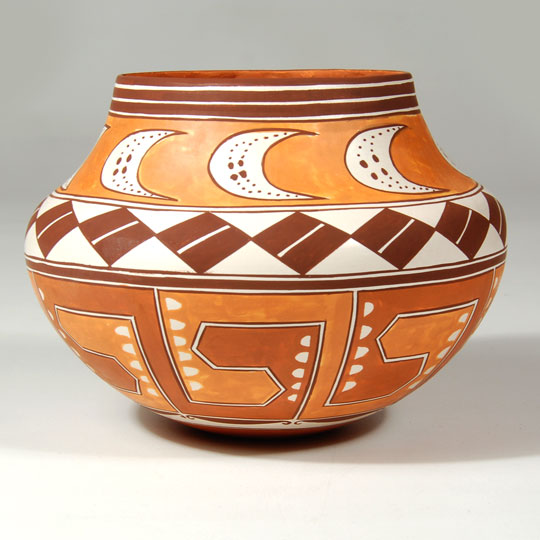
Delores Juanico is a daughter of Marie S. Juanico (1937 - ) who was her mentor. Marie had learned pottery principals from her mother, Delores Sanchez, who lived to the age of 103. Young Delores carries on the tradition from her grandmother and mother of making the finest Acoma pottery.
Would you like to know more?
Acoma Pueblo Old Polychrome Serving Bowl - C3753.25
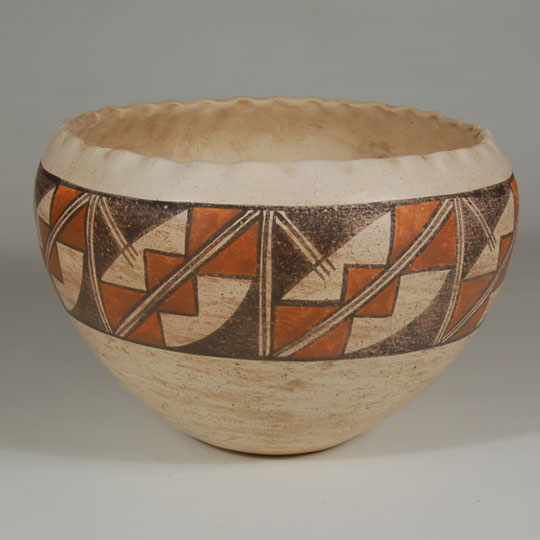
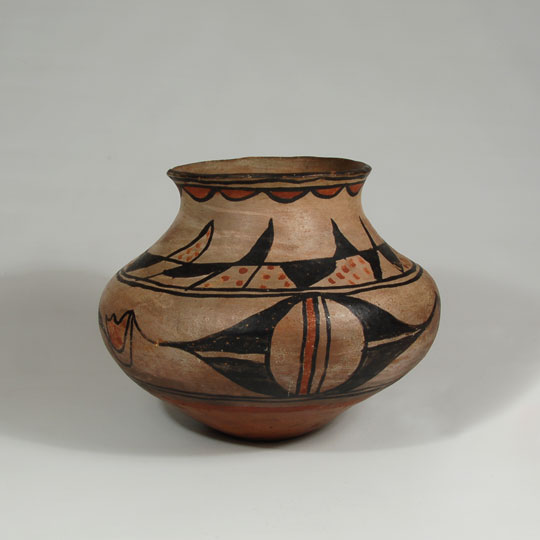
Three quarters of a century, from 1880 to the 1950s, saw an immense change in pueblo pottery in most of the pueblos and that includes pottery from Acoma Pueblo. When the transcontinental railroad passed through New Mexico Territory in 1880, it made a stop at Laguna Pueblo to give the tourists a chance to see the highly touted Indians of the area. Potters from Acoma Pueblo would load their wares on burros and take the trip to Laguna to sell to the train travelers. It did not take long for the potters to realize that their magnificent large and beautiful pottery was not practical for travelers to handle, so the potters began making smaller items for that purpose.
Following World War I, the railroad moved its tracks from Laguna over to the Acoma villages, thus greatly facilitating the Acoma potters and devastating those at Laguna. In the 1930s, Route 66 was built along the former railroad route giving potters from both pueblos another outlet to set up stands along the highway to sell their wares. Converting Route 66 to Interstate 25 ended that procedure, however.
Kewa Pueblo Chile Bowl with Ovoid Design - C3753.09
Visitors to the gallery often ask "what is the meaning of that decoration?" Our usual response is that it probably has no meaning. That seems better than saying, "I don't know". Most likely, many designs are repetitive from generations of use in a family and the later generations using those designs do not know their meaning, if there is a meaning. It is just a design that their mother and grandmother used so they continue using it.
To the older generation, there may have been meaning to designs chosen and the meaning may have been reserved for specific vessel shapes. A design used on a chile bowl would be different from one used on an olla.
Kewa Pueblo Low and Wide Chile Serving Bowl - C3760
This chile bowl has the most marvelous dark patina that developed over decades of use. The exterior was slipped in Santo Domingo cream slip from the rim to the underside so there is no red bottom as seen in many bowls. That makes this really special in my opinion. The simple design was planned to allow the most cream slip to be exposed and the dark brown paint to be at a minimum. This is an exceptional bowl that could easily predate the 1940s.
Would you like to know more?
Kewa Pueblo Orange Surface Slip Chile Serving Bowl - C3753.31
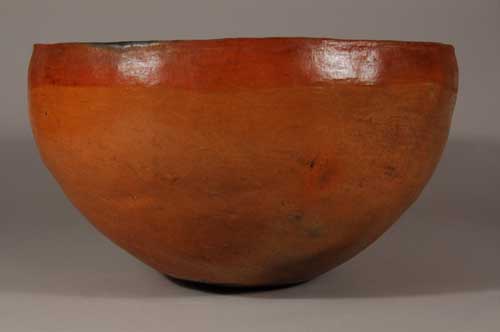
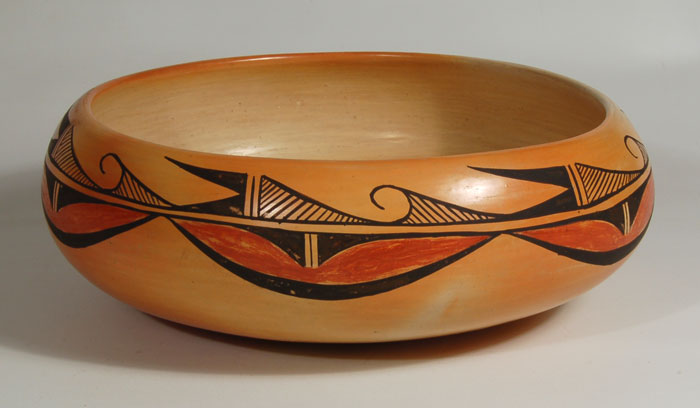
Kewa pottery is slipped with cream colored clay on which the design is painted. In this bowl, it appears that an orange or yellow slip was used for the interior and exterior of the bowl, however, it was the firing temperature that turned the cream slip to an orange color.
The design is a double row of black triangles enclosed with an upper and lower framing line. The rim is black and has a line break that continues through the design on the vessel wall.
Pueblo Chile Serving Bowl from Kewa - Santo Domingo - C3753.18
This chile serving bowl does not have the appearance of having been used for serving food at the pueblo prior to it being sold. When chile bowls have been used for serving red or green chile stew, they absorb a wonderful patina that is neither red nor green, but a warm and smooth oily look. The interior of the bowl soaks up the essence of the contents and the exterior picks up the oil from one's hands. The clay is porous so it absorbs easily.
Acoma Polychrome Jar with Lizard in Relief by Phyllis Leno - C3310ZB
Phyllis Leno (1943-present) is a daughter of famous Acoma matriarch Juana Leano.
This small Acoma Pueblo jar features a combination of polychrome geometric, monochrome fine line, and bas-relief decorations.
Acoma Pueblo Tea Cup with Handle and Human Face by Tina Kie - C3227.22
I have not located biographical information of Tina Kie but searching the internet, I found several small bowls about the size and shape of this one, but not with a handle and face.
Would you like to know more?
Old Arts and Crafts Wood Candlestick - Mission Candleholder - C3498Z
This beautiful Arts and Crafts Wood Single Candlestick holder or Mission Candleholder was purchased around 1999. It is unsigned and so we don't know who the maker is, but it is from the Arts and Crafts time period.
Would you like to know more?
Hopi Pueblo Tasap Katsina Doll circa 1940s - C3753.46
This is an exceptional Hopi Tasap Katsina doll carved from a piece of cottonwood root. Tasap is a Hopi representation of a Navajo God. There are Hopi versions of katsinam that honor and depict other tribes, such as the Navajo, Havasupai, Comanche, Zuni and other Pueblos.
This is the Hopi version of what the Navajo katsinam might look like. These katsinam are not borrowed from the Navajo, as they are unique to the Hopi. They have the same purpose and functions as all the Hopi Katsinam. They are messengers and/or intermediaries to the rain gods. Since they are katsinam in every respect, they are afforded the same reverence and dignity during their visits.