



Santa Clara Pueblo Original Painting “Mimbres Fish” by Helen Hardin - C3775C
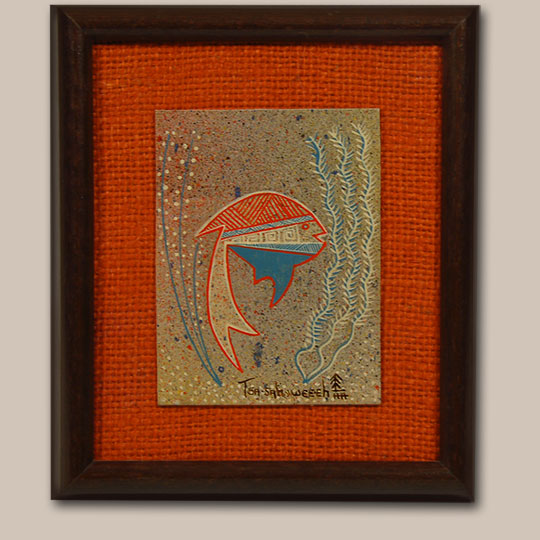 Helen Hardin, from the very beginning of her career, was at the cutting edge of Indian-influenced art. Her art, though obviously drawing on her Indian heritage and tradition, was very much in the mainstream of modern aesthetics. This small acrylic painting on artist board does not reflect a date. It is a simple painting of a fish but a work exhibiting exceptional drafting skills and superlative technical rendering. It is quite exceptional and striking, as the work of Helen Hardin tends to be, with a true sense of the complexities and intricacies involved in the creation of such a work.
Pencil Drawing “Superstition Mountain” by Joseph Imhof - C3720E
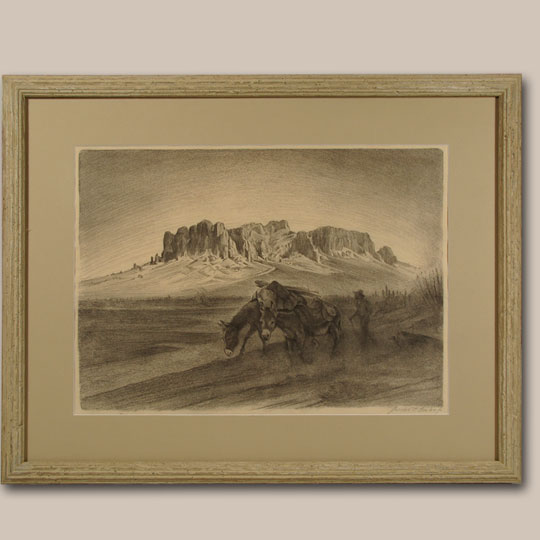 In 1905, Joseph Imhof and his wife went to the Southwest for the first time to record ceremonies of Pueblo Indians. He built a studio in Albuquerque in 1906 and traveled throughout the region and then lived in New York before settling in Taos in 1929. In Taos, he built his studio on the edge of the reservation facing the Sacred Mountain behind Taos Pueblo.
Tall Polished Santa Clara Pueblo Black Bear Paw Jar by Severa Tafoya - C3771D
 Severa Tafoya never received the publicity she should have. She was an extraordinary potter during the 1950s and 1960s, but pottery was not in the mainstream then as it is now. Had today's collectors been collecting pottery in the mid-1900s, she would have been high on their list. Very few collectors today know who she was and how fine her pottery is. She was an active potter for almost 60 years.
Santa Clara Pueblo Black Melon Jar by Angela Baca - C3771E
 Angela Baca is most likely represented in every collection of contemporary pottery with one of her black melon jars, the style and shape that has been associated with her since the 1960s. She was probably the first potter to produce melon jars. I recall that the very first purchase I made at The Covered Wagon in Albuquerque in the 1960s was a black melon jar by Angela Baca at a price of $35. I was so impressed when I saw it that I put it on lay-away immediately.
Mojave Four-spout Effigy Vessel by Elmer Gates - C3774B
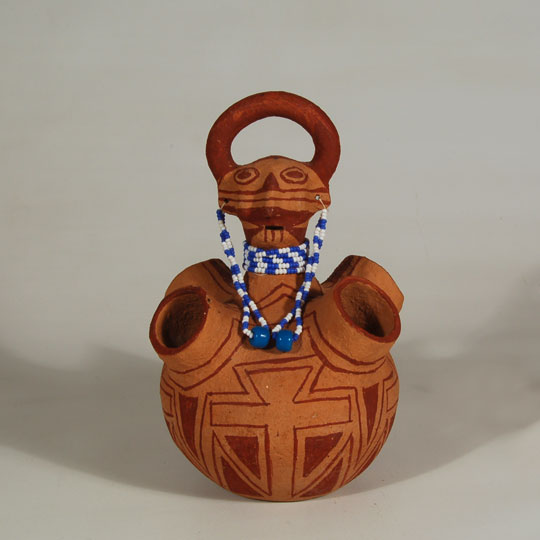 Generally, Mojave men were not potters, but Elmer Gates, who was born in 1929 and lived in Poston, Arizona, on the Fort Mohave Reservation, was an exception. He had learned to make pottery from his aunt. He then continued studying all styles of southwestern pottery and working with various techniques. He sold his work at the Colorado River Indian Tribal Museum in the 1970s. Gates was so confident in his chosen profession that he taught a number of young artists of Mojave and Maricopa tribes, as well as non-natives. Santa Fe ceramicist Rick Dillingham studied with Gates.
Original Painting “Tucked Away” by Laurence Sisson - C2820L
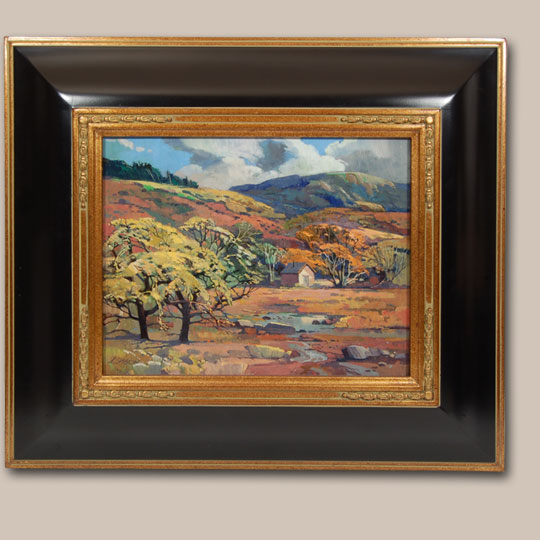 Laurence Sisson established his art reputation by making paintings of the Maine Coast for the first 30 years of his art career. He then moved to New Mexico and easily adapted to painting Southwest landscapes. He was a proficient plein-air, painter in watercolors and oils, depicting nature as he saw it.
Hopi Polychrome Jar with Deep Red Pigment by Mark Tahbo - 25855
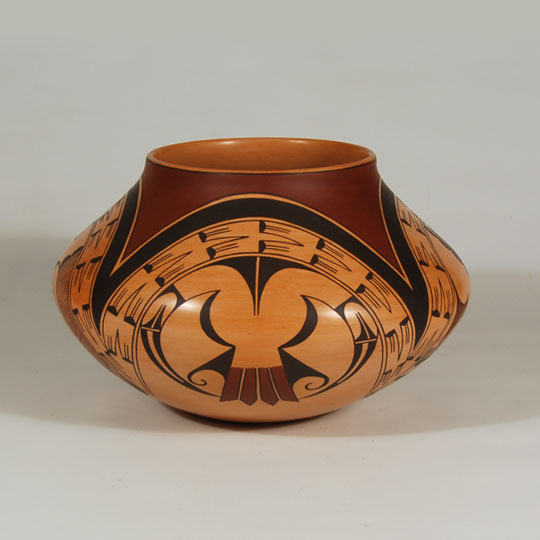 When Mark Tahbo delivers pottery to the gallery he always spends considerable time explaining each and every item of design. He treats each vessel as a special item and wants to be sure that we understand what he did and why he did it. I sometimes wish I had recorded his words rather than attempting to remember them.
Hopi Polychrome Jar with Dual Red Pigments by Mark Tahbo - 25856
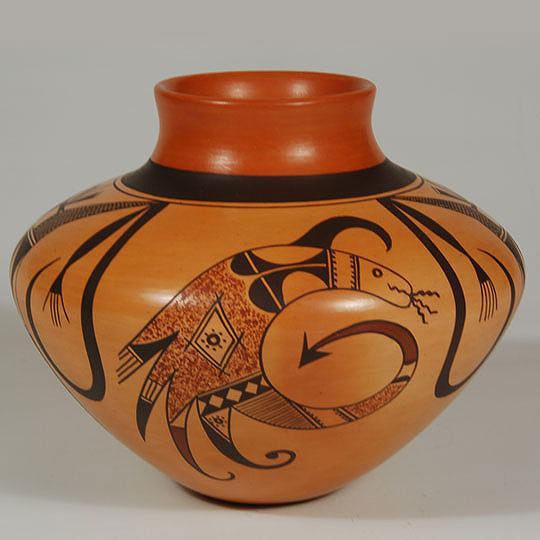 This jar is one with pictorial design elements, as probably one could say regarding all Sikyatki and Sikyatki-revival jar designs, since most of them feature some form of stylized bird elements, however, this one features two designs of the Plumed Serpent. The Hopi version, as seen on prehistoric Hopi pottery, is different from the manner in which the New Mexico Tewa Pueblos present their version of the Plumed Serpent or Avanyu. Of course, these versions as presented on this jar could be Mark Tahbo's imagination and artist license taking control. The diamond on the body of one of the serpents represents the house where the serpent resides according to Hopi legend. Mark admitted that the serpent might resemble an octopus in some people's mind but that is not the intent.
Hopi Sikyatki Revival Seed Jar by Elva Tewaguna Nampeyo - C3762D
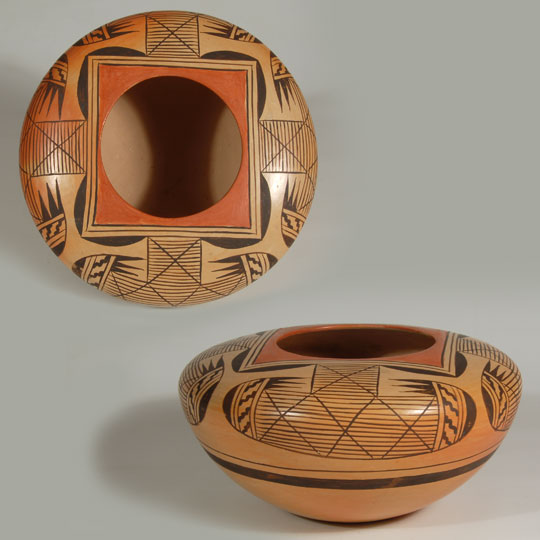 Elva Tewaguna Nampeyo was a granddaughter of Nampeyo of Hano and daughter of Fannie Nampeyo. She has been gone over 30 years now so there are not many of her wares on the market, and there certainly are not many of this magnificence. She was an exceptional potter and her work never deteriorated later in her life when she became ill. She certainly was one of the exceptional potters of her generation.
Mineral Earth Painting of a Family of Roadrunners by Pablita Velarde - C3772
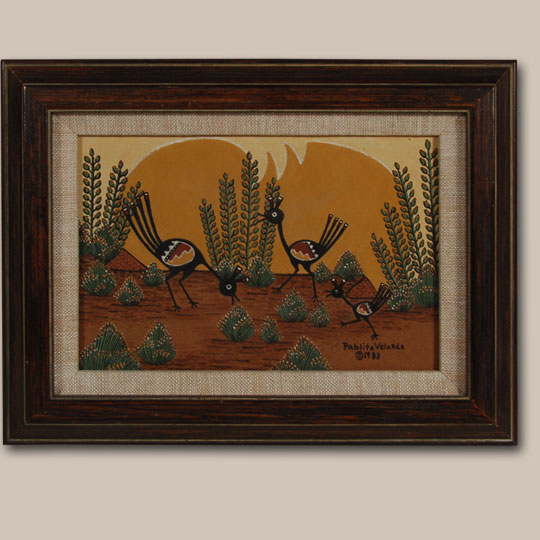 After meeting Dorothy Dunn at The Studio at the Santa Fe Indian School, Pablita Velarde was convinced that a career in painting was her calling. She had been inspired by watching Tonita Peña pursue an art career and was actually encouraged by Peña to pursue art as a career.
We are fortunate that she pursued the career of her choice. We now have a collection of art that is truly inspiring. She revived the art of painting with earth minerals. Preparation of the paints was a laborious task that took days of grinding pigments on a metate using a mano.
Black Pottery Bear Paw Jar from Santa Clara Pueblo by Angela Baca - C3771A
 Angela might be considered the Matriarch of the first family of Santa Clara melon potters. She was a melon pot specialist who made various sizes in both red and black and she made the same shape jars but with bear paws instead of melon ribs. She undoubtedly had one of the longest potting careers in Santa Clara Pueblo. Her pottery is in the collections of the National Museum of the American Indian of the Smithsonian Institution, The Wheelwright Museum of the American Indian and other numerous museums and galleries.
Santa Clara Pueblo Black Pottery Bear Paw Jar by Angela Baca - C3771B
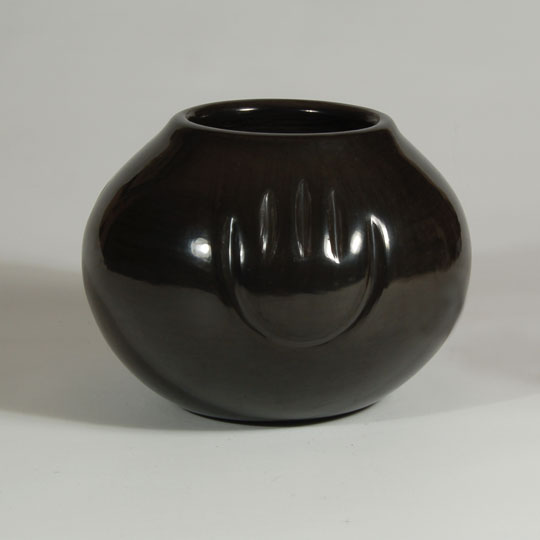 Angela Baca has long been associated with her ability to produce beautiful red and black jars, some with melon ribs and others with bear paw depressions into the clay. Works in these styles are first coil-formed with a large diameter coil of clay and allowed to dry to a leather-hard state, whereupon they are carved with the distinctive ribs or bear paw depressions. After carving, the pottery is slipped in iron-bearing red slip, intricately stone-polished and then fired in either a smothered, reduction atmosphere to achieve the superb black finish or in an oxidizing atmosphere to achieve the red finish.
Zia Pueblo Polychrome Deep Serving Bowl - C3753.27
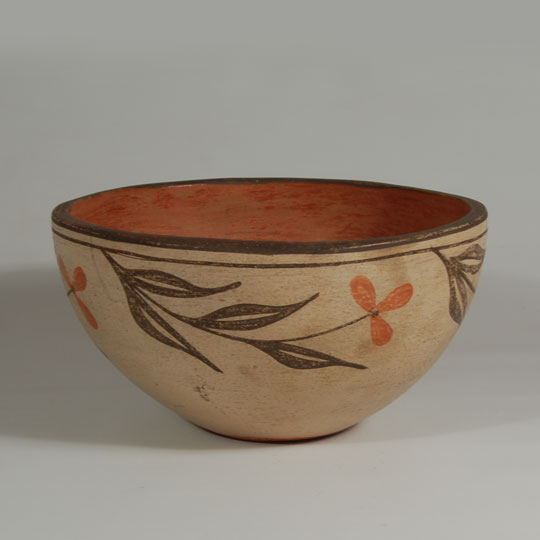 There were probably more bowls made in New Mexico Pueblos than there were jars. Very large bowls, called dough bowls, were used for preparing bread dough; medium-size ones were used for preparation of tortilla dough, serving food at the table or for storage and even overturned as a lid for covering jars; the smallest bowls were used for daily meals.
This bowl would be of the medium size and probably used as stated above. Most of the polished red slip on the interior has been rubbed from constant use so the bowl appears to have had an extensive life at the pueblo before entering the marketplace. It has a very traditional Zia design of floral elements over a cream slip. The underbody is slipped in red clay.
Very Large Historic Cochiti Pueblo Storage Jar - C3758A
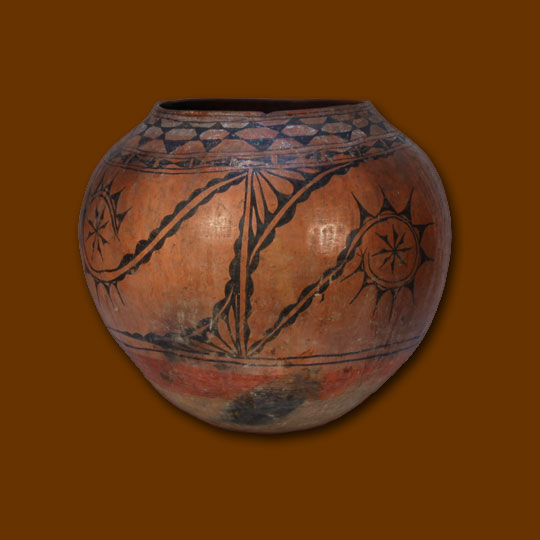 The historic period of pueblo pottery has been defined as beginning with the first contact with Europeans in 1540, the reasoning being that it was the Europeans who began documenting events, creating a history of the area, which was a logical beginning of the historic pottery period. At that time, pueblo potters made pottery for their own use and as a trade item to members of other pueblos or tribes.
With the arrival of the Spanish, the market for pueblo pottery greatly increased as it was easier and smarter to procure pottery from local pueblo potters than to wait for imports to arrive on the Camino Real from Mexico City, a journey that took over 6 months to complete. New shapes and new sizes of pottery were developed to satisfy the needs of the new markets. Large storage jars were standard measurements of volume to facilitate trade of wheat or grains to the market. In some cases, the historic jar in which the grain was stored was given with the sale of the grain as it was considered only a container of the product being sold. One wonders if the purchaser of a jar full of grain used the product then discarded the container.
Original Painting of a Cherokee Indian on Horseback by Cecil Dick - C3755D
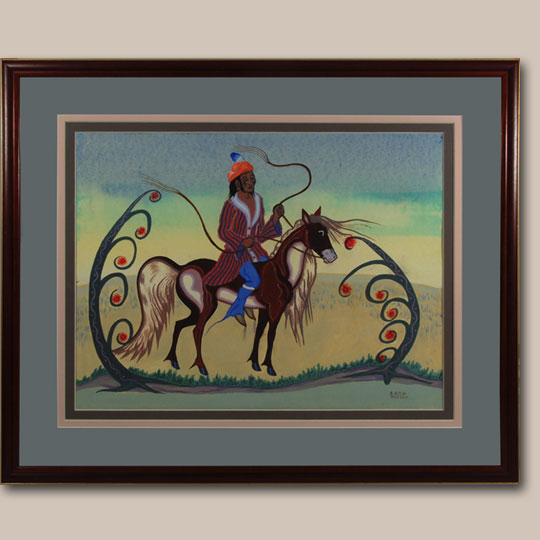 As a small child, Cecil Dick spoke only Cherokee. He was orphaned at age 12 and reared in Indian boarding schools. He was considered an authority on Cherokee mythology and the Cherokee written language. He attended the Santa Fe Indian School for one year, did not like the school's flat painting style, and chose to paint in the Woodlands style with the plants, trees, and hills that were part of his Woodlands experience. He was allowed to do so. After one year in Santa Fe, he returned to Oklahoma.
Dick did not paint on a regular basis at any time during his career. He painted when he felt like doing so and, as a result, his work is relatively rare. He also worked as a sign painter and a draftsman, another reason for not executing many art paintings.
Bronze Sculpture “Kachina Symbolism I” by Dan Namingha - C3769A
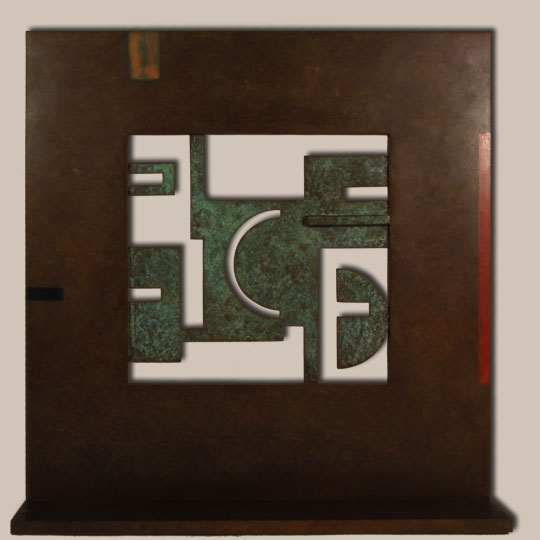 Dan Namingha is well-known as a painter but he has a strong presence in bronze sculpture as well. His sculptures have been executed in wood and bronze. In the 1990s he formulated a series of bronze sculptures relating to Kachinas. He executed a series of bronze sculptures entitled Kachina Symbolism. This sculpture measures approximately 18 x 18 inches, with a pedestal that is 6-1/8" deep. A very similar larger one was cast in 1997 at 50 x 48 x 16 inches.
Contemporary Large Serving Bowl from Zia Pueblo - C3753.22
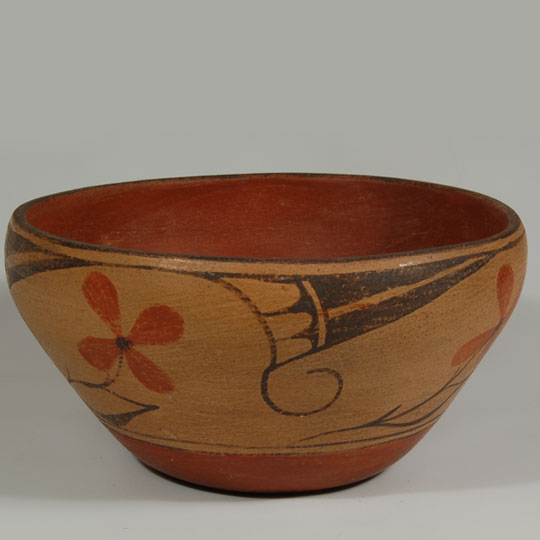 This is a beautifully executed serving bowl from Zia Pueblo, created most likely in the mid-20th century. This excellent medium-size bowl was coil-formed of native clay with the addition of crushed basaltic temper. The underbody bare paste was stone-polished to a warm brick red color. The design field was covered in soft orange slip over which was painted the design of floral elements. The rim of the bowl curves inward just so slightly and displays a very slight concave slope.
Original Painting "Moonrise Over the Sangre de Cristos" by Glenn Dean - C3768
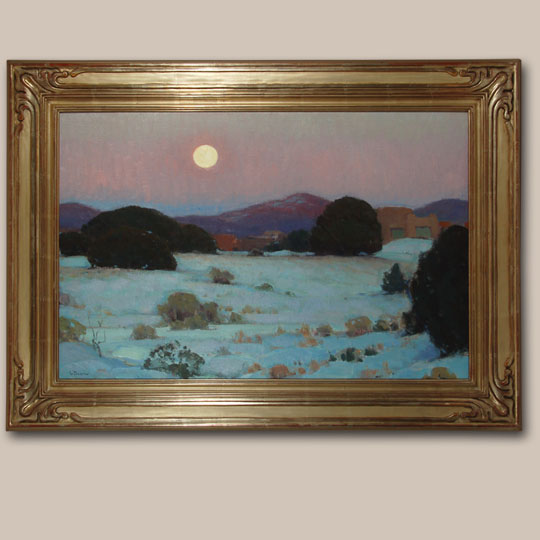
In this painting, one's mind cannot help but revert back to Ansel Adams' "Moonrise Over Hernandez," as an inspiration for this title, but the similarities end there. Dean has beautifully presented the low adobe homes nestled in the foothills of Santa Fe's Sangre de Cristo mountain range. The homes blend into the landscape with their earth colors and snuggle beneath the pink hues of the sky and the purple of the range. An excellent representation of the facts that exist.
Oil Painting of Landscape with Aspens and Deer by Jake Haverstick - 25312
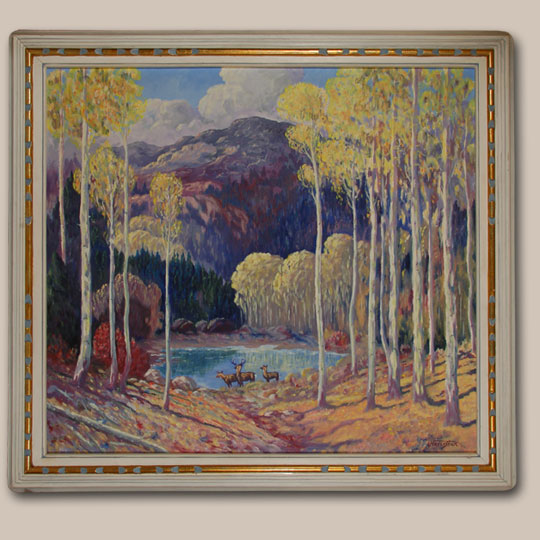
Haverstick and his family then moved from Taos to Albuquerque where they stayed until both he and his wife passed away. Haverstick's wife, Fay, made wooden hand carved frames for his paintings. Fortunately, this painting still retains the hand carved frame made by Fay Haverstick.
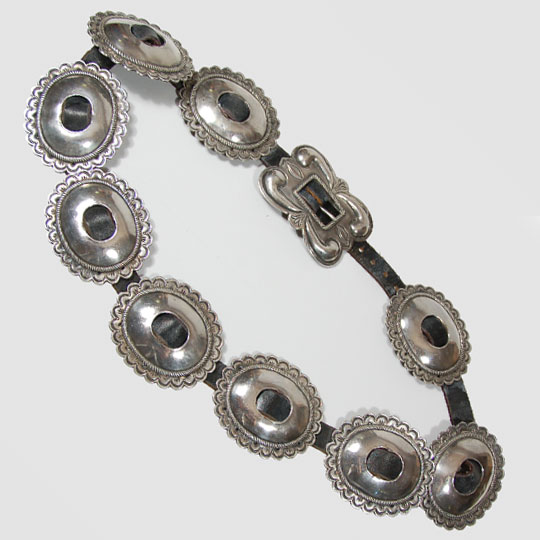
Cochiti Pueblo Sterling Silver Concha Belt by Silviano Quintana - C3276
Would you like to know more?